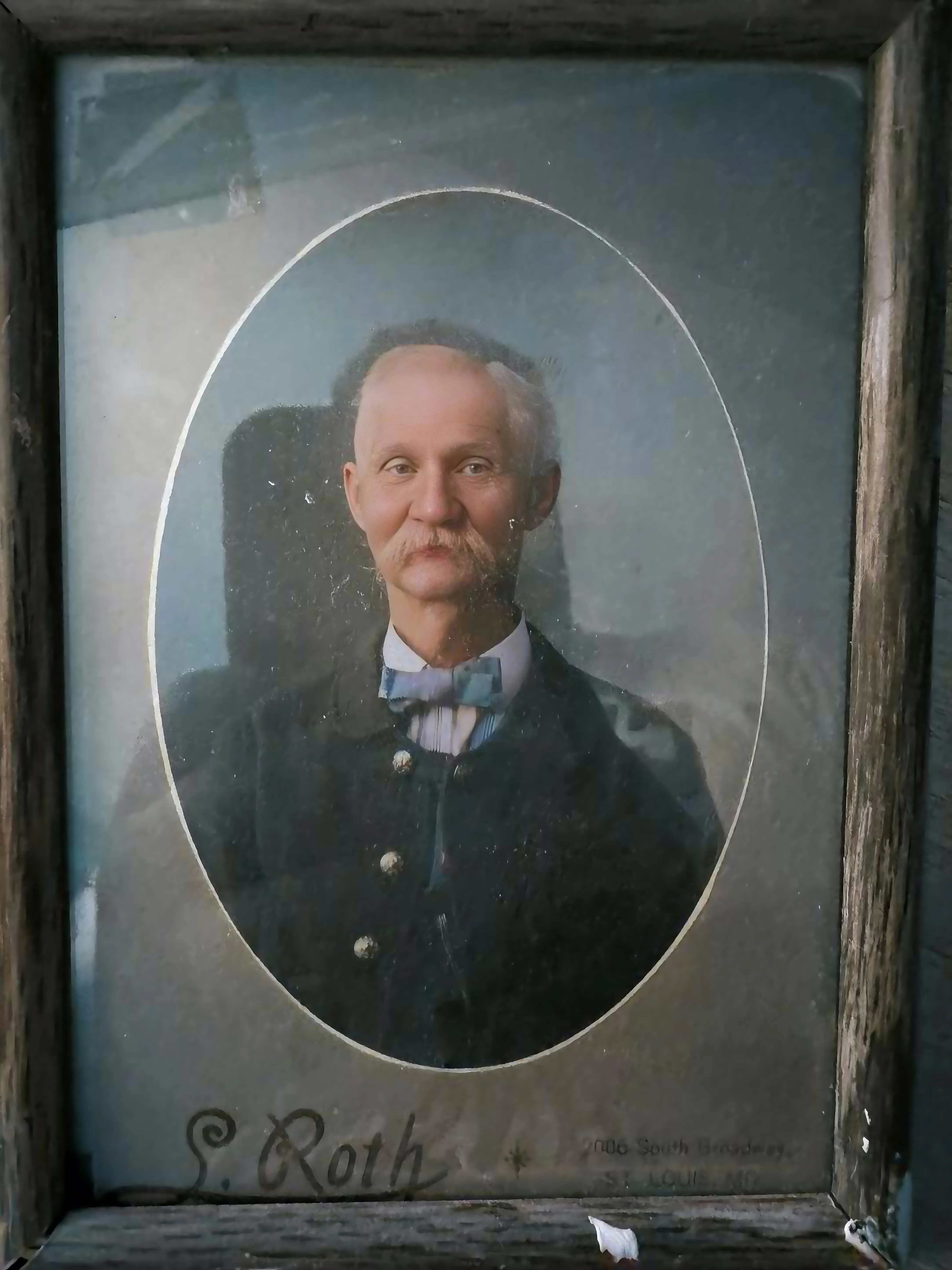
Charles Johnson Sr. (Carl / Charles Gannsen, 1835–1903) at the Louis Roth studio, 2006 South Broadway, St. Louis — 0.7 miles from his DeKalb Street home. Roth is listed at that address from 1889 to 1903–04 (St. Louis directories), so the card dates c. 1889–1904; the usual dating, between Auguste Kreichelt's death (December 1896) and Charles's own (December 1903), rests on his apparent age and is an estimate. The verso reads "Johnson · Father of Charles · Father of Henry · Father of Robert."
Source: Discovered September 2025 by a descendant in a moving box while hanging family photos. Shared with Jed Johnson via email 18 September 2025; historical context (studio, dating, age range) established in Jed's 21 September 2025 reply. Now hosted on the FamilySearch profile Charles Johnson Sr. · LZXC-6GB.
A life fully documented, not a closed file. Forty-four years in St. Louis, three years in a German immigrant artillery battery, one St. Marcus wedding, seven children, six addresses, one $12 monthly pension. The Hessian-born immigrant whose surname the American records never settled — written Gannsen, then Konsen, and at last Johnson — who became Charles Johnson, Sr. — from an unknown 1859 port of arrival to a south-side watchman's grave at Old St. Marcus in 1903.
Who he was. Born about 1835; the records give years from 1833 to 1841. The burial register gives 26 January and the 1900 census gives November. Neither date is proven. He died on 16 December 1903 at St. Louis. On 2 December 1862 he swore that he was born at Trendelburg, written “Trennelburg,” in Kurhessen. Deisel, about a mile and a half (2.3 km) away, was probably his last home and possibly his birthplace. The name he used fits two German surnames, Gans and Konze. Konze has more of the evidence, and neither is proven. The leading candidate was born a Hofedietz, and a Konze family possibly took him in. He signed himself Gannsen. The census of 1900 gives 1859 as the year he came to America; no passenger list or port record has been found for him.
Corporal 29 May 1863, then Sergeant; detached to the smallpox hospital in 1863. In June 1868, as “Carl Gansen”, he bought a horse and spring wagon from his father-in-law George Kreichelt and sold them back in trust for Henriette Kreichelt. In 1867–69 he kept the bar at 1206 Park Avenue (Schnerr’s brewery and beer garden), leasing it himself in 1869 as “Charles Konson”; in January 1870 he very probably took over a bar at Main & Bates on the north riverfront. From about late 1870 he worked the St. Louis Railroad cars beside his neighbor Henry D. Niemeier. The Kreichelt death notices of 1883 and 1894 call him son-in-law “Charles Gansen” / “Karl Ganßen”; the family cemetery lot is registered to “Gansen, Charles”; c. 1899–1900 he registered to vote as “Gansen Charles … Germany”. On 18 October 1900 he was admitted on paper to the Danville Branch, NHDVS — he never actually lived there; he stayed with his children on Sidney Street. A Trendelburg–Bremen–St. Louis Konze family is a separate line; no link to him has been shown. Life timeline.
1859–1903
2nd MO Light Artillery
at St. Marcus
St. Louis addresses
awarded 1891
pension file
Life arc — 1835 to 1903
The American life — 1859 to 1903
Charles arrived in St. Louis around 1859 — twenty-four years old, alone, carrying a name the city's clerks would never agree on. The 1900 census later set his arrival year; the port and the ship remain unidentified. He landed in a city already a magnet for German speakers: by 1860 St. Louis was the largest American city west of the Mississippi and roughly a third German by birth or parentage. He found his footing in the Soulard and LaSalle Park districts on the south side, where every street corner spoke his language.
Three years later he was a soldier. On 2 December 1862 he enlisted at the St. Louis recruiting office in Battery B, 2nd Missouri Light Artillery — a German-immigrant artillery unit assigned to the western garrison forts of Rolla and Wyman. His enlistment papers describe a 5'5" man with fair complexion, blue eyes, and blond hair, age 23 as recorded (27 if born 26 Jan 1835 — a year that is uncertain, c. 1833–1841), born in a place the clerk recorded as Freundburg, Kurhessen — a mishearing of Trendelburg, confirmed on 2 July 2026 when his signed Volunteer Enlistment surfaced spelling it “Trennelburg”. He served three years, was promoted to sergeant (7 November 1863), was reduced to the ranks on 15 March 1865, and mustered out a Private on 20 December 1865. (The 1890 invalid-pension declaration twenty-eight years later records 5'10" and "light" complexion — documenting either a recollection drift or a clerical re-read.)
Eighteen days after his discharge, on 7 January 1866, Charles married Auguste Kreichelt at St. Marcus Evangelical Church. The marriage register recorded his origin as "aus Deisse, Kreis Cassel, Churhessen" — almost certainly a clerical rendering of Deisel, the village near Trendelburg that anchors the Hesse side of this project. Auguste was eighteen, Hannover-born, in St. Louis since she was six (corrected July 2026 — this page previously said twenty-six and age thirteen, both inconsistent with her canonical 1847 birth and the family's September 1853 emigration; see Errata). Adam Herweck — Battery B comrade, sworn in at St. Louis on the same day as Charles — stood as senior witness; Auguste's father Georg and her brother August Kreichelt, the Battery B man of the family, completed the wedding party. Over the next fifteen years they baptized seven children at St. Marcus, the same parish that had married them. Two of those children carry the surname trail back to Hesse: the 1875 baptism of their son Erwin Carl was recorded as Konsen — the closest American phonetic capture to the Hesse-parish Kontzen / Konzen cluster (K-initial and -en suffix preserved, the tz cluster collapsed to s) — and fifteen years later the 1890 death record of daughter Auguste read “Auguste Somers, geb. Konzen”, preserving the documented Hesse-parish form verbatim. The 1890 entry is one of two American attestations of the full Hessian z-form and the strongest documentary bridge between the American family and the Konze line back in Hesse.
For most of his marriage Charles worked as a watchman in the city's south-side warehouse districts. The middle decades — the era of the Eads Bridge opening, the postwar industrial boom, Compton & Dry's Pictorial St. Louis — were the family's most stable. By 1890 the household had settled at 2408 DeKalb Street in the Kosciusko district, a long-tenure address that anchors every later document: the 1890 invalid-pension declaration, the 1891 pension award, the Surgeon's certificate of examination, and the Pension Office index cards through 1898.
The $12-a-month invalid pension came through in November 1891. Auguste died in 1896. In October 1900 Charles was admitted on paper to the Danville Soldiers' Home — he never actually lived there; he stayed with his children on Sidney Street, and 168 Sidney Street is his last residence of record. He developed stomach cancer. He died on 16 December 1903 at age 68 — the original death certificate records his last twelve days as an inmate of the City Hospital — and was buried three days later at Old St. Marcus Cemetery, entry #3393 — the same consecrated south-side ground his parish had been using since the 1850s. The cemetery was later converted to a city park and the markers removed, but the burial register survives.
Letters from a Deisel neighbor — the Köster correspondence, 1858–1862
In July 2026 the Forschungsbibliothek Gotha sent us 1,118 scanned pages from the Deutsche Auswandererbriefsammlung — Germany's national collection of emigrant letters. Inside was something this project had been hoping for since the beginning: twenty-two letters written between 1858 and 1862 by Johannes Köster, the schoolteacher of Deisel, home to his wife and children from America. Deisel — recorded at Charles's own wedding as “Deisse”, almost certainly the same village — is the place Charles named when he married. Köster left it in the winter of 1858 and ended up in St. Louis. For the first time we can read letters from Charles's own village, written from Charles's own city, in Charles's own years.
The original letters no longer exist — they burned in the bombing of Kassel. What survives is a full typed transcription made by Köster's descendant Dr. Rudolf Köster, who in 1937 interviewed the old man's surviving daughters, Marie and Mimi, and annotated the series from what they remembered. He indexed every name the letters mention — three alphabetical pages of them — and added the family's own notes. That index is the reason this collection could be searched honestly rather than skimmed.
The road Köster took may well be the road Charles took. He sailed from Bremen on 6 November 1858 — a schoolmaster of forty-three, born in Deisel on 11 July 1815 — and landed at New Orleans in early January 1859. He wrote his first letter home from the ship in harbor on the day he sailed; the second, five months later, is datelined St. Joseph, Missouri, 25 February 1859. By 1860 he had settled in St. Louis, where he founded and ran the St. George Deutsch-amerikanische Bürgerschule. Of it he wrote, not modestly, that it was “eine der besten” — one of the best — with “nur reiche Kinder,” none but rich children. Charles's own arrival year is given as 1859 by the 1900 census, and his port and ship remain unidentified; Köster is the first documented Deisel man whose crossing we can actually date.
So we read all fifty-five pages, and the index, and the appendices, looking for him. He is not there. No Konze, Kontze, Contze or Konzen; no Gans, Gannsen or Gonnson; no Carl used as a surname. The one name that made the heart jump — “Könne,” appearing three times — turned out on reading the sentences around it to be a merchant back in Kassel, asked after alongside the Schmoll neighbors (“Was macht Könne?”; “grüße… auch Schmoll und Könne”). Not a St. Louis man at all.
And yet the silence proves nothing — which is the most human thing the letters have to tell us. Köster had arrived in St. Louis and found it full of people from home, and he wanted no part of them:
“… meine Adresse für dich behälst, da hier zu viel meiner Landsleute sind, von denen ich aber nichts wissen will-, so auch von keinen Fremden, mich hat auch keiner geholfen;- daher werde ich dahier auch Niemanden kennen… was will man dē am Ende thun, wē man einen Landsmann in Lumpen sieht pp.”
— Johannes Köster, St. Louis, to his wife in Deisel · “… keep my address to yourself, since there are too many of my countrymen here, of whom I want to know nothing — nor of any strangers; no one has helped me either, so I shall know nobody here … what is one finally to do, when one sees a countryman in rags.” Read from the original image 19 July 2026: Gotha transcription p. 11 = image 0064.
He names two he paid off to be rid of — a Grebenstein man from Kirchhain, and Bödiker, the Kommissar's brother — and instructs his wife to keep his address secret from anyone back home. A penniless twenty-four-year-old farm boy from Deisel is exactly the countryman Köster refused to know. The letters were never going to name Charles. Their silence is the silence of a man closing his door, not evidence of an empty street.
What they do give us is the street itself. Until now, Charles's 1866 marriage entry — “aus Deisse, Kreis Cassel, Churhessen” — was a lone statement about a village a long way off. Köster's complaint turns it into a place: St. Louis held enough Hessian countrymen in exactly those years to be a nuisance to a man who wanted to rise above them — and Köster's own home network, village by village, was the Deisel one. The officially registered emigrants from Deisel — the Meimbresse, Koester and Fremder families in the Hessian lists — were only the paperwork. The rest, on this reading Charles among them, simply went.
Köster proves that too, in his own person. He has no emigration record either. The Hessian emigration database carries Koester entries from Deisel across 1833–1866, but not the schoolteacher who actually left in 1858. Charles's missing exit paper has long looked like a hole in our research; it is beginning to look instead like the normal condition of a Deisel departure.
The letters also hand us the village's own address book — Köster's greetings home run through Schwager Deppe, Göbel, Vetter Fremder, Freund Baumann, Schwager Temme and Meinbresse, the same surnames that fill the 1850s emigration lists — and a first-hand account of the city in the months Charles walked into a recruiting office. “Nur Kriegshandwerk wird hier getrieben,” Köster wrote of wartime St. Louis: nothing is practiced here but the trade of war. Charles enlisted in December 1862, while that sentence was still true.
Where this leads next. Köster is a findable man — a forty-three-year-old schoolteacher, out of Bremen on 6 November 1858, into New Orleans that January. Identify his ship and we can read the entire passenger manifest, because villagers traveled together: any male of eighteen to twenty-five with a K- or G- surname on that list is a candidate. That search of the New Orleans arrivals for 1858–60 is now the project's leading immigration lead. Two further avenues follow from it: the published Assion index of Hessian emigrants in the Hamburg ship lists 1855–1866, never yet searched for our name pool, and the Missouri Historical Society's German-press holdings for traces of the St. George Bürgerschule. The other three letter series in the same Gotha delivery — Rädeker–Schmelzer, Fischer–Barthel and the American Jewish Archives–Hagedorn papers, 996 images between them — have since been swept in full and are closed: no name from our pool appears in any of them.
Full page on the Köster letters → — who Köster was, his crossing stage by stage, and what the sweep found. And the letters themselves, one by one → — all twenty-two, with English summaries: the falsified dateline, the 1861 collapse, the school fraud, and the conscription notice of August 1862.
Sources: Forschungsbibliothek Gotha, Deutsche Auswandererbriefsammlung, Serie Köster–Köster (NABS Ordner 74, 119 scans — all published here in full; public domain, confirmed by the library 20 July 2026) — Briefliste, Personalkarten (Johannes Köster, b. Deisel 11 July 1815), the 1937 name index (images 0033–0035), the typed transcriptions (∼55 pp., the “Landsleute” passage at p. 11 = image 0064), and Rudolf Köster's article “Die Briefe des Johannes Köster aus Amerika in den Jahren 1859–1862.” Delivered 13 July 2026; analysed 17 July 2026.
Charles in St. Louis — documented addresses & life-arc pins
A summary map of Charles's St. Louis life. The five color-keyed life-arc pins — post-war first residence (1865), long-tenure 1890s DeKalb address, last residence at death (1903), the St. Marcus parish where he married and baptized his seven children, and his burial place — are joined by his other documented addresses: the 1880 U.S. Census stint at 2125 Jackson Street (St. Louis, Enumeration District 137; exact 1880 location of this renamed street pending re-geocoding — the earlier “1534 Jackson” reading was corrected to 2125 on 5 July 2026 after re-examination of the census image) and the pension-file address history (Case File 684507: 1518 S 7th → 718 Gate → 2409 Broadway → 2412 S 2nd → 1308 DeKalb). Pins are numbered 1–10 and labeled on the map; hover or click any for source detail and an exact “Open in Google Maps” link. The full address-by-address sourcing — each residence with its pension-file, census, and city-directory citations — is laid out on the St. Louis residences page.
Legend — pins numbered 1–10 in chronological order (matching the map)
Numbers match the pins on the map. The 1880-census and pension-history addresses (pins 6–10) are placed from the period street grid; each popup carries an exact “Open in Google Maps” link. Where a 19th-century street name no longer exists (Jackson, Gate), the pin is placed within the documented district and noted as approximate.
The parish church — St. Marcus German Evangelical
One congregation recorded almost every formal moment of the family's life — across two different buildings on the same corner. Charles married Auguste Kreichelt at St. Marcus on 7 January 1866 (marriage entry no. 676, Pastor G. W. Wall); all seven children were baptized there between 1866 and 1881; and the same register carried through to Auguste's funeral in 1896. (Of the children, only the youngest — Bertha — probably appears in the parish's confirmation register, in 1894 (a “Bertha Johnson”; identification probable); the five older children were not found there. See the note below.) But the church he was married in was gone within a year of the wedding.
The congregation began in 1843, when German families broke from Holy Ghost and met in the Benton School. In 1845 they built a frame church at Jackson and Soulard (today 3rd and Lafayette) and took the name St. Marcus in 1856. They then razed that first church and replaced it with a larger brick one — seating 800 — on the very same site (1867 in most accounts; Scharf, 1883, dates the pulling down of the old church to the spring of 1866). Charles and Auguste were married in January 1866, very probably in the original frame building; their firstborn’s baptism in September 1866 probably did not take place in the frame church, which on Scharf’s date had already been torn down and the new one was being built (corrected 10 Oct 2026). Everything afterward — six more baptisms and Auguste's 1896 funeral, months after the May 1896 tornado tore through the building — belongs to the brick successor at 301 Lafayette Avenue, which survived into the twentieth century (latterly as B'nai Zion synagogue) and was photographed in 1960. The Gothic-Revival church the congregation still occupies, at 2102 Russell Boulevard, was not dedicated until 1915 — twelve years after Charles's death.
Charles was married in — was razed
in 1867. No photograph is known
to survive.


| Family milestone | Date | Building |
|---|---|---|
| Marriage — Charles & Auguste (entry no. 676) | 7 Jan 1866 | 1845 frame church (very probably) |
| Baptism — Friedrich Wilhelm | 2 Sep 1866 | probably not the frame church (torn down spring 1866 per Scharf; new church under construction) |
| Frame church razed; new brick church (seats 800) dedicated | 1867 | — |
| Baptism — Maria Josephine | 1868 | 1867 brick church |
| Baptism — Katherine Carolina | 1870 | 1867 brick church |
| Baptism — Auguste | 1872 | 1867 brick church |
| Baptism — Louise | 1873 | 1867 brick church |
| Baptism — Erwin Carl Konsen | 1875 | 1867 brick church |
| Baptism — Bertha (b. 25 Dec 1880) | 1881 | 1867 brick church |
| Confirmation — Bertha, probable (recorded “Bertha Johnson”) | Palm Sun., 18 Mar 1894 | 1867 brick church |
| Confirmations of the five older children — none located (1882–1890 classes searched) | — | — |
| Tornado heavily damages the church | May 1896 | 1867 brick church |
| Funeral — Auguste (née Kreichelt), “Conson” | Dec 1896 | 1867 brick church |
| Congregation moves to 2102 Russell Blvd (after Charles's death) | 1915 | — |
All five daughters who reached adulthood married — Maria Josephine to Eduard Herr (1886), Kate to John T. Ruddy (1887), Auguste to James Somers (1890), Louise to a Mr. Foster (by 1897) and then William Fletcher (1903), and Bertha to Georg Rothschild (1899); Josephine and Auguste both died in 1890. St. Marcus's marriage register (running 1847–1908) opens with their parents' 1866 entry. Building chronology per the St. Louis Genealogical Society and St. Louis County Library (“razed its 1845 church and dedicated a new church seating 800 in 1867”). The two photographs are reproduced with credit pending formal reproduction permission from the Missouri History Museum (N05206) and the photographer; for a permanent archival copy, obtain clean files and self-host them in assets/ rather than hot-linking.
Note — one child, Bertha, was probably confirmed at St. Marcus; the other five were not found. The original confirmation register — “Confirmations 1849–1906,” GSU/FHL film 1503035, item 4 (FamilySearch image group DGS 7769184, image 258) — records “Bertha Johnson, geb. 20 December 1879” among the daughters confirmed on Palm Sunday, 18 March 1894 (confirmation text Matthew 5:8). The surname Johnson, given name Bertha, parish and the birth day 20 December (matching Charles's 1898 pension statement) probably identify her as Charles and Auguste's youngest, but the register gives no parents, birthplace or address, and its year 1879 and day 20 conflict with her baptism (25 Dec 1880). Fewer than three identifiers match, so the identification is graded probable, not documented (decision 10 Oct 2026; see Bertha's page). It is not evidence for the 1879 reading of her birth date. The remaining five children were searched for entry-by-entry in their expected confirmation classes — Maria Josephine (1882–83), Katherine (1884–85), Auguste (1886–87), Louise (1887–88), and Erwin Carl / Charles Jr. (1889–90) — and none appears under Johnson, Konzen, Konsen, or Gansen. (Earlier wording on this page stated the four survivors “were confirmed” at St. Marcus; that blanket claim was an inference and is now corrected: it probably holds for Bertha, not for the others.) Robert Buecher's published confirmation index, the only confirmation source checked in prior sessions, covers only 1848–1870 and so could not reach any of them. (Verified 8 June 2026 against the digitized register and re-read 10 Oct 2026: “Bertha Johnson” confirmed 1894, probably ours — image 258; the five older children not located in the 1882–1890 classes. The faded 1888 class page leaves a small residual gap for Louise.)
St. Louis in his lifetime — period images
Charles lived in St. Louis from 1859 until his death in 1903 — through the Civil War, the era of the Eads Bridge, the great German immigrant decades, and the run-up to the 1904 World's Fair. The collection below gathers period engravings, Currier & Ives prints, Library-of-Congress photographs, and Compton & Dry's Pictorial St. Louis (1875) documenting what the city actually looked like across his forty-four-year residence.
Show nine period images of the city Charles knew


Deep dives
Charles's American life breaks into three threads — the chronology of places and events, the people who shared his St. Louis years, and the primary sources behind the page. Open any tile for the full record.
Life & places
5 tilesLife Timeline — Birth to Burial
The full 18-event timeline · birth 1835 Kurhessen → 1859 immigration → 1862 Civil War → 1866 marriage → 7 children → pension 1891 → 1903 death. All anchored in primary records.
The Seven Gannsen Children
All baptized at St. Marcus 1866–1880. The Friedrich Wilhelm naming-and-Elector callout · the 1875 Erwin Carl Konsen baptism (the surname-preserving record) · child-by-child sponsor lists.
St. Louis Residences — Mapped
The interactive life-arc map above · the 1880-census Jackson Street stint in Kosciusko (south side) · the pension-file address chain (1518 S 7th → 718 Gate → 2409 Broadway → 2412 S 2nd → 1308 DeKalb) · address-by-address sources across pension file, 1880 census, and city directories.
Letters from a Deisel Neighbor
Twenty-two letters home, 1858–1862, from Johannes Köster — schoolteacher of Charles's own village, who made the crossing in Charles's own arrival window (Bremerhaven Nov 1858 → New Orleans → St. Joseph → St. Louis). Charles is not named — but Köster explains why: he shut his door on countrymen “in Lumpen.” What the letters do show is a Hessian countryman network in wartime St. Louis.
Old St. Marcus Cemetery
More than just Charles's plot. Six confirmed parish-circle burials — Charles, Jakob Reck (1868 baptism sponsor's husband), and four Goetz women. The Charles–Jakob Reck pairing in particular: same consecrated south-side ground, five years apart. Network bonds from baptism font to graveyard.
People
3 tilesThe Kreichelt & Herweck Connection
The wedding party 7 Jan 1866 · Battery B accounts for two of the wedding party · Adam Herweck (senior witness, sworn in the same day as Charles) · August Kreichelt (brother-in-law). Georg Kreichelt (father-in-law) served in the 1861 Reserve Corps, not Battery B. The civilian-life social network forged in a Missouri artillery battery during the war.
Auguste Kreichelt — the wife
b. 12 May 1847 Clausthal, Hannover · arrived St. Louis 1853 (age ~6) · m. Charles 7 Jan 1866 · 7 children · died 1896. The maternal anchor of every documented Gannsen relationship in St. Louis.
Erwin Carl Konsen · Charles Jr.
b. 1875 · baptized at St. Marcus under the Hesse-style surname Konsen — the strongest direct link between the American family and the German Konze line. m. Katherine Misch.
Sources & cross-links
2 tilesPension File F41-523680269E (40 pp.)
The canonical record of Charles's post-war life. 1890 declaration · 1891 award certificate · 1898 address-history letter · 1900 Soldiers' Home admission · 1904 "Pensioner Dropped" notice. Opens the full National Archives PDF.
People Who Knew Charles
Battery B comrades · pension witnesses · neighbors · treating physician · baptism sponsors. The full People index card grid.