★ At a Glance
Charles was at New Madrid, Missouri — the Mississippi River post captured by Pope's army in March 1862 — once, with his battery. Capt. John J. Sutter wrote on 9 December 1863: "I arrived with my Company at New Madrid Mo. December 5th 1863." Battery B garrisoned the post until 24 April 1864, when it marched for Cape Girardeau and Springfield. Charles stayed behind for a short time on detached service ("On det. service at New Madrid Mo. since Apl. 24/64") and was Present with the battery again on the May–June 1864 roll. His comrades Christian Meyer (5 May 1890) and August Derr (14 May 1890) swore that his deafness (heavy cannonading) and rheumatism (exposure) began at New Madrid; they dated it "about Sept 1863", but the War Department placed the battery at St. Louis on 30 September and 30 November 1863, so the place fits his record and the date is off by a few months. He was promoted to sergeant on 7 November 1863 at St. Louis, before the battery came here.
After New Madrid: Springfield, Rolla and McNeil's expedition (1864)
From New Madrid the battery went by Cape Girardeau to Springfield (May–June 1864) and was stationed at Rolla (Fort Wyman) from 20 June 1864. In October 1864 Charles's returns card reads "Absent on Expedn under Com'd Brig Gen John McNeal": McNeil's march from Rolla to Jefferson City (4–6 October) during Price's Raid, when a section of Battery B under Capt. Sutter "participated in the defence" (Missouri Adjutant General's Report 1864, pp. 200–201). Charles was with McNeil's column and with Sutter's guns at Jefferson City (proven); his own part in the 7–8 October action is not recorded, though as a sergeant he probably commanded one of the section's two guns. The battery wintered at Franklin from 21 November 1864.
Source: NARA M405, Roll 0762, Fold3 file 237922666, page 6 (image 237922690); full sequence on Where Charles Served and the service timeline.
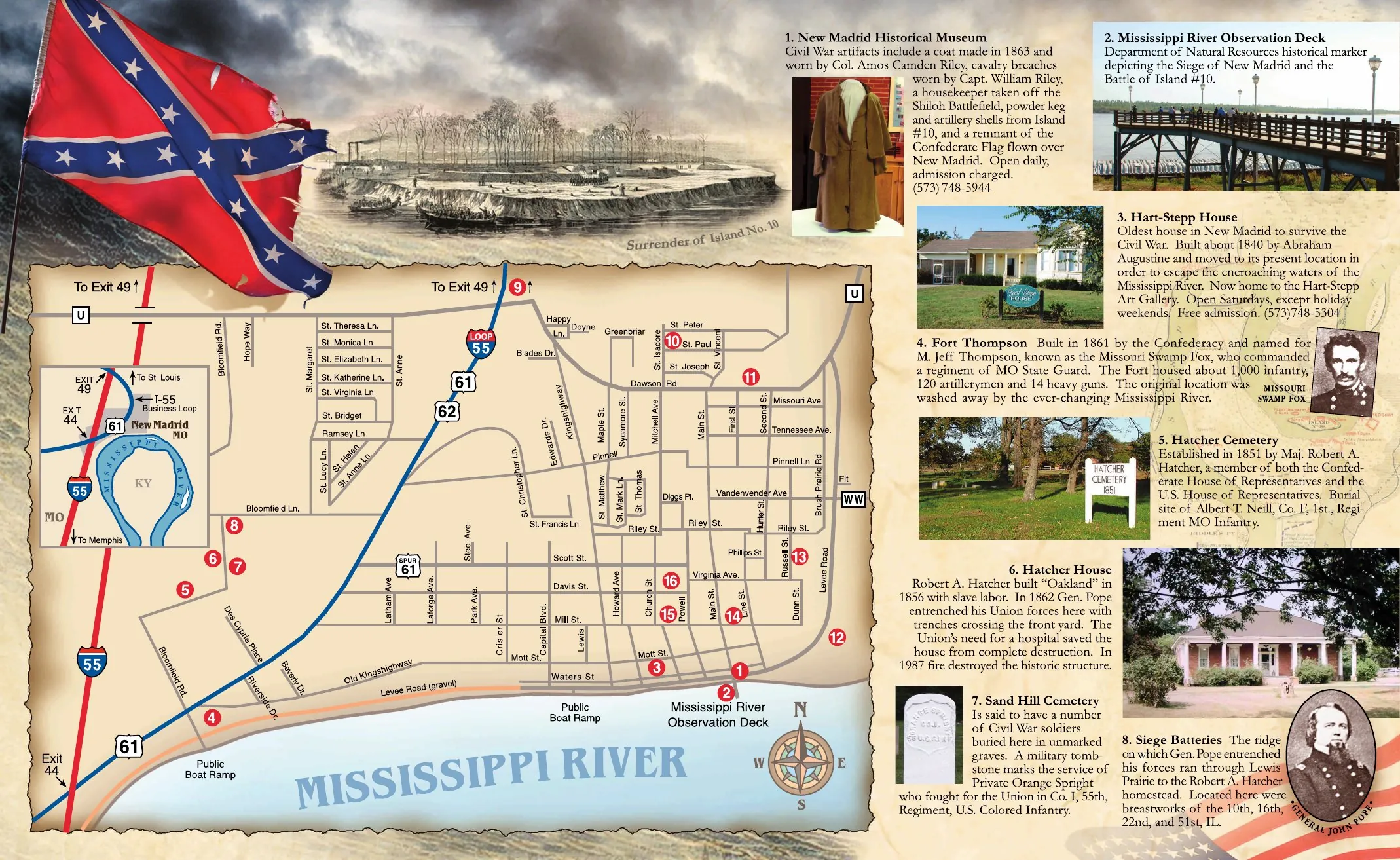
★ Driving Tour of Civil War Sites of New Madrid (brochure)
The official New Madrid Chamber of Commerce visitor brochure — sixteen numbered Civil War sites in town. The page below shows the street-map side with sites 1–8 (the historical museum, the Mississippi River observation deck, the Hurt-Stepp House, Fort Thompson, Hatcher Cemetery, Hatcher House, Sand Hill Cemetery, and the Siege Batteries). Click the image for that PDF, or jump to the site-by-site breakdown below covering sites 9–16.
What New Madrid looked like — period engravings, maps, and the reputed Pope headquarters
The Battle of New Madrid (March 3 – 13, 1862) and the linked Siege of Island No. 10 (Feb 28 – April 8, 1862) produced the first Union victory on the Mississippi and were heavily covered by the war's illustrated newspapers. Period engravings, official War Department maps, and the surviving mansion remembered as his headquarters give a remarkably full visual record of the post Charles would garrison with Battery B from 5 December 1863.


Charles's service here
| Date / period | Status | Source |
|---|---|---|
| 7 Nov 1863 | Promoted from Corporal to Sergeant at St. Louis (War Department: battery at St. Louis on 30 Sep and 30 Nov 1863) | Fold3 228767618 · pension file p. 35 |
| 5 Dec 1863 | Battery B arrives at New Madrid: "I arrived with my Company at New Madrid Mo. December 5th 1863" (Capt. John J. Sutter, 9 Dec 1863) | Herweck CSR (Fold3 229010820–21) |
| Nov–Dec 1863 · Jan–Feb 1864 | Present with the battery | Fold3 228767609 |
| 24 Apr 1864 | The battery leaves; Charles absent: "On det. service at New Madrid Mo. since Apl. 24/64" — a short detail behind the battery | Fold3 228767601 · NARA PG 09 |
| May–Jun 1864 | Present with the battery again (Springfield); the New Madrid detail had ended | Fold3 228767598 |
Correction history. Until October 2026 this page described two "tours" at New Madrid: Sept–Nov 1863 with the battery, and a detachment from 24 April 1864 to 27 March 1865. Both were wrong. The battery was at St. Louis until November 1863 and reached New Madrid on 5 December 1863; after 24 April 1864 Charles was back with the battery by May–June 1864, at Rolla in the summer and autumn, with McNeil in October, and at Franklin from November 1864. S.O. 82 (27 March 1865) sent him to Rolla from Franklin. The page was rewritten on 10 Oct 2026; see errata.
Historical context
The strategic geography of New Madrid
New Madrid sits on a sharp bend of the Mississippi River — the so-called "New Madrid Bend" — in the southeastern bootheel of Missouri, opposite Tennessee and just upstream of the river's joining with the Ohio at Cairo, Illinois. The town's position made it a strategic chokepoint for river traffic; in Confederate hands (1861–March 1862) it threatened all Union shipping descending the Mississippi from St. Louis. Pope's Union army captured New Madrid and the adjacent Island No. 10 between 28 February and 8 April 1862, opening the river to Union steamboats southward toward Memphis. Battery B garrisoned the fort from 5 December 1863 to 24 April 1864; Charles was there with it.
Why a light artillery battery at a river fort
By 1863 New Madrid had become a "static" Union position — the front had moved south to Vicksburg — but the post was kept manned to deny the river to Confederate raiders and to support Union counter-guerrilla operations in southeast Missouri. Battery B's 12-pounder Napoleon guns and 3-inch ordnance rifles were configured both for direct fire (against river targets and approaching cavalry) and for siege / fortress duty. The "heavy cannonading" Charles's Battery B comrades later attested to in their 1890 affidavits is consistent with garrison-artillery practice firings — daily training rounds, response-fire to Confederate guerrilla activity, and warning shots on river craft of uncertain affiliation.
The November weather and the rheumatism narrative
The Mississippi River bottomlands at New Madrid are notoriously damp and cold in late autumn — the river itself moderating frost but the persistent humidity and wind off the water producing the kind of chronic-cold exposure that 1860s medicine recognized as a rheumatism risk. Both Derr and Meyer's 1890 affidavits (May 1890) specifically locate Charles's "rheumatism contracted by exposure" in November 1863 at New Madrid — fitting the seasonal-weather profile of the post.
Visit today — museums, markers, and historic sites
New Madrid preserves an unusually rich Civil War footprint. The town is a stop on the Missouri Civil War Passport Program, and three core sites bracket the experience: the historical museum on the riverfront, the house remembered by family tradition as Pope's headquarters in 1862, and the marker tracing the Siege. The New Madrid Chamber of Commerce publishes a Civil War Driving Tour brochure covering 16 historic sites in town — embedded below.
★ Driving Tour of Civil War Sites of New Madrid (brochure detail)
The official New Madrid Chamber of Commerce brochure, "Driving Tour of Civil War Sites of New Madrid, Missouri." The brochure walks visitors through sixteen numbered stops in town, including:
- 9. Evergreen Cemetery — granite monument and burial site for seven Confederate veterans (Allen, Fontaine, Lee, Lewis, Barnes, Dawson, Digges).
- 10. Hunter-Dawson Cemetery — family burial ground including George Washington Dawson (1832–1862) and William Colson Hunter (1841–1902), both veterans of the 1st Regiment, Missouri (Confederate) Infantry.
- 11. Hunter-Dawson State Historic Site — the Hunters' 15-room cypress mansion, said to have been used as a hospital during the war and, by family tradition (not documented), as Pope's headquarters during the Siege of New Madrid.
- 12. Canal / Fort Bankhead — Pope's 12-mile bypass canal cut through swampy lowland in 19 days to outflank the Confederate batteries at Island No. 10. Route WW closely parallels the canal today. Fort Bankhead, the small companion redoubt at the mouth of St. Thomas Bayou, was washed away by the Mississippi.
- 13. East Side Cemetery — unmarked Civil War graves, including the only surviving stone (Pvt. Henry Riddle, drummer, Co. C, 4th Regiment U.S. Colored Heavy Artillery — died at age 14 at Columbus, KY, on 21 June 1863).
- 14. New Madrid County Library — a 13-inch mortar shell from the Battle of Island No. 10 sits at the base of the flagpole, recovered from Rucker's Battery on the Tennessee shore.
- 15. Masonic Lodge — Union forces burned the original lodge in 1862.
- 16. Immaculate Conception Catholic Church — interior painting depicts the burning of St. John Baptist Catholic Church by Union forces, who suspected the priest of Confederate sympathies (specifically with Brig. Gen. M. Jeff Thompson, "Missouri's Swamp Fox").
The brochure also summarizes the town's pivotal place in the war's western theater: "It was North against South, blue against gray, neighbor against neighbor. The year was 1862…" Featured facts include New Madrid as the August 1861 site where expelled MO Governor Claiborne F. Jackson signed the secession proclamation; the home of Co. I, 1st MO Infantry ("the shock troops" — the first MO unit to enter Confederate service); the appearance of "Old Abe," the eagle mascot of the 8th Wisconsin, at New Madrid in March–April 1862; and the only U.S. gas balloon reconnaissance operation in the entire Western theater. Capturing New Madrid took 20,000 Union troops and four 128-pounder siege guns.
Brochure (local copy on this site): Open the PDF ↗
Contact (per the brochure): New Madrid Chamber of Commerce, 537 B Mott Street, New Madrid, MO 63869 · phone (573) 748-5300 · email chambernm@yahoo.com · web new-madrid.mo.us.
★ Hunter-Dawson State Historic Site — Pope's headquarters by family tradition (1862)
The 15-room mansion that, by family tradition (as Missouri State Parks reports it; not documented), Maj. Gen. John Pope used as his headquarters during the Siege of New Madrid and the operations against Island No. 10. Built 1859–1860 for William Washington and Amanda Hunter; about 80% of the original 1860 furnishings are still in the house. Operated by the Missouri Department of Natural Resources as a state historic site, with guided tours.
Address: 310 Dawson Road, New Madrid, MO 63869.
Links: Missouri State Parks page · visitor information & hours · American Battlefield Trust profile · Wikipedia · Missouri Civil War Passport entry
★ New Madrid Historical Museum — Civil War Room
A riverfront museum in the former Kendall Saloon at the foot of Main Street. The Civil War Room displays letters, uniforms, equipment, and weapons from the Battle of New Madrid and the Siege of Island No. 10 — "much of it donated by local residents with family connections to the pieces." The Battle of Island No. 10 is interpreted from a local-historian perspective. The museum sells reference books on the campaign in its gift shop. Joint admission ticket available with the Higgerson School Historic Site.
Address: 1 Main Street, New Madrid, MO 63869 · phone 573-748-5944.
Hours: open 7 days a week, 358 days a year. April–November: Mon–Sat 9 AM – 5 PM, Sun noon – 5 PM. December–March: Mon–Sat 10 AM – 4 PM, Sun noon – 4 PM.
Links: newmadridmuseum.com · Official New Madrid city page · Facebook
Higgerson School Historic Site
A restored one-room schoolhouse at Higgerson Landing (just outside New Madrid), interpreting rural Bootheel education from the early 19th century forward. Joint-ticket eligible with the New Madrid Historical Museum.
Links: TripAdvisor reviews
The Siege of New Madrid Historical Marker
Roadside marker commemorating the March 1862 siege, cataloged on the Historical Marker Database. The HMDB entry for "The Siege of New Madrid" includes the marker text and photographs of the marker location.
Tourism & further reading
The official New Madrid Tourism page aggregates the town's Civil War sites, the river overlook, and the levee walk. Additional context: Battle of Island Number Ten (Wikipedia) · American History Central — Operations at New Madrid and Island No. 10 · Naval History Magazine — Checkmate at New Madrid Bend · State Historical Society of Missouri — New Madrid manuscripts.
What the muster cards say — verbatim
"This battery was formed of 1st Battery B Sept. 30, 1863." — NARA PG 08 Card A (July–Aug 1863) and PG 08 Card B (Sept–Oct 1863); the reorganization note carried forward across the autumn 1863 musters. Note: the corresponding Fold3 cards (PG 15/16) transcribe the same footnote as "Sept. 20, 1863" and as the unit becoming "3d Battery B" — see the full verbatim transcription; the 20th and "3d Battery B" are taken as the working readings.
"Promoted from Corporal to Sergeant Nov 7, 1863." — NARA PG 08 Card C (Nov–Dec 1863 Battery Muster Roll). The first concrete promotion date in any source examined.
"On det. service at New Madrid Mo. since April 24/64." — NARA PG 09 Card B (March–April 1864 Battery Muster Roll). The verbatim "New Madrid Mo." reading replaces the previously-illegible Fold3 transcription.
What the comrades' pension affidavits say
Two comrades swore to the origin of his deafness and rheumatism in 1890:
Charles, "while at New Madrid Mo about Sept 1863 contracted, from heavy cannonading, loss of hearing, further that about the same time, from exposure & hardships contracted the rheumatism." — August Derr, 1st Sergeant, Battery B, affidavit of 14 May 1890 (pension file p. 26); Christian Meyer gave the same account on 5 May 1890 (p. 22). Meyer was American-born and enlisted in August 1863.
The War Department's reply of June 1890 (p. 35) put the battery at St. Louis on 30 September and 30 November 1863; it reached New Madrid on 5 December 1863. The place in the affidavits fits Charles's record; the date is a few months early. Derr's second affidavit (29 September 1890, p. 24) placed the rupture not here but at Fort Wyman, Rolla, as did Charles's own declaration of 15 January 1890 (p. 14).
Comprehensive sources
Primary muster-card and pension sources (Charles's record)
- NARA mail-order Compiled Service Record packet (G11-422819443E, 13 pp.) — parallel scan of the cards: PG 08 Card C (the 7 Nov 1863 promotion to Sergeant, at St. Louis), PG 09 Card B ("On det. service at New Madrid Mo. since April 24/64"), PG 09 Card C (Present, May–June 1864).
- Fold3 / NARA M405 Compiled Service Records (25 pp.) — parallel scan of the same M405 series; Fold3 PG 15 records the September–October 1863 muster and the battery reorganization note. The New Madrid-related cards are Fold3 images 228767618, 228767609, 228767601 and 228767598 (see the CSR transcription key).
- Compiled Service Record (Doc O — single enlistment-summary card) — the AncestryProGenealogists 2020 journal anchor.
- Civil War Pension File F41-523680269E (40 pp.) — primary source for the Derr / Meyer comrade affidavits documenting Charles's New Madrid disabilities:
- 1st Sgt. August Derr sworn affidavits — Pension File Page 24 and Page 26
- Pvt. Christian Meyer sworn affidavit — Pension File Page 22
- Charles's own 1890 Declaration for Invalid Pension — Pension File Page 14
Secondary historical sources — the 1862 New Madrid / Island No. 10 campaign
- Battle of New Madrid (Wikipedia) — the March 1862 Union capture under Pope.
- Battle of Island Number Ten (Wikipedia) — the linked siege (Feb 28 – April 8, 1862) that opened the river to Memphis.
- "Operations at New Madrid and Island No. 10, 1862" — American History Central.
- "Battle of New Madrid, 13 March 1862" — historyofwar.org; "Battle of Island No. 10, 7 April 1862" — historyofwar.org.
- "Checkmate at New Madrid Bend" — U.S. Naval Institute, Naval History Magazine, April 2018.
- "Island No. 10" — Naval History and Heritage Command.
- New Madrid, Missouri (Wikipedia) — general town history.
Secondary historical sources — visit today / surviving sites
- Driving Tour brochure (New Madrid Chamber of Commerce): Sites 1–8 (street-map side, PDF) · Sites 9–16 (PDF) · Both sides combined (PDF). Original PDFs: View 422 / View 423.
- New Madrid Historical Museum (1 Main Street, New Madrid, MO 63869 · 573-748-5944) — Civil War Room with Battle of Island No. 10 artifacts. Also: official New Madrid city page · Facebook.
- Hunter-Dawson State Historic Site (310 Dawson Road, New Madrid, MO 63869) — by family tradition (Missouri State Parks; not documented) Pope's headquarters during the 1862 Siege of New Madrid; ~80% of the original 1860 furnishings intact. Also: American Battlefield Trust · Wikipedia · Missouri Civil War Passport.
- Higgerson School Historic Site — joint-ticket with the museum.
- "The Siege of New Madrid" — Historical Marker Database (HMDB).
- New Madrid Tourism — official city page.
- Missouri Civil War Passport Program — New Madrid is a stop.
Manuscript collections and additional research
- State Historical Society of Missouri — New Madrid manuscripts.
- Battery B's regimental history — Battery B, 2nd Missouri Light Artillery (Wikipedia) — general unit history (its New Madrid dates are superseded by the returns: 5 Dec 1863 – 24 Apr 1864).
- NPS Soldiers and Sailors System — 2nd Missouri Light Artillery.
Cross-references on this site
- → August Derr profile · Christian Meyer profile — the comrades who attested Charles's New Madrid disabilities.
- → Where Charles Served — posting-by-posting timeline
- → Battery B, 2nd Missouri Light Artillery · People Charles Served With
- → St. Louis Garrison Forts · St. Louis Smallpox Hospital · Fort Wyman, Rolla — the other postings inside Charles's enlistment
★ Research notes — New Madrid vs. Fort Wyman, the disability sources
The pension file places the three disabilities in two stations, and both are real stations of his service:
- Deafness and rheumatism — New Madrid. Meyer (5 May 1890) and Derr (14 May 1890) dated them "about Sept 1863"; the battery was in fact at New Madrid from 5 December 1863 to 24 April 1864, so the winter of 1863–64 is the likeliest time.
- Rupture (right side) — Fort Wyman, Rolla. Charles's declaration of 15 January 1890 (p. 14) and Derr's affidavit of 29 September 1890 (p. 24). The battery was at Rolla from 20 June to November 1864, and Charles was detached there again from 27 March to 1 July 1865 under S.O. 82.
Working synthesis. The places fit the record; the dates in the affidavits are a year or two off, as recollections of a quarter-century earlier often are. The pension award (certificate 684507, 18 Nov 1891) did not depend on resolving them.