By 1877 Charles had probably moved his family from Gate Street to Jackson Street, next door to Auguste’s parents. The 1875–76 directory is the last to list him at 718 Gate Street, as a driver for the St. Louis Railroad.1 The next year’s directory lists him, under one more spelling, as “Gonst Charles, driver. r. 1619 Jackson.”2
In this chapter
The move came in hard times, in the worst years of the depression that followed the Panic of 1873.3 In the winter of 1876–77 the city ran two soup kitchens, and Gould’s directory called 1877 a year “of panic and great shrinkage in values.”4
From 1877 to 1884 the directories and the census give Charles at least three occupations, and probably five: driver, baker, seller of liquors, laborer and candle-maker.5 Together they show a man who changed his work often.
The strike of 1877
In July 1877 the national railroad strike reached the city and became a general strike, in which workers of many trades stopped work. It collapsed within the week.6 The street railways, where Charles was probably then a driver, kept running. On 25 July the Globe-Democrat reported that the city’s drivers and conductors did not intend to strike. One of them said, “if we were to strike the companies could fill our places too easily.”7
A death in the family, 1877
Auguste’s brother August Kreichelt died on the evening of 24 November 1877, two weeks before his thirty-third birthday. He was the soldier who had escaped from the guard at Rolla in June 1864. The battery, in which Charles had been a sergeant, still listed him as a deserter when its men were discharged in 1865.8 Charles and Auguste had been godparents to his son August in 1872.9
The Westliche Post carried his death notice. It said that he “starb gestern Abend um 6 Uhr im Alter von 34 Jahren,” died yesterday evening at six o’clock at the age of thirty-four. His widow signed it: “Maria Kreichelt, geb. Mincke, nebst zwei Kindern,” with two children.10 The 1877 city death register gives his age as thirty-three, though by his baptism he was thirty-two, and lists the cause of death as “Phthisis Pulmonalis,” consumption, that is, tuberculosis of the lungs. He was buried the day after he died, in Holy Ghost Cemetery.11
The funeral started from his parents’ house at 1621 Jackson Street, next door to 1619 Jackson, where the 1877 directory probably lists Charles, still a driver.12 Whether Charles was at the funeral is not known.
Rear 1621 Jackson
Gould’s 1878 directory lists “Gansel Charles, driver, r. rear 1621 Jackson.” He was possibly still driving a horse car, but in a St. Louis directory “driver” could also mean a teamster, the driver of a freight wagon.13 The 1877 directory had listed Auguste’s father, Georg Kreichelt, at 1621 Jackson Street in the produce trade, and her brother Julius there as a barber.14 Georg Kreichelt had been a peddler, a street seller of produce, and for a time a grocer (see “Auguste Kreichelt and Her Family, 1847–1896”).15 Charles’s move onto his in-laws’ lot is the first proven record of the family living close to Auguste’s relatives.16
The 1879 directory probably gives him another trade: “Johnson Charles, baker.”17 The directory names no employer. The baker’s job was possibly seasonal work in one of the small German bakeries nearby. John Balbach had a bakery a block down Jackson Street, and the Freund brothers had one on Soulard Street.18
Jackson Street lay in the Kosciusko district, on the riverfront just south of downtown. Houses there were shared: a front house might hold one or two families, and the back house on the alley two or three more.19 Charles’s family lived in one of them. The south-side riverfront was not only German: the 1880 census lists German, Irish and American-born families side by side in the same apartment houses.20 The district lay in the band of wards that ran south along the river from downtown, which the historian Audrey Olson calls section two. About half of the city’s Hesse-born lived in that band in 1880, though it held fewer than a third of all its German-born.21 Charles, who came from Kurhessen, had his home among them.
People moved often but not far. A family that changed its address every year or two could stay within the same half-mile for decades, near the same church, the same grocer, and the same relatives. After the move to Jackson Street, each of Charles’s recorded moves in these years was a short one. St. Marcus Church was on Jackson Street itself, at the Soulard Street corner; Charles and Auguste had married there in 1866, and their children had been baptized there.22
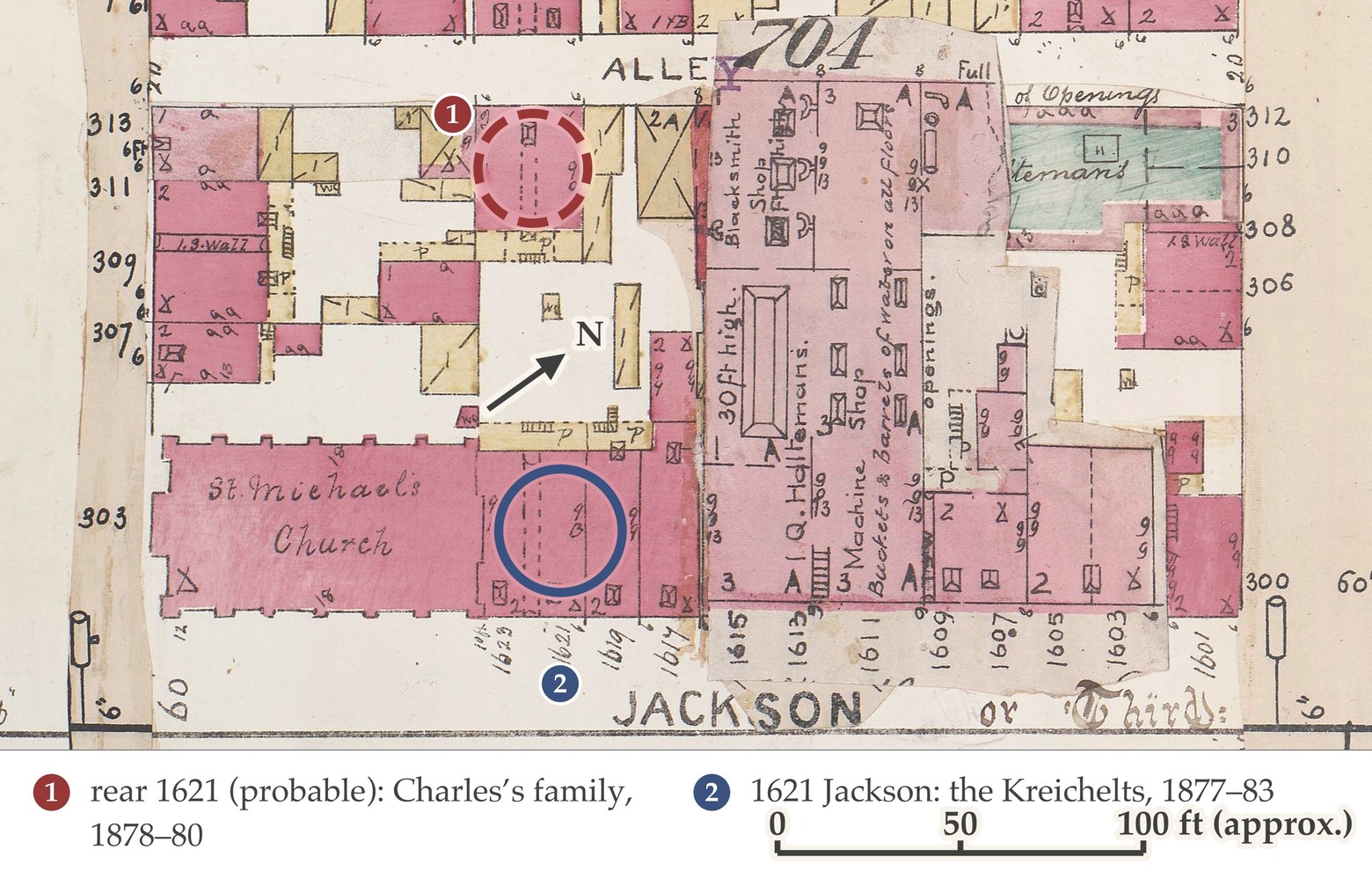
The Kreichelt lot was in the same block as the church. The house at 1621 Jackson stood on the west side of the street, the second house from the church at the Soulard Street corner. It was a two-story brick house, one of a pair with 1623, and a two-story brick building stood behind it on the alley. The 1878 and 1880 directories list the family there, at “rear 1621 Jackson” (map 10.1).23
Liquors, 1880
The 1880 directory lists Charles on the Kreichelt lot in a new trade: “Gansen Charles, liquors, r. rear 1621 Jackson.”26 It was the trade of his first years after the army, when he had kept saloons and a beer garden (see the chapter “The Saloon Years, 1866–1870”).27 The directory gives only one word, “liquors,” and does not say whether he kept a bar, which needed a dram-shop or beer-house license, or sold by the quart as a merchant.28 The liquor trade appears in no other record found for these years.29 It was probably a venture of a few months, run from the rear house on the lot.
In March 1880 a boy from the Kreichelt lot went missing. Rudolph Steitz, six, “whose parents reside at 1621 Jackson street,” had gone to the Carroll School for the first time and had not come home, the Globe-Democrat reported on 10 March.30 The papers searched do not report whether he was found.
The census of 5 June 1880 lists the family still in the rear house at 1621 Jackson. The census taker recorded “Charles Ganser,” 36, as a laborer who had been out of work for five months of the census year.31 He was one of many: in October 1879 the state’s new Bureau of Labor Statistics had written of “the large number of mechanics and laborers out of employment in the large cities.”32
The census taker listed the Steitzes next, in the same dwelling. Rudolph, five, the boy who had gone missing in March, was there with his parents, and against his name the census taker recorded “At School.”33 In November the census was taken again in St. Louis.34
Neighbors, 1880
By 9 November the family had left the Kreichelt lot. The second census taker recorded them about five blocks farther south, at 2125 Jackson Street, near the corner of Trudeau Street.35 He recorded the household as “Charles Gonson,” 39, who “works at Cotton Press,” his wife as “Guissie,” 36, and five children.36 The three eldest girls, “Joseph,” twelve, Katy and Gussie, were “at School,” as the June count had said of all three.37 Lewise was five and Charly four. These were Maria Josephine, Kate, Auguste, Louise and Erwin Carl (Charles Jr.).
Auguste’s age is not exact: born on 12 May 1847 by the church’s record, she was thirty-three.38 Charles’s own two ages that year do not agree. They make him younger than any other record does; most of his records point to a birth between about 1833 and 1841.39 The children’s census ages, like their parents’, are not exact.
The building was an apartment house of twelve families.40 On the 1876 insurance map, 2123 to 2127 Jackson are a row of three two-story brick houses with a long porch behind. They stood two doors from the Humboldt School, a three-story public school of seven hundred seats. Only the house at 2123 and a yard lay between the school and the family’s door.41 Jackson Street had German schools of its own. Christopher Rebenack, “a German school master of the old school,” kept a private school there, and so did William Glaeser, first near Barry Street and later several blocks farther south.42 In 1881 German was taught in fifty-four of the city’s public grade schools, to 20,258 pupils, and in 1888 the school board dropped it.43 No record found shows that the Humboldt School taught German or that the girls took it.
The family’s neighbors there were English, Irish, and German laborers, printers, a bricklayer, a grocer, a peddler, a miller and a man who kept a milk dairy. No other man on the page worked at a press.44
The levee and the cotton presses
In 1850 nearly half of the Germans in St. Louis were artisans or skilled workers. But in 1880 more than a third of them were unskilled laborers, as Charles was at the cotton press.45 The cotton he handled came to St. Louis by rail. By the early 1880s the railroads joined northern Texas and the whole of Arkansas to the city, which competed with Houston, Galveston and New Orleans for the cotton crop of the Southwest.46
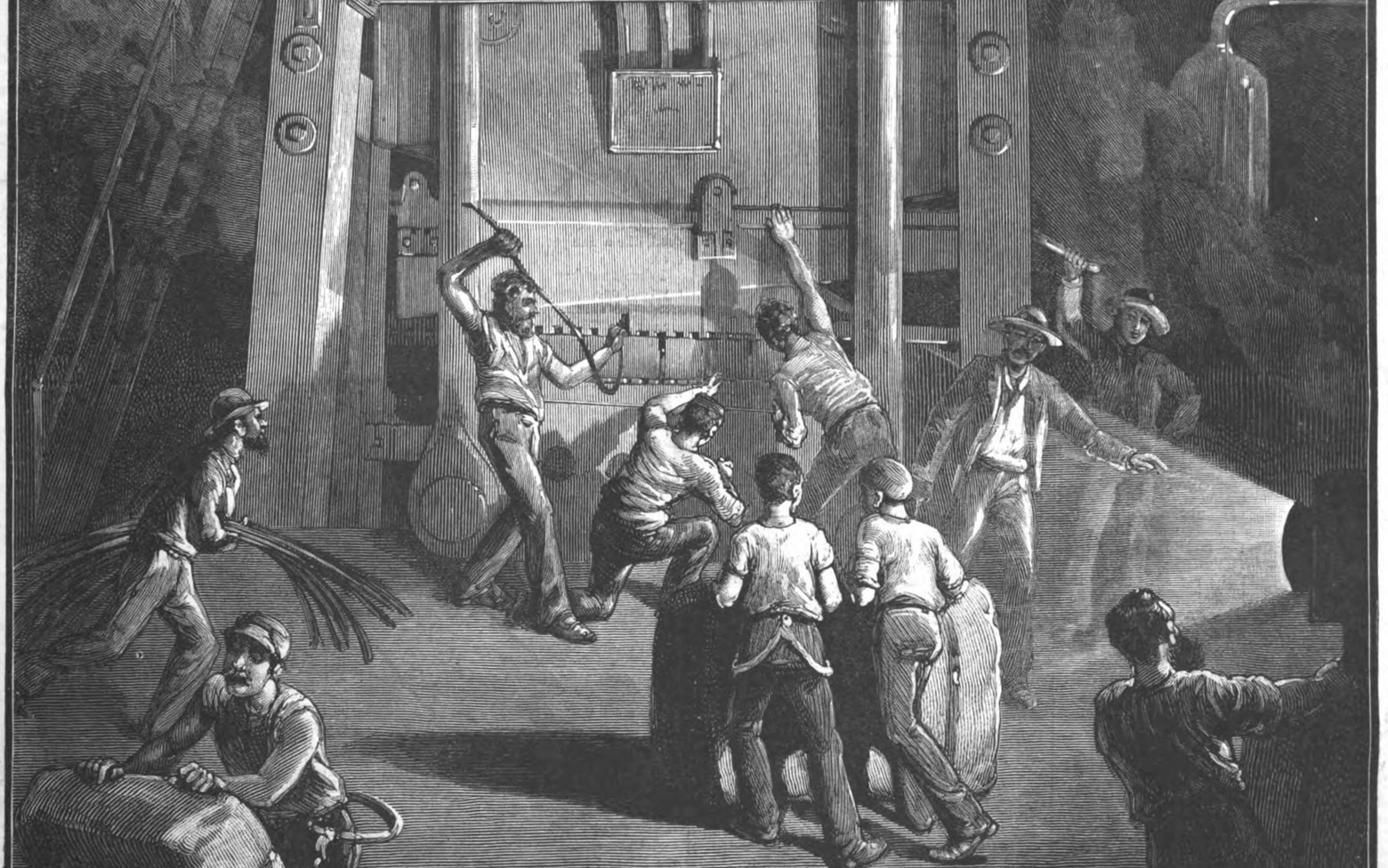
The cotton trade grew through the depression.47 Cotton reached the city in loose bales, already cleaned of seeds. A compress was a steam and hydraulic press that squeezed each bale hard, so more bales would fit in a freight car bound for the mills of the East. The St. Louis Cotton Compress Company’s four presses packed a bale “to a density of nine inches,” so that twenty-five thousand pounds went into an ordinary car.48
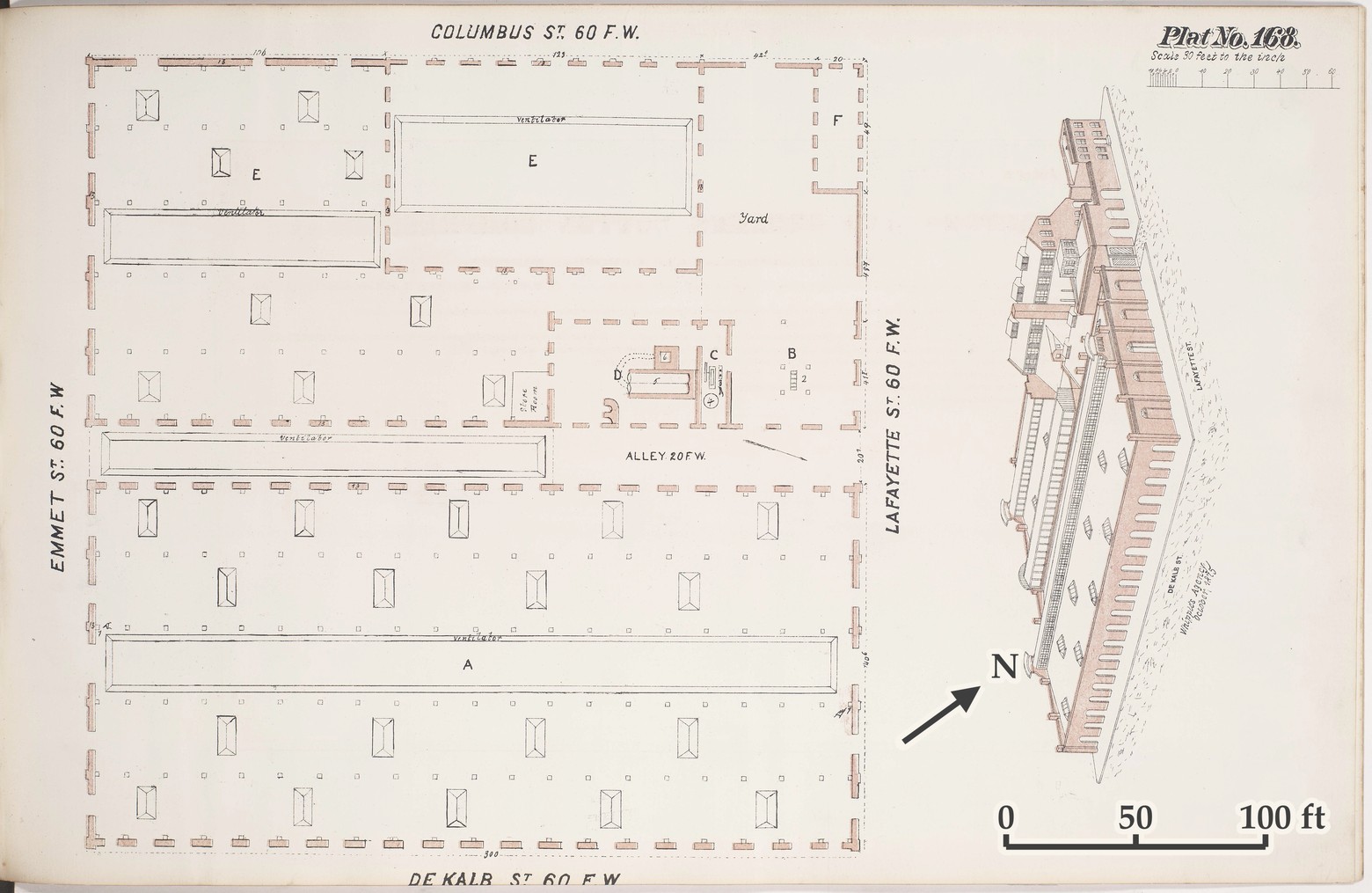
St. Louis had three compress companies in 1879, and two of them stood on the levee about a mile north of Jackson Street. The third, the Factors’ and Brokers’ Compress, filled a whole block at 1800 Columbus Street, now Second Street (map 10.3).50 It lay between the Kreichelt lot and 2125 Jackson, the family’s two houses of 1878–81, a few blocks from each.51 The census does not name Charles’s press, which was possibly this one, the nearest.52
The work was seasonal. Cotton was pressed from the fall picking through the winter and spring. The largest company employed “from three hundred to eight hundred men, according to the season.” Many of its workers were hired for the season and let go after it.53
Charles’s November job came at the start of the busiest months of a new pressing season (November and December, by the figures for 1882–83).54 The next directories, for 1880–81 and for 1881, list him at the same 2125 Jackson only as a laborer: “Gansen Charles, lab. r. 2125 Jackson.”55
A ruptured man at the press
Press work was heavy lifting. Charles said in his pension claim that his rupture, a hernia, dated from the army. He and August Derr, a fellow sergeant of the battery, both put it down to heavy lifting.56 His statement of 1890 says he had been “worse in fall and winter and in rainy weather.”57 Those were also the months of the compress season, so the heaviest work came when, by his own account, he was at his worst.
The last child
Charles’s seventh and youngest child, Bertha, was born in December 1880, while the family lived at 2125 Jackson. She was baptized at St. Marcus on 4 September 1881. Her godmother is in the chapter “The Godparents and Witnesses, 1866–1881.”58
Soap and candles, 1882–1884
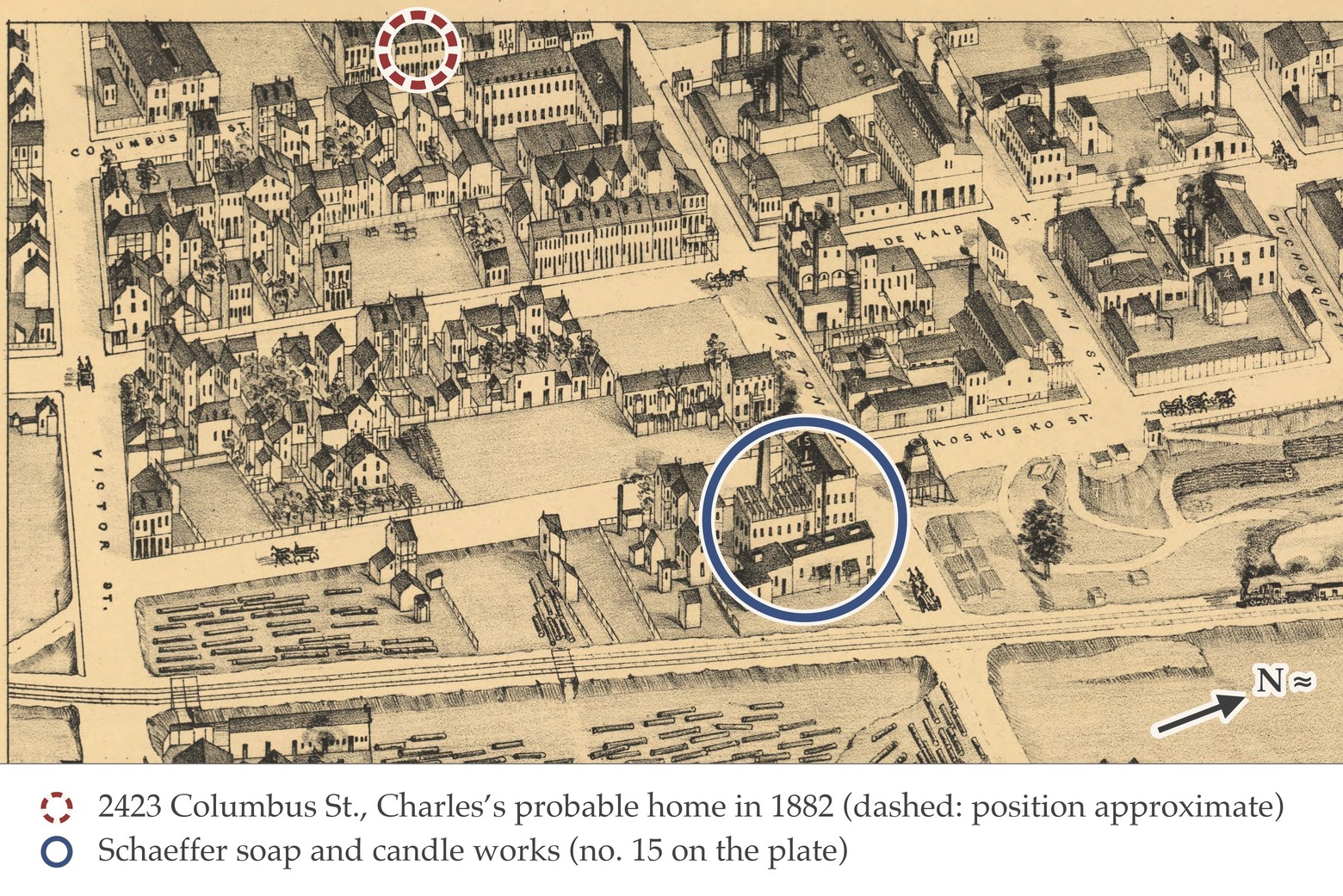
In 1882 the family probably moved a few blocks south to Columbus Street, near Barton Street. The 1882 directory lists him twice, as “Gansell Charles, lab. r. 2423 Columbus” and as “Kausen Charles, lab. Schaeffer Bros. & Powell.”59 Schaeffer Brothers and Powell made soap and candles. Their office was downtown on Second Street, but their works stood at Barton Street, two blocks from the house.60 In 1883 he is “Ganzer Charles,” living in “Schaefer’s alley near Barton,” the alley named for the works.61
In May 1882 the South St. Louis Turner Society dedicated its new hall at the northwest corner of Tenth and Carroll Streets. Besides the gymnasium, it held a hall thirty feet high with a stage, side rooms, a billiard room and a bowling alley. It was the first Turner hall with warm baths. Kargau called it “the central meeting place of the German element in this part of the city.” By 1893 the society had 648 members, with classes for older members and for women and a well-attended Turner school.63
The works belonged to one of the oldest firms in St. Louis.64 The factory stood at Barton and Kosciusko Streets, on the bluff above the river, one block from DeKalb Street, among lime kilns, quarries, a cotton mill and the railroad.65 Fat came in by the barrel, and the workers melted it down and bleached it, pressed out the oil and poured the hard fat into molds. The firm sold Star candles and candles for miners, railroads and coaches.66 It was hot, greasy work, and what Charles earned at it is not known. A few years later St. Louis soap-makers were paid about $1.77 a day.67 When the candle works burned in 1889, a private watchman raised the alarm, running to the corner of Barton and DeKalb. The papers do not give his name, and no record ties Charles to this alarm.68
The death of Georg Kreichelt
Charles’s father-in-law, Georg Kreichelt, died at 1621 Jackson Street on 20 September 1883, on the lot where Charles and Auguste had lived in 1878–80. Georg had served three months as a private in Company B of the 2nd U.S. Reserve Corps, one of the German home-guard regiments of St. Louis. The pension index lists a claim for that service, filed six months before his death.69 Two days later the family’s notice, which names Charles among the sons-in-law, appeared in German on the front page of the Anzeiger des Westens:70
Georg Kreichelt, our most dearly beloved husband, father and father-in-law, died Thursday, 20 September, at 6 in the morning, after a short illness, aged 64 years. Relatives and friends are respectfully invited to the funeral, which takes place Sunday, 23 September, at 1:30 p.m. from the house of mourning, 1621 Jackson Street. The mourning survivors: Henriette Kreichelt, née Weiß, wife; Carl Kreichelt, Julius Kreichelt, Babetta Ravotski, Auguste Gansen, children; Maria Kreichelt, née Minde, Catharina Kreichelt, née Albrecht, Maria Kreichelt, née Fischer, daughters-in-law; Herbert Ravotski, Charles Gansen, sons-in-law; with 15 grandchildren.71
The Westliche Post printed the same notice, with “Auguste Gansen” among the children and “Chas. Gansen” among the sons-in-law.72 Babette, the godmother of Bertha two years before, had married Herbert Rabuske, whom the notice spells Ravotski.73 Georg was buried that Sunday in the Old Picker’s Cemetery, and his pension claim passed to his widow.74
The notice ran in two of the city’s German papers. A guide of 1878 described several of them. The Anzeiger des Westens, the oldest, generally supported the Democrats. The others included the Westliche Post, the Catholic Amerika and the socialist Volksstimme des Westens, the youngest German daily.75
In 1884 the directory lists Charles as “Johnson Charles, candle.,” a candle-maker, at 2409 DeKalb Street, a block from the works.76 The names change, as his always did, but the place and the work stay the same. For about three years he probably worked at the soap and candle works, first as a laborer and then at the candles.77 The family’s new neighbor was an iron works. Michael and Peter Helmbacher had started their forge in 1857 with “a couple of workers,” and in 1869 the firm added rolling mills. By 1893 the iron works filled the block between Lami, Barton, DeKalb and Second Streets and half the block north, and their own tracks ran to the Iron Mountain railroad. Kargau wrote that its 280 workers made more railroad coupling pins and links than any other firm in the world.78
No record found for these years says how much longer he could keep at such work, with the rupture he dated from the army.79
Notes
79 notes
- St. Louis city directories (Edwards’, Gould’s), 1860–1904, read year by year in the image under every spelling of the surname, with the Kreichelt, Pinkepank, Brauneis, Orlemann and Misch entries. For this chapter: Gould’s 1875–76 (title year 1876), p. 351, https://
mdh , https://.contentdm .oclc .org/ digital/ collection/ p16795coll7/ id/ 7646 mdh , https://.contentdm .oclc .org/ digital/ collection/ p16795coll7/ id/ 7802 mdh . Gould’s 1875–76, pp. 351 and 507 (Missouri Digital Heritage, https://.contentdm .oclc .org/ digital/ collection/ p16795coll7/ id/ 11256 mdh and https://.contentdm .oclc .org/ digital/ collection/ p16795coll7/ id/ 7646 mdh : accessed 18 November 2026). [DIRS].contentdm .oclc .org/ digital/ collection/ p16795coll7/ id/ 7802 - Gould’s St. Louis Directory, for 1877, p. 372. — Probable. [D1877]
- James Neal Primm, Lion of the Valley, pp. 326–27. [PRIMM]
- David T. Burbank, Reign of the Rabble: The St. Louis General Strike of 1877 (New York: Augustus M. Kelley, 1966), p. 5 (soup kitchens, winter 1876–77; Gould’s directory on 1877), pp. 20–21 and 52–53 (German section of the Workingmen’s Party; Turner Hall, Tenth Street), p. 31 (the first Lucas Market mass meeting, Monday 23 July), pp. 147–149 (three meetings called for Friday evening, 27 July; the arrest of the Executive Committee at Schuler’s Hall; the end of the general strike), p. 164 (the Globe’s list of sixty factories closed by the strike), p. 172 (Henry Allen, interviewed in the City Jail by the Missouri Republican), pp. 181–182 (the German section after the strike). Read in the scan at the Internet Archive (reignrabblestlouisgeneralstrike, https://
archive : accessed 4 November 2026). [BURBANK66].org/ details/ reignrabblestlouisgeneralstrike - Gould’s St. Louis Directory, for 1878 (St. Louis: David B. Gould, 1878), p. 340; Gould’s St. Louis Directory, for 1879, p. 512, p. 898; Gould’s St. Louis Directory, 1880, p. 390, https://
mdh ; 1880 U.S. census, second enumeration (9 November 1880), St. Louis, ED 137, p. 4D (penned), dwelling 15, sheet 4-D; Gould’s St. Louis Directory, for 1884 (year ending 1 April 1885), p. 574. [D1878] [D1879] [D1880] [C1880] [D1884].contentdm .oclc .org/ digital/ collection/ p16795coll7/ id/ 15400 - David T. Burbank, Reign of the Rabble. [BURBANK66]
- St. Louis Globe-Democrat, 25 Jul 1877, p. 5, “The Street Car Employes” ( image 571034145), and 27 Jul 1877, p. 4 (image 571034343); imaged, (https://
www , https://.newspapers .com/ image/ 571034145/ www : accessed 8 November 2026); St. Louis newspapers 1876–78 searched under nineteen spellings of the surname, negative. [STRIKE77].newspapers .com/ image/ 571034343/ - Same file (Fold3 images 228986760 and 228986762–228986763, https://
www : accessed 8 November 2026): “Statement of the Escape of August Kreichelt … from Post Prison on the evening of June 28,” Rolla, 29 June 1864, signed 2nd Lt. M. V. B. Parke, Co. C, 145th Illinois Infantry, officer of the guard; Compiled Military Service Record, August Kreichelt, Battery B., roll 333. See the chapter “Sergeant on the Missouri Posts, 1863–1865.” [AUGESC] [AUGCSR].fold3 .com/ image/ 228986762 - St. Marcus Evangelical Church (St. Louis, Missouri), baptism register 1872, p. 367. [GOD72]
- Westliche Post, St. Louis, 25 Nov 1877, p. 2., p. 5. [AUGDEATH]
- Westliche Post, St. Louis, 25 Nov 1877, p. 2., p. 5. City of St. Louis, Register of Deaths, November 1877, p. 130, no. 5943; Westliche Post, 25 Nov 1877, p. 2. [AUGDEATH]
- Gould’s St. Louis Directory, for 1877, p. 372. [D1877]
- Gould’s St. Louis Directory, for 1878 (St. Louis: David B. Gould, 1878), p. 340. — Proven. [D1878]
- Kreichelt family: Edwards’ St. Louis directories 1864, p. 841, p. 452. Gould’s 1877 directory, p. 542. In November 1876 the Court of Criminal Correction tried a Geo., a Chas. and a Julius Kreichelt for assault and battery. They were probably Auguste’s father and her brothers Carl and Julius. Georg and Julius were let go. Chas. was found guilty and fined a dollar and court costs. The report does not say whom they fought. “Court of Criminal Correction,” St. Louis Globe-Democrat, 4 Nov 1876, p. 7 ( image 571018377), read in the image; imaged, (https://
www : accessed 2 November 2026). He had lived on South Seventh Street in 1864–66. [KR] [GD76].newspapers .com/ image/ 571018377/ - Kreichelt family: Edwards’ St. Louis directories 1864, p. 841, p. 452; For the Kreichelt family, the sources given in the chapter on Auguste and the Kreichelt family: Clausthal parish registers; St. Louis city directories 1864–1883; 1870 U.S. census, St. Louis County, Missouri, population schedule, St. Louis Ward 3, household of George Kreichelt (FHL film 4263033, image 476). Grocer: Edwards’ 1867, p. 495, and 1868, p. 454 (Ancestry, U.S. City Directories, St. Louis 1867, image 225, and 1868, image 209). [KR] [GPKREI]
- St. Louis city directories (Edwards’, Gould’s), 1860–1904, read year by year in the image under every spelling of the surname, with the Kreichelt, Pinkepank, Brauneis, Orlemann and Misch entries. For this chapter: Gould’s 1875–76 (title year 1876), p. 351. Gould’s 1878, p. 340 (https://
mdh : accessed 11 November 2026). [DIRS].contentdm .oclc .org/ digital/ collection/ p16795coll7/ id/ 11256 - Gould’s St. Louis Directory, for 1879, p. 512, p. 898. The 1879 directory numbered the rear house of the Kreichelt lot 1623 instead of 1621. The tailor Theodore Siemens, who lived in that rear house, is listed at “rear 1621” in 1878 and 1880 and at “rear 1623” in 1879. No other Charles is listed on the lot in 1879. The other baker named Charles Johnson, Charles W., worked for A. A. Condon and lived on Manchester Road. Another baker, Charles Gantz, is not the man: he kept his own addresses from 1882 to 1901, and none of them was on Jackson Street. Two points keep the grade at probably. First, no second record gives Charles the baker’s trade: the 1880 directory lists him in liquors, and the June 1880 census as a laborer. Second, the check for another Charles on the lot was a word search of the directory; the other Charles Johnsons of the 1879 directory have not been counted. — Probable. [D1879]
- Gould’s St. Louis Directory, for 1879, business list, “Bakers,” pp. 1074–1075: “Balbach John, 1717 Jackson”; “Freund L. & Bro. 917 Soulard”; “Lambert John, 1509 Jackson”; “Meyer & Gillman, 1458 Jackson”; “Sammann Charles, 2103 Jackson” (Missouri Digital Heritage, St. Louis Mercantile Library city directories, p16795coll7, pointers 14784–14785, read in the page images) (https://
mdh : accessed 30 October 2026). None names Charles. [OCC-D1879B].contentdm .oclc .org/ digital/ collection/ p16795coll7/ id/ 14784 - 1880 U.S. census, second enumeration (9 November 1880), St. Louis, ED 137, p. 4D (penned), dwelling 15, sheet 4-D. [C1880]
- 1880 U.S. census, second enumeration (9 November 1880), St. Louis, ED 137, p. 4D (penned), dwelling 15, sheet 4-D. [C1880]
- Audrey L. Olson, St. Louis Germans, 1850–1920, p. 48. Pages 57 and 59 (table 10): 49.7 percent of the 1,996 born in “Hesse,” against 29.0 percent of those entered only as born in “Germany” and 28.5 percent of the Prussian-born. Section two was wards 3, 5, 7, 9, 11, 22 and 24. Olson’s ward map (p. 48) is a sketch without streets, so it does not show which of these wards held Jackson Street. “Hesse” in the census covers both Hessian states. See the chapter “Kurhessen: Deisel and Trendelburg, c. 1835–1858.” [OLSON]
- Richard J. Compton and Camille N. Dry, Pictorial St. Louis. The 1875 Pictorial St. Louis plate of Jackson Street shows the church as no. 20 in its key. [PICT75]
- Oliver & Whipple’s Fire Insurance Map of St. Louis, Mo., 1876, vol. 1, plate 19, nos. 1601–1625, plate 6, nos. 2101–2131. Oliver and Whipple’s 1876 fire-insurance map shows the house, numbered 1621 as in the directories. The map labels the church “St. Michaels,” but Pictorial St. Louis shows St. Marcus on the same corner. [WHIP76]
- Gould’s St. Louis Directory, for 1878 (St. Louis: David B. Gould, 1878), p. 340; Gould’s St. Louis Directory, 1880, p. 390; Kreichelt family: Edwards’ St. Louis directories 1864, p. 841, p. 452; Anzeiger des Westens (St. Louis, Missouri), 22 Sep 1883. The church at the corner, lettered “St. Michaels Church,” stands where Pictorial St. Louis draws St. Marcus. 1623 and 1621 are the pair of two-story brick houses beside it. The blue circle marks 1621, the house of Auguste’s parents, Georg and Henriette Kreichelt, from 1877 (Gould’s 1877 directory, p. 542). The dashed red circle marks the brick building behind them on the alley. The map does not number it; the 1878 and 1880 directories list the family in the rear house of 1621. Pink marks brick, yellow wood. [D1878] [D1880] [KR] [NOT83]
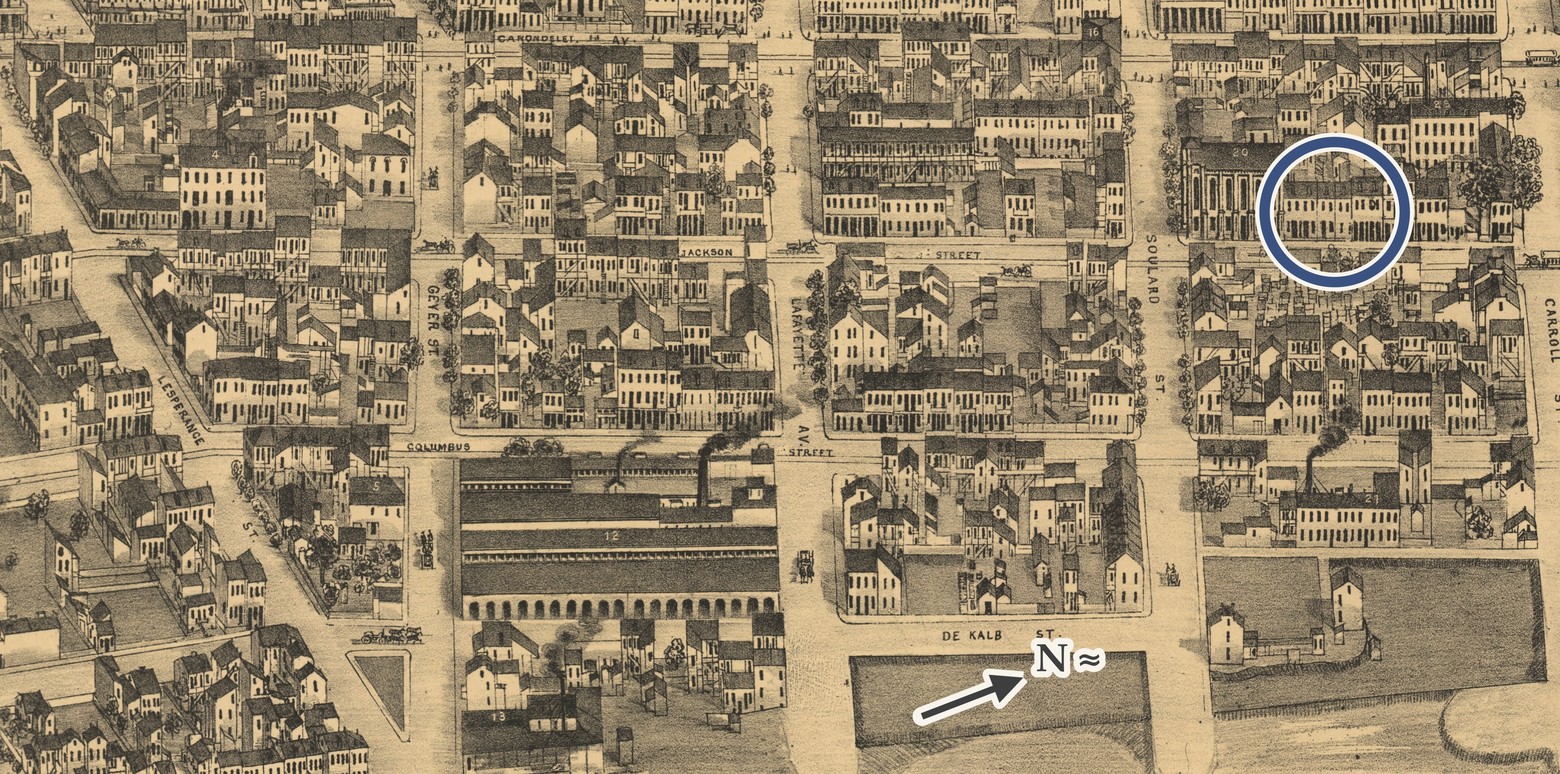
- The family lived there in 1878–80, in a back house hidden behind the front row. The view shows the neighborhood in 1875, from Lesperance Street (left) past Lafayette Avenue to Soulard and Carroll Streets, with Columbus and DeKalb Streets below. St. Marcus is the church at the upper right (no. 20 in the plate’s key). The long arcaded building, no. 12, is the Factors’ and Brokers’ cotton compress. The house of November 1880, 2125 Jackson, stood just beyond the left edge.
- Gould’s St. Louis Directory, 1880, p. 390. The directory was compiled in the months before its publication. — Proven. [D1880]
- “The Courts — Court of Criminal Correction,” Missouri Republican (St. Louis), 16 Sep 1869, p. 2. [REP69]
- J. G. Woerner, ed. A Digest of the Charter and the Revised Ordinances of the City of St. Louis (St. Louis, 1866), art. IX, pp. 574–575. [OCC-DIG1866]
- Gould’s St. Louis Directory, 1880–81, p. 413, image 911, image 401; St. Louis city directories (Edwards’, Gould’s), 1860–1904, every volume searched under every known spelling of the surname, 1877 and 1882–84 in the image: 1879, p. 512. [D1881] [DIRS]
- “Boy Missing,” St. Louis Globe-Democrat, 10 Mar 1880, p. 4: “Rudolph Steitz, a six-year-old boy, whose parents reside at 1621 Jackson street, is missing” ( image 571036727); imaged, (https://
www : accessed 11 November 2026). Read in the image twice independently, 11 November 2026. [GD80S].newspapers .com/ image/ 571036727/ - The census year ran from 1 June 1879 to 31 May 1880. 1880 U.S. census, first enumeration (5 June 1880), St. Louis, SD 1, ED 40, p. 14, dwelling 77, family 135, “Ganser, Charles,” 36, lines 45–50; 1880 U.S. census, population schedule, column 14, “Number of months this person has been unemployed during the Census year,” and note A, “The census year begins June 1, 1879, and ends May 31, 1880”; transcribed by IPUMS USA, “1880 Census: Enumeration Form” (https://
usa , accessed 6 November 2026). [C1880J] [CENS80I].ipums .org/ usa/ voliii/ items1880 .shtml - Missouri Bureau of Labor Statistics, First Annual Report, for the year ending January 1, 1880 (Jefferson City, 1880), p. 27 (farm labor “crowding into the large cities every Winter”), p. 28 (circular of October 1879 on “the large number of mechanics and laborers out of employment in the large cities”) and p. 53 (building trades, fall of 1879, “the mildness of the weather”). Internet Archive, annualreport10missgoog (https://
archive , accessed 6 November 2026). [BLS79U].org/ details/ annualreport10missgoog - 1880 U.S. census, first enumeration, St. Louis, Missouri, SD 1, ED 40, p. 15, enumerated 5 June 1880, Jackson Street, house 1621, dwelling 77, family 136, William Steitz household: “Rudolph,” son, 5, “At School”; FamilySearch 1:1:M6FN-LK2, image 15 of 58 (https://
www : accessed 12 November 2026). Read twice, independently, in the image, 12 Nov 2026. The March report called him six. The 1900 census gives his birth as July 1874, and his 1918 draft card as 4 July 1874, so he was five in June 1880. 1900 U.S. census, St. Louis, Missouri, ward 7, SD 11, ED 101, sheet 6, enumerated 5 June 1900, William Steitz household: Rudolph, son, born July 1874, 25, single, born Missouri; FamilySearch 1:1:M385-SB4, DGS 004118820, image 608 of 621 (https://.familysearch .org/ ark:/ 61903/ 3:1:33SQ-GYBV-NCK www : accessed 12 November 2026). Read twice in the image, 12 Nov 2026; World War I draft registration card, Rudolph Steitz, serial 929, order 696, Local Board for Division No. 15, City of St. Louis, registered 12 Sep 1918: 1812 Geyer Ave., age 44, born “July 4 1874”; nearest relative Barbara Steitz, 3740 Michigan Ave.; FamilySearch 1:1:7BM3-X62M, image 5828 of 5,978 (https://.familysearch .org/ ark:/ 61903/ 3:1:S3HY-DZJ3-ZCG www : accessed 12 November 2026). Read twice in the image, 12 Nov 2026. [C1880S] [C1900ST] [WWI18ST].familysearch .org/ ark:/ 61903/ 3:1:33SQ-GYTX-QQCD - 1880 U.S. census, second enumeration (9 November 1880), St. Louis, ED 137, p. 4D (penned), dwelling 15, sheet 4-D. [C1880]
- 1880 U.S. census, first enumeration (5 June 1880), St. Louis, SD 1, ED 40, p. 14, dwelling 77, family 135, “Ganser, Charles,” 36, lines 45–50; 1880 U.S. census, second enumeration (9 November 1880), St. Louis, ED 137, p. 4D (penned), dwelling 15, sheet 4-D. [C1880J] [C1880]
- 1880 U.S. census, second enumeration (9 November 1880), St. Louis, ED 137, p. 4D (penned), dwelling 15, sheet 4-D. — Proven. [C1880]
- 1880 U.S. census, second enumeration (9 November 1880), St. Louis, ED 137, p. 4D (penned), dwelling 15, sheet 4-D; 1880 U.S. census, first enumeration (5 June 1880), St. Louis, SD 1, ED 40, p. 14, dwelling 77, family 135, “Ganser, Charles,” 36, lines 45–50. [C1880] [C1880J]
- St. Marcus Evangelical Church (St. Louis, Missouri), death register 1896, pp. 120–121, no. 2631; 1880 U.S. census, second enumeration (9 November 1880), St. Louis, ED 137, p. 4D (penned), dwelling 15, sheet 4-D. [AUG96] [C1880]
- 1880 U.S. census, first enumeration (5 June 1880), St. Louis, SD 1, ED 40, p. 14, dwelling 77, family 135, “Ganser, Charles,” 36, lines 45–50; 1880 U.S. census, second enumeration (9 November 1880), St. Louis, ED 137, p. 4D (penned), dwelling 15, sheet 4-D. Charles’s age of thirty-nine points to a birth about 1841, and the June count’s thirty-six to about 1844. Both are later than the 26 January 1835 of his burial register. Only two figures in his records fall outside the range of about 1833–41 that the others allow: the June census age and the surgeons’ 1890 estimate (see the chapter “Where and When He Was Born”). [C1880J] [C1880]
- 1880 U.S. census, second enumeration (9 November 1880), St. Louis, ED 137, p. 4D (penned), dwelling 15, sheet 4-D. [C1880]
- Oliver & Whipple’s Fire Insurance Map of St. Louis, Mo., 1876, vol. 1, plate 19, nos. 1601–1625, plate 6, nos. 2101–2131; Twenty-first Annual Report of the Board of Directors of the St. Louis Public Schools, for the Year Ending August 1, 1875 (St. Louis: Globe-Democrat Job Printing Co., 1876), appendix, p. ccix, “Lists of Teachers, with Their Residences”: “Humboldt School.— Jackson and Trudeau streets; 700 seats,” the district bounded north by Lafayette Street, east by the river, south by Victor Street and west by Carondelet Avenue (Internet Archive, annualreportboa00diregoog, https://
archive : accessed 9 November 2026). Read in the searchable text. [WHIP76] [BOE75].org/ details/ annualreportboa 00diregoog - Ernst D. Kargau, The German Element in St. Louis, pp. 137–38, p. 137. Kargau gives no addresses or years, and no record shows that Charles’s children attended either school. [KARGAU]
- Audrey L. Olson, St. Louis Germans, 1850–1920, p. 48, pp. 94 and 106. The board voted on 3 January 1888 to end the German classes after the first semester. [OLSON]
- 1880 U.S. census, second enumeration (9 November 1880), St. Louis, ED 137, p. 4D (penned), dwelling 15, sheet 4-D. [C1880]
- Walter D. Kamphoefner, Wolfgang Helbich, and Ulrike Sommer, eds., p. 27, p. 288. [NEWSLAND]
- J. Thomas Scharf, History of Saint Louis City and County (Philadelphia, 1883), vol. 2, pp. 1218–1222. Vol. 2, pp. 991–92. [OCC-SCHARF]
- H. L. Purdy, An Historical Analysis of the Economic Growth of St. Louis, 1840–1945 (St. Louis: Federal Reserve Bank of St. Louis, 1945), Appendix J, “Cotton Compressed at St. Louis, 1875–1923,” and Appendix M, “Gross and Net Receipts of Cotton at St. Louis, 1871–1923” (FRASER, https://
fraser , PDF pp. 144 and 150: accessed 8 November 2026). [PURDY].stlouisfed .org/ files/ docs/ publications/ books/ econgrowthstl_purdy_1945 .pdf - J. Thomas Scharf, History of Saint Louis City and County (Philadelphia, 1883), vol. 2, pp. 1218–1222. [OCC-SCHARF]
- It filled the block between Columbus and DeKalb Streets, Emmet Street and Lafayette Avenue, with a bird’s-eye sketch at the right. It was the nearest of the city’s three cotton compresses to the family’s homes; which one Charles worked at is not known.
- Glen Holt and Tom Pearson, St. Louis Streets Index, p. 108. Page 108, “Second Street”: in Soulard it “was known as Columbus Street until 1883.” [STLSTR]
- J. Thomas Scharf, History of Saint Louis City and County (Philadelphia, 1883), vol. 2, pp. 1218–1222; Gould’s St. Louis Directory, for 1879, business section, p. 1121, “Cotton Warehouses and Compressing”: Factors’ & Brokers’ Cotton Compress Co. 1800 Columbus; Peper Cotton Press, Levee, north-west corner of Rutger; St. Louis Cotton Compress Co. Levee, south-west corner of Rutger (Missouri Digital Heritage, St. Louis Mercantile Library city directories, https://
mdh : accessed 11 November 2026; read in the image); Oliver & Whipple’s Fire Insurance Map of St. Louis, Mo., 1876, vol. 1, plate 19, nos. 1601–1625, plate 6, nos. 2101–2131. [OCC-SCHARF] [OCC-D1879] [WHIP76].contentdm .oclc .org/ digital/ collection/ p16795coll7/ id/ 14833 - 1880 U.S. census, second enumeration (9 November 1880), St. Louis, ED 137, p. 4D (penned), dwelling 15, sheet 4-D. — Possible. Gould’s St. Louis Directory, for 1879, business section; St. Louis city directories (Edwards’, Gould’s), 1860–1904, every volume searched under every known spelling of the surname, 1877 and 1882–84 in the image: 1879, p. 512. The 1882 directory lists a “Gansell Charles, lab. r. 2423 Columbus,” probably Charles, on the same street as that press. [C1880] [OCC-D1879] [DIRS]
- J. Thomas Scharf, History of Saint Louis City and County (Philadelphia, 1883), vol. 2, pp. 1218–1222. [OCC-SCHARF]
- George H. Morgan, secretary, Annual Statement of the Trade and Commerce of St. Louis for the Year 1883, Reported to the Merchants’ Exchange of St. Louis (St. Louis: R. P. Studley & Co., printers, 1884), p. 109, “Monthly Receipts and Shipments for Two Seasons” (receipts of cotton, 1882–83: September 8,339 bales, October 58,447, November 106,919, December 106,018, January 51,727, February 33,760, March 43,936, April 23,268, May 13,783, June 5,873, July 2,643, August 2,145; total 456,858), and p. 111, “Report of Cotton Compressed at St. Louis” (year ending 31 August: 1878, 205,861 bales; 1879, 237,437; 1880, 358,124; 1881, 317,195; 1882, 259,151; 1883, 304,300) and “Compresses and Warehouses” (St. Louis and Peper only, 1883); Internet Archive, annualstatement03louigoog (https://
archive : accessed 4 November 2026). Title page, pp. 109 and 111 read in the page images, 4 November 2026. [MEX83].org/ details/ annualstatement 03louigoog - Gould’s St. Louis Directory, 1880–81, p. 413, image 911, image 401. — Proven. Oliver & Whipple’s Fire Insurance Map of St. Louis, Mo., 1876, vol. 1, plate 19, nos. 1601–1625, plate 6, nos. 2101–2131. The 1876 insurance map shows both houses of 1878–81. Address chronology of Charles, 1865–1903, pp. 28–29. See the research website page “Charles’s Addresses and Occupations, Year by Year.” [D1881] [WHIP76] [RES]
- Charles Gannson (Private, Battery B, 2nd Missouri Light Artillery, Civil War), pension application no. Inv. 749,432, certificate no. 684,507; Case Files of Approved Pension Applications of Veterans Who Served in the Army and Navy Mainly in the Civil War and the War with Spain, 1861–1934; Civil War and Later Pension Files; Record Group 15: Records of the Department of Veterans Affairs; National Archives, Washington, D.C.; digital copy of the file supplied to the author by the National Archives, imaged at https://
charles-research : accessed 30 October 2026. Mail-order copies ordered by the author, first a partial file, order F21-314123835E, submitted 14 February 2017 and delivered electronically, and then the complete file, order F41-523680269E, submitted 8 September 2019 and sent by mail. Charles was a sergeant from 7 November 1863 until 15 March 1865. Pension file pp. 14 and 24. [PEN].netlify .app/ pension-file .html - Charles Gannson (Private, Battery B, 2nd Missouri Light Artillery, Civil War), pension application no. Inv. 749,432, certificate no. 684,507; Case Files of Approved Pension Applications of Veterans Who Served in the Army and Navy Mainly in the Civil War and the War with Spain, 1861–1934; Civil War and Later Pension Files; Record Group 15: Records of the Department of Veterans Affairs; National Archives, Washington, D.C.; digital copy of the file supplied to the author by the National Archives, imaged at https://
charles-research : accessed 30 October 2026. Mail-order copies ordered by the author, first a partial file, order F21-314123835E, submitted 14 February 2017 and delivered electronically, and then the complete file, order F41-523680269E, submitted 8 September 2019 and sent by mail. Charles was a sergeant from 7 November 1863 until 15 March 1865. Pension file p. 29. [PEN].netlify .app/ pension-file .html - St. Marcus Evangelical Church (St. Louis, Missouri), baptism register 1881, p. 574, entry 10269, Bertha Jansen. — Proven. Gould’s St. Louis Directory, 1880–81, p. 413, image 911, image 401; St. Marcus German Evangelical Church, baptism register 1881, p. 574, image 550. [BER] [D1881] [GPB81]
- Gould’s St. Louis Directory, for 1882, p. 423, p. 614. — Probable. The two lines are probably the same man, listed once at home and once at work, as in 1875 and 1876. [D1882]
- Gould’s St. Louis Directory, for 1873, p. 741, “SCHAEFFER NICHOLAS, mnfr. soaps, candles, lard oil, glycerine, etc. office, 325 and 327 N. 2d, factories, Washington av. bet. 20th and 21st, and Kosciusko se. cor. Barton” (Missouri Digital Heritage, St. Louis Mercantile Library city directories, p16795coll7, pointer 4856, read in the page image) (https://
mdh : accessed 30 October 2026). Nicholas Schaeffer founded the firm that Schaeffer Bros. & Powell continued; Gould’s St. Louis Directory, for 1877, business list, “Candle Manufacturers,” p. 1076, “SCHAEFFER NICHOLAS, Kosciusko, se. cor. Barton, office 325 N. 2d” (Missouri Digital Heritage, St. Louis Mercantile Library city directories, p16795coll7, pointer 10703, read in the page image; the same in 1876, p. 1048, pointer 8311) (https://.contentdm .oclc .org/ digital/ collection/ p16795coll7/ id/ 4856 mdh : accessed 30 October 2026); G. M. Hopkins, Atlas of the City of St. Louis, Missouri, from Official Records, Private Plans and Actual Surveys (Philadelphia: G. M. Hopkins, 1883), plate 16: “Candle Works” in block 747, at the south-east corner of Barton and Kosciusko Streets; house numbers 2401 and 2429 on the west side of Columbus Street, block 744; blocks 745 and 746 between Columbus and Kosciusko Streets. State Historical Society of Missouri, imaged at Missouri Digital Heritage, Missouri County Platbooks Collection (https://.contentdm .oclc .org/ digital/ collection/ p16795coll7/ id/ 10703 mdh : accessed 12 November 2026), read in the page image. [D1873] [D1877C] [HOPK83].contentdm .oclc .org/ digital/ collection/ mocoplats/ id/ 3202 - Gould’s St. Louis Directory, for 1883, p. 405, p. 634. — Probable. The 1883 line gives his trade as “candy.,” very probably a misprint for “candle.” [D1883]
- G. M. Hopkins, Atlas of the City of St. Louis, Missouri, from Official Records; Camille N. Dry and Richard J. Compton, Pictorial St. Louis. The view is plate 16 of Pictorial St. Louis, drawn in perspective. The factory stands beside Barton Street at Kosciusko. The dashed circle is two blocks west of the works on the atlas of 1883. DeKalb Street runs across the upper middle of the view, and the Iron Mountain railroad along the bottom. [HOPK83] [PSL1875]
- Ernst D. Kargau, The German Element in St. Louis, pp. 137–38, pp. 221–22. For the society’s founding see Chapter 8. The cornerstone of the hall was laid on 15 May 1881, and the hall was dedicated on 6 May 1882. No record shows that Charles or his children were Turners. [KARGAU]
- William Hyde and Howard L. Conard, eds., Encyclopedia of the History of St. Louis (New York: Southern History Co., 1899), vol. 4, pp. 1996–1997, “Schaeffer, Nicholas”; L. U. Reavis, Saint Louis: The Future Great City of the World, biographical ed. (St. Louis, 1875), pp. 565–568. Nicholas Schaeffer, a shoemaker’s son from Alsace, began making soap and candles in the city in 1839. For forty years his was the largest such business in the West. He died in 1880, and his sons Jacob, George and Louis carried it on with their father’s partner, Willis Powell. Gould’s St. Louis Directory, for 1882, p. 423, p. 614; Hyde and Conard, Encyclopedia of the History of St. Louis (1899), vol. 3, pp. 1792–1793, “Powell, Willis J.” Internet Archive, volume-3_202606 (https://
archive : accessed 4 November 2026). [SCHAEFFERBIO] [D1882] [POWELLBIO].org/ details/ volume-3_202606 - Camille N. Dry and Richard J. Compton, Pictorial St. Louis, the Great Metropolis of the Mississippi Valley (St. Louis, 1875), plate 16, No. 15, “Nicholas Schaeffer’s Soap and Candle Factory”; Library of Congress, Geography and Map Division, g4164sm.gpm00001, image 20 (https://
www : accessed 30 October 2026); no known restrictions on publication. In 1880 the city’s fifteen soap and candle works together employed about 250 people. U.S. Census Office, Report on the Manufactures of the United States at the Tenth Census (June 1, 1880) (Washington, 1883), Table VI, St. Louis, p. 433, “Soap and candles”: 15 establishments, 257 hands. [PSL1875] [CEN1880M].loc .gov/ item/ 2007627547/ - “A $60,000 Morning Blaze”, St. Louis Post-Dispatch, 4 May 1889, p. 1 ( image 138112724); imaged, (https://
www : accessed 30 October 2026). Also St. Louis Globe-Democrat, 4 May 1889, p. 9 (image 571285745). Neither names the watchman. Imaged, (https://.newspapers .com/ image/ 138112724/ www : accessed 8 November 2026); Missouri Republican (St. Louis, Missouri), 12 Aug 1882, p. 1, business directory, “Candles”: Schaeffer Bros. & Powell, “Star, Stearic Acid, Mining, Railroad, Coach and Stage Candles” ( image 1367870945); imaged, (https://.newspapers .com/ image/ 571285745/ www : accessed 30 October 2026). [PD1889] [REP1882].newspapers .com/ image/ 1367870945/ - Missouri Bureau of Labor Statistics, Twelfth Annual Report (Jefferson City, 1890), p. 202, wages in St. Louis soap and lard factories (soap-makers $1.77 a day); Internet Archive, annualreport08missgoog, leaf 208 (https://
archive : accessed 8 November 2026). [BLS1890].org/ details/ annualreport08missgoog - “A $60,000 Morning Blaze”, St. Louis Post-Dispatch, 4 May 1889. [PD1889]
- Ancestry, “U.S. Civil War Soldier Records and Profiles, 1861–1865” (Historical Data Systems), record 1163407. He served from 7 May to 16 August 1861. The claim was filed in March 1883 (pension index, George Kreichelt, 24 Mar 1883). [GEORG]
- Anzeiger des Westens (St. Louis, Missouri), 22 Sep 1883. — Proven. The notice appeared on Saturday, 22 September 1883. [NOT83]
- Translated from the German; the German text is on the research website page “The Family in the Newspapers.”
- Anzeiger des Westens (St. Louis, Missouri), 22 Sep 1883, image 642123569. The Westliche Post’s version differs in small ways: “George Kreichelt”; “Henrietta” for Henriette; “Sonntag, den 23. September, Nachmittags halb 2 Uhr, vom Trauerhause, No. 1621 Jackson Straße” (Sunday, 23 September, at half past one in the afternoon, from the house of mourning, No. 1621 Jackson Street). [NOT83]
- “Todes-Anzeigen” [Death notices], Anzeiger des Westens (St. Louis, Missouri), Sat. 22 Sep 1883, p. 1, Georg Kreichelt ( image 642123569, filed as “Abend-Anzeiger”); imaged, (https://
www : accessed 4 November 2026); family copy also on FamilySearch Memories, 137484006 (https://.newspapers .com/ image/ 642123569/ www : accessed 29 October 2026). Also, Westliche Post (St. Louis, Missouri), 22 Sep 1883, p. 1, col. 4, death notice of George Kreichelt ( image 640590817); imaged, (https://.familysearch .org/ en/ memories/ memory/ 137484006 www : accessed 29 October 2026). A family copy is also on FamilySearch Memories (45923036). Read in the image; St. Marcus Evangelical Church (St. Louis, Missouri), baptism register, sponsor entries for the seven children, 1866–1881 (FamilySearch image group number (IGN) 007769183, images 342, 372, 403, 437, 463, 488 and 550; https://.newspapers .com/ image/ 640590817/ www : accessed 6 November 2026). [GPNOT83] [SPONREG].familysearch .org - Ancestry, “U.S. Civil War Soldier Records and Profiles, 1861–1865” (Historical Data Systems), record 1163407. Pension index, George Kreichelt, 24 Mar 1883, widow Henrietta (index only); burial: City of St. Louis, Register of Deaths, September 1883, p. 567, no. 6589, Holy Ghost (Old Picker’s) Cemetery. [GEORG]
- J. A. Dacus and James W. Buel, A Tour of St. Louis, pp. 46, 478–79, 481, 549–50, pp. 549–50. For the German papers of the 1860s, see the chapter “The Saloon Years, 1866–1870.” [DACUS78]
- Gould’s St. Louis Directory, for 1884 (year ending 1 April 1885), p. 574. — Probable. [D1884]
- No payroll or other record of the firm naming him has been found. The firm’s own records, if any survive, have not been sought.
- Ernst D. Kargau, The German Element in St. Louis, pp. 137–38, pp. 138 and 260–62. On p. 138 Kargau puts the iron works “on Columbus and Barton Streets”; on p. 261 he gives the full block. The family’s DeKalb lot stood just across Barton Street from the iron works (see Chapter 11). No record shows that Charles or his son worked there. Charles’s one named employer in these years is Schaeffer Bros. & Powell, the soap and candle works (1882). [KARGAU]
- Charles Gannson (Private, Battery B, 2nd Missouri Light Artillery, Civil War), pension application no. Inv. 749,432, certificate no. 684,507; Case Files of Approved Pension Applications of Veterans Who Served in the Army and Navy Mainly in the Civil War and the War with Spain, 1861–1934; Civil War and Later Pension Files; Record Group 15: Records of the Department of Veterans Affairs; National Archives, Washington, D.C.; digital copy of the file supplied to the author by the National Archives, imaged at https://
charles-research : accessed 30 October 2026. Mail-order copies ordered by the author, first a partial file, order F21-314123835E, submitted 14 February 2017 and delivered electronically, and then the complete file, order F41-523680269E, submitted 8 September 2019 and sent by mail. Charles was a sergeant from 7 November 1863 until 15 March 1865. Pension file pp. 14 and 33. [PEN].netlify .app/ pension-file .html
Supplements
Records, images and data on this website that go with this chapter.