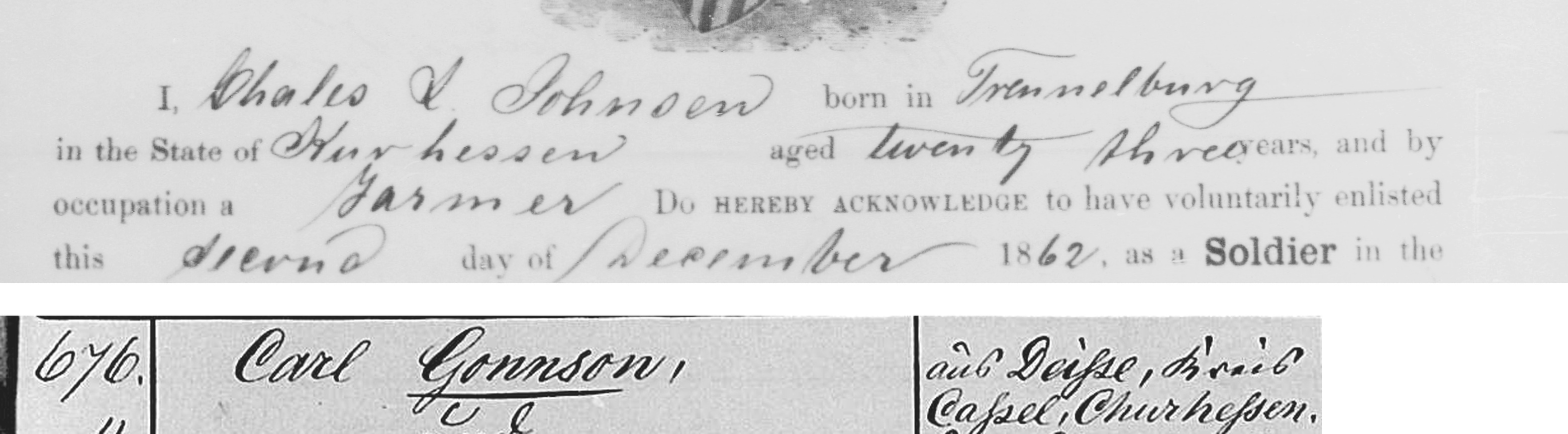
On 2 December 1862, at St. Louis, Charles Gannsen joined the Union army for three years. On his Volunteer Enlistment he swore that he was “born in Trennelburg in the State of Kurhessen,” and he signed his name in the German script.1
In this chapter
- A valley on the Diemel
- Baptized in the 1830s
- The same few families
- Sundays under Pastor Stieglitz
- School
- The hungry spring of 1847
- Whitsun 1849
- The punishment Bavarians
- No land, no leave to marry
- Twenty-one
- The place and the man
- Notes
- About the pictures
- More of the chapter, as printed until 11 November 2026
- Supplements
Three years later, on 7 January 1866, a St. Louis pastor recorded the same man’s marriage in his church register. The entry names him as “Carl Gonnson, aus Deiße, Kreis Caßel, Churheßen” (Carl Gonnson, from Deisel, district of Kassel, Electorate of Hesse).2
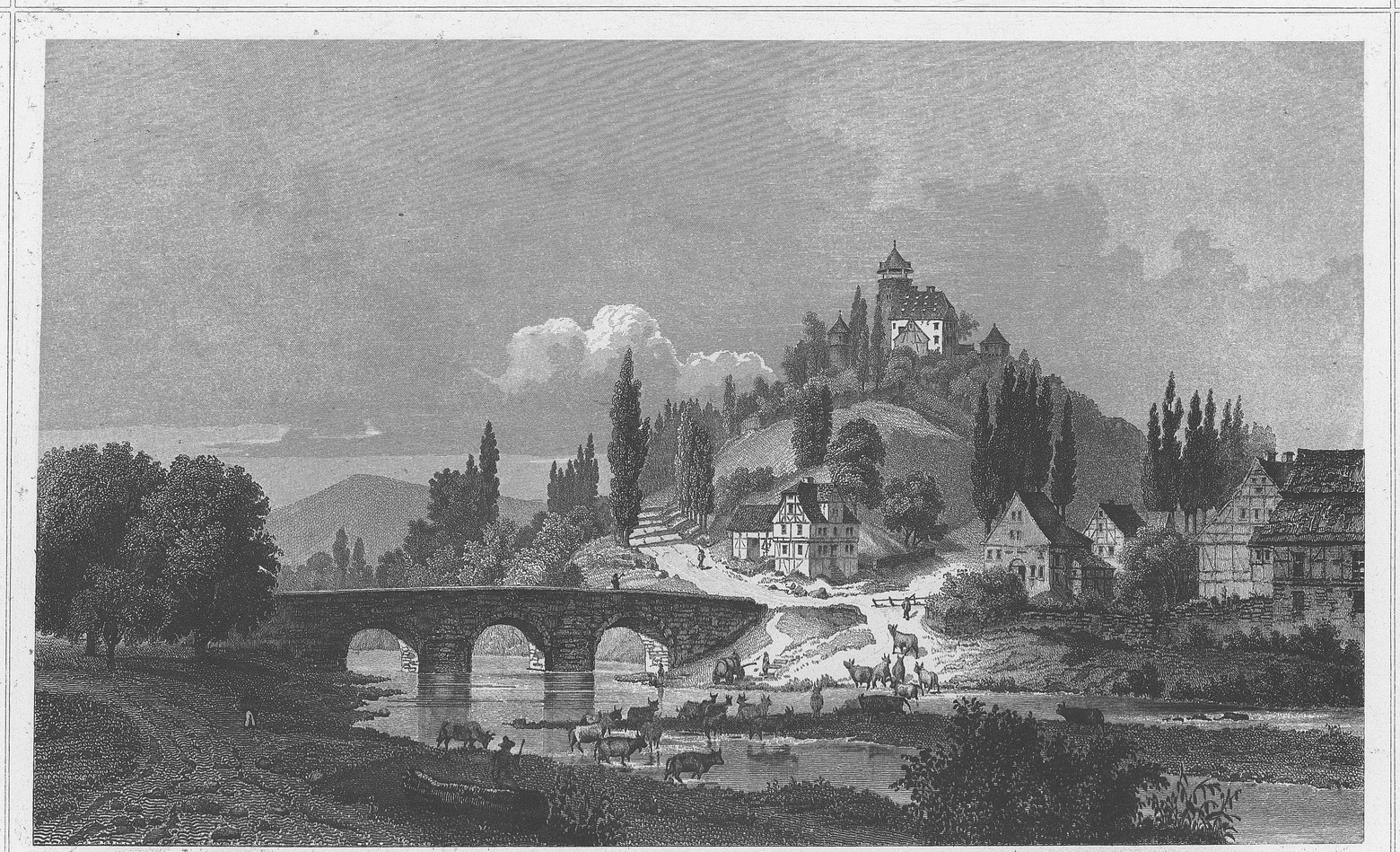
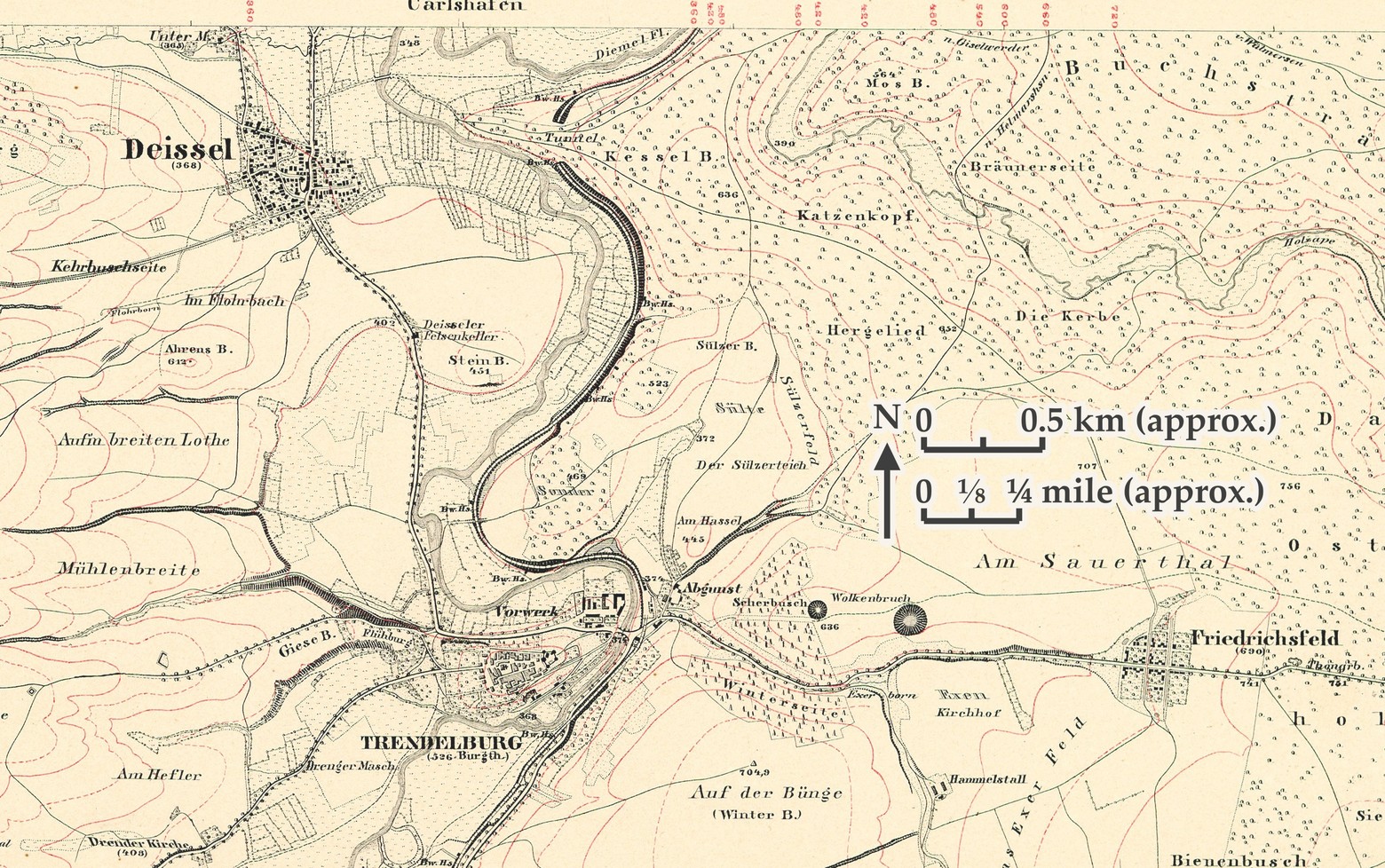
This book reads “Trennelburg” as Trendelburg, a small town in the north of the Electorate of Hesse. It stands on a hilltop in a wide bend of the Diemel river, under a castle built about 1300, beside a ford on the old road from Kassel to Bremen.5
The book reads “Deiße” as Deisel, a village about a mile and a half (2.3 km) north-northwest of Trendelburg.7 Deisel was probably Charles’s last home, and possibly his birthplace as well. The entries can also be read as “born in Trendelburg, living in Deisel.”8 No baptism in either parish, or in the parishes around them, can yet be shown to be his, so he was possibly born in either place.9 His birth date is uncertain too. The 1900 census gives his birth as November 1836. The 1903 register of his burial gives it as 26 January 1835. Most of the ages he gave point to years from about 1833 to 1841.10
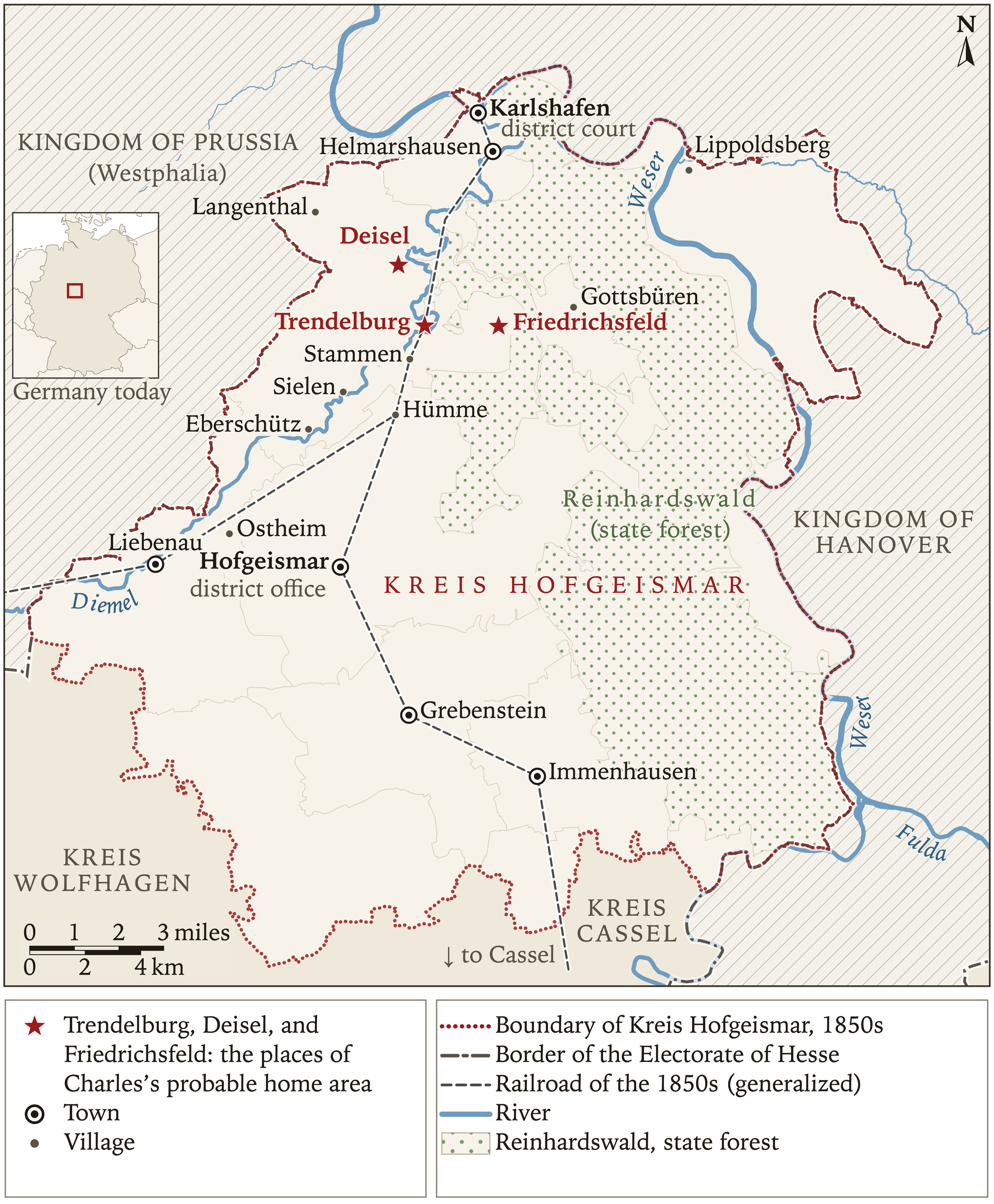
Who he was in Germany, and in which family, is the question of Part Four. The two records point to the Electorate’s district of Kreis Hofgeismar, where the town of Trendelburg, the village of Deisel and the colony of Friedrichsfeld lay a few miles apart. All three are now part of the town of Trendelburg.11 In America his surname was written Gannsen and Gansen, close to the German name Gans, and later also Konsen and Konzen, close to Konze.12 Families of both names lived in these parishes, but no record yet shows that either one was his family.13
Nothing is known of Charles’s own childhood. The childhood of his neighbors is on record. The pastors and mayors of these parishes, and the newspapers of the time, recorded the village that a boy born there in the 1830s grew up in, before he was old enough for the army. Two people of Deisel later wrote about the village in their own words. This chapter follows those neighbors. Their records show the home Charles left and the pressures on a young man of his age there.
A valley on the Diemel
In 1842, when Charles was a child, the state archivist Georg Landau called Deisel “the most beautiful and prosperous village of the Diemel valley.” It then had 150 houses and 1,230 people, and it grew a great deal of flax.14 The village lies on the left bank of the Diemel, on the old north–south highway. Its houses and farmyards stood clustered together, not spread out over the fields.15 Its lands were mostly plowed fields, still in the old scattered strips, with little meadow and almost no woodland of its own.16
Uplands rise to the west of the village. To the east the Reinhardswald, a large state forest, fills the land between the Diemel and the Weser.17 The forest was pasture as well as timber, and the villagers around it drove their cattle up into it every summer.18 A village like Deisel depended on its commons and on this forest pasture for grazing.19
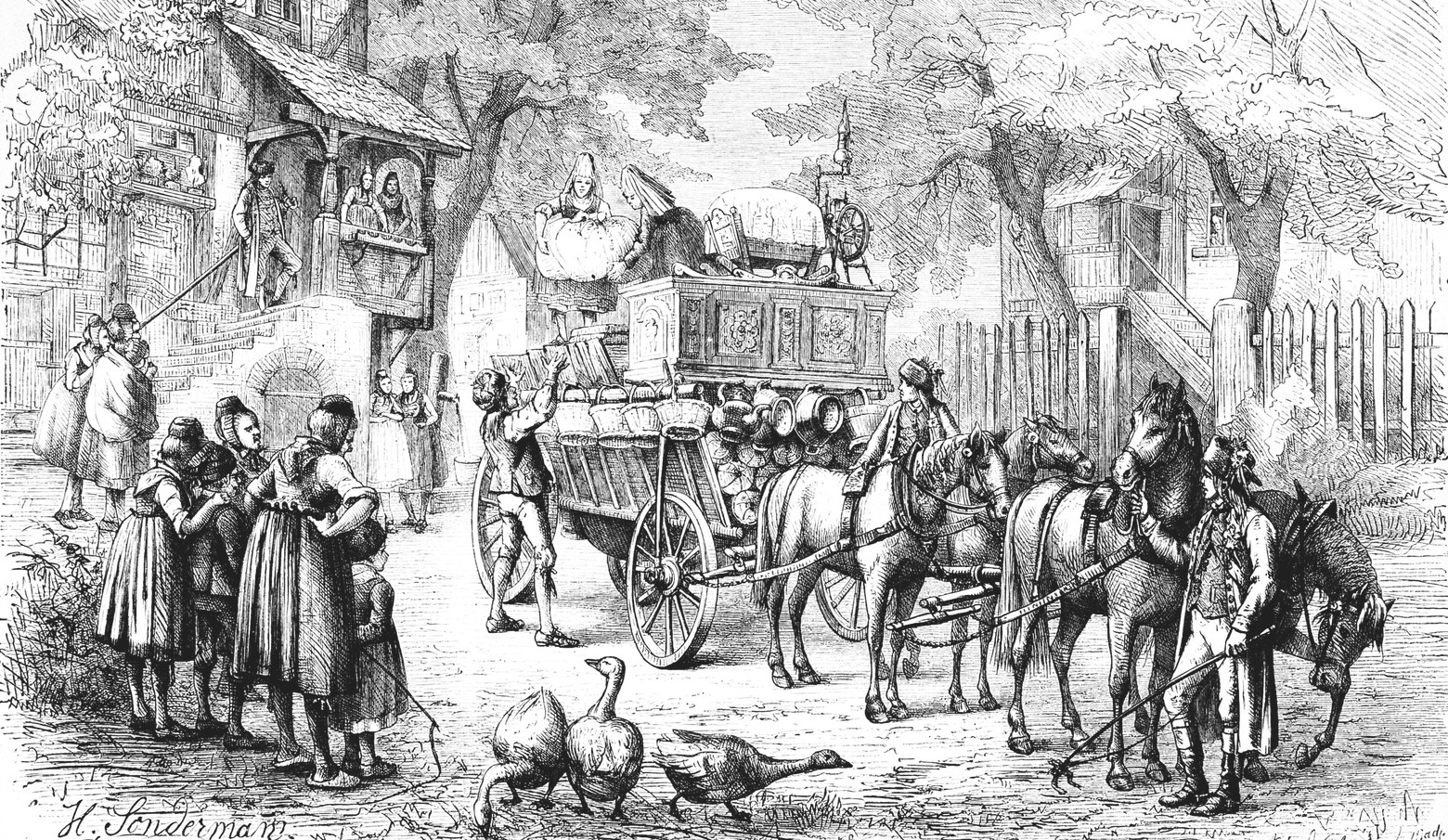
Deisel was growing crowded. By 1846 nearly twice as many people lived on much the same land as in 1787.20 Linen was one of the village’s largest sources of work, and more than half of those who worked at it were women.21 One quarter of the village was called the Gänsewinkel, the goose corner.
One child of Deisel wrote down what she saw there. Mary A. Niemeyer was born at Deisel in 1845 and left with her family for America in 1854. She went blind at twelve and later wrote her life story, Light in Darkness (1878).22 Mary remembered the winter evenings. When the cold came, the young men and women gathered in one another’s houses and brought their spinning wheels, for flax was one of the main products of that part of Germany. They passed the evenings in talk and song over the whirring wheels, and children of nine or ten could spin as well as some grown people. (p. 27)23 Her memories are of the late 1840s and early 1850s, the years of Charles’s youth.
The Diemel rises in the Sauerland and flows northeast. On its last miles to the Weser at Karlshafen it runs through a narrow valley past Trendelburg.24 Karlshafen, at the mouth of the Diemel, was the river port and the court town of the lower valley.25 In 1848 a railway came up the valley from Karlshafen. It had a station at Trendelburg and a tunnel near Deisel, but no station at Deisel itself. Depending on his year of birth, Charles was a boy of about seven to fifteen when the trains began to run.26
Trendelburg, the town, had always been small. It had belonged to Hesse since the fifteenth century.27 In 1842 Landau counted 138 houses and 890 people in the town, with two outlying estate farms. Farming there was hard, because the town stood high on its hilltop and was short of water.28 The state domain, a farm of 336 hectares (about 830 acres), lay beside the town.29 Some fathers in the Trendelburg baptism register for 1833–41 gave their trade as Tagelöhner, day laborer.30
Friedrichsfeld, the third place, lies on a rise at the western edge of the Reinhardswald, between Trendelburg and Gottsbüren. Landgrave Friedrich II of Hesse-Kassel laid it out in 1775 and gave it his name. It was a colony for ten families of Lutheran settlers from Mensfelden near Limburg.31 The colony’s own register gives Trendelburg as the place of each baptism in the 1830s, and many of its boys and girls were confirmed at Trendelburg.32 A man born at Friedrichsfeld could therefore say, truthfully, that he had been baptized at Trendelburg. For that reason this book counts Friedrichsfeld, with Trendelburg and Deisel, as a possible birthplace for Charles.33
Baptized in the 1830s
On 21 January 1835 a son was born to a Köster day laborer at Deisel. The Deisel register records him without a forename, as “Männl: Köster,” a male child Köster. The column for the church baptism is ruled through, and the remark beside it reads “Frühgetauft am 23/1 35.” The boy had been baptized at home in an emergency, and he died that morning, two days old.35
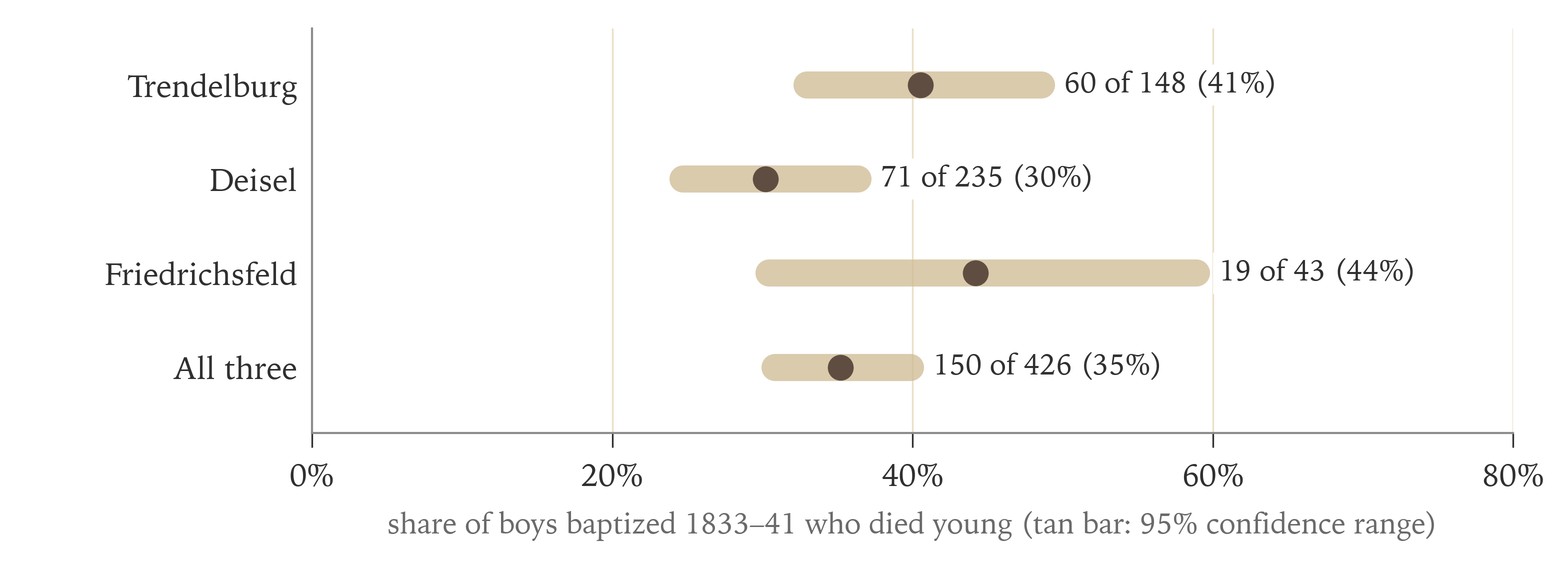
Many children did not live to be confirmed. About one boy in three born at Trendelburg, Deisel and Friedrichsfeld in 1833–41 is recorded as stillborn, unbaptized or dead in childhood.36 A family of the 1830s with six children could expect to bury two of them.37 Each boy who died young is one fewer who could have grown up to be Charles.
Most boys baptized in the three parishes in 1833–41 received two or more forenames, and Carl or Karl was the third most common of them.39 Combinations such as Carl Ludwig, Carl Wilhelm, and Heinrich Wilhelm recur often. A boy was usually known by one of his names, not always the first. A boy recorded as Johann Carl Wilhelm could be known all his life as Carl, or as Wilhelm. So a man who called himself Charles in America could have had Carl as his first forename, or as his second or third. Many of Charles’s army papers give him a second initial L.40 His own signature on the enlistment paper begins “Karll,” and two readers disagree on the initial after it (see the chapter “The Name He Signed”).41
Not every child was born to married parents, and the name a child of an unmarried mother carried could change. Births out of wedlock were about as common in the three parishes as in the rest of Niederhessen.42 Under Kurhessian law such a boy was entered under his mother’s surname only.43 In daily life he could still carry his mother’s surname, his father’s or a stepfather’s, and he could move from one to another during his life. The registers show no single rule.44 Charles possibly carried such a changed name. If so, the German name he Americanized need not be the one in his baptism.
The same few families
Johannes Köster was born at Deisel on 11 July 1815, the son of Johannes Köster, innkeeper, and Marie Fremder. His family could be traced there to before the Thirty Years’ War.45 He trained as a schoolmaster, and from 1844 he sang in the chorus of the Elector’s theater at Kassel. In 1858 he left for America. More than twenty of his letters and notes home to his wife and children at Kassel survive, and this book follows him through them.46 They are the only words from America of any man of Deisel in these years that are known to survive. Köster was an educated man of the capital, not a young farm worker. After he left he still had land at Deisel, and he still sent greetings to its families. In April 1859, from Missouri, he wrote to his wife:47
On the land at Deißel you can have corn [grain] sown once more this autumn, but you must tell Teme, so that he arranges it accordingly. If you go to Deißel, give my warmest greetings to brother-in-law Teme, Deppe, Göbel, Meinbresse and Godfather Köster, all with their families, but especially to my mother, to Sophie, and to Ludwig too, ill though he has acted by me; were he here with his children he could live very well.48
Temme, Deppe, Göbel, and Meimbresse are Deisel names, and the Meimbresses appear among the Deisel emigrants of 1857–61.49 In the fall of 1861 Köster’s wife came back from a visit with “the basketful of greetings from Deisel.” For Christmas he wrote each sender a letter of his own, and he sent those letters with his next letter home. In April 1862 he wrote that “the whole of Deißel is a marmots’ nest,” probably meaning as silent as marmots asleep in winter.50
The same few families filled the registers, and for generations they married one another. These names fill the Deisel registers of the years when Charles was a child. Köster’s own surname appears repeatedly in the Deisel confirmation classes of 1847 to 1849. The Köster fathers were farmers, a smith, a shoemaker, an innkeeper and a day laborer. Hofedietz (also written Hofeditz), Thiele, Schildknecht, Meimbresse, Bonhagen, Kloppmann, Koch, and Niemeyer recur almost as often.51 A child’s mother was often born into another of these families. A Köster boy had a mother born Schildknecht, a Hofedietz boy a mother born Köster, and a Meimbresse boy a mother born Konze.52 Families often married across the parish lines too. A boy’s godparents, his mother’s family or his future wife could come from any of the parishes around.53 Godparents were usually relatives or neighbors and, when a family could manage it, people of standing.54
Konze is one of these names. Its families were townsmen of Trendelburg and, through the nineteenth century, farmers at Deisel. Trendelburg’s own officers came from its townsmen’s families. In the eighteenth century, for example, men of the Konze family (then written Kontze) sat on the Trendelburg town council.55 In 1847 a Grosbernd boy of Trendelburg had a mother born Jungkonze, and an Enders boy a mother born Konze. Jungkonze (“young Konze”) was a form of the name used by some of the family.56 One Konze household, that of Andreas Konze, lived at Friedrichsfeld as colonists. He had married a Friedrichsfeld colonist’s daughter in 1821.57
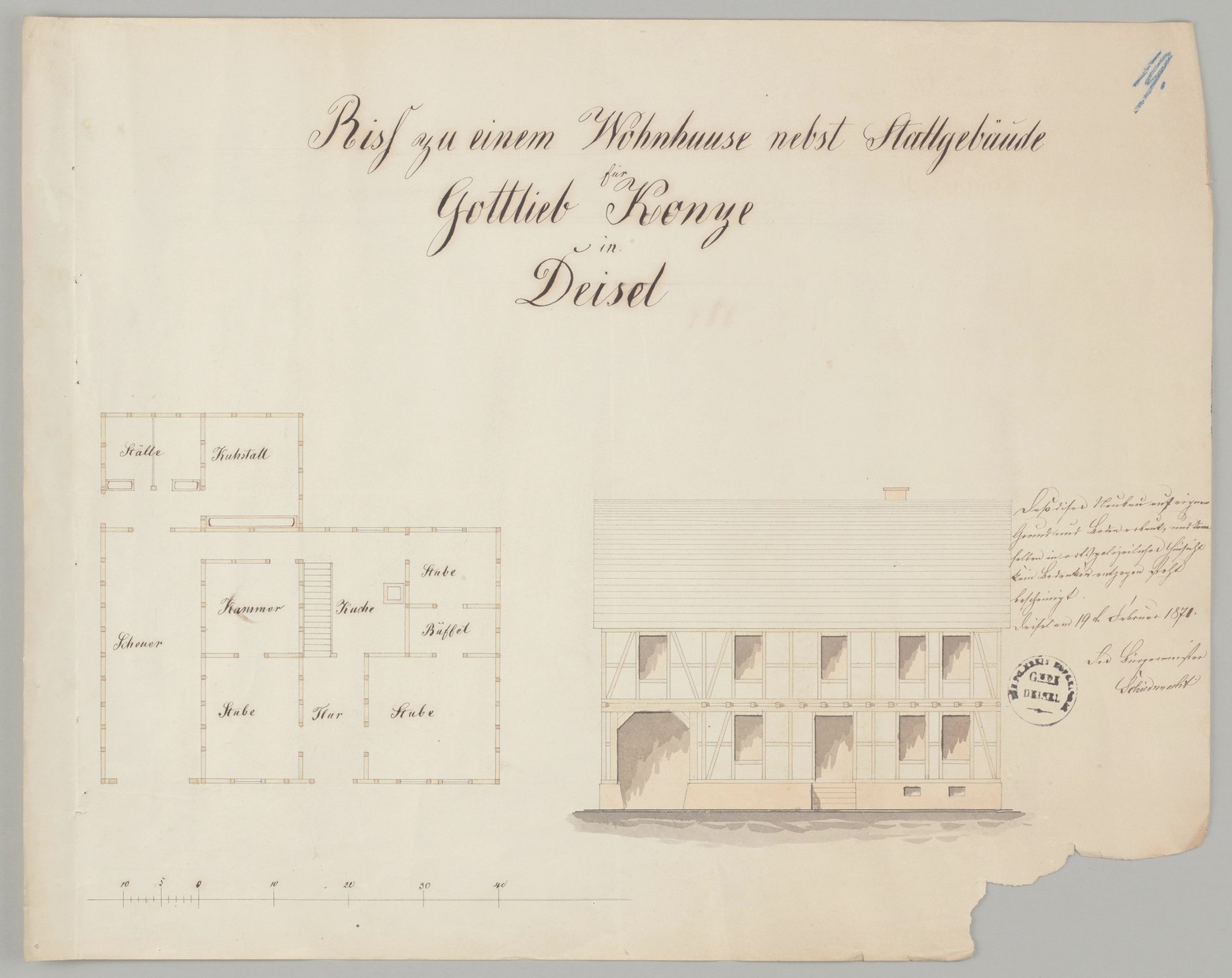
A younger Konze also remained at Deisel and built a new house there. In 1871 Gottlieb Konze, the Deisel innkeeper of that name born in 1842, had a house and stable drawn up for a building permit (figure 1.4).58
Gans was rare here. One Christian Gans family lived at Deisel from 1829 until about 1834. The father was a day laborer from Lippoldsberg. Their son Johann Ernst Dietrich was born at Deisel in 1833. He married and died in Germany, so he cannot be Charles.59 The chapter “The Name He Used: Gans, Konze or Another Name” sets out what the parish books show about the Konze and Gans families.60 Charles, for his part, was a Protestant in every record of his life that names a church.61
Sundays under Pastor Stieglitz
Mary Niemeyer began her life story with her village and its church:62
The Reformed is the prevailing religious belief. There is but one Church in the place; this is very large and built in Gothic style. It is noted for its chime of bells, well known to the villagers, and loved by them for their sweetly falling cadences or swelling notes, pealing forth on the Sabbath morning air, calling them to worship within the sacred temple. (p. 10)63
The church behind those bells was strict in Charles’s boyhood. Georg Ernst Stieglitz, pastor from 1832 to 1849, brought more cases of misconduct before the church council than any other pastor of the parish between 1781 and 1914. The historian Martina Lüdicke found this in the council’s records.64 Stieglitz fought hardest for a quiet Sunday. In 1833 he called the village together “under the linden,” the court linden by the old churchyard, to stop the bleaching of linen on Sundays.65
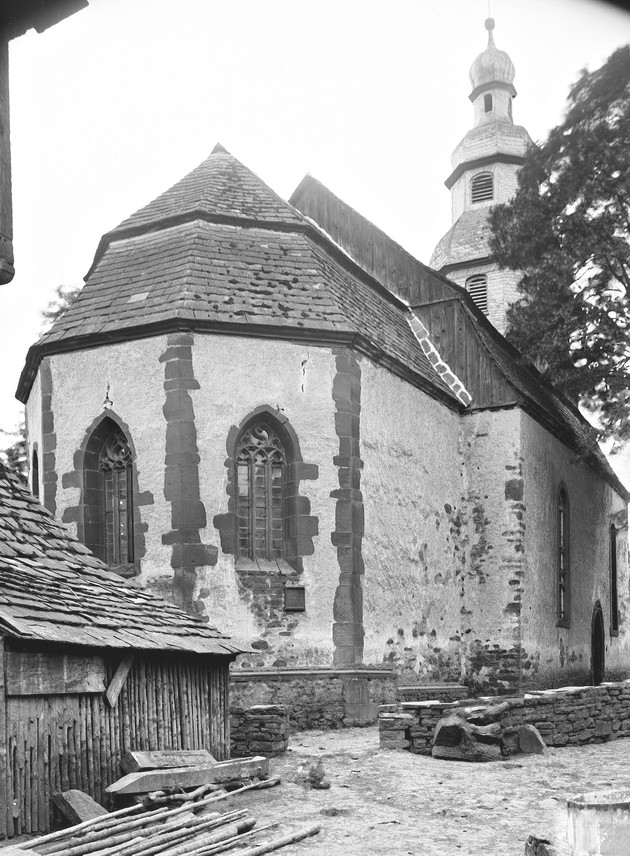
The law was on his side. An 1801 Hessian ordinance forbade work in house and field on Sundays, and public buying and selling. During the hours of service no one was to walk about the streets without need or sit in front of a house door. No one was to sit in an inn until the afternoon service was over.67
On Sunday, 19 August 1838, a sore throat kept Stieglitz from preaching. So he walked through the village himself during the service, to see whether the Sunday rules were kept. He found, as the minutes put it, “a mass of contraventions.” While the cantor stood at the altar, four farmers and Heinrich Drönner’s farmhand came home from the pasture with their horses. Christoph Knapp sat in the lower inn, and when told to go home he answered, “We have business here.” Heinrich Gräbe’s wife crossed the street with a bottle, “pretending” to fetch vinegar. Christoph Weifenbach swept his front door and the ground before it. Konrad Weller went for a walk. Andreas Heere sat with another man outside the door of Meier, a Jew of the village. Both left when the pastor spoke to them, but he soon found Heere back in the street, smoking tobacco. And “the Jews were selling.”68
Each of these people broke the Sunday order: by work, by trade, by idling in the street or at a door, or by sitting in an inn while the service went on. Lüdicke calls these everyday habits; what was new was a pastor who held the parish to a stricter Sunday than before.69 These were the Sundays that boys of Charles’s age grew up with.
The village resisted. When Stieglitz preached against brandy in 1842, much of the parish threatened to stay away from church. On New Year’s Day 1843, he reported, the mayor and a following of seventeen men went instead to a nearby town church, “where the idol was not fought.” The innkeepers said openly that the pastor ought simply to be thrashed.70 That April the pastor asked the mayor, who also sat on the church council, what the village authorities had done to promote temperance, as the government required. The mayor answered with one word: “Nichts,” nothing.71
School
In Charles’s boyhood the village school, as Mary Niemeyer described it, led straight on to confirmation:
There is also a large and well-arranged school house in the village. The school is divided into two departments: first, the primary, where the children remain three years, and are instructed in the rudiments of education. Then follows a higher department, where the full course is five years. … Their graduation, however, renders incumbent upon them early confirmation to the Reformed Church, catechetical instruction having been part of their education. (p. 12)72
Her first teacher, Mr. Uffelman, began every school day with music:
School opened daily with the singing of a morning hymn by the children, and the reading by the teacher of a portion of Scripture; after these exercises, a prayer was repeated in concert by the school. … Our first lesson was in vocal music. A full hour was devoted to this study every day. The teacher accompanied either with violin or some other instrument. (p. 44)73
Every child in Hesse-Kassel was bound to attend school from about the age of seven to fourteen. In practice a village child attended from about six until confirmation. Children attended in winter and left school in summer for work in the fields.74 The district office kept a file on the Deisel school. It runs from 1837 to 1853, the very years in which a Deisel boy born in the 1830s would have been at school. Its title reads, in translation, “Moral laxity of the school children; school absences at Deisel, and measures to stop them” (Sittenlosigkeit der Schuljugend; Schulversäumnisse zu Deisel, auch Maßregeln zu deren Abstellung).75
Charles’s own papers show a literate man schooled in German. In December 1862 he signed both of the enlistment papers that called for his signature, in Kurrent, the old German script. A German paleographer who has compiled village family books for Gottsbüren and the places around it examined the signatures. He read the signature as the handwriting of a man who had learned to write at school. He judged it shaky but correct, the hand of a schooled man who did not write often.76
The hungry spring of 1847
The last great food crisis of pre-industrial Germany came in 1846 and 1847, when Charles, if born about 1835, was about eleven. Poor harvests and the potato blight, which had spread since 1844, made food scarce. Prices rose, and in the spring of 1847 food riots spread across Germany.77 Kurhessen was a land of farms, with little industry outside Kassel and Hanau, and its people grew in number faster than its work. Historians call the result pauperism, a lasting mass poverty that did not lift with a good harvest. In Kurhessen it ended only in the 1850s.78
At Deisel the hunger reached the animals. In May 1847 the mayor wrote to the district office at Hofgeismar that the horses and cattle were so weak from hunger that the fields could not be worked at seed time. Many milk cows gave no milk for want of fodder, and the poorer families had depended on a single cow. “I hardly know any more,” he wrote, “what I am to do with my needy people.”79 The village had known bad years before. In October 1840 the pastor had urged the mayor to cancel the village fair, because hail had destroyed “a great part of our harvest.”80
Registered departures from Deisel rose to about twenty in 1846 and 1847 together.81 Each departure made the next one easier.82
Linen weaving lasted in the village when Charles was a boy, but it was failing. A man married at Deisel in 1849 gave his station as “Einwohner und Leinweber,” resident and linen weaver.83 Weavers appear among the fathers of every confirmation class from 1847 to 1849, even as the guild trade in the towns nearby collapsed.84 Machines and cheap cotton were driving linen out.85
Whitsun 1849
At Whitsun 1849 the pastor confirmed twenty-two boys at Deisel.86 He recorded them in his confirmation book one by one, each with his date of birth and the names and station of his parents. The fathers were farmers, linen weavers, joiners, a miller, a brewer, a shoemaker, a herdsman, a night watchman, and an innkeeper. The boys were all born within about a year of one another, and most were fourteen. One entry, for Friedrich Schrage, names only his mother, Elisabeth Schrage, probably because he was born out of wedlock.87 The pastor added his own count of the class.88 No record describes the service itself.
Confirmation admitted the young person to communion. It came at about fourteen, the age at which compulsory schooling ended, and in these parishes the classes of the 1840s were confirmed at Whitsun (Pfingsten), the seventh Sunday after Easter.89 Not every child was confirmed with his class. Some were confirmed late, aged sixteen or seventeen, and some privately. At Deisel in 1850 Friedrich Hillebrand was “privatim confirmirt, weil die Eltern nach Amerika auswandern wollten,” confirmed privately because his parents wanted to emigrate to America.90
Because each entry gives a date of birth, the confirmation books are one place to look for Charles. A Deisel boy born about 1835 would have been confirmed in the class of Whitsun 1849. A Trendelburg boy born in January 1835 would normally have been confirmed in the Trendelburg class of the same Whitsun. One boy of that class, born in December 1834, is still untraced. His later life has not yet been followed far enough to rule him out as Charles.91 No other class of the surrounding parishes holds a Carl born on 26 January.92
The punishment Bavarians
On 1 November 1850, when Charles, if born about 1835, was a boy of about fifteen, an Austrian and Bavarian corps marched into Kurhessen to restore the Elector’s authority.93 In Kurhessen these troops were known as the Strafbayern, the “punishment Bavarians.”94 They came because the Elector and his parliament had quarreled over money and power. When the parliament refused a new tax, the government ordered it collected by decree and declared martial law.95 The Elector won, and in 1852 the 1831 constitution was set aside.96
The quarrel had run through all of Charles’s boyhood. Friedrich Wilhelm governed Kurhessen in those years, first for his father and from November 1847 as Elector himself, Friedrich Wilhelm I.97 Ludwig Hassenpflug was his chief minister in two periods, 1832–37 and 1850–55. In Kurhessen Hassenpflug’s name stood for government against the constitution.98
The conflict was not fought out in Trendelburg or Deisel, some twenty miles (about 30 km) north of Kassel. Köster’s family remembered that he spoke slightingly of the Elector and was stirred by the revolution of 1848, and they gave the cause of his emigration as “political pressure.”99 A report from Kassel in the emigrant newspaper Allgemeine Auswanderungs-Zeitung said in November 1858 that “the Federal Execution of 1850 and the Hassenpflug period” had greatly increased emigration from the country. The “Execution” was the occupation of 1850 by the troops of the German Confederation.100 The figures agree with the report. Emigration from Kurhessen fell in the troubled years 1849 and 1850 and rose sharply after the Elector’s new constitution of 1852.101
Charles grew up in the years that report blamed for the rise in emigration, and he left a few years after them. The politics of the Hassenpflug era were therefore possibly part of why he went. No record of his own gives his reason.
No land, no leave to marry
A young man with no land and no place in a trade had little chance of marrying at home. Village society was ranked by land. The registers give a man’s station by rank: Ackermann, a farmer who worked his own holding; Einwohner, a resident listed with no farm or trade; and Tagelöhner.102 Kreis Hofgeismar had more day laborers than any other Kreis of Niederhessen, and it paid them the lowest day wage in the province.103
A man’s right of settlement, his Heimatrecht, tied him to one community, which had to support him if he became poor. Disputes over it fill a series of district files.104 In Kurhessen an 1834 law gave each community the right to choose its own members. In the 1830s and 1840s many German states let towns use such powers against newcomers and the poor.105 These limits were possibly part of why so many of Charles’s generation left.106
The village also decided who could marry. Martina Lüdicke’s study of the church records shows the rules. Kurhessen’s 1834 community ordinance gave the village itself the say over marriage, and a man who wanted to marry needed a certificate that he could support a family. Journeyman weavers, tailors, shoemakers and joiners could not marry until they became masters. A man liable for military service could not be given leave to marry before he was twenty-five. From 1850 to the mid-1860s, a writer of 1871 recalled, the villages had “the freest scope” to refuse the certificate to men who lived by the work of their hands alone. Many young men did not wait for leave to marry. Between 1850 and 1858, Lüdicke found, at least forty young men of Deisel aged up to thirty-two emigrated.107
Deisel shrank in these years. Its people numbered 1,302 in 1852 and 1,139 in 1858, and only twelve children were born there in 1856.108 In 1856 the village mayor, also named Köster, gave these reasons for the fall: emigration, people hiring themselves out elsewhere, and how few had married.109
Lüdicke’s study of the village finds the poverty in individual households. The linen weaver Helwig Carl told the presbytery in 1854 that he had no clothes to wear to church. His property was put up for auction from February 1856, and in 1857 he left for America with his children. The master tailor Friedrich Wilhelm Leimbach sold his small plot and half a house in 1857, with money that relatives already in America had advanced. In 1862 two weavers and day laborers petitioned for about thirty Deisel families who were in the greatest need.110 This was Deisel in the years around the time Charles left.
In July 1862 Johannes Köster wrote to Frau Casselman, a friend of the family. He told her that the hard struggle to make a living at home had cast him onto the shore of America. He called that struggle “those thieves of human blood,” probably meaning that it drained the life out of a man.111 In his thoughts, he wrote, he was “the eternal wanderer,” forever roaming the German lands.112
The later lives of the boys confirmed at Deisel at Whitsun 1849 show the choices open to Charles’s generation. Of the twenty-one whose baptisms are identified, seven are known to have left Kurhessen, four of them in the 1850s.113 One of them married in Virginia, and another settled near Bremen. Twelve stayed and married or died at home. Two are untraced, neither of them a Carl.114 Three boys of the Trendelburg class of 1849, a butcher, a merchant’s clerk and a locksmith, were released for North America in 1853 and 1854. The record is the state’s emigration index, drawn from its files of releases, the permits to emigrate.115
Twenty-one
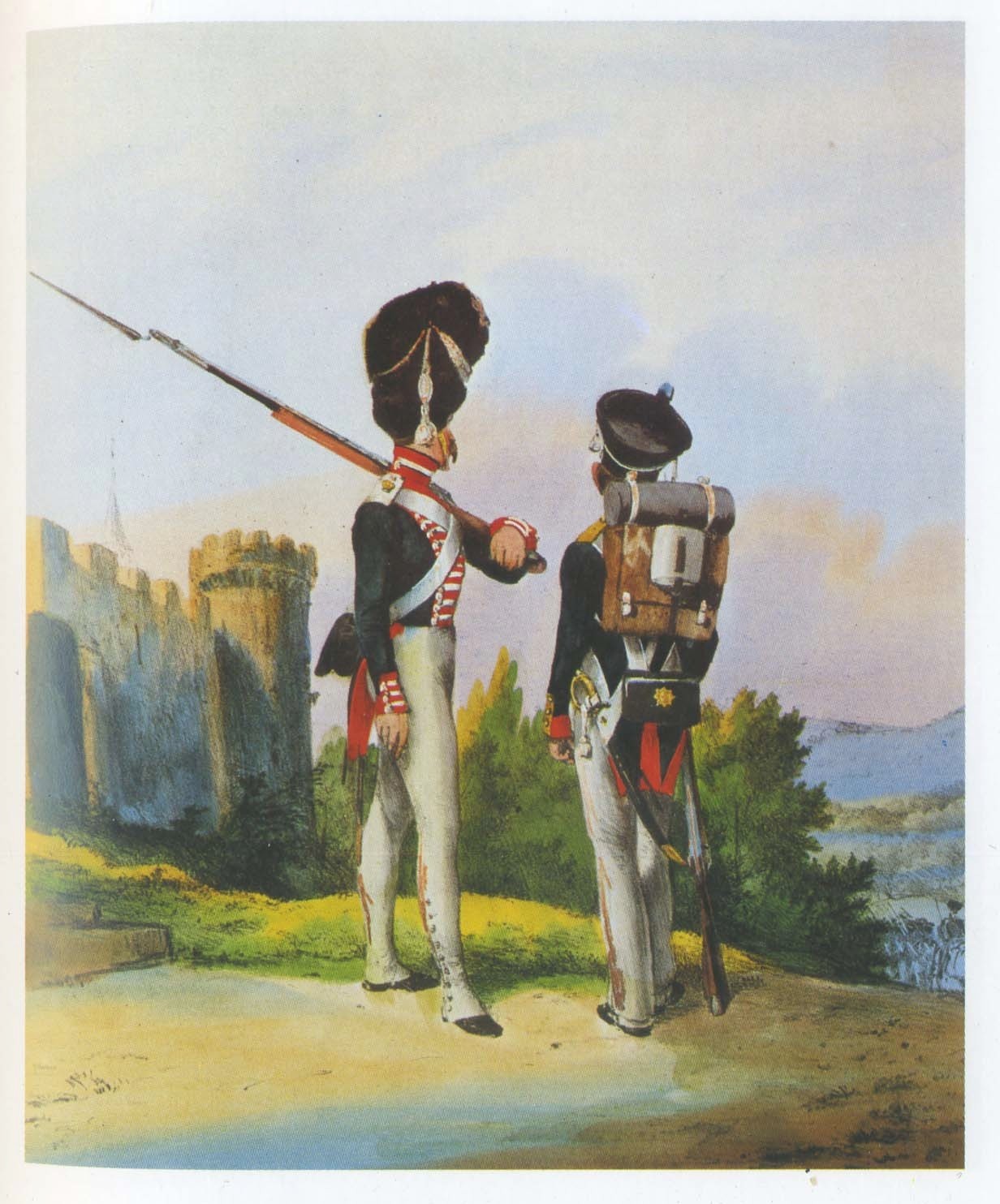
Kurhessen kept a standing army, and every man was liable to serve.116 The lot decided who was taken. Men from twenty (from 1848, twenty-one) to thirty could be called up.117 A family could buy a substitute, but only the well-off could afford it.118 The conscription lists were drawn up locally from the church books. A boy born about 1835 would have been liable from about 1856.119
Whether Charles was drawn, served or left before his year came is not known. No list of individual conscripts for Kreis Hofgeismar in these years survives at the state archive in Marburg: the district office’s recruitment files hold only directives and circulars.120 Soldiers and old soldiers appear throughout the registers of the 1830s. The Deisel register records a boy of 1840 as the son of “the soldier Philipp Niemeyer.”121
The government knew that young men were leaving to avoid service, and the provincial weeklies printed their names.122 Most men on such lists, the historian Kurt Günther found in these files, had simply left on a passport before their year came. True flight from service across the Atlantic was rare.123 Lüdicke found one Deisel man whose file names the reason outright: Philipp Feuring, who left without a release in 1861, was fleeing military service.124 The reports of 1858 and 1859 quoted here and later come from a later and tenser time.125
The place and the man
On 6 February 1858 the officials at Hofgeismar, in Charles’s own district, summoned fifteen men who had missed that year’s muster. The notice was printed that month in the weeklies for the provinces of Niederhessen and Fulda.127 Twelve of them had still not come by the summer, and the criminal court at Kassel then declared them absconded.128
By the late 1850s the boys of the class of 1849 were men of military age, and some of them had already gone.129 Charles went too. Two of his Deisel neighbors described the road out of the valley: Mary Niemeyer, a girl of nine, and Johannes Köster, a schoolmaster.
Notes
129 notes
- Declaration of Recruit and Volunteer Enlistment, St. Louis, 2 Dec 1862. — Proven. The Electorate of Hesse, in German Kurfürstentum Hessen, was usually shortened to Kurhessen; his marriage entry has the older spelling “Churhessen.” Prussia annexed the Electorate on 20 September 1866, and Trendelburg and Deisel became part of the Prussian province of Hesse-Nassau. St. Marcus Evangelical Church (St. Louis, Missouri), marriage register 1866, p. 135, entry 676/4, image 381; Meyers Großes Konversations-Lexikon, 6th ed., vol. 9 (Leipzig, 1907), “Hessen-Kassel,” pp. 274–278; , http://
www (context; accessed 4 November 2026); Deutsches Historisches Museum, LeMO, “Die preußischen Annexionen 1866” (the Elector’s mobilization of 16 June against the estates’ wishes; Kassel occupied 19 June; the Elector held at Stettin); https://.zeno .org/ nid/ 20006769284 www (accessed 6 November 2026); Universitätsarchiv Marburg, “150 Jahre preußische Universität Marburg (1866/67–2016/17),” p. 1 (Prussian ultimatum of 15 Jun 1866; invasion from Wetzlar 16 June; Kassel occupied 19 June; annexation law 20 September), https://.dhm .de/ lemo/ kapitel/ reaktionszeit/ deutscher -bund -und -nationale -frage/ die -preussischen -annexionen -1866 www : accessed 7 November 2026; LAGIS, Historisches Ortslexikon, “Deisel, Kassel” (ID 2054, https://.uni-marburg .de/ de/ uniarchiv/ inhalte-pdf/ preussen1 .pdf lagis : accessed 8 November 2026), read July and October 2026, quoting for 1749 Dorfleben. Ein Blick in die Geschichte von Deisel [Village life: a look into the history of Deisel] (2005), p. 74; Meyers Großes Konversations-Lexikon, 6th ed., vol. 9 (Leipzig, 1907), “Hessen-Nassau,” pp. 278–279 (province formed in 1867 and 1868); , http://.hessen .de/ de/ orte/ historisches -ortslexikon/ alle-eintraege/ 2054 www (accessed 8 November 2026). [ENL62] [MAR66] [MEYHK] [LEMO66] [UMR66] [LAGISD] [MEYHN].zeno .org/ Meyers-1905/ A/ Hessen-Nassau - St. Marcus Evangelical Church (St. Louis, Missouri), marriage register 1866, p. 135, entry 676/4, image 381. The whole entry is transcribed in Chapter 7. A Kreis was a district, much like an American county. [MAR66]
- Declaration of Recruit and Volunteer Enlistment, St. Louis, 2 Dec 1862. [ENL62]
- St. Marcus Evangelical Church (St. Louis, Missouri), marriage register 1866, p. 135, entry 676/4, image 381. [MAR66]
- LAGIS, Historisches Ortslexikon, “Trendelburg, Kassel”, read 10 Oct 2026. [LAGIST]
- The view shows the stone bridge over the river, the town on its hill and the castle above it, as it looked in the years Charles was growing up. From Rohbock’s series of steel engravings of German towns.
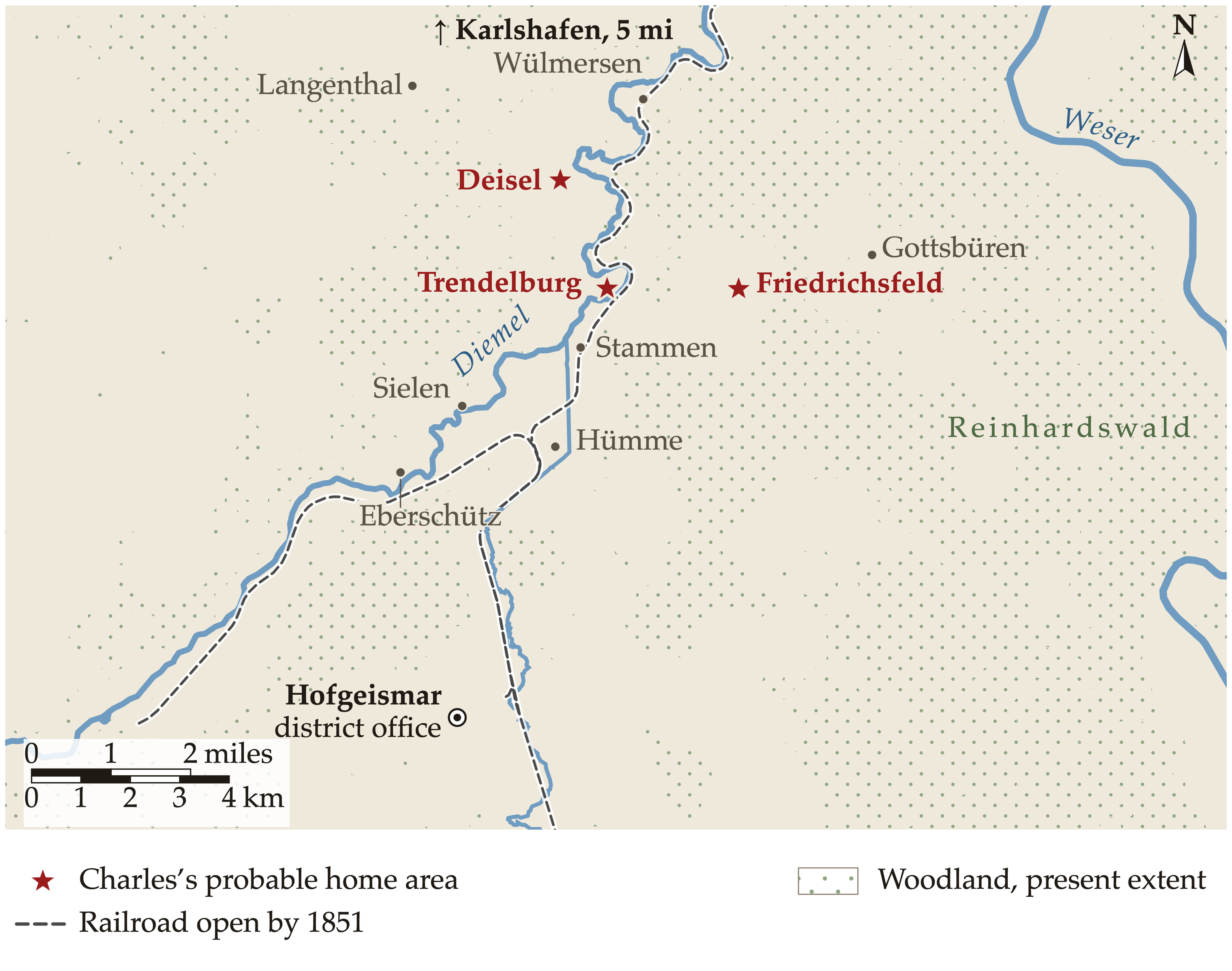
- In Charles’s time the village’s name was often written Deissel or Deißel. The Electorate’s 1857 survey map has “Deissel” (map 1.3), and in 1865 the pastor of Wölfterode, a village of Kreis Rotenburg, Kurhessen (now part of the town of Sontra), entered the marriage of Karl Konze, a Deisel-born schoolteacher, “geb. zu Deissel,” born at Deissel. The card the War Department copied from the battery’s descriptive book gives the town as “Freundburg,” a clerk’s garbled spelling; see the chapter “Enlistment.” The June 1880 census gives his birthplace only as “Prussia,” which Kurhessen had become in 1866. Kurfürstenthum Hessen, Niveau-Karte auf 112 Blättern, sheet 4; Evangelische Kirchengemeinde Wölfterode (Kirchenkreis Rotenburg), p. 17, no. 48; Regimental Descriptive Book card, “L. Charles Gannsen,” Pvt., roll 762; 1880 U.S. census, first enumeration (5 June 1880), St. Louis, SD 1, ED 40, p. 14, dwelling 77, family 135, “Ganser, Charles,” 36, lines 45–50, https://
www . [NIV1857] [K1865] [RDB62] [C1880J].familysearch .org/ ark:/ 61903/ 1:1:M6FN-LKZ - St. Marcus Evangelical Church (St. Louis, Missouri), marriage register 1866, p. 135, entry 676/4, image 381; Working positions of the research, October 2026. [MAR66] [DEC]
- Baptism registers of Trendelburg (Archion register 220108, images 1395–1478), Deisel (218842, images 22–100) and Friedrichsfeld (218959), every boy born 1833–1841, with the later remarks in the margin. Each boy is traced forward through the confirmations of Trendelburg (Archion register 220102) and Deisel (218836), the marriages, the burials (Archion registers 218851 and 220114), the civil registers (HStAM Best. 909 and 910) and LAGIS Hessische Auswanderer, retrieved 10 Oct 2026; imaged, Archion (https://
www : accessed 8 October 2026) > Hessen > Landeskirchliches Archiv der Evangelischen Kirche von Kurhessen-Waldeck > Kirchenkreis Hofgeismar, by the register numbers given; citing Landeskirchliches Archiv der Evangelischen Kirche von Kurhessen-Waldeck, Kassel. [REGAPP].archion .de - 1900 U.S. census, City of St. Louis, Missouri, population schedule, Ward 9, ED 129, sheet 5-B (penned); St. Marcus Evangelical Church (St. Louis, Missouri), burial register, pp. 240–241, no. 3393, image 943; Comparison of the eleven American records that state Charles’s age or birth date. [C1900] [BUR03] [BD]
- The northernmost Kreis of the Electorate of Hesse, Kreis Hofgeismar was formed in 1821 in the province of Niederhessen, with Hofgeismar as the district town; after 1866 it was a Kreis of the Prussian Regierungsbezirk (administrative region) Kassel, until it was merged into the Landkreis Kassel in 1972. The villages marked on map 1.1 are those named in this book; Trendelburg, Deisel, and Friedrichsfeld are the places of Charles’s probable home area. The Kreis boundary is that of the 1850s, drawn along the present cadastral districts (Gemarkungen) of the places that belonged to the Kreis then. It takes in Hohenkirchen, part of the Kreis until 1970, and Wilhelmshausen, part of it until 1866, and leaves out Ochsenhof on the Weser, which belonged to Hanover until 1890. Forest land given to Knickhagen and Rothwesten in 1928 is not drawn. The older Amt (district office) Trendelburg, to which Deisel belonged until 1821, and the district of the Justizamt (district court) at Karlshafen, under which Deisel came for justice from 1822 and Trendelburg from 1823, are not drawn. The border of the Electorate follows the present boundary of Hesse, which here follows the old border with Hanover and Prussian Westphalia, except at Ochsenhof. Railroads are generalized; rivers are shown in their present courses. Trendelburg and Deisel lay in Kreis Hofgeismar, the northernmost district of Niederhessen, the northern province of Kurhessen. In 1848–51 they came under the Bezirk (region) of Kassel. The St. Louis pastor who recorded “Kreis Caßel” in Charles’s marriage entry used “Cassel” for other places outside that district too; see the chapter “Where and When He Was Born.” The Kingdom of Hanover lay across the Weser to the east and northeast. The Prussian province of Westphalia lay to the west and north, across the lower Diemel and the Weser. The district town, Hofgeismar, stood about seven miles (11 km) south-southwest of Deisel. Two offices in two towns served the villages. From 1821 the district office at Hofgeismar, the Landratsamt, handled the state’s business. That business included the releases of emigrants. A release was the state’s formal permission to leave the country. If Charles asked leave to go, his application went to this office. The local court was the Justizamt (district court office) at Karlshafen, now Bad Karlshafen. It kept the guardianships and property cases of Deisel from 1822 and of Trendelburg from 1823. That is why parish entries of the period place people of these villages in the “Amt Carlshafen,” the Karlshafen district, although they lived in Kreis Hofgeismar. Pierer’s Universal-Lexikon, 4th ed., vol. 8 (Altenburg, 1859), pp. 323–328; LAGIS, Historisches Ortslexikon, “Deisel, Kassel” (ID 2054, https://
lagis : accessed 8 November 2026), read July and October 2026, quoting for 1749 Dorfleben. Ein Blick in die Geschichte von Deisel [Village life: a look into the history of Deisel] (2005), p. 74; LAGIS, Historisches Ortslexikon, “Trendelburg, Kassel”, read 10 Oct 2026; Landesgeschichtliches Informationssystem Hessen (LAGIS), Hessische Auswanderer, Nr. 128, 155 and 843, Nr. 3237–3239. [PIERER] [LAGISD] [LAGISD] [LAGIST] [LAGIS59].hessen .de/ de/ orte/ historisches -ortslexikon/ alle-eintraege/ 2054 - The surname record: twenty-eight attestations of Charles’s surname in fourteen spellings. [SURN]
- Baptism registers of Trendelburg (Archion register 220108, images 1395–1478), Deisel (218842, images 22–100) and Friedrichsfeld (218959), every boy born 1833–1841, with the later remarks in the margin; Working positions of the research, October 2026. [REGAPP] [DEC]
- Georg Landau, Beschreibung des Kurfürstenthums Hessen (Kassel: Theodor Fischer, 1842). The village is first named in the ninth century. It counted 152 households in 1747 and 1,118 inhabitants in 1885, more than the town. LAGIS, Historisches Ortslexikon, “Deisel, Kassel” (ID 2054, https://
lagis : accessed 8 November 2026), read July and October 2026, quoting for 1749 Dorfleben. Ein Blick in die Geschichte von Deisel [Village life: a look into the history of Deisel] (2005), p. 74. [LANDAU42] [LAGISD].hessen .de/ de/ orte/ historisches -ortslexikon/ alle-eintraege/ 2054 - LAGIS, Historisches Ortslexikon, “Deisel, Kassel” (ID 2054, https://
lagis : accessed 8 November 2026), read July and October 2026, quoting for 1749 Dorfleben. Ein Blick in die Geschichte von Deisel [Village life: a look into the history of Deisel] (2005), p. 74. [LAGISD].hessen .de/ de/ orte/ historisches -ortslexikon/ alle-eintraege/ 2054 - LAGIS, Historisches Ortslexikon, “Deisel, Kassel” (ID 2054, https://
lagis : accessed 8 November 2026), read July and October 2026, quoting for 1749 Dorfleben. Ein Blick in die Geschichte von Deisel [Village life: a look into the history of Deisel] (2005), p. 74. A church survey of 1835 noted that Deisel lay on the made road to Bremen. The parish, with its daughter church at Langenthal, then had about 1,660 Protestants, with about fifty-one baptisms and thirty-seven confirmations a year. Deisel was its own parish, with its own registers from 1633, in the church district of Trendelburg. Such a district was called a Klasse: a group of neighboring parishes overseen by one senior pastor, the Metropolitan, who visited and reported on their churches and schools. At Deisel Georg Ernst Stieglitz baptized and confirmed the children of the 1830s and 1840s. Carl Wilhelm Saul, “zeitiger Pfarrer und Metropolitan,” was Trendelburg’s own pastor until 1837, and Carl Heinrich Wilhelm Rohde from 1838. In the late 1850s, when Charles possibly left, Thomas Cornelius was pastor of Deisel. Kurhessen’s Protestants were not one uniform church: most were Reformed (Calvinist), but there were more than 158,000 Lutherans, among them the colonists of Friedrichsfeld. Wilhelm Bach, Kirchenstatistik der evangelischen Kirche im Kurfürstenthum Hessen: Aus amtlichen Quellen bearbeitet [Church statistics of the Protestant church in the Electorate of Hesse, from official sources] (Cassel: published by the author, 1835), § 129, p. 211 (Friedrichsfeld, built 1778 for settlers from the Trier territory, 19 houses, 168 Protestants, “meist Luther.”), § 130, p. 212 (the Lutheran congregation of Carlshafen drew for communion and confirmation “besonders der größere Theil der kleinen Gemeinde Friedrichsfeld,” in “immer mehr abnehmende” numbers), § 131, p. 214 (Deisel “an der Bremer Kunststraße”; with Langenthal 1,664 Protestants, a year’s births 51, confirmations 37); Internet Archive, 10448307bsb (Bayerische Staatsbibliothek copy), https://.hessen .de/ de/ orte/ historisches -ortslexikon/ alle-eintraege/ 2054 archive (accessed 4 November 2026); Evangelische Kirchengemeinde Deisel (Deisel, Kreis Hofgeismar, Kurhessen), “Kirchenbuch 1633–1736” [Church book 1633–1736] (Archion register 218818), images 954–1171, the oldest Deisel church book on Archion; LAGIS, Historisches Ortslexikon, “Deisel, Kassel” (ID 2054, https://.org/ details/ 10448307bsb lagis : accessed 8 November 2026), read July and October 2026, quoting for 1749 Dorfleben. Ein Blick in die Geschichte von Deisel [Village life: a look into the history of Deisel] (2005), p. 74; Evangelische Kirchengemeinde Deisel (Deisel, Kreis Hofgeismar, Kurhessen), “Taufen 1830–1861” [Baptisms 1830–1861] (Archion register 218842), images 22–101; Kurhessisches Staats- und Adreß-Handbuch [Kurhessian state and address handbook] (to 1833) and Kurfürstlich Hessisches Hof- und Staatshandbuch [Electoral Hessian court and state handbook] (from 1836), Cassel: Waisenhaus, section “Kirchliche Behörden,” “10) Klasse Trendelburg,” editions of 1830, 1833, 1836–1838, 1841–1845, 1847, 1850, 1851, 1853, 1855, 1857, 1858, 1861, 1862 and 1864–1866 (Bayerische Staatsbibliothek copies, digitized by Google; Internet Archive and ). Read in the scanned text; for Deisel, 1833 edition, p. 299 (Internet Archive, bub_gb_tQFTAAAAcAAJ, https://.hessen .de/ de/ orte/ historisches -ortslexikon/ alle-eintraege/ 2054 archive ), and 1847 edition, p. 258 (bub_gb_N_pSAAAAcAAJ, https://.org/ details/ bub_gb_tQFTAAAAcAAJ/ page/ 299 archive ), both read in the page image, accessed 11 November 2026; Ev. Kirchengemeinde Trendelburg, Taufen 1830–1863 (Archion register 220108), images 1385; Pierer’s Universal-Lexikon, 4th ed., vol. 8 (Altenburg, 1859), pp. 323–328; LAGIS, Historisches Ortslexikon, “Friedrichsfeld, Kassel” (ID 2059, https://.org/ details/ bub_gb_N_pSAAAAcAAJ/ page/ 258 lagis : accessed 8 November 2026), read 10 Oct 2026 (founded 1775 for ten Lutheran families from Mensfelden near Limburg; served first by the Lutheran pastor of Karlshafen, later by the Trendelburg pastors). [LAGISD] [BACH35] [DKB1633] [LAGISD] [DBAP] [KHSH] [TBAP] [KHSH] [PIERER] [LAGISF].hessen .de/ de/ orte/ historisches -ortslexikon/ alle-eintraege/ 2059 - LAGIS, Historisches Ortslexikon, “Deisel, Kassel” (ID 2054, https://
lagis : accessed 8 November 2026), read July and October 2026, quoting for 1749 Dorfleben. Ein Blick in die Geschichte von Deisel [Village life: a look into the history of Deisel] (2005), p. 74. [LAGISD].hessen .de/ de/ orte/ historisches -ortslexikon/ alle-eintraege/ 2054 - K. Aßhauer and M. Bunzenthal, “Die Hute im Reinhardswald,” Deutsches Historisches Museum, Gäste-Archiv, 2002 (https://
www : accessed 9 November 2026). The Reinhardswald was a Hutewald, a forest used as pasture, under grazing rules first fixed in 1748. From May to the end of August the larger animals went up into the forest. [HUTE].dhm .de/ archiv/ gaeste/ koerber/ 2002/ hute/ einleitung .htm - K. Aßhauer and M. Bunzenthal, “Die Hute im Reinhardswald,” Deutsches Historisches Museum. [HUTE]
- Johann Christian Martin, ed., Topographisch-statistische Nachrichten von Niederhessen, vol. 1 (Göttingen: Grießbach, 1789), 214–15, Amt Trendelburg, Deisel: 150 houses; the count of 1787 (145 men, 169 women, 208 sons, 194 daughters, 1 journeyman, 22 maids, 2 apprentices, 19 farmhands; with 3 Jewish families, 760 people); occupations; flax and yarn sold into the Paderborn territory (the author’s translation); imaged, Bayerische Staatsbibliothek, Münchener DigitalisierungsZentrum, bsb10020743, images 234–235 (https://
mdz-nbn-resolving : accessed 5 November 2026); page numbers read on the page images; Martina Lüdicke, „Verschwunden ist der Strand…“ Studien zur Auswanderung nach Amerika aus Kurhessen in den Jahren 1831–1866, dargestellt am Beispiel des Dorfes Deisel (Kreis Hofgeismar) (Hofgeismar: Verein für hessische Geschichte und Landeskunde, Zweigverein Hofgeismar, 1994), notes and list of sources, pp. 69–75: HStAM 180 Hofgeismar Nr. 665 (division of closed holdings and succession, 1824–1887), 1998 (poor relief at Deisel, 1856–1914), 2011 (grazing and commons at Deisel, 1823–1927); parish archive of Deisel (hail relief for Deisel and Langenthal, 1854–1862; confirmation and dispensations from the age of confirmation, 1850–1866; parish chronicle by Pastor Bansmann, 1899–1900); note 3, citing Fenner 1934 (Helmarshausen weavers) and Burmeister 1986 (Grebenstein weavers’ guild); Mayer-Edenhauser, Untersuchungen über Anerbenrecht und Güterschluß in Kurhessen (1942); p. 25 (Deisel’s population rose from 631 in 1773 to 1,420 in 1846) and table 3, p. 78 (760 in 1789; 1,420 in 1846). Read in full in a copy borrowed through interlibrary loan, 5 Nov 2026; pp. 25 and 78 rechecked in the page photographs, 11 Nov 2026. A count of 1787 had found 760 people in the same 150 houses. Three Jewish families were among them. There were 65 farmers, 8 linen weavers, 8 tailors and a few other tradesmen, and all of them, the writer said, made a good living. Much of the flax was spun into yarn in the village and sold into the neighboring Paderborn country. By 1846 Deisel had 1,420 people. Johann Christian Martin, ed., Topographisch-statistische Nachrichten von Niederhessen; Martina Lüdicke, „Verschwunden ist der Strand…“ Studien zur Auswanderung nach Amerika aus Kurhessen in den Jahren 1831–1866, dargestellt am Beispiel des Dorfes Deisel (Kreis Hofgeismar) (Hofgeismar: Verein für hessische Geschichte und Landeskunde, Zweigverein Hofgeismar, 1994), notes and list of sources, pp. 69–75: HStAM 180 Hofgeismar Nr. 665 (division of closed holdings and succession, 1824–1887), 1998 (poor relief at Deisel, 1856–1914), 2011 (grazing and commons at Deisel, 1823–1927); parish archive of Deisel (hail relief for Deisel and Langenthal, 1854–1862; confirmation and dispensations from the age of confirmation, 1850–1866; parish chronicle by Pastor Bansmann, 1899–1900); note 3, citing Fenner 1934 (Helmarshausen weavers) and Burmeister 1986 (Grebenstein weavers’ guild); Mayer-Edenhauser, Untersuchungen über Anerbenrecht und Güterschluß in Kurhessen (1942); p. 25 (Deisel’s population rose from 631 in 1773 to 1,420 in 1846) and table 3, p. 78 (760 in 1789; 1,420 in 1846). Read in full in a copy borrowed through interlibrary loan, 5 Nov 2026; pp. 25 and 78 rechecked in the page photographs, 11 Nov 2026. [MARTIN89] [LUED] [MARTIN89] [LUED].de/ urn: nbn: de: bvb: 12 -bsb 10020743 -2 - LAGIS, Historisches Ortslexikon, “Deisel, Kassel” (ID 2054, https://
lagis : accessed 8 November 2026), read July and October 2026, quoting for 1749 Dorfleben. Ein Blick in die Geschichte von Deisel [Village life: a look into the history of Deisel] (2005), p. 74. A 1749 count of Deisel’s occupations lists 65 men who lived from farming alone, 12 linen weavers, 8 tailors, 5 smiths, 5 day laborers, 5 Jewish traders and a few other craftsmen, and “15 single women who support themselves solely by spinning.” [LAGISD].hessen .de/ de/ orte/ historisches -ortslexikon/ alle-eintraege/ 2054 - Mary A. Niemeyer, Light in Darkness, pp. 10, 12, 27, 44, pp. 90 and 125. [NIEMLID]
- Mary A. Niemeyer, Light in Darkness, pp. 10, 12, 27, 44. [NIEMLID]
- LAGIS, Historisches Ortslexikon, “Deisel, Kassel” (ID 2054, https://
lagis : accessed 8 November 2026), read July and October 2026, quoting for 1749 Dorfleben. Ein Blick in die Geschichte von Deisel [Village life: a look into the history of Deisel] (2005), p. 74. [LAGISD].hessen .de/ de/ orte/ historisches -ortslexikon/ alle-eintraege/ 2054 - LAGIS, Historisches Ortslexikon, “Bad Karlshafen, Kassel”, read 10 Oct 2026. Karlshafen was founded in 1699 by Landgrave Karl of Hesse-Kassel for French Protestant refugees. [LAGISK]
- LAGIS, Historisches Ortslexikon, “Trendelburg, Kassel”, read 10 Oct 2026; Deutsche Märchenstraße, “Historic Carlsbahntunnel,” https://
www , accessed 29 October 2026 (tunnel of 202 m near Deisel, a listed monument); Allgemeine Auswanderungs-Zeitung, 16 Apr 1858, p. 4, p. 68. [LAGIST] [TUNNEL] [AAZ58F].deutsche -maerchenstrasse .com/ en/ start/ poi/ historic-carlsbahntunnel - LAGIS, Historisches Ortslexikon, “Trendelburg, Kassel”, read 10 Oct 2026. It had 130 households in 1747 and 772 people in 1885, the first full count the state gazetteer gives. That put it near the bottom of the scale for a German “home town,” which the historian Mack Walker sets at about 750 people. Below that lay the farm village, which had no guilds and no town citizenship. Deisel was such a village (Walker, page 30). LAGIS, Historisches Ortslexikon, “Trendelburg, Kassel”, read 10 Oct 2026; Mack Walker, German Home Towns: Community, State, and General Estate, 1648–1871 (Ithaca, N.Y.: Cornell University Press, 1971), 30, 137, 140, 310–11, 335 and 339–40; reissued 2014, EBSCO eBook Collection, through Utah Valley University Library, page images checked 2 Nov 2026. [LAGIST] [LAGIST] [WALKER71]
- Georg Landau, Beschreibung des Kurfürstenthums Hessen (Kassel: Theodor Fischer, 1842). [LANDAU42]
- LAGIS, Historisches Ortslexikon, “Trendelburg, Kassel”, read 10 Oct 2026. In the early modern period it was the largest domain estate in Hesse-Kassel, as the state was called before it became the Electorate in 1803. From 1736 the town also held four fairs a year, the market for livestock, cloth, and wares that did not come to the door. LAGIS, Historisches Ortslexikon, “Trendelburg, Kassel”, read 10 Oct 2026. [LAGIST] [LAGIST]
- Ev. Kirchengemeinde Trendelburg, Taufen 1830–1863 (Archion register 220108), images 1385. Day laborers appear, for example, in the entries of 1833, no. 78; 1834, no. 95; and 1841, no. 330. Among the other fathers of boys baptized in 1833–41 are townsmen who farmed their own land (Ackerbürger), smiths, tailors, linen weavers, shepherds, a surgeon and the innkeeper of the town inn (images 1395–1478). In the 1830s most Trendelburg families still lived by farming, on their own land or someone else’s, and a smaller number lived by a craft. The Trendelburg confirmation register also gives the names and station of the parents, and it includes the children of Friedrichsfeld, the town’s colony, who were confirmed at Trendelburg. In the classes of 1847 to 1849 the fathers were farmers, day laborers and village craftsmen, with a few officials. The fathers’ trades, class by class, are given on the research website. Most of the old town burned in 1868. Its parish church of St. Mary is a late-Gothic hall church with a tower of 1462. Ev. Kirchengemeinde Trendelburg, Taufen 1830–1863 (Archion register 220108), images 1385; Evangelische Kirchengemeinde Trendelburg (Trendelburg, Kreis Hofgeismar, Kurhessen), “Konfirmationen 1831–1914” [Confirmations 1831–1914] (Archion register 220102), classes of Whitsun 1847 (images 2265–2267), Whitsun 1848 (images 2267–2269) and Whitsun 1849 (image 2270–2272), each closed by the pastor’s count of sons and daughters; classes of 1850–1856 (images 2273–2289) for the surnames and the Uffelmann fathers (Johann Christoph Uffelmann, Schneidermeister; Johann David Uffelmann, “Bürger und Bürgermeister” 1848, Küfermeister 1852–1856); class of 1846, image 2263, p. 70, no. 4 (Carl Wilhelm Konze); imaged, Archion (https://
www : accessed 2 August 2026) > Hessen > Landeskirchliches Archiv der Evangelischen Kirche von Kurhessen-Waldeck > Kirchenkreis Hofgeismar > Trendelburg > Konfirmationen 1831-1914; citing Landeskirchliches Archiv der Evangelischen Kirche von Kurhessen-Waldeck, Kassel. [TBAP] [TBAP] [TCONF].archion .de/ de/ viewer/ churchRegister/ 220102 - Rudolf Schmidmann, “Die Kolonien der Réfugiés in Hessen-Kassel und ihre wirtschaftliche Entwicklung im 17. und 18. Jahrhundert” [The colonies of the refugees in Hesse-Kassel and their economic development in the 17th and 18th centuries], Zeitschrift des Vereins für hessische Geschichte und Landeskunde 57 (1929): 115–224, at 130 (Sieburg, later Karlshafen, and Kelze among the refugee colonies of 1699) and 183–84 (of Friedrich II’s colonies of 1775 only Friedrichsdorf near Hofgeismar was French; the others had “keine Leute von französischer Herkunft”); PDF, Verein für hessische Geschichte und Landeskunde, http://
www (accessed 4 November 2026). The state’s rulers took the title of Elector only in 1803. Mensfelden was shared between the Electorate of Trier and Nassau. Friedrichsfeld was not a Huguenot colony, though French Protestant refugees had settled nearby, at Karlshafen and at Kelze. Of the colonies Friedrich II laid out, only Friedrichsdorf near Hofgeismar, founded in 1775, was French. At first Friedrichsfeld belonged to the town of Trendelburg. It became a village in its own right before 1825. The colonists held allotments called portions. In 1837 the Trendelburg confirmation register records one of them, Andreas Konze, as “Colonie-Portionist zu Friedrichsfeld,” a colonist holding a portion at Friedrichsfeld. At Whitsun 1842 the same register lists him as missing (“verschollen”). Twelve years later the colony’s register of deaths recorded his death at Mainz on 6 October 1854; he was then a factory worker. None of his children was a surviving son born in 1833–41. Rudolf Schmidmann, “Die Kolonien der Réfugiés in Hessen-Kassel und ihre wirtschaftliche Entwicklung im 17. und 18. Jahrhundert” [The colonies of the refugees in Hesse-Kassel and their economic development in the 17th and 18th centuries], Zeitschrift des Vereins für hessische Geschichte und Landeskunde 57 (1929): 115–224, at 130 (Sieburg, later Karlshafen, and Kelze among the refugee colonies of 1699) and 183–84 (of Friedrich II’s colonies of 1775 only Friedrichsdorf near Hofgeismar was French; the others had “keine Leute von französischer Herkunft”); PDF, Verein für hessische Geschichte und Landeskunde, http://.vhghessen .de/ inhalt/ zhg/ ZHG_57/ Schmidmann_Kolonien .pdf www (accessed 4 November 2026); LAGIS, Historisches Ortslexikon, “Friedrichsfeld, Kassel”, read 10 Oct 2026; Ev. Kirchengemeinde Trendelburg, “Konfirmationen 1831–1914” [Confirmations 1831–1914], image 2244, no. 21, image 2255, no. 15, image 2257, p. 58, no. 9, https://.vhghessen .de/ inhalt/ zhg/ ZHG_57/ Schmidmann_Kolonien .pdf www ; Evangelische Kirchengemeinde Friedrichsfeld (Friedrichsfeld, Kreis Hofgeismar, Kurhessen), “Kirchenbuch 1830–2011” [Church book 1830–2011] (Archion register 218959): baptisms pp. 1–34 (images 1326–1359, 1830–1842; brick-burners images 1327–1328, master shoemaker image 1335, master harness-maker [Riemermeister] image 1351, charcoal-burner image 1354 and 1359, shepherd’s three crosses image 1343), including entries 48 (1835), 81 (1839) and 108 (1843); Todtenbuch pp. 1–92, entries 1–371 (1830–1898), including entries 75, 81, 84, 116, 133, 139, 143, 205–206, 222, 228, 237, 263, 271, 275 and 301; marriage register image 1530, Nro 36 (21 Nov 1858); imaged, Archion (https://.archion .de/ de/ viewer/ churchRegister/ 218959 www : accessed 11 April 2026) > Hessen > Landeskirchliches Archiv der Evangelischen Kirche von Kurhessen-Waldeck > Kirchenkreis Hofgeismar > Friedrichsfeld > Kirchenbuch 1830-2011; citing Landeskirchliches Archiv der Evangelischen Kirche von Kurhessen-Waldeck, Kassel. [SCHMIDMANN29] [SCHMIDMANN29] [LAGISF] [ANDREAS] [ANDREAS] [FKB].archion .de/ de/ viewer/ churchRegister/ 218959 - Evangelische Kirchengemeinde Friedrichsfeld (Friedrichsfeld, Kreis Hofgeismar, Kurhessen), “Kirchenbuch 1830–2011” [Church book 1830–2011] (Archion register 218959): baptisms pp. 1–34 (images 1326–1359, 1830–1842; brick-burners images 1327–1328, master shoemaker image 1335, master harness-maker [Riemermeister] image 1351, charcoal-burner image 1354 and 1359, shepherd’s three crosses image 1343), including entries 48 (1835), 81 (1839) and 108 (1843); Todtenbuch pp. 1–92, entries 1–371 (1830–1898), including entries 75, 81, 84, 116, 133, 139, 143, 205–206, 222, 228, 237, 263, 271, 275 and 301; marriage register image 1530, Nro 36 (21 Nov 1858); imaged, Archion (https://
www : accessed 11 April 2026) > Hessen > Landeskirchliches Archiv der Evangelischen Kirche von Kurhessen-Waldeck > Kirchenkreis Hofgeismar > Friedrichsfeld > Kirchenbuch 1830-2011; citing Landeskirchliches Archiv der Evangelischen Kirche von Kurhessen-Waldeck, Kassel; Confirmation registers read entry by entry for every class 1845–1858, images 427–438. It kept no confirmation book of its own before 1880. Yet in 1835 most of its families, who were Lutherans, still went to the Lutheran church at Karlshafen for communion and confirmation, though fewer did so each year. Its register of deaths, 1830–98, also records the deaths of its people elsewhere, entered from notices sent to the pastor. So if a man is missing from it for many years, that is evidence that he left the parish, but not of where he went. Wilhelm Bach, Kirchenstatistik der evangelischen Kirche im Kurfürstenthum Hessen. [FKB] [CONF401] [BACH35] [FKB].archion .de/ de/ viewer/ churchRegister/ 218959 - Entry-by-entry reads 1830/33–41: Friedrichsfeld 218959, Hümme 219532, Stammen 220069. [PARISH2]
- Detail of sheet 4, “Trendelburg,” of the Electorate of Hesse’s 1857 survey map: Deisel (“Deissel”) at the upper left, Trendelburg with its castle at the bottom, and Friedrichsfeld at the right.
- Evangelische Kirchengemeinde Deisel (Deisel, Kreis Hofgeismar, Kurhessen), “Taufen 1830–1861” [Baptisms 1830–1861] (Archion register 218842), images 22–101. [DBAP]
- Baptism registers of Trendelburg (Archion register 220108, images 1395–1478), Deisel (218842, images 22–100) and Friedrichsfeld (218959), every boy born 1833–1841, with the later remarks in the margin. The three parishes baptized 426 boys born from 1833 to 1841, and 150 of them are recorded as stillborn, unbaptized or dead in childhood. The figure of 150 is a minimum, since it counts only the deaths that a remark or a burial entry records. Trendelburg’s own year totals record thirty-seven baptisms in 1839, thirty-five in 1840 and twenty-six in 1841. The Deisel register’s running numbers rise from 100 in January 1833 to 543 at the end of 1841, about forty-nine baptisms a year. Every parish in Kurhessen kept a church book (Hildebrand, page 64). In these parishes the pastor entered a child within one to three weeks of birth. Each entry gives the dates of birth and baptism, the child’s forenames, the parents, the father’s station and place and the godparents, and it has a column for remarks. Over the years pastors added later events in that column: a death, a confirmation, a legitimation, or a marriage elsewhere. A blank margin does not show that a boy left. [REGAPP]
- Bruno Hildebrand, Statistische Mittheilungen über die volkswirthschaftlichen Zustände Kurhessens, p. 64; Baptism registers of Trendelburg (Archion register 220108, images 1395–1478), Deisel (218842, images 22–100) and Friedrichsfeld (218959), every boy born 1833–1841, with the later remarks in the margin; Ev. Kirchengemeinde Trendelburg, Taufen 1830–1863 (Archion register 220108), images 1385; Evangelische Kirchengemeinde Deisel (Deisel, Kreis Hofgeismar, Kurhessen), “Taufen 1830–1861” [Baptisms 1830–1861] (Archion register 218842), images 22–101. [HILDE53] [REGAPP] [TBAP] [DBAP]
- Baptism registers of Trendelburg (Archion register 220108, images 1395–1478), Deisel (218842, images 22–100) and Friedrichsfeld (218959), every boy born 1833–1841, with the later remarks in the margin. “Died young” means that a burial or a remark in the register records the boy’s death before the age of confirmation; the counts are a minimum. A confidence range made this way holds the true share nineteen times in twenty, given how few cases there are. [REGAPP]
- Baptism registers of Trendelburg (Archion register 220108, images 1395–1478), Deisel (218842, images 22–100) and Friedrichsfeld (218959), every boy born 1833–1841, with the later remarks in the margin. More than half of these boys received two or more forenames, and about one boy in five was given Carl or Karl among them. The count is of the 426 boys baptized in the three parishes in those years. Heinrich and Wilhelm each appear in more than a hundred of the boys’ names, Carl or Karl in 87, and Friedrich in about seventy. Ludwig, Johann, Philipp, Georg and August follow. [REGAPP]
- Declaration of Recruit and Volunteer Enlistment, St. Louis, 2 Dec 1862; Regimental Descriptive Book card, “L. Charles Gannsen,” Pvt., roll 762; Missouri Adjutant General, descriptive roll, 2nd Regiment Missouri Artillery, Battery B, Book 2., https://
www . [ENL62] [RDB62] [AGO2].familysearch .org/ ark:/ 61903/ 3:1:3QHV-J3DP-9QFC - A German paleographer and compiler of village family books, letters to the author by email; A fellow researcher, reading of the 1862 signature. [Paleographer's letters, 2026] [Fellow researcher's reading, 2026]
- Baptism registers of Trendelburg (Archion register 220108, images 1395–1478), Deisel (218842, images 22–100) and Friedrichsfeld (218959), every boy born 1833–1841, with the later remarks in the margin; Bruno Hildebrand, Statistische Mittheilungen über die volkswirthschaftlichen Zustände Kurhessens, p. 64. About one boy in nine born in the three parishes in 1833–41 was born out of wedlock. That was close to the rate for all of Niederhessen, where about one birth in ten in 1836–47 was illegitimate (Hildebrand, page 70). The figure for the three parishes counts boys only; Hildebrand’s counts all births. Marita Metz-Becker, “Die Kindsmörderin Anna Maria Steinbrecher aus Treysa: Ein Beitrag zur Sozialgeschichte unehelicher Schwangerschaft in der ersten Hälfte des 19. Jahrhunderts” [The child-murderer Anna Maria Steinbrecher of Treysa: on the social history of illegitimate pregnancy in the first half of the nineteenth century], Zeitschrift des Vereins für hessische Geschichte und Landeskunde 98 (1993): 215–21, at 218 (putting the child out to nurse so the mother could go back into service, “eine gesellschaftlich tolerierte” practice, the child with little hope of a long life) and 219–20 (the father bound to pay maintenance but seldom paying, denying the child; a pregnant servant dismissed at once; the government ordinance of 1815 requiring her master to report her on pain of ten thaler; the government’s inquiry of 1851). The case is from Treysa and Marburg, in Oberhessen. PDF, Verein für hessische Geschichte und Landeskunde, http://
www (accessed 4 November 2026). For the mother such a birth was hard, across Kurhessen. A servant who became pregnant lost her place at once, and the father, bound to pay for the child, seldom did. An ordinance of 1815 fined a master who did not report her. The father could usually deny the child. Many such mothers went back into service and put the child out to nurse with another family, which the authorities tolerated, though such children often did not live long. The census of 1861 counted unmarried mothers village by village. Deisel then had seventeen unmarried women with children, Trendelburg eleven, and little Friedrichsfeld, with 229 people, nine. The census column counts women, not children, and it was taken twenty years or more after the candidates were born. [Statistische Commission], Die Vertheilung der Bevölkerung Kurhessens nach der Verschiedenheit der Religion und in Hinsicht auf eheliche Verbindung [The population of Kurhessen by religion and by marital status], Zeitschrift des Vereins für hessische Geschichte und Landeskunde, 9th Supplement (Kassel: A. Freyschmidt, 1864), pp. 16–17, Kreis Hofgeismar, Amt Carlshafen, census of 1861, column “Insbesondere weiblichen Geschlechts mit Kindern” (unmarried women with children): Deisel 17, Trendelburg 11, Friedrichsfeld 9 (population 110 men and 119 women); Internet Archive, bub_gb_dJsAAAAAcAAJ, https://.vhghessen .de/ inhalt/ zhg/ ZHG_98/ Metz _Becker _Kindsmoerderin .pdf archive (accessed 4 November 2026), read twice in the page images. [REGAPP] [HILDE53] [METZBECKER93] [VERT64].org/ details/ bub_gb_dJsAAAAAcAAJ - Georg Ludwig Büff, Kurhessisches Kirchenrecht [Kurhessian church law], pp. 443–46. Under an ordinance of 1829 a child born out of wedlock was entered under his mother’s surname only. A father could own the child by signing the register, but a ruling of 1840 made clear that this did not give the boy his father’s name. Only a later marriage of the parents, or an adoption, did that, and from 1835 any other change of surname needed the government’s leave. Georg Ludwig Büff, Kurhessisches Kirchenrecht [Kurhessian church law], pp. 443–46. [BUFF61] [BUFF61]
- Friedrichsfeld Todtenbuch, Archion register 218959, entries 1–371. At Friedrichsfeld a boy baptized in 1835 under his unmarried mother’s surname, Halmbrecht, died in 1875 as “Helmbrecht genannt Weike,” Helmbrecht called Weike, after his stepfather. When his widow was buried in 1880, the register called her the widow of the day laborer “Carl Weyhe,” with no Halmbrecht. — Possible. [TODT]
- “Lebenslauf des Lehrers Johannes Köster aus Deisel/Diemel,” typed family record, Kassel, 20 Apr 1961; Deutsche Auswandererbriefsammlung [German emigrant letter collection], series Köster/Köster; Forschungsbibliothek Gotha der Universität Erfurt, Gotha, image 0028: birth, parents, posts held, departure from Bremen 6 Nov 1858; Rudolf Köster, “Die Briefe des Johannes Köster aus Amerika”, Hessische Familienkunde 21, pp. 163–164 and 211–214, images 0012–0017. [KLEB] [KRK]
- Johannes Köster, letters to his wife Christiane Köster (née Gunkel) and children at Kassel, and one to Frau Casselman, Kassel, 6 Nov 1858 – 2 Dec 1862: typed transcription, 55 pages, made within the Köster family, with the 1937 index of names in the letters (images 0033–0035) and seven original leaves of the letter of 24 Apr 1859 (images 0113–0119). [KOESTER]
- As in note 46. [KOESTER]
- Johannes Köster, letters to his wife Christiane Köster (née Gunkel) and children at Kassel, and one to Frau Casselman, Kassel, 6 Nov 1858 – 2 Dec 1862: typed transcription, 55 pages, made within the Köster family, with the 1937 index of names in the letters (images 0033–0035) and seven original leaves of the letter of 24 Apr 1859 (images 0113–0119). Letter of 24 April 1859, second sheet, typescript p. 9, image 0062. [KOESTER]
- Landesgeschichtliches Informationssystem Hessen (LAGIS), Hessische Auswanderer, Nr. 128, 155 and 843, Nr. 3237–3239. [LAGIS59]
- Johannes Köster, letters to his wife Christiane Köster (née Gunkel) and children at Kassel, and one to Frau Casselman, Kassel, 6 Nov 1858 – 2 Dec 1862: typed transcription, 55 pages, made within the Köster family, with the 1937 index of names in the letters (images 0033–0035) and seven original leaves of the letter of 24 Apr 1859 (images 0113–0119). [KOESTER]
- Evangelische Kirchengemeinde Deisel (Deisel, Kreis Hofgeismar, Kurhessen), “Konfirmationen 1831–1926” [Confirmations 1831–1926] (Archion register 218836), column “Namen und Stand der Eltern”: class of 1847 (images 930–931, pp. 59–61), 1848 (images 932–934, pp. 62–66), 1849 (images 934–936, pp. 67–71), 1850 (image 938, p. 74, no. 1, Friedrich Hillebrand, born 2 Mar 1836, “privatim confirmirt” on 10 Apr 1850); 1852 (image 941, no. 14, confirmed 11 April 1852). Some occupational readings are uncertain and are so described in the text; imaged, Archion (https://
www : accessed 19 July 2026) > Hessen > Landeskirchliches Archiv der Evangelischen Kirche von Kurhessen-Waldeck > Kirchenkreis Hofgeismar > Deisel > Konfirmationen 1831-1926; citing Landeskirchliches Archiv der Evangelischen Kirche von Kurhessen-Waldeck, Kassel. [DCONF].archion .de/ de/ viewer/ churchRegister/ 218836 - Evangelische Kirchengemeinde Deisel (Deisel, Kreis Hofgeismar, Kurhessen), “Konfirmationen 1831–1926” [Confirmations 1831–1926] (Archion register 218836), column “Namen und Stand der Eltern”: class of 1847 (images 930–931, pp. 59–61), 1848 (images 932–934, pp. 62–66), 1849 (images 934–936, pp. 67–71), 1850 (image 938, p. 74, no. 1, Friedrich Hillebrand, born 2 Mar 1836, “privatim confirmirt” on 10 Apr 1850); 1852 (image 941, no. 14, confirmed 11 April 1852). Some occupational readings are uncertain and are so described in the text; imaged, Archion (https://
www : accessed 19 July 2026) > Hessen > Landeskirchliches Archiv der Evangelischen Kirche von Kurhessen-Waldeck > Kirchenkreis Hofgeismar > Deisel > Konfirmationen 1831-1926; citing Landeskirchliches Archiv der Evangelischen Kirche von Kurhessen-Waldeck, Kassel. The registers add numbers to fathers of the same name, a Johannes Köster VII, a Johann Christoph Konze VI, to tell them apart. In the 1847 and 1848 classes the fathers were farmers, linen weavers, day laborers and village craftsmen, with a schoolmaster and a few men of standing. The pastor entered a retired captain’s daughter and a seamstress’s daughter in the same column of the same book. Evangelische Kirchengemeinde Deisel (Deisel, Kreis Hofgeismar, Kurhessen), “Taufen 1830–1861” [Baptisms 1830–1861] (Archion register 218842), images 22–101; Evangelische Kirchengemeinde Deisel (Deisel, Kreis Hofgeismar, Kurhessen), “Konfirmationen 1831–1926” [Confirmations 1831–1926] (Archion register 218836), column “Namen und Stand der Eltern”: class of 1847 (images 930–931, pp. 59–61), 1848 (images 932–934, pp. 62–66), 1849 (images 934–936, pp. 67–71), 1850 (image 938, p. 74, no. 1, Friedrich Hillebrand, born 2 Mar 1836, “privatim confirmirt” on 10 Apr 1850); 1852 (image 941, no. 14, confirmed 11 April 1852). Some occupational readings are uncertain and are so described in the text; imaged, Archion (https://.archion .de/ de/ viewer/ churchRegister/ 218836 www : accessed 19 July 2026) > Hessen > Landeskirchliches Archiv der Evangelischen Kirche von Kurhessen-Waldeck > Kirchenkreis Hofgeismar > Deisel > Konfirmationen 1831-1926; citing Landeskirchliches Archiv der Evangelischen Kirche von Kurhessen-Waldeck, Kassel. A ring of other parishes lay within a morning’s walk of Deisel. Trendelburg was one, and Eberschütz, upstream on the same bank of the Diemel. Sielen and Hümme lay up the valley toward Hofgeismar, and Stammen and Langenthal on the higher ground. Helmarshausen and Karlshafen lay downstream, and Gottsbüren in the Reinhardswald. All of them lay in Kreis Hofgeismar. Today they belong to the towns of Trendelburg, Hofgeismar and Bad Karlshafen. [DCONF] [DBAP] [DCONF].archion .de/ de/ viewer/ churchRegister/ 218836 - LAGIS, Historisches Ortslexikon, entries “Eberschütz, Kassel” (ID 2055), “Sielen, Kassel” (ID 2093), “Hümme, Kassel” (ID 2074), “Stammen, Kassel” (ID 2094), “Langenthal, Kassel” (ID 2080), “Helmarshausen, Kassel” (ID 2070), “Bad Karlshafen, Kassel” (ID 2077) and “Gottsbüren, Kassel” (ID 2063) (https://
lagis followed by the ID: accessed 8 November 2026): each in Kreis Hofgeismar, province of Niederhessen, from 1821; Karlshafen is now Bad Karlshafen; Hümme is now part of Hofgeismar, Helmarshausen of Bad Karlshafen, and the others of Trendelburg. In 1708 a Trendelburg boy was given both first names of his godfather, the apothecary (pharmacist) of Hofgeismar. [LAGISRING].hessen .de/ de/ orte/ historisches -ortslexikon/ alle-eintraege/ - Ev. Kirchengemeinde Trendelburg, older Kirchenbücher (Archion registers 220093 and 220096): baptisms, marriages, confirmations and burials of the Kontze/Contze family, 1708–1830, including 220093 pp. 1 (image 709, baptism of Arnold Philipp Kontze, 4 Mar 1708), 16, 22, 364–371, 436–477 and 220096 pp. 38, 139, 193 (image 1080), 224–225 (p. 225 at image 1105), 288, 306 (image 1148, marriage of 15 Feb 1795), 361 (image 1178, burial of 5 Apr 1780), 365, 396 (image 1196); the register’s own index note “siehe auch K. Contze, Cortze, Cordes, Contz”; imaged, Archion (https://
www : accessed 13 April 2026; https://.archion .de/ de/ viewer/ churchRegister/ 220093 www : accessed 29 October 2026) > Hessen > Landeskirchliches Archiv der Evangelischen Kirche von Kurhessen-Waldeck > Kirchenkreis Hofgeismar > Trendelburg, by the register numbers given; citing Landeskirchliches Archiv der Evangelischen Kirche von Kurhessen-Waldeck, Kassel. [TOLD].archion .de/ de/ viewer/ churchRegister/ 220096 - Ev. Kirchengemeinde Trendelburg, older Kirchenbücher. The registers record Arnold Philipp Kontze, “Rathsverwandter und Ackermann” (town councilor and farmer), baptized in 1708 and buried on 5 April 1780, and Andreas Contze, Rathsverwandter, who died on 7 November 1800 aged about seventy-eight. [TOLD]
- Evangelische Kirchengemeinde Trendelburg. A handful of names fill the town’s registers, as they fill Deisel’s. The name Uffelmann appears in almost every confirmation class from 1847 to 1856. The fathers were farmers, a master tailor, and a master cooper who was also the town’s mayor. Grosbernd and Albrecht are nearly as frequent, and Drönner, Weecke, Meerkamm, Bornemann and Lucas recur.Trendelburg confirmations 1831–1914 (Archion register 220102), classes of 1847–1856, images 2265–2289. Here too a child’s mother was usually born into another of these families. In 1851 an Uffelmann boy and a Rode boy both had mothers born Grosbernd.Trendelburg confirmations (Archion register 220102), class of 1851, images 2276–2278, nos. 1 and 2. Evangelische Kirchengemeinde Trendelburg. [TCONF] [TCONF] [TCONF]
- Evangelische Kirchengemeinde Trendelburg (Trendelburg, Kreis Hofgeismar, Kurhessen), “Kirchenbuch 1819–1831” [Church book 1819–1831] (Archion register 220099), marriages 1821, image 1314, 23 Mar 1821: Andreas Konze, Ackermann, son of Friedrich Konze, Bürger and Ackermann at Trendelburg, and Wilhelmine Hofeditz, legitimate daughter of the colonist Ludwig Hofeditz of Friedrichsfeld; read in the image, April 2026; imaged, Archion (https://
www : accessed 2 November 2026) > Hessen > Landeskirchliches Archiv der Evangelischen Kirche von Kurhessen-Waldeck > Kirchenkreis Hofgeismar > Trendelburg > Kirchenbuch 1819-1831; citing Landeskirchliches Archiv der Evangelischen Kirche von Kurhessen-Waldeck, Kassel; Ev. Kirchengemeinde Trendelburg, “Konfirmationen 1831–1914” [Confirmations 1831–1914], image 2244, no. 21, image 2255, no. 15, image 2257, p. 58, no. 9. [AK1821] [ANDREAS].archion .de/ de/ viewer/ churchRegister/ 220099 - “Riß zu einem Wohnhause nebst Stallgebäude für Gottlieb Konze in Deisel”, plan and elevation, signed by the Bürgermeister (mayor), Deisel, 19 Feb 1871; Hessisches Staatsarchiv Marburg, Best. Karten Nr. P II 9658/3 (Arcinsys, https://
arcinsys : accessed 8 November 2026); image Bildarchiv Foto Marburg. The innkeeper: Gottlieb Konze, Gastwirt (innkeeper) in the burial register, born 23 May 1842, buried at Deisel 4 Dec 1904, Ev. Kirchengemeinde Deisel, “Beerdigungen 1876–1956” [Burials 1876–1956] (Archion register 218854), image 109, entry 669; his civil death entry, HStAM 909 Nr. 962 (1904), Nr. 20. The plan names no occupation or birth date. The only other Gottlieb Konze of the parish in these years, a schoolmaster born at Deisel on 5 June 1816, died at Langenthal on 7 December 1856 (Dornette death database, Gottsbüren and district); imaged, Archion (https://.hessen .de/ arcinsys/ show Archival Description Details .action ?archivalDescriptionId =12285426 www : accessed 21 June 2026) > Hessen > Landeskirchliches Archiv der Evangelischen Kirche von Kurhessen-Waldeck > Kirchenkreis Hofgeismar > Deisel > Beerdigungen 1876-1956; citing Landeskirchliches Archiv der Evangelischen Kirche von Kurhessen-Waldeck, Kassel. The plan gives no age or trade. But the Konze families of the parish have only one other Gottlieb born before 1850, a schoolmaster born in 1816, and he died in 1856. Konze, Kontze and Contze entries in the registers of Trendelburg and Deisel, images 1494 and 1558. [KONZE71] [KONZE].archion .de/ de/ viewer/ churchRegister/ 218854 - He married at Lippoldsberg on 24 October 1858 (Lippoldsberg marriages, Archion register 219790, image 568, no. 147) and died on 24 December 1859 (Lippoldsberg burials, register 219784, image 1173, no. 600). Evangelische Kirchengemeinde Deisel (Deisel, Kreis Hofgeismar, Kurhessen), “Taufen 1830–1861” [Baptisms 1830–1861] (Archion register 218842), image 8. Johann Ernst Dietrich’s baptism is image 22, no. 102. Many more Gans families lived a few miles away, in the Weser parishes of Lippoldsberg, Gieselwerder and Oedelsheim. Their baptism registers for 1833–41 were read entry by entry, and no boy in them fits Charles. The district office kept the files on emigration releases, schools, poor relief, settlement disputes and the Jews of the district. Hofgeismar had the largest Jewish community in the district, and Gans was a Jewish surname in the district as well as a Christian one. On the district office’s list of 1858 the only Jewish Gans household in the whole district was that of Nathan Wolf Gans at Grebenstein, a small town south of Hofgeismar. Trendelburg had a small Jewish community: twenty-four people in 1835, counting Wülmersen. By the gazetteer’s account the community belonged to the congregation at Deisel. On 9 October 1858 the district office listed four Jewish households at Trendelburg, none of them named Gans. Deisel’s Jewish community numbered eighteen people in 1835 and twenty-five in 1861. Its prayer room served the Jews of Trendelburg too, and the 1858 district list names six Jewish households in the village. Whether Charles could have come from a Jewish family is weighed in “What DNA Can and Cannot Say.” Klaus Kunze, Ortssippenbücher (HeiKun-Verlag) for Helmarshausen (1521–1950); Parish search coverage, 57 places of Kreis Hofgeismar; Hessisches Staatsarchiv Marburg (HStAM), Arcinsys catalog, Nr. 21, 24, 57, 115; HStAM Best. 18 Nr. 2631, images 156–170; Alemannia Judaica, pages “Trendelburg (Kreis Kassel)” and “Deisel (Stadt Trendelburg, Kreis Kassel)” (https://
www and https://.alemannia-judaica .de/ trendelburg_synagoge .htm www : accessed 8 November 2026); LAGIS, Historisches Ortslexikon, “Trendelburg, Kassel”, read 10 Oct 2026; LAGIS, Historisches Ortslexikon, “Deisel, Kassel” (ID 2054, https://.alemannia-judaica .de/ deisel_synagoge .htm lagis : accessed 8 November 2026), read July and October 2026, quoting for 1749 Dorfleben. Ein Blick in die Geschichte von Deisel [Village life: a look into the history of Deisel] (2005), p. 74. [GANSDEI] [OSB] [COVER] [ARC] [JEW58] [ALEM] [LAGIST] [JEW58] [LAGISD] [JEW58].hessen .de/ de/ orte/ historisches -ortslexikon/ alle-eintraege/ 2054 - The surname record: twenty-eight attestations of Charles’s surname in fourteen spellings. [SURN]
- St. Marcus Evangelical Church (St. Louis, Missouri), marriage register 1866, p. 135, entry 676/4, image 381; St. Marcus Evangelical Church (St. Louis, Missouri), burial register, pp. 240–241, no. 3393, image 943; Hessisches Staatsarchiv Marburg, Best. 18 Nr. 2631. [MAR66] [BUR03] [JEW]
- Mary A. Niemeyer, Light in Darkness, pp. 10, 12, 27, 44. [NIEMLID]
- Mary A. Niemeyer, Light in Darkness, pp. 10, 12, 27, 44. [NIEMLID]
- Martina Lüdicke, Kirchenzucht und Alltagsleben. Pages 155 (table 8: 205 cases in sixteen years, 12.8 a year, against 4.7 a year under his predecessor) and 161. [LUED03]
- Martina Lüdicke, Kirchenzucht und Alltagsleben. Pages 161–62 and note 47, citing the council minutes (PP II), 7 May 1833. Lüdicke places the tree, from what people at Deisel told her, at the edge of the old churchyard; it no longer stands. [LUED03]
- The many-sided end is the choir of 1512–16 of this late-Gothic single-nave church, with the tower behind. Its pastors kept the Deisel registers quoted in this chapter.
- Martina Lüdicke, Kirchenzucht und Alltagsleben. Page 319, summarizing the ordinance of 13 May 1801 (HLO 8, p. 25), which has not been seen. [LUED03]
- Martina Lüdicke, Kirchenzucht und Alltagsleben. Page 323, quoting the minutes, PP II, 19 Aug 1838: “vorgebend Essig holen zu wollen”; “Tabak rauchend; die Juden verkauften.” The round was normally the elders’ task. [LUED03]
- Martina Lüdicke, Kirchenzucht und Alltagsleben, pp. 319 and 323. [LUED03]
- Martina Lüdicke, Kirchenzucht und Alltagsleben. Page 289, quoting the pastor’s report of January 1844 (BF C III Nr. 4). [LUED03]
- Martina Lüdicke, Kirchenzucht und Alltagsleben. Page 292, citing PP II, 5 Apr 1843. [LUED03]
- Mary A. Niemeyer, Light in Darkness, pp. 10, 12, 27, 44. [NIEMLID]
- Mary A. Niemeyer, Light in Darkness, pp. 10, 12, 27, 44. [NIEMLID]
- Martin Arnold, “Die Anfänge der Dorfschulen und des Elementarunterrichts in der Region Eschwege im 17. Jahrhundert,” Zeitschrift des Vereins für hessische Geschichte und Landeskunde 115 (2010), 137–151, at 140, 148; H. Grebe, “Zur Geschichte der hessischen Dorfschule – das Beispiel der Schule zu Singlis,” Zeitschrift des Vereins für hessische Geschichte und Landeskunde 94 (1989), at 310; Sylvia Kesper-Biermann, Staat und Schule in Kurhessen 1813–1866 [State and school in Kurhessen, 1813–1866] (Göttingen: Vandenhoeck & Ruprecht, 2001), not read. The duty dated from a decree of 1726 of the consistory at Kassel, the church board that ran the state church and its schools. Seminary-trained teachers reached the villages in the 1830s and 1840s, and not every parent welcomed them. A village teacher at Singlis complained in 1850 that parents would not buy their children slates and copybooks, reasoning that what they had not learned themselves their children could do without. Trendelburg had a town school, with two teachers and 134 pupils in 1858, about 67 children to a teacher. Deisel had a school of its own. At Deisel a district file of 1827–37 concerns a second teacher and a second classroom for the school, and the village built a new school about 1845. Martin Arnold, “Die Anfänge der Dorfschulen und des Elementarunterrichts in der Region Eschwege im 17. Jahrhundert,” Zeitschrift des Vereins für hessische Geschichte und Landeskunde 115 (2010), 137–151, at 140, 148; HStAM, Arcinsys catalog, school files (titles only, not read): 180 Hofgeismar Nr. 530 (“Sittenlosigkeit der Schuljugend; Schulversäumnisse zu Deisel, auch Maßregeln zu deren Abstellung,” 1837–1853, Arcinsys v3949959, https://
arcinsys , accessed 6 November 2026), 1028 (improvement of the Deisel school, a second teacher and a second classroom, 1827–1837), 3390 (second teacher’s post at Deisel, 1838–1862), 1121, 3299, 4358 (report on the schools of the Klasse Trendelburg, 1829), 4936 and 4940; 330 Trendelburg A 229 (Rector Krug, 1813), A 1300 (schoolhouse, 1818–1819), A 1381 (examination day, 1824), A 1790 (spinning school, 1841), A 64 (attendance and fees, 1843), A 89 (school fee, 1841–1842), A 953 (second teacher, 1850); LAGIS, Historisches Ortslexikon, “Trendelburg, Kassel”, read 10 Oct 2026; LAGIS, Historisches Ortslexikon, “Deisel, Kassel” (ID 2054, https://.hessen .de/ arcinsys/ detailAction ?detailid =v3949959 lagis : accessed 8 November 2026), read July and October 2026, quoting for 1749 Dorfleben. Ein Blick in die Geschichte von Deisel [Village life: a look into the history of Deisel] (2005), p. 74. [SCHOOL] [SCHOOL] [HSTAMSCH] [LAGIST] [LAGISD].hessen .de/ de/ orte/ historisches -ortslexikon/ alle-eintraege/ 2054 - HStAM, Arcinsys catalog, school files (titles only, not read). [HSTAMSCH]
- A German paleographer and compiler of village family books, letters to the author by email. On his January 1890 pension declaration he signed in Latin letters, but still with the German long s. In 1880 the census taker left the columns for “cannot read” and “cannot write” blank for him. In June 1900 the census taker recorded that he could read, write and speak English, though the census does not say who answered for him. His statement to the Commissioner of Pensions in 1890 is in English and in the first person, but only the signature is his. The body was written out in the office of his pension agent, Frederick W. Fout, in the same handwriting as the witnesses’ affidavits there. Volunteer Enlistment, 2 Dec 1862, pp. 11, 13, 14, 29, 30; Charles Gannson (Private, Battery B, 2nd Missouri Light Artillery, Civil War), pension application no. Inv. 749,432, certificate no. 684,507; Case Files of Approved Pension Applications of Veterans Who Served in the Army and Navy Mainly in the Civil War and the War with Spain, 1861–1934; Civil War and Later Pension Files; Record Group 15: Records of the Department of Veterans Affairs; National Archives, Washington, D.C.; digital copy of the file supplied to the author by the National Archives, imaged at https://
charles-research : accessed 30 October 2026. Mail-order copies ordered by the author, first a partial file, order F21-314123835E, submitted 14 February 2017 and delivered electronically, and then the complete file, order F41-523680269E, submitted 8 September 2019 and sent by mail. Charles was a sergeant from 7 November 1863 until 15 March 1865. Pension file pp. 28–29 (statement received 14 June 1890); the affidavits in the same hand are pp. 18, 20, 24 and 26. — Proven. [Paleographer's letters, 2026] [LIT] [PEN].netlify .app/ pension-file .html - Deutsches Historisches Museum, LeMO: “Die Krisenjahre 1846/47” (https://
www : accessed 8 November 2026); Uwe Schmidt, “Die Hungersnot von 1846/47 in Kurhessen: Das Beispiel des oberhessischen Dorfes Josbach,” Zeitschrift des Vereins für hessische Geschichte 109 (2004): 191–223, at 191–92 (harvest failures of 1843 and 1845; export to districts paying higher prices), 203 (export bans of limited effect; distilleries closed from 1 March 1847 to the harvest; state grain sold below market price to needy communities) and 222 (the last crisis of its scale). Read in the PDF, 1 Nov 2026; p. 222 read 9 Nov 2026. [DHM] [SCHMIDT04].dhm .de/ lemo/ kapitel/ vormaerz-und-revolution/ alltagsleben/ die-krisenjahre-1846/ 47 - Hellmut Seier, “Kurhessen und Deutschland im 19. Jahrhundert: Grundzüge ihrer politischen und gesellschaftlichen Entwicklung” [Kurhessen and Germany in the nineteenth century: outlines of their political and social development], Zeitschrift des Vereins für hessische Geschichte und Landeskunde 105 (2000): 135–47, at 138 (few towns, industry almost only at Kassel and Hanau; population growth above all in the 1820s and 1830s; “der sogenannte Pauperismus”; smallholders, village craftsmen, home industry, seasonal workers, journeymen and day laborers more numerous than the farmers with family-supporting holdings), 141 (pauperism ended in Kurhessen in the 1850s) and 145 (after 1866 the Kurhessians had to serve “ohne das Rettungsseil der Stellvertretung”); PDF, Verein für hessische Geschichte und Landeskunde, https://
www (accessed 4 November 2026). Population grew fastest in the 1820s and 1830s. The smallholders, village craftsmen, home weavers, journeymen and day laborers came to outnumber the farmers whose land could feed a family. [SEIER00].vhghessen .de/ inhalt/ zhg/ ZHG_105/ 08_Seier_Kurhessen .pdf - Martina Lüdicke, Kirchenzucht und Alltagsleben. Page 47, quoting the mayor’s letter of 9 May 1847 (StAM, Best. 180 Hofgeismar, Nr. 2011), as given in Lüdicke. [LUED03]
- Martina Lüdicke, Kirchenzucht und Alltagsleben. Page 167, quoting the pastor’s letter of 6 Oct 1840 (BF C III Nr. 4). [LUED03]
- Landesgeschichtliches Informationssystem Hessen (LAGIS), Hessische Auswanderer, Nr. 128, 155 and 843, Nr. 3237–3239. These are entries in the release files, and they count people, not families. The Hessian state’s emigration index records about forty-three from Eberschütz, upstream on the Diemel, in 1847 alone. [LAGIS59]
- Simone A. Wegge, “Chain Migration and Information Networks,” Journal of Economic History 58, no. 4 (December 1998); Allgemeine Auswanderungs-Zeitung, 17 Dec 1858, p. 3, p. 1. Allgemeine Auswanderungs-Zeitung, 24 Dec 1858, p. 1, and 17 Dec 1858, p. 3. On 24 December 1858 a leading article in the emigrant newspaper looked back on ten years of emigration. In Mecklenburg and Kurhessen, it said, “the pressure that lay on the people” had driven a large part of them overseas. The pressure did not end with the good harvest of 1847. Across Germany, emigration rose and fell in waves over the next eight years. Emigration fell back after 1847, rose again from 1851 and peaked at about a quarter of a million in 1854. In 1855 it dropped abruptly to under one hundred thousand. Mack Walker, Germany and the Emigration, 1816–1885 (Cambridge, Mass.: Harvard University Press, 1964), 42 and 153 (German emigration fell after 1847, rose from 1851, peaked at about a quarter million in 1854 and dropped to under one hundred thousand in 1855). Internet Archive (germanyemigratio0000walk), text layer read 1 Nov 2026. In December 1858 a report in the same paper said that day wages had risen because farmers were paying more to keep their laborers. [WEGGE98C] [AAZ58D] [WALKER64]
- Evangelische Kirchengemeinde Deisel (Deisel, Kreis Hofgeismar, Kurhessen), “Trauungen 1830–1901” [Marriages 1830–1901] (Archion register 218860), p. 51, Nro 187 (1849), image 1344, groom “Einwohner und Leinweber”; imaged, Archion (https://
www : accessed 7 June 2026) > Hessen > Landeskirchliches Archiv der Evangelischen Kirche von Kurhessen-Waldeck > Kirchenkreis Hofgeismar > Deisel > Trauungen 1830-1901; citing Landeskirchliches Archiv der Evangelischen Kirche von Kurhessen-Waldeck, Kassel. [DMAR].archion .de/ de/ viewer/ churchRegister/ 218860 - Evangelische Kirchengemeinde Deisel (Deisel, Kreis Hofgeismar, Kurhessen), “Konfirmationen 1831–1926” [Confirmations 1831–1926] (Archion register 218836), column “Namen und Stand der Eltern”: class of 1847 (images 930–931, pp. 59–61), 1848 (images 932–934, pp. 62–66), 1849 (images 934–936, pp. 67–71), 1850 (image 938, p. 74, no. 1, Friedrich Hillebrand, born 2 Mar 1836, “privatim confirmirt” on 10 Apr 1850); 1852 (image 941, no. 14, confirmed 11 April 1852). Some occupational readings are uncertain and are so described in the text; imaged, Archion (https://
www : accessed 19 July 2026) > Hessen > Landeskirchliches Archiv der Evangelischen Kirche von Kurhessen-Waldeck > Kirchenkreis Hofgeismar > Deisel > Konfirmationen 1831-1926; citing Landeskirchliches Archiv der Evangelischen Kirche von Kurhessen-Waldeck, Kassel; Martina Lüdicke, „Verschwunden ist der Strand…“ Studien zur Auswanderung nach Amerika aus Kurhessen in den Jahren 1831–1866, dargestellt am Beispiel des Dorfes Deisel (Kreis Hofgeismar) (Hofgeismar: Verein für hessische Geschichte und Landeskunde, Zweigverein Hofgeismar, 1994), notes and list of sources, pp. 69–75: HStAM 180 Hofgeismar Nr. 665 (division of closed holdings and succession, 1824–1887), 1998 (poor relief at Deisel, 1856–1914), 2011 (grazing and commons at Deisel, 1823–1927); parish archive of Deisel (hail relief for Deisel and Langenthal, 1854–1862; confirmation and dispensations from the age of confirmation, 1850–1866; parish chronicle by Pastor Bansmann, 1899–1900); note 3, citing Fenner 1934 (Helmarshausen weavers) and Burmeister 1986 (Grebenstein weavers’ guild); Mayer-Edenhauser, Untersuchungen über Anerbenrecht und Güterschluß in Kurhessen (1942); p. 25 (Deisel’s population rose from 631 in 1773 to 1,420 in 1846) and table 3, p. 78 (760 in 1789; 1,420 in 1846). Read in full in a copy borrowed through interlibrary loan, 5 Nov 2026; pp. 25 and 78 rechecked in the page photographs, 11 Nov 2026. Helmarshausen, a few miles downstream, had sixty master linen weavers in 1734 and six by 1861. [DCONF] [LUED].archion .de/ de/ viewer/ churchRegister/ 218836 - Simone A. Wegge, “Occupational Self-Selection of European Emigrants,” European Review of Economic History 6, no. 3 (December 2002). Among Kurhessen’s emigrants of 1852–57, linen weavers were older than other craftsmen, half of them twenty-nine or older. [WEGGE02]
- Evangelische Kirchengemeinde Deisel (Deisel, Kreis Hofgeismar, Kurhessen), “Konfirmationen 1831–1926” [Confirmations 1831–1926] (Archion register 218836), column “Namen und Stand der Eltern”: class of 1847 (images 930–931, pp. 59–61), 1848 (images 932–934, pp. 62–66), 1849 (images 934–936, pp. 67–71), 1850 (image 938, p. 74, no. 1, Friedrich Hillebrand, born 2 Mar 1836, “privatim confirmirt” on 10 Apr 1850); 1852 (image 941, no. 14, confirmed 11 April 1852). Some occupational readings are uncertain and are so described in the text; imaged, Archion (https://
www : accessed 19 July 2026) > Hessen > Landeskirchliches Archiv der Evangelischen Kirche von Kurhessen-Waldeck > Kirchenkreis Hofgeismar > Deisel > Konfirmationen 1831-1926; citing Landeskirchliches Archiv der Evangelischen Kirche von Kurhessen-Waldeck, Kassel. [DCONF].archion .de/ de/ viewer/ churchRegister/ 218836 - As in note 86. [DCONF]
- Confirmation registers read entry by entry for every class 1845–1858, images 427–438. [CONF401]
- Martin Arnold, “Die Anfänge der Dorfschulen und des Elementarunterrichts in der Region Eschwege im 17. Jahrhundert,” Zeitschrift des Vereins für hessische Geschichte und Landeskunde 115 (2010), 137–151, at 140, 148; Evangelische Kirchengemeinde Trendelburg. Trendelburg confirmations (Archion register 220102), Whitsun classes of 1847–1849, images 2265–2272. Confirmation registers read entry by entry for every class 1845–1858, images 427–438. A confirmation entry gives the child’s name, the parents’ names and station, and the date of birth. That lets it be matched to a baptism thirteen or fourteen years earlier. Trendelburg’s register is Archion 220102; images 427–438 are Stammen’s (220066). Confirmation registers read entry by entry for every class 1845–1858, images 427–438. [SCHOOL] [TCONF] [CONF401] [CONF401]
- Confirmation registers read entry by entry for every class 1845–1858, images 427–438; Evangelische Kirchengemeinde Deisel (Deisel, Kreis Hofgeismar, Kurhessen), “Konfirmationen 1831–1926” [Confirmations 1831–1926] (Archion register 218836), column “Namen und Stand der Eltern”: class of 1847 (images 930–931, pp. 59–61), 1848 (images 932–934, pp. 62–66), 1849 (images 934–936, pp. 67–71), 1850 (image 938, p. 74, no. 1, Friedrich Hillebrand, born 2 Mar 1836, “privatim confirmirt” on 10 Apr 1850); 1852 (image 941, no. 14, confirmed 11 April 1852). Some occupational readings are uncertain and are so described in the text; imaged, Archion (https://
www : accessed 19 July 2026) > Hessen > Landeskirchliches Archiv der Evangelischen Kirche von Kurhessen-Waldeck > Kirchenkreis Hofgeismar > Deisel > Konfirmationen 1831-1926; citing Landeskirchliches Archiv der Evangelischen Kirche von Kurhessen-Waldeck, Kassel. [CONF401] [DCONF].archion .de/ de/ viewer/ churchRegister/ 218836 - Baptism registers of Trendelburg (Archion register 220108, images 1395–1478), Deisel (218842, images 22–100) and Friedrichsfeld (218959), every boy born 1833–1841, with the later remarks in the margin; Evangelische Kirchengemeinde Trendelburg. Trendelburg confirmations (Archion register 220102), class of Whitsun 1849, images 2270–2272. [REGAPP] [TCONF]
- Confirmation registers read entry by entry for every class 1845–1858, images 427–438; Confirmation registers read entry by entry, with the pastors’ year totals, for the classes 1845–1858: Hümme (Archion register 219529), Gottsbüren (219046), Bad Karlshafen Lutheran (218674) and Reformed (218707), Hofgeismar Altstadt (219259) and Neustadt (219358), Helmarshausen (219208), Grebenstein (219097; Heinrich Ludwig Thöne, Whitsun 1849, image 1901, p. 147, no. 9), Eberschütz (218884, to 1855), Niedermeiser (219874, to 1856), Veckerhagen (220207, to 1856), Zwergen (220357), Udenhausen (220141), Vaake (220171), Hohenkirchen (219412, to 1857), Obermeiser (219907, to 1856), Westuffeln (220300), Carlsdorf (218806), Calden (218776), Griemelsheim (219145), Knickhagen (219643), Ehrsten (218917, to 1856), Fürstenwald (218983, to 1856), Wilhelmshausen (220324, to 1856), Schachten (219991, to 1856; Carl Osterberg, class of 1847, image 511, no. 1), Burguffeln (218749, to 1857), Ersen (218947, to 1855), Mönchehof (219850, to 1855) and Wilhelmsthal (220345, images 390–393; no boy confirmed 1845–1858); imaged, Archion (https://
www : accessed 11 October 2026) > Hessen > Landeskirchliches Archiv der Evangelischen Kirche von Kurhessen-Waldeck > Kirchenkreis Hofgeismar, by the register numbers given; citing Landeskirchliches Archiv der Evangelischen Kirche von Kurhessen-Waldeck, Kassel; Confirmation registers of Ehrsten (Archion register 218917), Fürstenwald (218983), Wilhelmshausen (220324), Schachten (Kirchenbuch 219991), Burguffeln (Kirchenbuch 218749), Ersen (218947), Mönchehof (Kirchenbuch 219850), Eberschütz (218884), Niedermeiser (219874) and Veckerhagen (220207), the classes of 1856 or 1857 to 1860, read entry by entry with the pastors’ totals, about 280 boys, Oct 2026 (at Ersen no class was held in 1857). No Konze, Kontze, Conze, Konzen, Gans or Gansen; no Carl born on or near 26 January; no note of emigration. The one Trendelburg-born boy, Heinrich August Carl Kreßling, born 29 Jun 1844 and confirmed at Burguffeln on 11 Apr 1858 (image 1444), is of another family; imaged, Archion (https://.archion .de www : accessed 2 November 2026) > Hessen > Landeskirchliches Archiv der Evangelischen Kirche von Kurhessen-Waldeck > Kirchenkreis Hofgeismar, by the register numbers given; citing Landeskirchliches Archiv der Evangelischen Kirche von Kurhessen-Waldeck, Kassel. The registers do show that a Trendelburg boy could be confirmed elsewhere: Heinrich Ludwig Thöne, born at Trendelburg in 1834, was confirmed at Grebenstein at Whitsun 1849. [CONF401] [CONFRING] [CONF60] [CONFRING].archion .de - Meyers Großes Konversations-Lexikon, 6th ed., vol. 9 (Leipzig, 1907), “Hessen-Kassel,” pp. 274–278; Deutsches Historisches Museum, LeMO, “Verfassungskonflikt in Kurhessen 1850”; https://
www (accessed 4 November 2026); James Chastain (ed.), Encyclopedia of 1848 Revolutions, “Hesse-Kassel” (estates’ first meeting since 1816 in 1830; ruler’s revenues separated from the state’s in 1831; tax refused 31 Aug 1850; court ruling of 12 September; 241 of 257 officers resigned); https://.dhm .de/ lemo/ kapitel/ reaktionszeit/ deutscher -bund -und -nationale -frage/ verfassungskonflikt -kurhessen -1850 people (accessed 6 November 2026). [MEYHK] [LEMO50] [CHAST].ohio .edu/ chastain/ dh/ hessek .htm - Meyers Großes Konversations-Lexikon, 6th ed., vol. 9 (Leipzig, 1907), “Hessen-Kassel,” pp. 274–278; James Chastain (ed.), Encyclopedia of 1848 Revolutions. [MEYHK] [CHAST]
- Meyers Großes Konversations-Lexikon, 6th ed., vol. 9 (Leipzig, 1907), “Hessen-Kassel,” pp. 274–278; Eckhart G. Franz, “Hassenpflug, Hans Daniel Ludwig Friedrich,” Neue Deutsche Biographie 8 (1969), pp. 46–47, and Karl Wippermann, same title, Allgemeine Deutsche Biographie 11 (1880), pp. 1–9 (dissolutions of 26 Jul 1832 and 18 Mar 1833; the estates’ charges and his acquittal; the tax decree of 4 Sep 1850; the federal intervention; “der Hessen Haß und Fluch”); https://
www (accessed 4 November 2026); Deutsches Historisches Museum, LeMO, “Verfassungskonflikt in Kurhessen 1850”; James Chastain (ed.), Encyclopedia of 1848 Revolutions. [MEYHK] [NDBHASS] [LEMO50] [CHAST].deutsche-biographie .de/ gnd119237644 .html - Meyers Großes Konversations-Lexikon, 6th ed., vol. 9 (Leipzig, 1907), “Hessen-Kassel,” pp. 274–278; Meyers Großes Konversations-Lexikon, 6th ed., vol. 15 (Leipzig, 1908), “Olmütz,” pp. 47–48 (conferences of 28 and 29 Nov 1850); , http://
www (accessed 8 November 2026); Eckhart G. Franz, “Hassenpflug, Hans Daniel Ludwig Friedrich,” Neue Deutsche Biographie 8 (1969); James Chastain (ed.), Encyclopedia of 1848 Revolutions; James J. Sheehan, German History, 1770–1866, Oxford History of Modern Europe (Oxford: Clarendon Press, 1989), 606 (Hesse-Kassel’s constitution of 1831; the Landtag led by Sylvester Jordan; “an extremely progressive constitution”) and 714–15 (the 1850 crisis: Hassenpflug, the Landtag, army and civil service, the appeal to the Confederation, Prussia’s military roads through Hesse, Olmütz). Internet Archive lending copy, https://.zeno .org/ Meyers-1905/ A/ Olmütz archive , read in the page images, 8 Nov 2026. The fuller story of these years, from the assembly of 1830 to the conferences at Olmütz in November 1850, is kept on this chapter’s page on the research website. [MEYHK] [MEYOLM] [NDBHASS] [CHAST] [SHEEHAN89].org/ details/ germanhistory17700shee - Meyers Großes Konversations-Lexikon, 6th ed., vol. 9 (Leipzig, 1907), “Hessen-Kassel,” pp. 274–278. After the unrest of 1830 his father, the Elector, left the government to him. After a hard winter and a failed harvest, crowds in Kassel and Hanau rose in 1830 against high prices, taxes and tolls. To calm the country the Elector granted a constitution, which took effect on 5 January 1831. It bound every man fit to bear arms to defend the country, and it gave everyone the right to emigrate. The constitution calls the parliament the Ständeversammlung, the assembly of estates. Its paragraph 40 made every man able to bear arms liable to defend the country “in case of need” up to the age of fifty. It limited active service in peacetime to not more than five years and declared it lawful for a man to provide a substitute. Paragraph 41 gave every inhabitant “the right of free emigration, subject to the statutory provisions.” Meyers Großes Konversations-Lexikon, 6th ed., vol. 9 (Leipzig, 1907), “Hessen-Kassel,” pp. 274–278; Deutsches Historisches Museum, LeMO, “Revolution 1830” (unrest over prices in Kassel and Hanau; the Kurhessen constitution of 1831); https://
www (accessed 6 November 2026); James Chastain (ed.), Encyclopedia of 1848 Revolutions; Verfassungsurkunde für das Kurfürstentum Hessen, 5 Jan 1831. [MEYHK] [MEYHK] [LEMO30] [CHAST] [VERF31] [VERF31].dhm .de/ lemo/ kapitel/ vormaerz-und-revolution/ der-deutsche-bund/ revolution-1830 - Meyers Großes Konversations-Lexikon, 6th ed., vol. 8 (Leipzig, 1907), “Hassenpflug,” pp. 865–866 (minister from March 1832, dismissed July 1837; recalled 22 Feb 1850, dismissed 16 Oct 1855); (http://
www : accessed 9 November 2026). In his first ministry Hassenpflug twice dissolved the estates, in July 1832 and March 1833, as they moved to charge him with breaking the constitution of 1831. He was acquitted. His opponents called him “der Hessen Haß und Fluch,” the hate and curse of the Hessians. Eckhart G. Franz, “Hassenpflug, Hans Daniel Ludwig Friedrich,” Neue Deutsche Biographie 8 (1969). Karl Wippermann, “Hassenpflug, Hans Daniel Ludwig Friedrich,” Allgemeine Deutsche Biographie 11 (1880), pp. 1–9 (https://.zeno .org/ Meyers-1905/ A/ Hassenpflug www : accessed 18 November 2026). Ralph Menning, “Hesse-Cassel,” in James Chastain, ed., Encyclopedia of 1848 Revolutions (Ohio University, rev. 2004), https://.deutsche-biographie .de/ gnd119237644 .html people (the 1831 constitution and ministerial oath; the 1850 tax refusal; 241 of 257 officers resigning; federal intervention; accessed 6 November 2026). [MEYHASS] [NDBHASS] [MENNING].ohio .edu/ chastain/ dh/ hessek .htm - Personalkarte (analysis card) for Johannes Köster, Deutsche Auswandererbriefsammlung, Gotha series Köster/Köster, image 0010: parents, brothers, cause of emigration (“Politischer Druck”), notes on his politics and religion. [KPERS]
- Allgemeine Auswanderungs-Zeitung, 19 Nov 1858, p. 4. [AAZ58N]
- Kurt Günther, “Beiträge zum Problem der kurhessischen Auswanderung im 18. und 19. Jahrhundert, insbesondere nach Nordamerika” [Contributions to the problem of Kurhessian emigration in the 18th and 19th centuries, especially to North America], Zeitschrift des Vereins für hessische Geschichte und Landeskunde 75/76 (1964/65): 489–538, at 495 (releases published in the Wochenblatt für die Provinz Niederhessen; releases of minors applied for by the guardian, 15 in 1846, 27 in 1847, 51 in 1849, 44 in 1850, 81 in 1851), 522–26 (the recruitment laws of 1834 and 1848: service from the completed twentieth year, from 1848 the twenty-first; four years active and one in the reserve; substitutes under a court-certified contract; the substitution society of 1839 and its 100-thaler stake; the conscript who ignored the summons declared “ausgetreten,” fined 100 thaler or six months, sought by warrant, his property frozen by the criminal court and placed “unter Curatel” until his death, when his nearest heirs could take it) and 533 (emigration fell in 1849/50 and rose after the constitution of 1852; most absent conscripts had left on a passport; “Die echte Desertion über den Atlantik ist und bleibt ein seltener Ausnahmefall”); PDF, Verein für hessische Geschichte und Landeskunde, https://
www (accessed 4 November 2026). Günther dates the recruitment law 23 October 1834; the law itself is dated 25 October 1834 (“Rekrutirungs-Gesetz vom 25sten October 1834,” signed at Kassel the same day, issued 27 October): Sammlung von Gesetzen, Verordnungen, Ausschreiben und anderen allgemeinen Verfügungen für Kurhessen, Jahr 1834, Nr. XX, pp. 113 and 141, Internet Archive, bub_gb_XSxGAAAAcAAJ, https://.vhghessen .de/ inhalt/ zhg/ ZHG_75_76/ Guenther_Auswanderung .pdf archive (accessed 4 November 2026), read in the page images. The 23 October date belongs to the community ordinance (same volume, p. 181). [GUENTHER65].org/ details/ bub_gb_XSxGAAAAcAAJ - Evangelische Kirchengemeinde Deisel (Deisel, Kreis Hofgeismar, Kurhessen), “Konfirmationen 1831–1926” [Confirmations 1831–1926] (Archion register 218836), column “Namen und Stand der Eltern”: class of 1847 (images 930–931, pp. 59–61), 1848 (images 932–934, pp. 62–66), 1849 (images 934–936, pp. 67–71), 1850 (image 938, p. 74, no. 1, Friedrich Hillebrand, born 2 Mar 1836, “privatim confirmirt” on 10 Apr 1850); 1852 (image 941, no. 14, confirmed 11 April 1852). Some occupational readings are uncertain and are so described in the text; imaged, Archion (https://
www : accessed 19 July 2026) > Hessen > Landeskirchliches Archiv der Evangelischen Kirche von Kurhessen-Waldeck > Kirchenkreis Hofgeismar > Deisel > Konfirmationen 1831-1926; citing Landeskirchliches Archiv der Evangelischen Kirche von Kurhessen-Waldeck, Kassel. [DCONF].archion .de/ de/ viewer/ churchRegister/ 218836 - Bruno Hildebrand, Statistische Mittheilungen über die volkswirthschaftlichen Zustände Kurhessens, p. 64, pp. 100–101. [HILDE53]
- Hessisches Staatsarchiv Marburg (HStAM), Arcinsys catalog, Nr. 21, 24, 57, 115. Among them are one for Trendelburg from 1833 to 1852 and one for Deisel from 1854. Belonging to a village had a price. At Harleshausen, near Kassel, a newcomer who asked to be admitted between 1836 and 1866 had to show a court certificate that he owned 150 thaler, and he paid the village a leather fire bucket and two fruit trees. For a day laborer’s family that was out of reach. In the German towns of this period, a man’s place rested on his town citizenship (Bürgerrecht). His neighbors granted it, not the state. A man without it usually could not practice a citizen’s trade, marry or keep a household of his own. Peter Wieden, “Der Weg Harleshausens vom Bauerndorf zur Arbeiterwohnsitzgemeinde” [Harleshausen’s path from farming village to workers’ residential community], Zeitschrift des Vereins für hessische Geschichte und Landeskunde 92 (1987): 259–80, at 270 and n. 66 (from the village resolutions book, 1836–66: admission required a birth certificate, a police certificate of conduct and a court certificate of means of “150 Thaler ”, with “ein lederner Feuereimer und zwei Obstbäume” as the admission fee; a rule of that village, not a state law); PDF, Verein für hessische Geschichte und Landeskunde, http://
www (accessed 4 November 2026); Mack Walker, German Home Towns. [ARC] [WIEDEN87] [WALKER71].vhghessen .de/ inhalt/ zhg/ ZHG_92/ Wieden_Harleshausen .pdf - Mack Walker, German Home Towns, pp. 137, 140, 310–11, 335 and 339–40. Land also decided what a son could hope to inherit. In most of Kurhessen a farm passed whole to a single heir. The survey describes the custom as it stood before the First World War. Charles’s district was different. In a survey of the mid-1850s, the villages of Kreis Hofgeismar reported that they mostly divided their land among the children. A son could expect a share of his parents’ land, if they held any. The custom of inheritance probably did less there than elsewhere to push its young men out. [WALKER71]
- I. Jessen, “Die Vererbung des ländlichen Grundbesitzes in Hessen-Kassel, Hannover und Oldenburg,” in Max Sering and Constantin von Dietze, eds., Die Vererbung des ländlichen Grundbesitzes in der Nachkriegszeit [The inheritance of rural landholding in the postwar period], Erster Teil: Deutsches Reich, Schriften des Vereins für Sozialpolitik 178/I (Munich and Leipzig: Duncker & Humblot, 1930), pp. 259–262, on the Regierungsbezirk Kassel (open access, CC BY 4.0, doi 10.3790/978-3-428-57519-0), read 17 Oct 2026; Simone A. Wegge, “To Part or Not to Part: Emigration and Inheritance Institutions in Nineteenth-Century Hesse-Cassel,” Explorations in Economic History 36, no. 1 (1999): 30–55, at 30 (single-heir villages sent more emigrants, with less cash, younger, more often alone), 32–34, 33 n. 10 (purposes of the emigration records, after Auerbach 1993) and 41 n. 29 (Kreis Hofgeismar primarily partible, from the village survey of the mid-1850s, HStAM Best. H3; Wegge places it in Upper Hesse, a slip for Lower Hesse), https://
doi . Read in the PDF, 1 Nov 2026. [JESSEN] [WEGGE99].org/ 10 .1006/ exeh .1998 .0703 - Martina Lüdicke, Kirchenzucht und Alltagsleben. Pages 220 (the forty young men, citing Lüdicke’s study of 1994, 86–87), 228 (the ordinance of 28 April 1817; the easing of the soldiers’ consent rule in 1848), 231–32 (the certificate of earning capacity, required from 1823; the guild ordinance of 5 March 1816; the community ordinance of 1834, § 63) and 240 (quoting Metz 1871, 37; the restriction lifted in 1868). Each law is cited as given in Lüdicke. [LUED03]
- Martina Lüdicke, „Verschwunden ist der Strand…“: Studien zur Auswanderung nach Amerika aus Kurhessen in den Jahren 1831–1866, dargestellt am Beispiel des Dorfes Deisel (Kreis Hofgeismar), Die Geschichte unserer Heimat 14 (Hofgeismar: Verein für hessische Geschichte und Landeskunde, Zweigverein Hofgeismar, 1994), 18 (the consent of parents or guardian for a minor; illegal emigration in the 1850s about as large as legal, after Auerbach 1985, 21; the rule of 1853 sending home travelers without a release or an overseas passport, citing HStAM 180 Hofgeismar Nr. 640), 26 (population 1852–58; the mayor, Köster, in 1856, citing HStAM 180 Hofgeismar Nr. 57), 32–34 (249 emigrants, 1833–66; emigrants by year, figure 2 on p. 33; single persons and families), 43 (the military obligation from 1 January of the year a man reached the age of service, after Auerbach 1985, 20f.; Philipp Feuring, 1861, citing HStAM 180 Hofgeismar Nr. 116), 48–49 (Leimbach; Helwig Carl; the petition of 1862, citing HStAM 180 Hofgeismar Nr. 1998), 50 (places where the Deisel emigrants settled), 57 (the Deisel emigrants’ song), 78–79 (tables 3 and 5, population and births), 81 (tables 9 and 10: loss of population to emigration, and occupations of the emigrants, 1833–66), 86–89 (list of the emigrants, with none named for 1859 or 1860; its sources include HStAM 180 Hofgeismar Nr. 115) (the author’s translation). The village counted 1,229 people in 1855. [LUEDCTX]
- Martina Lüdicke, „Verschwunden ist der Strand…“: Studien zur Auswanderung nach Amerika aus Kurhessen in den Jahren 1831–1866, dargestellt am Beispiel des Dorfes Deisel (Kreis Hofgeismar), Die Geschichte unserer Heimat 14 (Hofgeismar: Verein für hessische Geschichte und Landeskunde, Zweigverein Hofgeismar, 1994), 18 (the consent of parents or guardian for a minor; illegal emigration in the 1850s about as large as legal, after Auerbach 1985, 21; the rule of 1853 sending home travelers without a release or an overseas passport, citing HStAM 180 Hofgeismar Nr. 640), 26 (population 1852–58; the mayor, Köster, in 1856, citing HStAM 180 Hofgeismar Nr. 57), 32–34 (249 emigrants, 1833–66; emigrants by year, figure 2 on p. 33; single persons and families), 43 (the military obligation from 1 January of the year a man reached the age of service, after Auerbach 1985, 20f.; Philipp Feuring, 1861, citing HStAM 180 Hofgeismar Nr. 116), 48–49 (Leimbach; Helwig Carl; the petition of 1862, citing HStAM 180 Hofgeismar Nr. 1998), 50 (places where the Deisel emigrants settled), 57 (the Deisel emigrants’ song), 78–79 (tables 3 and 5, population and births), 81 (tables 9 and 10: loss of population to emigration, and occupations of the emigrants, 1833–66), 86–89 (list of the emigrants, with none named for 1859 or 1860; its sources include HStAM 180 Hofgeismar Nr. 115) (the author’s translation). [LUEDCTX]
- As in note 109. [LUEDCTX]
- Johannes Köster, letters to his wife Christiane Köster (née Gunkel) and children at Kassel, and one to Frau Casselman, Kassel, 6 Nov 1858 – 2 Dec 1862: typed transcription, 55 pages, made within the Köster family, with the 1937 index of names in the letters (images 0033–0035) and seven original leaves of the letter of 24 Apr 1859 (images 0113–0119). Letter to Frau Casselman, St. Louis, 11 July 1862, typescript p. 41, image 0094. [KOESTER]
- Johannes Köster, letters to his wife Christiane Köster (née Gunkel) and children at Kassel, and one to Frau Casselman, Kassel, 6 Nov 1858 – 2 Dec 1862: typed transcription, 55 pages, made within the Köster family, with the 1937 index of names in the letters (images 0033–0035) and seven original leaves of the letter of 24 Apr 1859 (images 0113–0119). The same letter, typescript p. 41, image 0094. In 1861 he wrote that he wished he had spent his years in hell rather than in “the plague-pit of the theater,” and had gone to America sooner. [KOESTER]
- Landesgeschichtliches Informationssystem Hessen (LAGIS), Hessische Auswanderer, Nr. 128, 155 and 843, Nr. 3237–3239. Wilhelm Heinrich Bonhagen was released in 1857 and married at Norfolk, Virginia, in 1858. Friedrich Wilhelm Heere stayed in Germany. He moved to Hemelingen near Bremen, then in Kreis Achim in the Prussian province of Hanover (now part of Bremen), and died there in 1914. [LAGIS59]
- Ev.-luth. Kirchengemeinde Hemelingen (Kreis Achim, Provinz Hannover), burials 1914, Nr. 3, 13 Jan 1914: “Here, Friedrich Wilhelm,” of Hemelingen, died 10 Jan 1914, aged 78 years, 8 months and 16 days (born about 25 Apr 1835); no birthplace or parents given. FamilySearch, “Deutschland, Preußen, katholische und lutherische Kirchenbücher, 1580–1974,” image group number (IGN) 008282838, item 4, image 68, read in the image 17 Oct 2026. The civil death entry, Standesamt Hemelingen, deaths 1914, Nr. 2, 11 Jan 1914, reported by Marie Adelheid Heere geb. Blome, gives him as Zimmermeister Friedrich Wilhelm Heere, 78¾, born at Deisel, Amt Carlshafen, married to Katharina geb. Uppenborn, son of the late Ackermann Andreas Heere and Katharina Elisabeth geb. Köster of Deisel (Staatsarchiv Bremen, StAB 4.60/5-563, Arcinsys image 3, found through the Die MAUS Bremen index; read in the image 19 Oct 2026). This identifies him with the Deisel boy born 24 Apr 1835; imaged, FamilySearch (https://
www ), by the image group numbers and images given; Baptism registers of Trendelburg (Archion register 220108, images 1395–1478), Deisel (218842, images 22–100) and Friedrichsfeld (218959), every boy born 1833–1841, with the later remarks in the margin. [HEM14] [REGAPP].familysearch .org - Baptism registers of Trendelburg (Archion register 220108, images 1395–1478), Deisel (218842, images 22–100) and Friedrichsfeld (218959), every boy born 1833–1841, with the later remarks in the margin; Landesgeschichtliches Informationssystem Hessen (LAGIS), Hessische Auswanderer, Nr. 128, 155 and 843, Nr. 3237–3239. [REGAPP] [LAGIS59]
- Pierer’s Universal-Lexikon, 4th ed., vol. 8 (Altenburg, 1859), pp. 323–328. In the 1850s its contingent to the army of the German Confederation was 6,626 men with 1,893 in reserve. The recruitment law of 29 September 1848 fixed when the obligation began. Every man who completed his twenty-first year in a calendar year was liable from 1 January of that year, and he stayed liable through his thirtieth year. Martina Lüdicke, who studied Deisel’s emigrants, dates the same 1 January rule to 1846, when the age was still twenty. Before then a boy could leave freely until he was twenty; afterward a youth who wanted to emigrate in his first year of liability had first to apply to be excused from service. [PIERER]
- “Rekrutirungs-Gesetz vom 29sten September 1848,” in Sammlung von Gesetzen, vol. 11, no. XXIII; Martina Lüdicke, „Verschwunden ist der Strand…“: Studien zur Auswanderung nach Amerika aus Kurhessen in den Jahren 1831–1866, dargestellt am Beispiel des Dorfes Deisel (Kreis Hofgeismar), Die Geschichte unserer Heimat 14 (Hofgeismar: Verein für hessische Geschichte und Landeskunde, Zweigverein Hofgeismar, 1994), 18 (the consent of parents or guardian for a minor; illegal emigration in the 1850s about as large as legal, after Auerbach 1985, 21; the rule of 1853 sending home travelers without a release or an overseas passport, citing HStAM 180 Hofgeismar Nr. 640), 26 (population 1852–58; the mayor, Köster, in 1856, citing HStAM 180 Hofgeismar Nr. 57), 32–34 (249 emigrants, 1833–66; emigrants by year, figure 2 on p. 33; single persons and families), 43 (the military obligation from 1 January of the year a man reached the age of service, after Auerbach 1985, 20f.; Philipp Feuring, 1861, citing HStAM 180 Hofgeismar Nr. 116), 48–49 (Leimbach; Helwig Carl; the petition of 1862, citing HStAM 180 Hofgeismar Nr. 1998), 50 (places where the Deisel emigrants settled), 57 (the Deisel emigrants’ song), 78–79 (tables 3 and 5, population and births), 81 (tables 9 and 10: loss of population to emigration, and occupations of the emigrants, 1833–66), 86–89 (list of the emigrants, with none named for 1859 or 1860; its sources include HStAM 180 Hofgeismar Nr. 115) (the author’s translation). [KHGS48] [LUEDCTX]
- Kurt Günther, “Beiträge zum Problem der kurhessischen Auswanderung im 18. und 19. Jahrhundert, insbesondere nach Nordamerika” [Contributions to the problem of Kurhessian emigration in the 18th and 19th centuries, especially to North America], Zeitschrift des Vereins für hessische Geschichte und Landeskunde 75/76 (1964/65): 489–538, at 495 (releases published in the Wochenblatt für die Provinz Niederhessen; releases of minors applied for by the guardian, 15 in 1846, 27 in 1847, 51 in 1849, 44 in 1850, 81 in 1851), 522–26 (the recruitment laws of 1834 and 1848: service from the completed twentieth year, from 1848 the twenty-first; four years active and one in the reserve; substitutes under a court-certified contract; the substitution society of 1839 and its 100-thaler stake; the conscript who ignored the summons declared “ausgetreten,” fined 100 thaler or six months, sought by warrant, his property frozen by the criminal court and placed “unter Curatel” until his death, when his nearest heirs could take it) and 533 (emigration fell in 1849/50 and rose after the constitution of 1852; most absent conscripts had left on a passport; “Die echte Desertion über den Atlantik ist und bleibt ein seltener Ausnahmefall”); PDF, Verein für hessische Geschichte und Landeskunde, https://
www (accessed 4 November 2026). Günther dates the recruitment law 23 October 1834; the law itself is dated 25 October 1834 (“Rekrutirungs-Gesetz vom 25sten October 1834,” signed at Kassel the same day, issued 27 October): Sammlung von Gesetzen, Verordnungen, Ausschreiben und anderen allgemeinen Verfügungen für Kurhessen, Jahr 1834, Nr. XX, pp. 113 and 141, Internet Archive, bub_gb_XSxGAAAAcAAJ, https://.vhghessen .de/ inhalt/ zhg/ ZHG_75_76/ Guenther_Auswanderung .pdf archive (accessed 4 November 2026), read in the page images. The 23 October date belongs to the community ordinance (same volume, p. 181). The men liable to serve were divided into two age groups, called levies. The army took its soldiers from the first levy, the men aged twenty to twenty-five. A man of the first levy who was called could send a man of the second levy, aged twenty-six to thirty, to serve in his place. Under the recruitment law of October 1834 a young man’s service began after his twentieth birthday and lasted five years, four in active service (“with the colors”) and one in the reserve. A man could send a substitute only under a contract certified by a court. Joining the society that found substitutes, founded after the law of 1834 allowed them, meant paying in a hundred thaler (the thaler was the silver coin of Kurhessen and the unit its accounts were kept in). The society paid back 120 thaler if no substitute was needed, and only well-off families could join. The right to send a substitute ended with Kurhessen itself: under Prussia, from 1866, every man drawn had to serve. Pierer’s Universal-Lexikon, 4th ed., vol. 8 (Altenburg, 1859), pp. 323–328; Kurt Günther, “Beiträge zum Problem der kurhessischen Auswanderung im 18. und 19. Jahrhundert, insbesondere nach Nordamerika” [Contributions to the problem of Kurhessian emigration in the 18th and 19th centuries, especially to North America], Zeitschrift des Vereins für hessische Geschichte und Landeskunde 75/76 (1964/65): 489–538, at 495 (releases published in the Wochenblatt für die Provinz Niederhessen; releases of minors applied for by the guardian, 15 in 1846, 27 in 1847, 51 in 1849, 44 in 1850, 81 in 1851), 522–26 (the recruitment laws of 1834 and 1848: service from the completed twentieth year, from 1848 the twenty-first; four years active and one in the reserve; substitutes under a court-certified contract; the substitution society of 1839 and its 100-thaler stake; the conscript who ignored the summons declared “ausgetreten,” fined 100 thaler or six months, sought by warrant, his property frozen by the criminal court and placed “unter Curatel” until his death, when his nearest heirs could take it) and 533 (emigration fell in 1849/50 and rose after the constitution of 1852; most absent conscripts had left on a passport; “Die echte Desertion über den Atlantik ist und bleibt ein seltener Ausnahmefall”); PDF, Verein für hessische Geschichte und Landeskunde, https://.org/ details/ bub_gb_XSxGAAAAcAAJ www (accessed 4 November 2026). Günther dates the recruitment law 23 October 1834; the law itself is dated 25 October 1834 (“Rekrutirungs-Gesetz vom 25sten October 1834,” signed at Kassel the same day, issued 27 October): Sammlung von Gesetzen, Verordnungen, Ausschreiben und anderen allgemeinen Verfügungen für Kurhessen, Jahr 1834, Nr. XX, pp. 113 and 141, Internet Archive, bub_gb_XSxGAAAAcAAJ, https://.vhghessen .de/ inhalt/ zhg/ ZHG_75_76/ Guenther_Auswanderung .pdf archive (accessed 4 November 2026), read in the page images. The 23 October date belongs to the community ordinance (same volume, p. 181); Hellmut Seier, “Kurhessen und Deutschland im 19. Jahrhundert: Grundzüge ihrer politischen und gesellschaftlichen Entwicklung” [Kurhessen and Germany in the nineteenth century: outlines of their political and social development], Zeitschrift des Vereins für hessische Geschichte und Landeskunde 105 (2000): 135–47, at 138 (few towns, industry almost only at Kassel and Hanau; population growth above all in the 1820s and 1830s; “der sogenannte Pauperismus”; smallholders, village craftsmen, home industry, seasonal workers, journeymen and day laborers more numerous than the farmers with family-supporting holdings), 141 (pauperism ended in Kurhessen in the 1850s) and 145 (after 1866 the Kurhessians had to serve “ohne das Rettungsseil der Stellvertretung”); PDF, Verein für hessische Geschichte und Landeskunde, https://.org/ details/ bub_gb_XSxGAAAAcAAJ www (accessed 4 November 2026). [GUENTHER65] [PIERER] [GUENTHER65] [SEIER00].vhghessen .de/ inhalt/ zhg/ ZHG_105/ 08_Seier_Kurhessen .pdf - “Rekrutirungs-Gesetz vom 29sten September 1848,” in Sammlung von Gesetzen, vol. 11, no. XXIII; Hessisches Staatsarchiv Marburg (HStAM), Arcinsys catalog, Nr. 21, 24, 57, 115; Kurt Günther, “Beiträge zum Problem der kurhessischen Auswanderung im 18. und 19. Jahrhundert, insbesondere nach Nordamerika” [Contributions to the problem of Kurhessian emigration in the 18th and 19th centuries, especially to North America], Zeitschrift des Vereins für hessische Geschichte und Landeskunde 75/76 (1964/65): 489–538, at 495 (releases published in the Wochenblatt für die Provinz Niederhessen; releases of minors applied for by the guardian, 15 in 1846, 27 in 1847, 51 in 1849, 44 in 1850, 81 in 1851), 522–26 (the recruitment laws of 1834 and 1848: service from the completed twentieth year, from 1848 the twenty-first; four years active and one in the reserve; substitutes under a court-certified contract; the substitution society of 1839 and its 100-thaler stake; the conscript who ignored the summons declared “ausgetreten,” fined 100 thaler or six months, sought by warrant, his property frozen by the criminal court and placed “unter Curatel” until his death, when his nearest heirs could take it) and 533 (emigration fell in 1849/50 and rose after the constitution of 1852; most absent conscripts had left on a passport; “Die echte Desertion über den Atlantik ist und bleibt ein seltener Ausnahmefall”); PDF, Verein für hessische Geschichte und Landeskunde, https://
www (accessed 4 November 2026). Günther dates the recruitment law 23 October 1834; the law itself is dated 25 October 1834 (“Rekrutirungs-Gesetz vom 25sten October 1834,” signed at Kassel the same day, issued 27 October): Sammlung von Gesetzen, Verordnungen, Ausschreiben und anderen allgemeinen Verfügungen für Kurhessen, Jahr 1834, Nr. XX, pp. 113 and 141, Internet Archive, bub_gb_XSxGAAAAcAAJ, https://.vhghessen .de/ inhalt/ zhg/ ZHG_75_76/ Guenther_Auswanderung .pdf archive (accessed 4 November 2026), read in the page images. The 23 October date belongs to the community ordinance (same volume, p. 181), pp. 522–26. [KHGS48] [ARC] [GUENTHER65].org/ details/ bub_gb_XSxGAAAAcAAJ - Hessisches Staatsarchiv Marburg, reply to Jed Johnson, 8 Jul 2026, on the conscription class lists of Kreis Hofgeismar. [HSTAM0708]
- Ev. Kirchengemeinde Trendelburg, Taufen 1830–1863 (Archion register 220108), images 1385; Evangelische Kirchengemeinde Deisel (Deisel, Kreis Hofgeismar, Kurhessen), “Taufen 1830–1861” [Baptisms 1830–1861] (Archion register 218842), images 22–101; Ev. Kirchengemeinde Trendelburg, older Kirchenbücher; Hessisches Staatsarchiv Marburg (HStAM), Arcinsys catalog, Nr. 21, 24, 57, 115. The acknowledged father of a Trendelburg boy born in January 1835 was a musketeer, Carl Ludwig Hund of Langenthal (Trendelburg baptisms, Archion register 220108, image 1416, no. 125). Among the old soldiers of Trendelburg, the Konze family had a grenadier in the Leib-Grenadier battalion in the previous generation. The town’s files include the affairs of the widow of an artillerist George Jungkonze in 1833 and the pension of an ex-sergeant Johannes Jungkonz in 1840 (HStAM Best. 330 Trendelburg, A 573 and A 184). [TBAP] [DBAP] [TOLD] [ARC]
- On 17 April 1858 a Kassel correspondent of the emigrant newspaper Allgemeine Auswanderungs-Zeitung reported on a single issue of the weekly for the province of Hanau, in the south of the Electorate, dated 25 March. That issue had printed the names of 206 fugitive conscripts from six districts, 90 of them from Hanau alone.Allgemeine Auswanderungs-Zeitung, 30 April 1858, p. 3; Deutsches Zeitungsportal (https://
www : accessed 18 November 2026). Allgemeine Auswanderungs-Zeitung (Rudolstadt), 30 Apr 1858, p. 3, correspondence from Kassel dated 17 Apr 1858 (notices of fugitive conscripts in the Wochenblatt für die Provinz Hanau of 25 Mar 1858). Deutsches Zeitungsportal, Deutsche Digitale Bibliothek (ZDB 2405291-7). [AAZ58A].deutsche -digitale -bibliothek .de/ newspaper/ item/ 7YJOVEW 5B 2YKWQVBCFMESAYC 7XUS 2IAB - Kurt Günther, “Beiträge zum Problem der kurhessischen Auswanderung im 18. und 19. Jahrhundert, insbesondere nach Nordamerika” [Contributions to the problem of Kurhessian emigration in the 18th and 19th centuries, especially to North America], Zeitschrift des Vereins für hessische Geschichte und Landeskunde 75/76 (1964/65): 489–538, at 495 (releases published in the Wochenblatt für die Provinz Niederhessen; releases of minors applied for by the guardian, 15 in 1846, 27 in 1847, 51 in 1849, 44 in 1850, 81 in 1851), 522–26 (the recruitment laws of 1834 and 1848: service from the completed twentieth year, from 1848 the twenty-first; four years active and one in the reserve; substitutes under a court-certified contract; the substitution society of 1839 and its 100-thaler stake; the conscript who ignored the summons declared “ausgetreten,” fined 100 thaler or six months, sought by warrant, his property frozen by the criminal court and placed “unter Curatel” until his death, when his nearest heirs could take it) and 533 (emigration fell in 1849/50 and rose after the constitution of 1852; most absent conscripts had left on a passport; “Die echte Desertion über den Atlantik ist und bleibt ein seltener Ausnahmefall”); PDF, Verein für hessische Geschichte und Landeskunde, https://
www (accessed 4 November 2026). Günther dates the recruitment law 23 October 1834; the law itself is dated 25 October 1834 (“Rekrutirungs-Gesetz vom 25sten October 1834,” signed at Kassel the same day, issued 27 October): Sammlung von Gesetzen, Verordnungen, Ausschreiben und anderen allgemeinen Verfügungen für Kurhessen, Jahr 1834, Nr. XX, pp. 113 and 141, Internet Archive, bub_gb_XSxGAAAAcAAJ, https://.vhghessen .de/ inhalt/ zhg/ ZHG_75_76/ Guenther_Auswanderung .pdf archive (accessed 4 November 2026), read in the page images. The 23 October date belongs to the community ordinance (same volume, p. 181). [GUENTHER65].org/ details/ bub_gb_XSxGAAAAcAAJ - Martina Lüdicke, „Verschwunden ist der Strand…“: Studien zur Auswanderung nach Amerika aus Kurhessen in den Jahren 1831–1866, dargestellt am Beispiel des Dorfes Deisel (Kreis Hofgeismar), Die Geschichte unserer Heimat 14 (Hofgeismar: Verein für hessische Geschichte und Landeskunde, Zweigverein Hofgeismar, 1994), 18 (the consent of parents or guardian for a minor; illegal emigration in the 1850s about as large as legal, after Auerbach 1985, 21; the rule of 1853 sending home travelers without a release or an overseas passport, citing HStAM 180 Hofgeismar Nr. 640), 26 (population 1852–58; the mayor, Köster, in 1856, citing HStAM 180 Hofgeismar Nr. 57), 32–34 (249 emigrants, 1833–66; emigrants by year, figure 2 on p. 33; single persons and families), 43 (the military obligation from 1 January of the year a man reached the age of service, after Auerbach 1985, 20f.; Philipp Feuring, 1861, citing HStAM 180 Hofgeismar Nr. 116), 48–49 (Leimbach; Helwig Carl; the petition of 1862, citing HStAM 180 Hofgeismar Nr. 1998), 50 (places where the Deisel emigrants settled), 57 (the Deisel emigrants’ song), 78–79 (tables 3 and 5, population and births), 81 (tables 9 and 10: loss of population to emigration, and occupations of the emigrants, 1833–66), 86–89 (list of the emigrants, with none named for 1859 or 1860; its sources include HStAM 180 Hofgeismar Nr. 115) (the author’s translation). [LUEDCTX]
- Kurt Günther, “Beiträge zum Problem der kurhessischen Auswanderung im 18. und 19. Jahrhundert, insbesondere nach Nordamerika” [Contributions to the problem of Kurhessian emigration in the 18th and 19th centuries, especially to North America], Zeitschrift des Vereins für hessische Geschichte und Landeskunde 75/76 (1964/65): 489–538, at 495 (releases published in the Wochenblatt für die Provinz Niederhessen; releases of minors applied for by the guardian, 15 in 1846, 27 in 1847, 51 in 1849, 44 in 1850, 81 in 1851), 522–26 (the recruitment laws of 1834 and 1848: service from the completed twentieth year, from 1848 the twenty-first; four years active and one in the reserve; substitutes under a court-certified contract; the substitution society of 1839 and its 100-thaler stake; the conscript who ignored the summons declared “ausgetreten,” fined 100 thaler or six months, sought by warrant, his property frozen by the criminal court and placed “unter Curatel” until his death, when his nearest heirs could take it) and 533 (emigration fell in 1849/50 and rose after the constitution of 1852; most absent conscripts had left on a passport; “Die echte Desertion über den Atlantik ist und bleibt ein seltener Ausnahmefall”); PDF, Verein für hessische Geschichte und Landeskunde, https://
www (accessed 4 November 2026). Günther dates the recruitment law 23 October 1834; the law itself is dated 25 October 1834 (“Rekrutirungs-Gesetz vom 25sten October 1834,” signed at Kassel the same day, issued 27 October): Sammlung von Gesetzen, Verordnungen, Ausschreiben und anderen allgemeinen Verfügungen für Kurhessen, Jahr 1834, Nr. XX, pp. 113 and 141, Internet Archive, bub_gb_XSxGAAAAcAAJ, https://.vhghessen .de/ inhalt/ zhg/ ZHG_75_76/ Guenther_Auswanderung .pdf archive (accessed 4 November 2026), read in the page images. The 23 October date belongs to the community ordinance (same volume, p. 181). [GUENTHER65].org/ details/ bub_gb_XSxGAAAAcAAJ - A guardsman (left) and a line infantryman with his pack, from Eckert and Monten’s series of plates of the armies of the German Confederation, about 1840.
- Wochenblatt für die Provinz Niederhessen (Kassel), Nr. 20, 16 Feb 1858; Wochenblatt für die Provinz Fulda (Fulda), 1858, Nr. 8, p. 82, image 96. [WB1858] [WBFULDA58]
- Wochenblatt für die Provinz Oberhessen (Marburg), 1858, Nr. 39, p. 723, image 730. Under the law of 1834 a young man who missed the muster and then ignored the public summons was declared absconded. The criminal court fined him a hundred thaler or six months in prison. If he still did not come, it put out a warrant for him and placed whatever property he had under a curator, a guardian named by the court, until his death. The law of 1848 kept the rule (see “The Boy from the Goose Corner”). Kurt Günther, “Beiträge zum Problem der kurhessischen Auswanderung im 18. und 19. Jahrhundert, insbesondere nach Nordamerika” [Contributions to the problem of Kurhessian emigration in the 18th and 19th centuries, especially to North America], Zeitschrift des Vereins für hessische Geschichte und Landeskunde 75/76 (1964/65): 489–538, at 495 (releases published in the Wochenblatt für die Provinz Niederhessen; releases of minors applied for by the guardian, 15 in 1846, 27 in 1847, 51 in 1849, 44 in 1850, 81 in 1851), 522–26 (the recruitment laws of 1834 and 1848: service from the completed twentieth year, from 1848 the twenty-first; four years active and one in the reserve; substitutes under a court-certified contract; the substitution society of 1839 and its 100-thaler stake; the conscript who ignored the summons declared “ausgetreten,” fined 100 thaler or six months, sought by warrant, his property frozen by the criminal court and placed “unter Curatel” until his death, when his nearest heirs could take it) and 533 (emigration fell in 1849/50 and rose after the constitution of 1852; most absent conscripts had left on a passport; “Die echte Desertion über den Atlantik ist und bleibt ein seltener Ausnahmefall”); PDF, Verein für hessische Geschichte und Landeskunde, https://
www (accessed 4 November 2026). Günther dates the recruitment law 23 October 1834; the law itself is dated 25 October 1834 (“Rekrutirungs-Gesetz vom 25sten October 1834,” signed at Kassel the same day, issued 27 October): Sammlung von Gesetzen, Verordnungen, Ausschreiben und anderen allgemeinen Verfügungen für Kurhessen, Jahr 1834, Nr. XX, pp. 113 and 141, Internet Archive, bub_gb_XSxGAAAAcAAJ, https://.vhghessen .de/ inhalt/ zhg/ ZHG_75_76/ Guenther_Auswanderung .pdf archive (accessed 4 November 2026), read in the page images. The 23 October date belongs to the community ordinance (same volume, p. 181). [WBOBERH58] [GUENTHER65].org/ details/ bub_gb_XSxGAAAAcAAJ - Evangelische Kirchengemeinde Deisel (Deisel, Kreis Hofgeismar, Kurhessen), “Konfirmationen 1831–1926” [Confirmations 1831–1926] (Archion register 218836), column “Namen und Stand der Eltern”: class of 1847 (images 930–931, pp. 59–61), 1848 (images 932–934, pp. 62–66), 1849 (images 934–936, pp. 67–71), 1850 (image 938, p. 74, no. 1, Friedrich Hillebrand, born 2 Mar 1836, “privatim confirmirt” on 10 Apr 1850); 1852 (image 941, no. 14, confirmed 11 April 1852). Some occupational readings are uncertain and are so described in the text; imaged, Archion (https://
www : accessed 19 July 2026) > Hessen > Landeskirchliches Archiv der Evangelischen Kirche von Kurhessen-Waldeck > Kirchenkreis Hofgeismar > Deisel > Konfirmationen 1831-1926; citing Landeskirchliches Archiv der Evangelischen Kirche von Kurhessen-Waldeck, Kassel; “Rekrutirungs-Gesetz vom 29sten September 1848,” in Sammlung von Gesetzen, vol. 11, no. XXIII; Baptism registers of Trendelburg (Archion register 220108, images 1395–1478), Deisel (218842, images 22–100) and Friedrichsfeld (218959), every boy born 1833–1841, with the later remarks in the margin; Landesgeschichtliches Informationssystem Hessen (LAGIS), Hessische Auswanderer, Nr. 128, 155 and 843, Nr. 3237–3239. [DCONF] [KHGS48] [REGAPP] [LAGIS59].archion .de/ de/ viewer/ churchRegister/ 218836
Also on this page
About the pictures
The printed captions of these pictures were shortened on 25 October 2026. Their full text is kept here.
Northern Kurhessen in the 1850s. The Diemel valley north of Cassel (modern Kassel), where Charles was born by his own statement (Trendelburg; no baptism has yet been found) and probably last lived (Deisel). The Diemel runs north to join the Weser at Karlshafen. The dashed lines are the railroads of the 1850s, drawn in simplified form: the Carlsbahn from Hümme down the Diemel to Karlshafen (1848) and the line from Cassel through Hofgeismar to Warburg. The names of the neighboring states are placed approximately; their borders are not drawn. Rivers follow their present courses.
Detail of sheet 4, “Trendelburg”, of the Electorate of Hesse’s survey map, printed in 1857 at a scale of 1:25,000 from a survey of 1841–42, with additions to 1856: Deisel (“Deissel”) at the upper left, Trendelburg with its castle at the bottom, and the colony of Friedrichsfeld at the right, on the road into the Reinhardswald. The double line along the river is the railway along the Diemel to Karlshafen, opened in 1848. This is the country as it was mapped while Charles was a boy. Kurfürstenthum Hessen, Niveau-Karte auf 112 Blättern, sheet 4, Trendelburg (Kassel, 1857), via LAGIS Hessen and Wikimedia Commons. Public domain.
Trendelburg, Deisel and Friedrichsfeld. The probable home area of Charles in Kreis Hofgeismar. His marriage record names Deisel as his home, and Trendelburg is his birthplace by his own statement of 1862; both are held provisionally, because his baptism has not been found. Friedrichsfeld, a neighboring settlement, is part of the same search. Hofgeismar was the district town. The dashed line is the Carlsbahn of 1848, traced from its removed track bed; roads and the other railroad are as they are today.
The Trendelburg confirmation register, Whitsun (Pentecost, 27 May) 1849, pages 84–85, entries 1–9. The boys’ class of 1849, in which a boy born in January 1835 would have been confirmed. These are the first nine of the class’s nineteen boys, and Charles is not in the class.
What the records say of his origin
This section of the printed chapter was shortened on 26 October 2026. Its full text is kept here.
Trendelburg is his birthplace by his own statement. His sworn and signed enlistment gives “Trennelburg”, read as Trendelburg. [ENL62] [DEC] [PARISH2] His muster-in card, copied from his battery’s own descriptive book, a separate record from the enlistment, is a second reference to it: its “Freundburg” is a botched recording of Trendelburg. [RDB62] He named his home state many more times, and the answer kept pace with events. Thirteen records made in his lifetime give it: Kurhessen six times between 1862 and 1866 (the enlistment, the muster-in card, three entries on the Missouri rolls and the marriage entry); Prussia three times after Prussia annexed Kurhessen in 1866 (his naturalization of 1868, its index card and the census of June 1880); and Germany four times after the German Empire was founded in 1871 (the census of November 1880, the voters’ register of about 1899–1900, and the census and the Danville Soldiers’ Home register of 1900). [AGO1] [AGO2] [MAR66] [NAT68] [NATCARD] [DEMANDT] [C1880J] [C1880] [VOTE] [C1900] [DAN] No baptism of his has been found at Trendelburg, at Deisel or in the fifty-five other places around them whose baptisms have been searched, so the place remains provisional, and he may have been born somewhere else. [REGAPP] The enlistment and the descriptive book for the same enlistment, known from his muster-in card, are the two original records of his birthplace, and both point to Trendelburg; the Missouri rolls are later copies. Until 1821 the Amt Trendelburg, the local government district, included Deisel, and a man born in the Friedrichsfeld colony could truthfully say he was born at Trendelburg. Baptisms of 1833–41 have been searched in 57 places, read page by page in most of the nearer parishes and searched for the likely boys in the rest; the full boy-by-boy read is under way, and the appendix lists what was read in each. Of the 426 boys born at Trendelburg, Deisel and Friedrichsfeld in those years, 399 have been followed to an adult life or an early death and 27 are still open, three of them probably traced; no boy born on 26 January can be he. The marriage entry's “aus Deiße” is read as Deisel, his probable last home before he emigrated: “born in Trendelburg, living in Deisel” is a normal reading of the two records together. [MAR66] [DEC] probable Deisel lay in Kreis Hofgeismar, and the pastor's “Kreis Cassel” was probably his loose regional label; he glossed other north-Hessian villages by the provincial capital in the same way. [WALL]
His birth date is uncertain in day, month and year. Only one record gives a full date, the St. Marcus burial register of December 1903: 26 January 1835. It was written after his death, probably from details someone in the family gave the pastor, and it names no informant. Nothing he said in life confirms it: the census of 1900 gives November 1836, and the death certificate’s age of 69 points to 1834. [BUR03] [BD] [DEC] [C1900] [DC03] The day appears only in the St. Marcus burial register of December 1903, whose details the family supplied after his death, and the year 1835 comes from the age at death in the same entry. The ages he gave in life point to a year between about 1833 and 1841, and the burial register's 1835 falls within that range, so this book writes “c. 1835”. One figure, in the census of June 1880, falls later still and is set aside as the weakest of them. [C1880J] The census of June 1880 gives his age as 36, which implies a birth about 1844, but census ages were often given by another member of the household.
Sources for this section
- ENL62 Declaration of Recruit and Volunteer Enlistment, Charles Gannsen, 2 December 1862, St. Louis; Compiled Service Record, Battery B, 2nd Missouri Light Artillery, National Archives, RG 94; FamilySearch, “Missouri, Military Records, 1861–1863”, image 155.
- DEC Working positions adopted in October 2026, while his German family remains unidentified (surname: possibly Gans or Konze, or another name; Konze has more of the evidence, but no record yet proves either; places: Trendelburg, by his own statement, and Deisel, both provisional; birth: 26 January, year uncertain, c. 1833–1841, 1835 in the burial register), with the evidence summarized in Part Four.
- PARISH2 Entry-by-entry reads 1830/33–41: Friedrichsfeld 218959, Hümme 219532, Stammen 220069; Gottsbüren 219049, Sielen 220042, Langenthal 219715, Mariendorf 219811; Helmarshausen 219214, Karlshafen 218677 and 218713, Gieselwerder 219016, Hofgeismar Altstadt 219265.
- RDB62 Regimental Descriptive Book card, 2nd Missouri Light Artillery, “L. Charles Gannsen”, age 23, farmer, born “Freundburg, Kurhessen”; National Archives, Compiled Service Records of Union soldiers, Missouri (M405), file of Charles Gannsen, Battery B.
- AGO1 Missouri Adjutant General, descriptive roll, Company B, 2nd Regiment Missouri Artillery (Capt. J. J. Sutter), Book 1, certified St. Louis 1 Apr 1864 by Col. N. Cole, FamilySearch DGS 008723493, image 20, sergeants line 3 (“Gaunsen Charles”, farmer), with the officers and other sergeants on the same page; certificate image 27.
- AGO2 Missouri Adjutant General, descriptive roll, 2nd Regiment Missouri Artillery, Battery B, Book 2, FamilySearch DGS 008723493, image 183, line 65 (“Charles L. Gansen”).
- MAR66 St. Marcus Evangelical Church, St. Louis, marriage register 1866, p. 135, entry 676/4, 7 January 1866, Pastor G. W. Wall; FamilySearch DGS 007769184, image 381.
- NAT68 St. Louis Court of Criminal Correction, naturalization, 21 Oct 1868, Vol. 10, p. 126 (Missouri State Archives reel C 46598).
- NATCARD St. Louis Naturalization Record Indexes, 1844–1876, card "Gausen, Charles"; FamilySearch DGS 007787201, image 4805.
- DEMANDT Karl E. Demandt, Geschichte des Landes Hessen, 2nd ed. (Kassel: Bärenreiter, 1972), on the Prussian annexation of Kurhessen in 1866 (context); Meyers Großes Konversations-Lexikon, 6th ed., vol. 9 (Leipzig, 1907), “Hessen-Kassel”, pp. 274–278, at 276 (Kurhessen united with Prussia, 20 September 1866), zeno.org, http://www.zeno.org/nid/20006769284.
- C1880J 1880 U.S. census, first enumeration, St. Louis, Missouri, SD 1, ED 40, p. 14, enumerated 5 June 1880 by Geo. Wenniger [?], dwelling 77, family 135, lines 45–50 and one line below; National Archives T9, roll 719; FamilySearch 1:1:M6FN-LKZ, image 3:1:33S7-9YBV-N67.
- C1880 1880 U.S. census, St. Louis, ED 137, sheet 4D, dwelling 15, family 34, "Charles Gonson", 39, "works at Cotton Press", 2125 Jackson Street, with families 30–41 of the same dwelling.
- VOTE St. Louis Register of Voters, Ward 9, book of the 1896 series, G page, line 22, "Gansen Charles", 168 Sidney, born Germany, naturalized October 1868, Court of Criminal Correction (c. 1899–1900); FamilySearch DGS 110019551, image 190.
- C1900 1900 U.S. census, St. Louis, Ward 9, ED 129, sheet 5B, line 96, Peter Kuhn household, 170 Sidney St. ("immig. 1859", born "Nov 1836").
- DAN Historical Register of National Homes for Disabled Volunteer Soldiers, Danville Branch, NARA M1749, image 297, p. 2072, "Charles Gannson", admitted 18 Oct 1900.
- REGAPP Baptism registers of Trendelburg (Archion 220108, Bild 1395–1478), Deisel (218842, Bild 22–100) and Friedrichsfeld (218959), every boy born 1833–1841, with the records of each boy's later life, as tabulated on the research website, “Deisel, Trendelburg and Friedrichsfeld Registers, 1830–1858”, where each row cites its record. LKA Kassel via Archion.
- WALL St. Marcus Evangelical Church, St. Louis, marriage register 1850–1866, place-of-origin column read for every entry, FamilySearch DGS 007769184, images 324–382.
- BUR03 St. Marcus burial register, pp. 240–241, no. 3393, 19 Dec 1903 (Charles, d. 16 Dec 1903). FamilySearch DGS 007769184.
- BD Charles Gannsen Research (website), “Birth date across the records”.
- DC03 City of St. Louis, certificate of death, burial permit no. 10619 (register no. 4166), Charles Johnson, filed 17 December 1903 (“Length of Residence (in city or town) 40 years”); Missouri State Archives.
Hofgeismar and the Jewish Gans households
The printed paragraph on Hofgeismar was shortened on 26 October 2026. Its full text is kept here.
Hofgeismar, the district town, was where the state’s business for the villages was done, as distinct from the court business at Karlshafen. The district office, the Landratsamt, kept the files on emigration releases, schools, poor relief, settlement disputes and the Jews of the district. [ARC] Its Jewish community was the largest in the district, and Gans was a Jewish surname as well as a Christian one. Gerson Gans, the community's cantor, who led the singing of the prayers in the synagogue, signed the Hofgeismar Jewish register between 1828 and 1842. He died at Hofgeismar on 10 May 1845, aged 74; the community’s death register calls him “the Vorsänger Gerson Gans from Posen”. His daughter Hannchen died there in 1850, and his widow Zippora in 1854, aged 71. [JEWDEATH] By 9 October 1858 no Gans was left at Hofgeismar. The district office’s list of Jewish households of that date names only one Gans in the whole of Kreis Hofgeismar: Nathan Wolf Gans of Grebenstein, with a household of five. [JEWREG] [JEW58] These Jewish households matter to Charles's story only because of the name. He was a Protestant in every record of his life, and the Gans hypothesis this book holds open is a Christian one. Marriage between the two faiths was rarely permitted in these years: as a rule a Jew and a Christian could marry only if one of them converted, until civil marriage reached the former Electorate, by then a Prussian province, on 1 October 1874; in the rest of Germany it followed on 1 January 1876. [MEIRING] [PSTG] [MOSES] A child born outside marriage to a Christian mother was baptized in her church and under her surname, whoever the father was, and the father was named only if he acknowledged the child. No such baptism with a Jewish father has been found so far in the registers read for this book. A Christian Gans family lived at Deisel itself for a few years around 1830, [GANSDEI] Johann Daniel Gans, a day laborer born at Lippoldsberg in 1787, married at Deisel; between 1833 and 1835 the family moved to Lippoldsberg, on the Weser. and Gans families were numerous a few miles away, in the parishes along the Weser. [OSB] They are counted in the section “The Konze and Gans families in Germany” of the chapter “The Name He Used: Gans, Konze or Another Name”.
Sources for this section
- ARC Hessisches Staatsarchiv Marburg (HStAM), Arcinsys catalog, classification trees of Best. 180 Landratsamt Hofgeismar and Best. 330 Stadt Trendelburg, titles only (no file read): 180 Hofgeismar Nr. 21, 24, 57, 115, 116 (census and statistics, 1824–1867), 636 and 639 (permissions to change names, 1839–1858 and 1852–1887), 2993 and 2004 (disputed right of settlement, Trendelburg 1833–1852, Deisel 1854), 3469 (recruiting for foreign military service, 1852–1862), 4933 (inspection, including the Jewish school at Deisel, 1839–1866); 330 Trendelburg B 25 (Militärstammrolle with index, 1829–1833), A 632 (cantonal lists completed from the church book, 1830), A 1761 (recruitment lists 1839–1844), A 901 (community lists for recruitment, 1850), A 972 (display of the recruitment list, 1851), A 1120 and A 1114 (disobedient conscripts, 1832–1833), A 926 (Karl Wilhelm Bornemann, 1840), A 1152 (search for Christoph Aderholz, 1834), A 1153 and A 1430 (care of the Jungkonze children, 1834–1835), A 573 (widow of the artillerist George Jungkonze, 1833), A 184 (pension of ex-Sergeant Johannes Jungkonz, 1840), B 22 (citizens and Beisitzer, 1850), A 882 (tax revision, 1844), A 52 (general survey, 1847). Catalog browsed 10 October 2026.
- JEWDEATH Jewish community of Hofgeismar, death register 1827–1903 (FamilySearch, “Germany, Hesse-Nassau, Civil Registers and Church Books, 1701–1875”, coll. 1768560: Hofgeismar, Jüdische Gemeinde, Tote 1827–1903, image 9): Gerson Gans, died 10 May 1845, buried 13 May, “Der Vorsänger Gerson Gans aus Posen, 74 Jahre alt”; read twice in the image. Hessisches Hauptstaatsarchiv Wiesbaden (HHStAW), Abt. 365 Nr. 457, death register of the Jews of Hofgeismar, 1845–1917: Hannchen Gans, 18 Apr 1850, “daughter of the late Vorsänger Gerson Gans”; Zippora, widow of Gerson Gans, 16 Apr 1854, aged 71; read twice in the images.
- JEWREG HStAM Best. 18 Nr. 2631, Tabelle A (October 1823); Hessisches Hauptstaatsarchiv Wiesbaden, Best. 365 (Jewish civil registers, Hofgeismar, Nr. 455) and Nr. 797 (Trendelburg Jewish cemetery); Hessisches Staatsarchiv Marburg, Genealogische Quellen im Staatsarchiv Marburg (finding aid, as of 23 November 2020), section “Protokolle II”, entries for Kreis Hofgeismar.
- JEW58 HStAM Best. 18 Nr. 2631, images 156–170: list of the self-supporting Jewish households of Kreis Hofgeismar, Kurfürstliches Landrathsamt, Hofgeismar, 9 October 1858 (169 households, 808 persons), read in the image.
- MEIRING Kerstin Meiring, Die christlich-jüdische Mischehe in Deutschland 1840–1933, Studien zur jüdischen Geschichte 4 (Hamburg: Dölling und Galitz, 1998) (mixed marriage before civil marriage) (context; not seen).
- PSTG Prussian law on civil status and marriage of 9 March 1874, in force 1 October 1874 throughout the monarchy except the Cologne appeal-court district and the former Free City of Frankfurt; Reich law of 6 February 1875, in force 1 January 1876; summarized in “150 Jahre Personenstandsregister in Preußen”, Computergenealogie (compgen.de), 2024 (context).
- MOSES Julia Moses, “From Faith to Race? ‘Mixed Marriage’ and the Politics of Difference in Imperial Germany”, The History of the Family (2019); author’s accepted version, White Rose Research Online, eprint 143853 (before civil marriage, “marrying across confessional lines was rarely permitted – unless, of course, one of the betrothed converted”) (context).
- GANSDEI Ev. Kirchengemeinde Deisel, Taufen 1830–1861 (Archion register 218842), Bild 8 (1831) and Bild 22, Nro 102 (Johann Ernst Dietrich Gans, b. 9 Jan 1833), read in the images; Klaus Kunze, Ortssippenbuch Lippoldsberg (HeiKun-Verlag), families 759 (Johann Daniel Gans and Karoline Haacke, m. Deisel 8 Mar 1829) and 764 (Johann Ernst Dietrich Gans, confirmed 1847, m. 24 Oct 1858). LKA Kassel.
- OSB Klaus Kunze, Ortssippenbücher (HeiKun-Verlag) for Helmarshausen (1521–1950), Lippoldsberg, Gieselwerder, Oedelsheim and Karlshafen, online name registers (klauskunze.com/heikun), consulted June 2026; family entries in the printed books not seen.
More of the chapter, as printed until 11 November 2026
Charles’s boyhood: the constitution and the crisis of 1850
This passage of the printed chapter was shortened on 11 November 2026 so that the chapter stays with Charles (engagement read of build 28). The text that stood in the book is kept here; the bracketed keys are those of the book’s sources.
Charles grew up in years of political conflict. Before 1831 the Elector ruled Kurhessen without a written constitution. The old assembly of nobles, towns, and countryside had not met since 1816. A hard winter in 1829–30 and a failed harvest drove up the price of food, and in 1830 crowds in Kassel and Hanau rose against high prices, taxes and tolls. To calm the country the Elector granted a constitution, which took effect on 5 January 1831. [LEMO30] [CHAST] [VERF31] The assembly, led by the Marburg jurist Sylvester Jordan, had won what the historian James Sheehan calls an extremely progressive constitution. [SHEEHAN89] It set up a parliament, and no new tax could be raised without that parliament's consent. It kept the Elector's own income apart from the state's. It bound every man fit to bear arms, up to the age of fifty, to defend the country. A separate law was to set how men were called up. The constitution also gave everyone the right to emigrate. [VERF31] [CHAST] (The constitution calls the parliament the Ständeversammlung, the assembly of estates. Its paragraph 40 made every man able to bear arms liable to defend the country “in case of need” up to the age of fifty. It limited active service in peacetime to not more than five years and declared it lawful for a man to provide a substitute. Paragraph 41 gave every inhabitant “the right of free emigration, subject to the statutory provisions.”)
The constitution did not end the quarrel over money. The revolution of March 1848 reached Kurhessen, as it reached most German states. In February 1850 the Elector brought Hassenpflug back as chief minister. The parliament refused to approve his budget, and on 31 August 1850 it turned down a new tax. Four days later the government ordered the tax collected anyway, by decree, and declared martial law. On 12 September the state's highest court ruled these measures unconstitutional, and 241 of the army's 257 officers resigned rather than enforce them. The Elector turned to the German Confederation for help. On 1 November 1850, when Charles, if born about 1835, was a boy of about fifteen, an Austrian and Bavarian corps marched in to restore the Elector’s authority. In Kurhessen these troops were known as the Strafbayern, the “punishment Bavarians.” Prussia was Austria's rival for the lead in Germany. It sent troops of its own to hold the Prussian military roads that crossed the state, and they marched into Kassel and Fulda. [CHAST] [LEMO50] On 8 November Prussian and Bavarian troops exchanged fire at Bronnzell, near Fulda, and for a few weeks war between the two seemed possible. [LEMO50] [CHAST] At Olmütz at the end of November Prussia gave way. The Elector had won, and in 1852 the constitution of 1831 was set aside. [MEYHK] [MEYOLM] [NDBHASS] [LEMO50] [CHAST] [SHEEHAN89] (Prussian troops entered Kurhessen at the beginning of November 1850, as the federal corps did. According to a caption in the Deutsches Historisches Museum’s LeMO, Prussian troops under Prince Radziwill entered Fulda on 1 November. The conferences at Olmütz were held on 28 and 29 November.)
Sources for this section
- LEMO30 Deutsches Historisches Museum, LeMO, “Revolution 1830” (unrest over prices in Kassel and Hanau; the Kurhessen constitution of 1831); dhm.de/lemo/kapitel/vormaerz-und-revolution/der-deutsche-bund/revolution-1830 (accessed 6 November 2026).
- CHAST James Chastain (ed.), Encyclopedia of 1848 Revolutions, “Hesse-Kassel” (estates’ first meeting since 1816 in 1830; ruler’s revenues separated from the state’s in 1831; tax refused 31 Aug 1850; court ruling of 12 September; 241 of 257 officers resigned); people.ohio.edu/chastain/dh/hessek.htm (accessed 6 November 2026).
- VERF31 Verfassungsurkunde für das Kurfürstentum Hessen, 5 Jan 1831, §§ 40–41 (§ 40: every man fit to bear arms, up to his fiftieth year, bound to defend the country in need, the duty of military service to be set by law; § 41: free emigration); text in H. Dreier (ed.), Verfassungsdokumente, Universität Würzburg, https://www.jura.uni-wuerzburg.de/professoren/professoren-im-ruhestand/dreier-horst/verfassungsdokumente-von-der-magna-carta-bis-ins-20-jahrhundert/verfassung-des-kurfuerstentums-hessen-5-jan-1831/, accessed 4 November 2026 (context).
- SHEEHAN89 James J. Sheehan, German History, 1770–1866, Oxford History of Modern Europe (Oxford: Clarendon Press, 1989), 606 (Hesse-Kassel's constitution of 1831; the Landtag led by Sylvester Jordan; “an extremely progressive constitution”) and 714–15 (the 1850 crisis: Hassenpflug, the Landtag, army and civil service, the appeal to the Confederation, Prussia's military roads through Hesse, Olmütz). Internet Archive lending copy, https://archive.org/details/germanhistory17700shee, read in the page images, 8 Nov 2026.
- LEMO50 Deutsches Historisches Museum, LeMO, “Verfassungskonflikt in Kurhessen 1850”; https://www.dhm.de/lemo/kapitel/reaktionszeit/deutscher-bund-und-nationale-frage/verfassungskonflikt-kurhessen-1850 (accessed 4 November 2026).
- MEYHK Meyers Großes Konversations-Lexikon, 6th ed., vol. 9 (Leipzig, 1907), “Hessen-Kassel,” pp. 274–278; zeno.org, http://www.zeno.org/nid/20006769284 (context; accessed 4 November 2026).
- MEYOLM Meyers Großes Konversations-Lexikon, 6th ed., vol. 15 (Leipzig, 1908), “Olmütz,” pp. 47–48 (conferences of 28 and 29 Nov 1850); zeno.org, http://www.zeno.org/Meyers-1905/A/Olmütz (accessed 8 November 2026).
- NDBHASS Eckhart G. Franz, “Hassenpflug, Hans Daniel Ludwig Friedrich,” Neue Deutsche Biographie 8 (1969), pp. 46–47, and Karl Wippermann, same title, Allgemeine Deutsche Biographie 11 (1880), pp. 1–9 (dissolutions of 26 Jul 1832 and 18 Mar 1833; the estates’ charges and his acquittal; the tax decree of 4 Sep 1850; the federal intervention; “der Hessen Haß und Fluch”); https://www.deutsche-biographie.de/gnd119237644.html (accessed 4 November 2026).
Supplements
Records, images and data on this website that go with this chapter.