This appendix explains how the records behind this book were found, read and weighed. It identifies the kinds of record used and the archives that hold them, how each was read, and what standard a statement must meet before the book states it plainly. It also explains when a search that found nothing counts as complete, and how the book decided what to call Charles and where to place him while those questions remain open. A reader who wants to check any statement in the book, or to carry the search further, should start here.
In this chapter
Previous research and reading list
The earlier professional search for Charles’s origin, made by Ancestry
The book follows the Genealogical Proof Standard as the Board for Certification of Genealogists sets it out in Genealogy Standards, and its source notes follow Elizabeth Shown Mills, Evidence Explained.5 On German handwriting it cites Roger P. Minert’s guide to German vital records;6 on DNA it cites Blaine T. Bettinger’s guide to genetic genealogy and the Shared cM Project.7 On the Germans of St. Louis and their letters home, it cites the work of Walter D. Kamphoefner.8 On emigration from Hesse-Kassel, it cites Simone A. Wegge’s studies of its emigrants, Martina Lüdicke’s study of Deisel and Kamphoefner’s 2017 article “Who Went South?”9
Where the search began
In his death records Charles appears as Charles Johnson, the name his children kept.10 His great-great-grandson Jed Johnson, the author of this book, has researched Charles and his family on and off since 2016. In 2020 the author commissioned a professional firm, Ancestry
Decisions on the name and the places
A book has to call its subject something and place him somewhere, so the book follows one set of decisions on his name, places and birth date throughout.14
The surname. His German surname is still unproven; he was possibly Karl Ludwig Hofedietz, born at Deisel in 1837, the leading candidate among the boys still open. Hofedietz was an orphan, and the Konze form possibly came from a Konze family that took him in. No foster record has been found (see “The Boy from the Goose Corner”). The American forms of the name he used fit Gans and Konze best, and the chapter “The Name He Used: Gans, Konze or Another Name” weighs them.15
The name used in this book. The book calls him Charles Gannsen because that is the form he wrote himself in 1862, the earliest form of the name in his own hand. The choice is a convenience for the reader, not a judgment between Gans and Konze. Where a record or a passage concerns the family after it took the name Johnson, the book uses that name.16
The places. Charles himself gave his birthplace as “Trennelburg,” read as Trendelburg, and the book presents it as his statement, not as a proven fact. The book treats Deisel, which the pastor who married him spelled “Deiße,” as his probable last home before he emigrated. Neither is confirmed by a baptism. The baptism registers of both places have been read for 1833–41, the years to which all but two of his ages point, without finding him.17 The pastor also recorded “Kreis Caßel,” although Deisel lay in Kreis Hofgeismar. The book reads the phrase as the pastor’s own regional label, for reasons given in the chapter “Where and When He Was Born.”18
The birth date. His birth date is not settled. The chapter “Where and When He Was Born” presents its sources and the spread of his ages, and charts give the year as “c. 1835.” The German reading began with boys born near 26 January, the date in his burial register; the 1900 census month, November, later counted for more (see the order of work, below). The book excludes no boy for his birth date or birth year alone.19
The sources
Military and pension records
The fullest single record of Charles’s life is his Civil War pension file, thirty-seven pages of papers written between 1890 and 1904; the National Archives copy runs to forty pages.20 The other military records are his compiled service record, the three enlistment papers of 2 December 1862, the Missouri Adjutant General’s rolls and cards, and the register of the Soldiers’ Home at Danville, Illinois.21 The printed rosters of the Grand Army of the Republic record his post,22 and the Official Records and the reports of the Adjutant General of Missouri give the movements of his battery.23
Church registers in St. Louis
Charles married at St. Marcus Evangelical Church, his children were baptized there, and its pastor recorded his burial.24 Its registers were read on FamilySearch, and the reading covered every marriage entry of 1850–80, to see how the pastors recorded other men from Kurhessen. It also covered every confirmation class of 1881–94, the years in which his children were of an age to be confirmed.25
Censuses, directories, deeds and courts
Charles appears in both 1880 enumerations of St. Louis, in the 1890 special schedule of Union veterans and in the 1900 census.26 The city directories were read year by year from 1860 to 1904, under every spelling of the surname and under Johnson.27 The deed books, his naturalization of 21 October 1868, the registers of voters and his death certificate complete the American civil record.28
Newspapers
The city’s main German and English dailies were searched for every form of his name, for his wife’s family and for his G.A.R. post. The German papers are printed in Fraktur, the old German typeface, which the machine-read text of the online collections often garbles. For the key dates, the pages were therefore also read one by one in the images.29 Some runs of the German papers were filmed poorly and many issues are missing.30 But because the German dailies copied one another’s news, a missing issue can sometimes be checked in another paper.31
German church registers
The church’s archive in Kassel, the Landeskirchliches Archiv, keeps the parish registers of the Evangelical Church of Kurhessen-Waldeck. They are read online through Archion, the image portal of the German Protestant church archives.32 The baptism, confirmation, marriage, and burial registers of Trendelburg, Deisel and Friedrichsfeld were the core of the German search. The reading then expanded in stages to fifty-seven places, most of them parishes of Kreis Hofgeismar, the Kassel district and both banks of the Weser.33 The Trendelburg researcher sent transcriptions and family charts, or Stammtafeln, for families of Deisel, Trendelburg, Friedrichsfeld, Hofgeismar and Lippoldsberg, and a list of the emigrants from Deisel to 1859. Six of his entries were spot-checked against the registers. Three agreed; in the other three the birth date differed from the register, and the book follows the register.34
German state records and emigration indexes
The Hessian state archive at Marburg holds the files of the district office at Hofgeismar, among them the volumes in which the releases of emigrants were filed village by village. A release was the permission an emigrant needed to give up his Hessian citizenship. The archive’s online catalog, Arcinsys, was searched for every file that could name a young man of Trendelburg or Deisel.35 The state’s online emigrant index in LAGIS (the Hessian state’s online historical information system) was covered place by place for the whole Amt Trendelburg.36 Eberhardt’s Allgemeiner Polizei-Anzeiger, a German police gazette, was checked for every notice from the Hofgeismar district in 1853–66.37 The 1858 volume of the Wochenblatt für die Provinz Fulda, a provincial weekly that printed notices from the Hofgeismar district too, has no searchable text, so it was read page by page. It printed the February 1858 summons of Karl Ludwig Hofedietz and fourteen other conscripts who had not appeared at that year’s muster.38 The 1858 volume of the Wochenblatt für die Provinz Oberhessen, which also printed notices from the Hofgeismar district, was searched as well. It printed the Kassel court’s judgment against him, made that summer after he failed to answer the summons.39
For the voyage, the Hamburg emigrant lists and the New York, Baltimore and New Orleans arrival lists were searched. Bremen’s own departure lists for these years are lost, so the only Bremen list searched is a transcription made from the American arrival lists. It gives a passenger’s home village only when the American clerk recorded one. The American lists usually give only “Hessen” or “Germany,” so a young man from Deisel could sail from Bremen and leave no trace in it.40
Published works and the work of other researchers
Klaus Kunze has published Ortssippenbücher of the Oberweser parishes, those along the upper Weser; these village family books rearrange a parish’s registers family by family. Together with Mr. Dornette’s database, they showed where the Konze and Gans surnames were found across the region. They also gave a first list of boys who vanish from the local records.41 Martina Lüdicke’s 1994 study of emigration from Deisel was read in full. It counts 249 emigrants from the village in 1833–66 and lists them by year and name, with its archive sources, and that list names no one under 1859 or 1860. It also draws on the letters of two emigrants,42 one of them the Deisel-born schoolmaster Johannes Köster, who wrote home between 1858 and 1862. The emigrant-letter collection of the Forschungsbibliothek Gotha holds his letters, which describe Missouri in those years.43
DNA
The chapter “What DNA Can and Cannot Say” reports a Big Y test of a descendant in Charles’s direct male line, and autosomal tests at three companies.44 This book names no living person who matched a test. Each match list is open only to its own tester, and a source that readers cannot consult carries less weight.45 So the tables in “What DNA Can and Cannot Say” and in this appendix give every figure on which an argument rests. The source notes give the date each list was read. The codes let a later researcher with access match each row to its source.
A large study of proved male lines, 513 pairs of men in Belgium and the Netherlands, is cited in “What DNA Can and Cannot Say” on how often records name the wrong father. It required at least two records for every father-to-son step and excluded any line with a child born out of wedlock.46 The Hofedietz line falls short of that rule at one step: Andreas Hofedietz, Karl Ludwig’s half-brother, born in 1809 out of wedlock, is named as their father Ricus’s son in his 1833 marriage entry.47
The DNA matches in figures
The three tables below give the figures behind the autosomal results told in the chapter “What DNA Can and Cannot Say.”
Table C.1 lists the matches that chapter discusses, with trees given by region only and “Frederick’s side” as that chapter defines it. The last column shows how wide the choice of relationship is at each size, so no match in it can be fixed to one relationship.
Table C.1. The autosomal matches discussed in “What DNA Can and Cannot Say”
| Code | Company | Shared cM, the author / the close relative | Segments | Side | Tree link | Relationship range |
|---|---|---|---|---|---|---|
| M01 | MyHeritage | 55.1 / 55.1 | 1 | Frederick’s side; line not placed | Northern Hesse | Second cousin once removed to beyond fourth cousin |
| M02 | MyHeritage | 52.5 / 45.4 | 3 | Frederick’s side; line not placed | Northern Hesse | Second cousin once removed to beyond fourth cousin |
| M05 | MyHeritage | 49.3 / 54.1 | 2 | Frederick’s side; line not placed | None known | Second cousin once removed to beyond fourth cousin |
| M06 | AncestryDNA | 10 / not listed | 1 | Family of Frederick’s wife, by shared matches | Northern Hesse | Third cousin to beyond fourth cousin |
| M07 | AncestryDNA | 8 / 9 | 1 | Family of Frederick’s wife, by the company’s label | Northern Hesse | Third cousin to beyond fourth cousin |
| M08–M13 | MyHeritage, Family | 9.1–22 / not all read | 1 where read | Father’s side, by the company’s label or shared matches | American lines, no German place | Third cousin to beyond fourth cousin |
| M14–M19 | AncestryDNA | 9–20 / not read | 1 where read | Frederick’s side; Charles’s family or Michael Misch’s | None placed | Third cousin to beyond fourth cousin |
The range covers the relationships with at least a 5 percent chance at that amount in the Shared cM Project tool, which assumes one shared family and no intermarriage. Sources: company match lists48; Shared cM Project tool49.
Table C.2 gives the positions of the Deisel-area group on chromosome 17.
Table C.2. The Deisel-area group on chromosome 17
| Code | Start–end (million base pairs) | Size (cM) | Shared with the family |
|---|---|---|---|
| M02 | 13.90–44.16 | 30.9 | With the close relative and the author (one line of descent) |
| M02 | 52.97–64.34 | 14.3 | With the close relative and the author (one line of descent) |
| M01 | About 13.9–64.7, inferred | 55.1 | Not shown: segment data hidden |
| M03, close relative of M02 | Not shown | 30.4, largest | Not shown: segment data hidden |
| M04, close relative of M02 | 54.15–64.73 | 12.8 | Within M02’s family only |
Positions are on genome build 37, with the author’s DNA. M02’s third segment, 7.3 cM, is on chromosome 4. Close relatives count as one tester in a triangulation50; the five testers from Ashkenazi Jewish families discussed below triangulate with the author and M02 on parts of the stretch. Source: MyHeritage chromosome browser and match list51.
Table C.3 gives the chance of each relationship at the sizes shared by the largest German matches and the two small Hofeditz matches.
Table C.3. Chance of each relationship at the sizes shared (percent)
| Relationship group | M01, 55 cM | M02, 45 cM | M06, M07, 8–10 cM |
|---|---|---|---|
| Second cousin once removed level | 10 | 5 | under 1 |
| Third cousin level (a descendant of a brother or sister of Charles) | 20 | 13 | 7 |
| Third cousin once removed or half third cousin level | 29 | 26 | 15 |
| Fourth cousin level | 21 | 22 | 15 |
| More distant than fourth cousin | 20 | 33 | 62–63 |
M01 and M02: the amount shared with the close relative. M06 and M07: with the author. Each group also holds other relationships of about the same distance. If M01’s amount is moved 15 percent either way, the chance of third cousin or closer, 29 percent, moves between 21 and 37. Columns may not add to 100 because of rounding. Source: Shared cM Project tool52.
Reading the records
The image, not the index
Most of the records used here can be reached through an index, a typed abstract or a transcription made by someone else. Those finding aids served to find records, not as evidence. For every record on which a statement in this book depends, the reading comes from the image of the original page. Where the image and the index differ, the book follows the image.
The reason is practical: indexes miss entries and misread names, and they do it most often with the kind of name this search was looking for. The Trendelburg register’s own alphabetical index to its baptisms does not list the Konze household at house number 14. That was the home of the Ackerbürger Johann Christoph Könze (or Kunze) and Catharina Elisabeth Heine (Kleine in the son’s confirmation entry). Only a page-by-page reading revealed their son Johann Friedrich Wilhelm’s baptism of 8 August 1841.53 In that same page-by-page reading, a Konze baptism of 1837 at Trendelburg was misread as “Berger” and set aside. Only a check against the register’s own name index, as recorded in the project’s names database, recovered it.54 A Deisel boy first read as “Karl Jansen” proved to be Karl Person, his capital P mistaken for a J.55 In St. Louis the 1870 census indexer listed Charles’s father-in-law, Georg Kreichelt, as “Reichel.”56 The online images of the service record were compared with the copies supplied by the National Archives, and where the two differ, the book follows the National Archives copy.57
The appendix “German Words and Abbreviations” lists the German words used in the book, each with a short meaning, and the abbreviations.
The standard of proof
The Genealogical Proof Standard, named above, has five parts.58 They are: a reasonably exhaustive search (see “What was searched, and why,” later in this appendix); complete and accurate citation of sources; analysis and correlation of the evidence; resolution of evidence that conflicts; and a soundly reasoned, written conclusion. In practice that meant three habits.
First, each record was weighed for what it is. A record made at the time of the event by a participant, such as a pastor recording a baptism on the day, carries more weight than a later copy or a statement made decades afterward. A fact given by a person who knew it at first hand carries more weight than one passed on by someone else. The book also distinguishes a record that states a fact outright from records that only imply it when read together. Mills’s terms for these three distinctions are original and derivative sources, primary and secondary information, and direct and indirect evidence; “How to Read This Book” gives an example of each.59 Charles’s enlistment paper, which he swore and signed himself, is the strongest statement of where he was born. His birth month comes from two records that disagree. The chapter “Where and When He Was Born” weighs them record by record, and the order of work below follows that reasoning.60
Second, the book shows where records disagree and does not hide the disagreement. With two exceptions, the ages in Charles’s records point to birth years from about 1833 to 1841, and the same records give his surname in fourteen spellings. The church register gives his death as 16 December 1903, and the city’s certificate gives 17 December.61 Where one version is better supported, the book says which and why; where neither is, the book gives both.
Third, when a conclusion rests on reasoning rather than on a single record, the book writes the reasoning out. Every statement about his origin is of that kind, and the chapters on his origin present the argument for each surname and each place. No record names Charles in Germany. If his origin is ever proved without a German record that names him, the proof will rest on indirect and negative evidence alone, with all conflicting evidence resolved. That is the hardest of the five ways evidence can be assembled.62
The wording of each statement shows how certain it is, following the rules in “How to Read This Book” at the front.63
How a DNA result would be judged
The chapter “What DNA Can and Cannot Say” proposes tests of Karl Ludwig Hofedietz’s family, and this section specifies the conditions under which a result would count.
When results come in, the amount each tester shares with the author and with the close relative will be entered in What Are the Odds?, a tool at DNA Painter. It compares the possible family trees, with Charles as the full brother of Karl Ludwig’s sisters, as their half-brother or as no kin at all, against the probabilities that AncestryDNA simulated for each relationship. It then says how many times more likely one tree is than another.64
A result counts only if four conditions hold: first, two or more cousins must match, ideally from two sisters’ lines. Second, they must share one and the same segment with the family and with each other, which is called triangulation. Genealogists treat a confirmed triangulation as very good supporting evidence, though not proof, because a shared segment can also come from an ancestor the cousins did not know they shared.65 Third, the matches must lie on the Johnson side. Fourth, the cousins must share no DNA with the families of the other open boys.66
Deisel calls for extra care, because the village and its neighbors married among themselves for generations. This marrying within a small community (endogamy) makes cousins share more DNA than their relationship predicts, and the testing companies’ relationship estimates lean too close for such families.67 That is why the present Deisel-area group (German matches whose family trees lead to the Deisel area), at about 45 and 55 centimorgans of shared DNA, is still weak evidence.68
This book adopts a threshold for the What Are the Odds? comparison described in this section. The leading tree must be at least 100 times as likely as the next before the DNA counts as strong evidence. The figure is the book’s own; DNA Painter’s guide to the tool sets none. That guide says that its scores are relative, that they cannot prove a relationship on their own, and that endogamy can distort them.69 Except for a parent or a sibling, DNA must be correlated with the records before it supports a conclusion.70 The DNA would be written up with the records, and only the two together could raise Karl Ludwig above “possibly.”
How each result will be weighed, fixed before the tests
This section sets down how much each possible result would weigh before any test, so that the results cannot shape their own reading.71 The author will report the results against the plan as written here and will name any departure from it as a departure.72 The section before this one, “How a DNA result would be judged,” sets out what a result must show to count. It also says what would change Karl Ludwig’s grade. This plan adds how far each result would move the weighing.73
Each result counts as one more clue in the comparison of the open boys in “The Boy from the Goose Corner.” Like the record clues, it has a likelihood ratio. The ratio says how many times more likely the result is if Charles came from Karl Ludwig’s family than if he came from another family of the area. It multiplies Karl Ludwig’s present, calibrated fit of about ninety-three.74 The DNA ratios themselves are not calibrated.75 A Y match or a match through the sisters would fit Karl Ludwig’s full brother Friedrich Wilhelm just as well. So each ratio is applied to both brothers, and only the records can choose between them. A Y match could also fit another open boy of Deisel, Friedrich Wilhelm Hofeditz, son of Konrad Hofedietz, if the two male lines are one. The Y ratios are applied to him as well, while a match through Elise’s line counts for less in his case.
Table C.4 gives the ratio set for each result and its place on the verbal scale of the European Network of Forensic Science Institutes, which this appendix also uses.76 The ratios are judgments, set blind before any DNA result. The reader who set them did not see Karl Ludwig’s share or fit, and worked from the published rates of unrecorded fathers and from the Shared cM Project. Each has a central value and a range, and the last column gives the reason. In the weighing each ratio is drawn at random within its range, like the judgments for the record clues.77
The Y ratios were revised, still blind, after the facts about Charles’s branch were measured. Of the 39 testers on FamilyTreeDNA’s tree for the larger branch I-Y11261, only one gives Germany as the home of his male line, and he is the family’s own tester. Most of the others who give a country name one in eastern Europe.78 So a Hessian line on this branch is rare, and a man of another local family is unlikely to share it. A tester from the Diemel villages could yet appear on I-Y38863 or its parent branch before the result is opened. If one does, the Y ratios will be set again, blind.
A Y match is graded by how many of Charles’s five mutations the tester shares. The more he shares, the nearer their common ancestor lies to Ricus, born in 1789. YFull dates a branch by counting each man’s reliable mutations in one stretch of the Y chromosome, at about 144 years a mutation. If the tester’s own count dates the common ancestor before about 1700, the ratio for one shared mutation is used.79 Even a strong result is one piece of evidence, to be correlated with the records, never proof on its own.80
Table C.4. How each DNA result would weigh, set blind before the tests
| Result | Likelihood ratio, central (range) | On the forensic scale, at the central value | Why |
|---|---|---|---|
| Y test: the Hofeditz man shares four or five of the five mutations now found only in Charles’s line | 150 (30 to 600) | Moderately strong support for the Hofedietz male line | Places their common ancestor near Ricus’s generation. If Charles was of the Hofedietz line this happens about 21 times in 100. For another family of the area it needs a hidden Hofedietz father, about once in a thousand. |
| Y test: he shares two or three of them | 60 (15 to 250) | Moderate support for the Hofedietz male line | About 20 times in 100 for the Hofedietz line, against about 3 in 1,000 for another family, mostly through a male line shared with the Hofedietz family since about 1450. |
| Y test: he shares one of them | 10 (3 to 40) | Weak support for the Hofedietz male line | Places the common ancestor about 1430–1550, before Ricus’s family can be traced, where an old line shared with another family fits nearly as well. |
| Y test: he falls on or next to Charles’s branch but shares none of those mutations | 2 (0.8 to 6) | Weak support for the Hofedietz male line | Rare either way. A tester of the same line who shares none of the mutations is very unlikely, and a man of another local family lands near the branch about 3 times in 1,000. It would show mainly that the branch was local, a lead in itself. |
| Y test: he falls on another branch | 0.55 (0.35 to 0.8) | Weak support against the Hofedietz male line, close to none | Because no Hessian line is known on Charles’s branch, a break in the line is the likelier account even if he was of the Hofedietz line: about 55 times in 100, against 99 for another family. It weighs only a little against the line. |
| Autosomal test: a great-grandchild of Elise Wiegand shares DNA with the family in the expected range, on the Johnson side, and has no other known family in common | 25 (9 to 90) | Moderate support for Karl Ludwig and his full brother | A true third cousin shares 20 centimorgans or more about 85 times in 100, a little less after allowing for a break in the Wiegand line. A tester with no tie to the family matches at that level about 3 times in 100. |
| Autosomal test: the Wiegand great-grandchild shares no measurable DNA | 0.13 (0.06 to 0.25) | Weak support against Karl Ludwig and his full brother | About 11 true third cousins in 100 share nothing, counting a break in the Wiegand line, against 85 in 100 testers with no tie to the family. |
| Both: a Y match and a Wiegand match | 4 or 5 shared: 500 (150 to 2,000) 2 or 3 shared: 450 (120 to 1,500) 1 shared: 200 (50 to 700) | Moderately strong support for Karl Ludwig and his full brother | Below the product of the two single ratios when two or more mutations are shared. A hidden Hofedietz father in another family would give both a Y match and a half-cousin match. With one shared mutation, an old local line is the likelier account, and the joint ratio is close to the product. |
| Y match, no Wiegand match | 4 or 5 shared: 65 (15 to 250) 2 or 3 shared: 12 (3 to 40) 1 shared: 1.5 (0.5 to 5) | Moderate support, falling to almost none with one shared mutation | Above the product when two or more are shared. A hidden Hofedietz father would often give a Wiegand match too, so a missing match tells against him more than against Karl Ludwig. |
A ratio above 1 favors the Hofedietz family; below 1, another family of the area. The ratios shown are those for Karl Ludwig and his full brother. For Friedrich Wilhelm, son of Konrad, the ratios differ a little; they are given in the DNA decision plan in the book’s dataset. If Karl Ludwig and Elise had different fathers, a Wiegand match counts 20 (7 to 60) and no match 0.21 (0.1 to 0.35). Verbal terms from the ENFSI scale81. Source: the DNA decision plan, set blind on 10 November 2026 and revised blind the same day after the branch facts82.
The ratios for a Y match together with a Wiegand result were set blind for each grade of match, not taken as products. Where two or more mutations are shared, a hidden Hofedietz father is the likelier account in another family, and he would also give a Wiegand match. With one, an old local line is the likelier account, and it says nothing about the Wiegand result. A Y result on another branch is multiplied with the Wiegand result, as the plan allows for pairs that rest on chance background matches. With a Wiegand match, the product is an approximation. An unrecorded father for Karl Ludwig himself would make the Y test fail, and the sisters’ descendants would then be half-cousins, sharing less (the last row of the table of tests in “What DNA Can and Cannot Say”).83
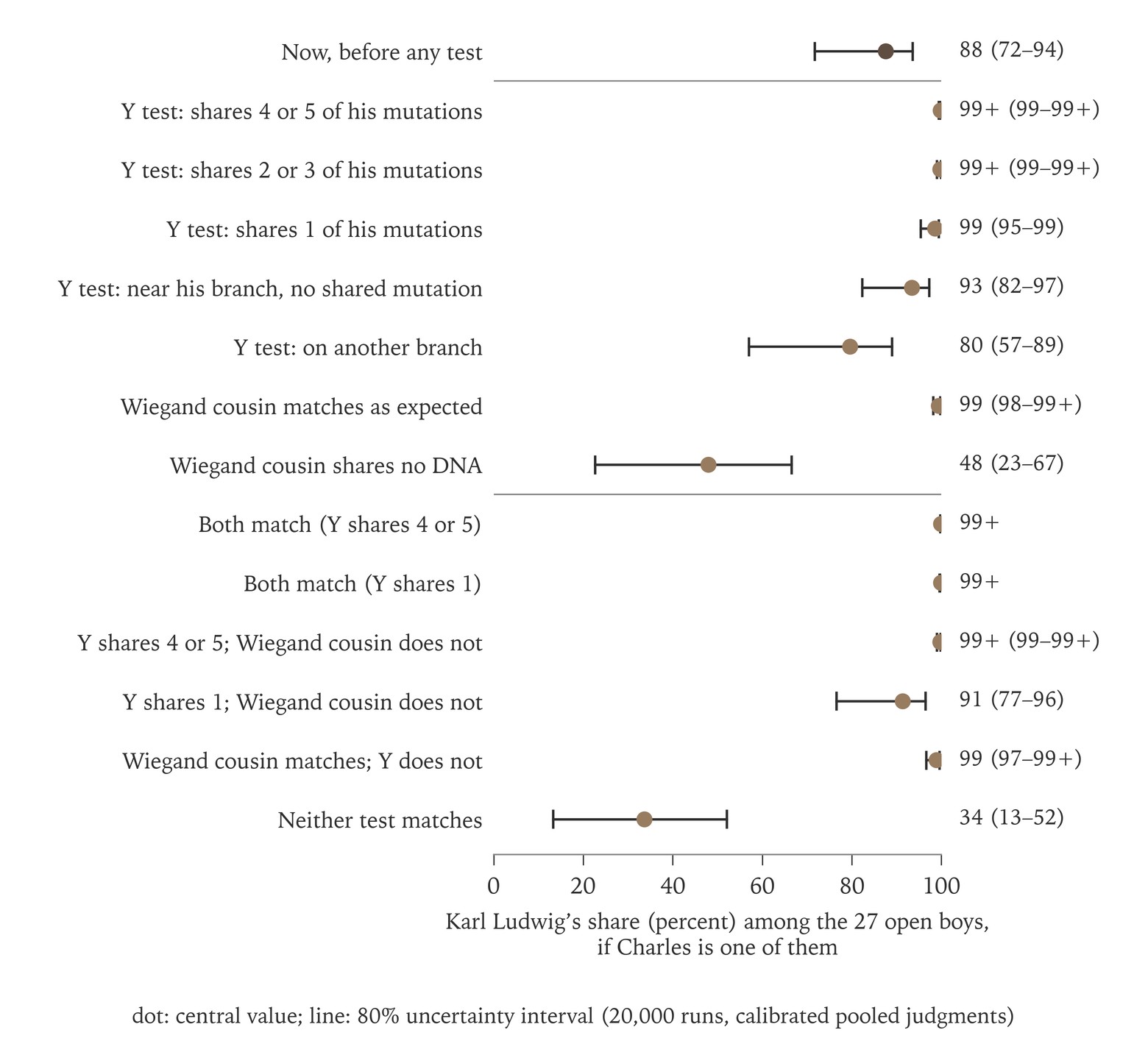
If both tests matched, with four or five shared mutations, Karl Ludwig’s share among the open boys would rise to over 99 percent (the chart gives its range). If neither matched, it would fall to 34 percent (80 percent range 13 to 52). A match through Elise’s line with a Y result on another branch would put it at 99 percent (80 percent range 97 to over 99). What that result would mean is set out in “What DNA Can and Cannot Say.” Each of these figures assumes the testers named in that chapter: a man of Andreas’s line and a great-grandchild of Elise. A more distant cousin would move the share less. Figure C.1 shows every case.84
The author will report a result that fits none of these rows as outside the plan, and will mark any ratio set for it afterward as set after the result. The grade still follows the conditions in the section before this one; a share orders the work and does not by itself raise a grade.
Search criteria and method
What was searched, and why
This section gives the rules of the search for Charles’s baptism, so that another researcher who follows them should find the same boys. The first element of the Genealogical Proof Standard is a reasonably exhaustive search, planned in advance and carried on until every source that could answer the question has been checked.85
A candidate is any boy baptized in the searched parishes who was born from 1833 to 1841, including boys baptized in an emergency and boys entered without a surname.86 No boy is excluded for his surname or his birth year alone.87 The years come from Charles’s own records: all but two of the ages he gave point to a birth from 1833 to 1841. Births of 1842–44 are read last.88
The places come from his records too: he swore in 1862 that he was born at Trendelburg, and the pastor who married him in 1866 gave his home as Deisel.89 From there the rings of parishes widen outward. Ring 0 is Trendelburg, Deisel and Friedrichsfeld, Ring 1 is the twenty parishes next to them, and Ring 2 is thirty-four more places of the district and the Weser. Ring 3, the parishes beyond, waits until Rings 1 and 2 are done. The rings and the years are choices made for this search, not rules of any standard.90
The plan rests on a few assumptions. It assumes that Charles was born near Trendelburg or Deisel in 1833–41, and that Carl was among his names, since Charles is the English form of Carl. It assumes that he left in the late 1850s, as the 1900 census says. It assumes that he was baptized in the Evangelical (Protestant) church, as an Evangelical pastor married and buried him.91 It assumes, finally, that he is among the twenty-seven open boys of the three home parishes, those not yet ruled out or found to have died young. The boys’ shares are their parts of the chance if Charles is one of them, and the table under “The order of work” below shows how they change if he is not. No boy was closed for his name or his departure year. If the place or the years are wrong, his baptism lies outside the boys compared, and the search must expand. The technical appendix (on the research website; see the section on data and code below) lists each assumption with what would follow if it were wrong. It also lists the known gaps in the records, such as the lost Bremen passenger lists and the missing Deisel emigration releases for 1859–60.92
How the records were read
An original record is better evidence than any copy or index made from it,94 so every register is read in the page images, one entry at a time. A name index only points to a record; it never proves that a record is not there. A register searched only through its index is marked “index only” and waits for a full reading. Ring 0 was read boy by boy, every month. Ring 1 has since been read the same way, twice, and Ring 2 is being read, nearest parishes first.
The Ring 1 baptisms of 1833–41 have now been read twice in all twenty places, though some of the burial checks have so far been read only once. The second reader recorded every entry, apart from one skipped leaf at Hofgeismar Neustadt and two entries at Dalhausen; the first reader usually listed only the boys. In twelve places the second reader saw no entry of the first reading, although at Stammen and Schöneberg a summary or brief named some of the boys. In the other eight, part of the reading was not fully blind, or its disagreements had not yet had a third reading. Those eight had a third reading of the disputed entries on 6 November 2026; at Dalhausen most of it comes from a draft whose method is not recorded. A reading counts as settled when two readings match or when a published list, the family’s other entries or a burial supports it. The settled rates therefore do not measure agreement between blind readers. Many settled readings still carry a query on one letter. Of thirteen entries whose fate, such as an early burial, was in doubt, four remain unclear, and the third reading put two more in doubt.95
Not every other set has had a second reading yet; “How good the data are” gives the agreement measured so far. Two readings are compared field by field: boy or girl, name, date and remark, and when they disagree, the entry goes through these steps, in order, until it is resolved:
- A third reading at full size, with the image’s contrast tools. If a parish agrees less than 90 percent of the time on the boy or his surname, every entry that differs gets this reading.
- The family’s other entries (brothers and sisters, confirmation and marriage), the project’s names database, the Dornette database and the works of Klaus Kunze.
- The village family book (Ortssippenbuch), if there is one.
- One more independent reading of an image of the entry, made with no hint of the earlier readings.
- If the readings still disagree, the entry is marked [?], and nothing in the book rests on it.
Three finding aids are a standing cross-check: Mr. Dornette’s database of births, marriages and deaths; the name indexes of Klaus Kunze’s village family books; and Kunze’s combined index of those books, the Gesamtpersonenregister.96 They help find a misread name or a missed death. A match in any of them supports a reading, but the register image remains the authority.
A boy who lived to adulthood is ruled out only by a record read in the image. That record must tie his adult life to his baptism by at least three separate facts, such as his names, birth date, birthplace and parents.97 A boy counts as “died young” only on a burial entry or a death note read in the image. A blank note never shows that a boy lived, so every open boy is checked against his parish’s burials to about 1855. A boy whose later record falls short of the three-fact test is “probably traced” and remains open. A status changes only after a second reading and one other record that agrees. When a boy’s own records end, the next records examined are those of the people around him: his family, godparents, guardians and neighbors. Elizabeth Shown Mills calls this the FAN principle (friends, associates and neighbors).98 The chapter “The Candidates and How They Were Ruled Out” re-examines the eleven eliminations on which the search most depends.99
Standards followed
Genealogy has published rules for research and proof, as statistics has for reporting numbers, and this book follows both, with the standard guides to style and plain language. Table C.5 identifies each standard and says in plain words what it governs; the full references are in the source list.
Table C.5. Standards this book follows, and what each governs
| Standard | What it governs |
|---|---|
| Board for Certification of Genealogists, Genealogy Standards 100 | The working rules of the field: planned research, a reasonably exhaustive search, original records first, proof |
| The Genealogical Proof Standard101 | When a fact counts as proved |
| Thomas W. Jones, Mastering Genealogical Proof 102 | How to meet that standard and write a proof argument, the written case for a conclusion |
| Elizabeth Shown Mills, Evidence Explained and QuickLesson 11103 | How to cite and weigh each kind of record; the FAN principle |
| The Chicago Manual of Style 104 | Spelling, punctuation, notes, tables and figures |
| Federal Plain Language Guidelines105 | Short sentences, common words, the main point first |
| Fellegi and Sunter; Wrigley106 | Record linkage: whether two records describe the same person |
| ENFSI, Guideline for Evaluative Reporting 107 | Putting the strength of evidence into words |
| The Sheffield Elicitation Framework (SHELF)108 | Writing down a judgment with its range and reason |
| GUILD109 | What a study that links records must report |
| TRIPOD110 | What to report about a ranking and its test |
| SAMPL; the ASA statement on p-values111 | Every statistic given with its size and range, never as a bare conclusion |
| Benjamini and Hochberg112 | A correction for running many tests at once |
| The FAIR principles113 | Publishing the data so others can find and reuse it |
| Carlo Ginzburg, “Microhistory: Two or Three Things That I Know about It”114 | Keeping the gaps, doubts and dead ends of the search in the account, not smoothing them over |
| Cleveland; Tufte115 | Charts a reader can judge accurately, each estimate with its range |
Sources: as cited in each row.
The order of work
Twenty-seven boys of the home villages are still open, and they cannot all be traced at once, so they are put in an order. The order comes from record linkage, a published method of judging whether two records describe the same person. It evaluates each point on which the records agree or differ.116 Historians use it to link people across parish registers and censuses.117
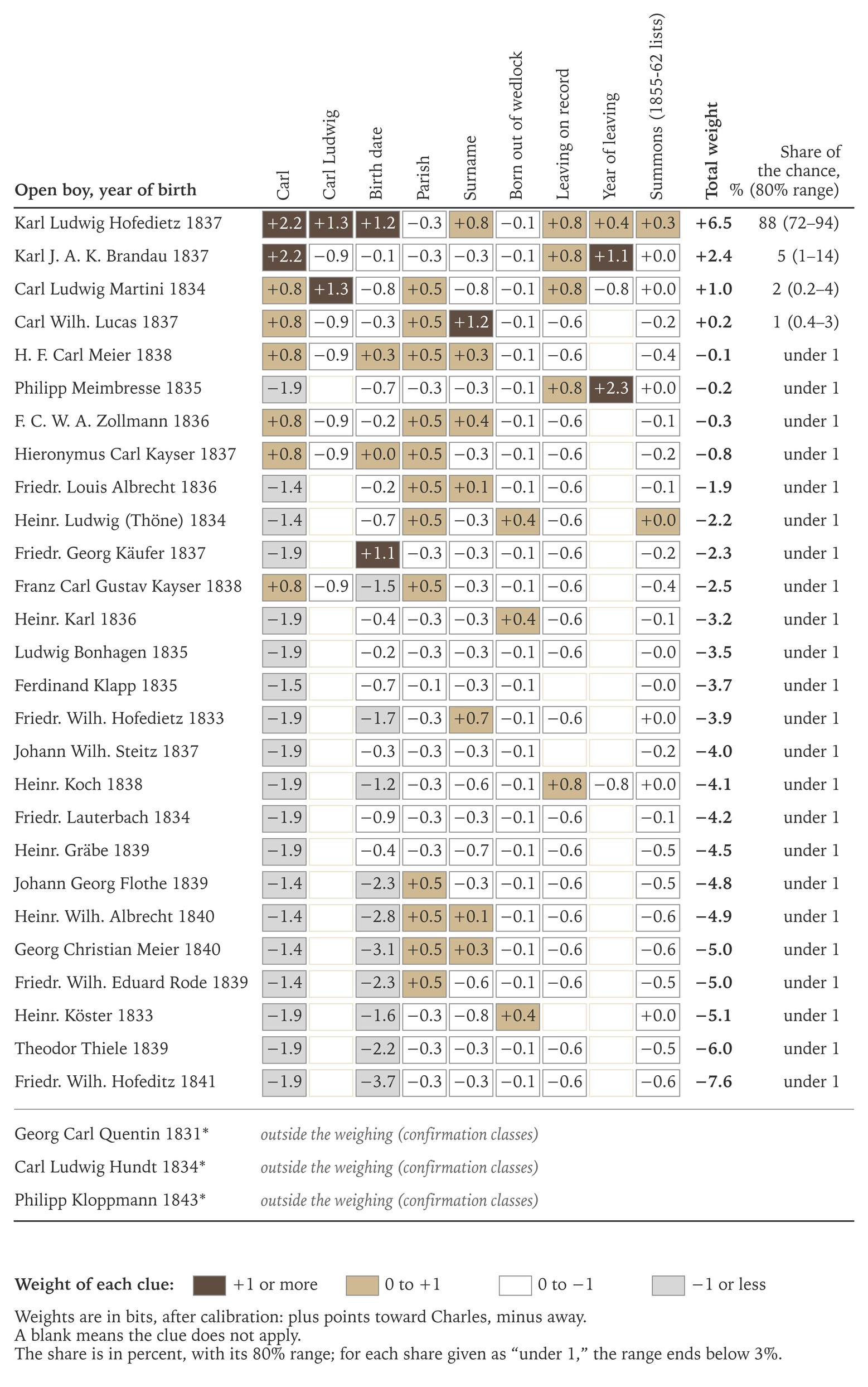
Each clue in Charles’s records faces two questions. If this boy were Charles, how probable is it that his records would show the clue? With only one man to find, this is a judgment, written down with a low value, a high value and the reason.118 These judgments were set three times, separately: by the author and by two blind reviewers (two AI models, described under “Who did the blind work” at the end of this section). The reviewers saw the clue definitions, Charles’s own records and the counts from the registers, but not the author’s values, the boys’ names or which boy led. The weighing pools the three, giving each an equal say. If the boy were not Charles, how probable is the clue anyway? That figure, the base rate, is counted from the 276 boys of these villages who lived to fourteen. For birth dates it is counted from all 426 baptisms, and for the leaving clues from the release index and the estimates in the dataset. The first figure divided by the second is the clue’s weight, its likelihood ratio: above 1, it points toward the boy; below 1, it points away. The clues are his names (Carl, and Carl followed by Ludwig), his birth month and day, his parish, birth out of wedlock, his surname, and his departure. Two of them, the birth date and the surname, are weighed by standards fixed in advance rather than by these judgments, as the next paragraph explains.
The birth date is weighed by a standard for a man’s stated ages and birth dates, written and frozen on 8 November 2026 without opening any boy’s file. It weighs each age or date in Charles’s records by who gave it, whether it was given in his lifetime or after his death, how exact it is and any reason to shade it. Its error rates were measured on men whose birth dates are known. The 1900 census gives November 1836, the only birth month and year recorded in his lifetime; the 26 January date comes from his burial entry, written after his death.119 In 1900 he was a boarder, and no one knows who answered the census taker. The standard spreads his birth over the possible months: most of it falls in November and January of the mid-1830s, and very little after 1838. A boy’s date clue is that spread’s weight on his birthday, divided by how often boys of these villages were born on such a day. No date rules a boy out. The standard does not count the age on the battery’s muster-out card of December 1865, because the card was not in the age table from which the standard was set. That age fits a birth in 1837 (see “Where and When He Was Born”).120
Table C.6 gives those measurements by kind of record: fifty-three American records of twenty-one men of the home parishes whose baptisms are known.121
The surname is weighed by a model of how clerks recorded the names he gave. The model was set down on 8 November and amended on 10 November 2026, before it was run on the open boys. Every open boy was baptized under another surname, so any of them who was Charles changed it. The model prices that change, and it prices it lower for a boy raised in a Konze household, on the premise that such a boy came to be known by that household’s name. How likely each boy was to have been raised by a Konze household was first set by a further blind reviewer, who saw a brief without the boys’ names. Since 12 November 2026 every open boy is priced by one rule, from five kinds of Konze tie (see “Weighing the Konze ties evenly” below). The earlier clue of Konze or Gans kin is dropped, so that the Konze named in 1900 as curator of Karl Ludwig’s affairs is not counted twice.122
Two other points need explanation. First, Carl is weighed within each parish: it was a common name at Trendelburg and a rare one at Deisel, so a Carl counts for more at Deisel. Multiplying weights assumes conditional independence: for Charles and for other boys alike, one clue says nothing about another. A test on the 276 boys of every pair of clues that could be tested there found only Carl and the parish clearly linked. The leaving clues could not be tested, because they are known only for the open boys.
Table C.7 gives each clue’s judgment, how often the clue occurs among the boys of these villages, and its weight; the reasons for the judgments are in the dataset. The table states weights in bits, the base-2 logarithm of the ratio, so 0 bits points neither way. Each bit doubles or halves the odds, and bits add where ratios multiply.123
Table C.6. How far stated ages were off, by kind of record: 21 emigrants of the home parishes
| Kind of record | Records (no.) | Men (no.) | Right year | One year off | Two or more off | The larger errors (years) |
|---|---|---|---|---|---|---|
| Census | 16 | 13 | 11 of 16 | 3 | 2 | +2, +2 |
| Death record, obituary or gravestone | 20 | 18 | 15 of 20 | 3 | 2 | −2, +6 |
| Naturalization, passport or voter register | 6 | 4 | 4 of 6 | 0 | 2 | +2, +3 |
| Passenger list or emigration record | 5 | 5 | 5 of 5 | 0 | 0 | none |
| Military or veterans’ record | 3 | 3 | 2 of 3 | 1 | 0 | none |
| Marriage record | 2 | 2 | 2 of 2 | 0 | 0 | none |
| Published sketch | 1 | 1 | 1 of 1 | 0 | 0 | none |
| All records | 53 | 21 | 40 of 53 | 7 | 6 | −2, +2, +2, +2, +3, +6 |
Source: compiled by the author from the American records of the test men124; the standard125.
Note: an error is the nearest year of the range a record implies, less the year of the baptism; a plus sign means the record makes the man younger. Each kind has few records, so the table gives counts, not shares.
Table C.7. The weight of each clue
| Clue | How likely if he were Charles (judgment and range) | How often among the boys | Weight if present (bits) | Weight if absent (bits) |
|---|---|---|---|---|
| Carl or Karl among the names, Deisel boy | 85% (65%–95%) | 13% | +2.7 | −2.5 |
| Carl or Karl among the names, Trendelburg boy | 85% (65%–95%) | 41% | +1.1 | −2.0 |
| Carl or Karl among the names, Friedrichsfeld boy | 85% (65%–95%) | 38% | +1.2 | −2.1 |
| Carl followed by Ludwig or Louis (Carls only) | 85% (70%–95%) | 21% | +2.0 | −2.4 |
| Born out of wedlock | 20% (10%–35%) | 10% | +1.0 | −0.2 |
| Baptized at Deisel | 40% (25%–55%) | 59% | −0.6 | – |
| Baptized at Trendelburg | 50% (30%–70%) | 32% | +0.7 | – |
| Baptized at Friedrichsfeld | 10% (5%–15%) | 9% | +0.2 | – |
| Leaving on record | 60% (45%–75%) | 42% | +0.5 | −0.5 |
| Probably traced to another man | ratio 0.2 (0.1–0.4) | – | −2.3 | – |
| Year of leaving, against the 1900 census year (measured; boy by boy, if leaving is on record) | census year exact 43% (33%–54%) | by year, from the releases | −0.9 to +2.7; Karl Ludwig +0.5 | – |
| Birth date (frozen standard, weighed boy by boy) | the standard’s spread over his birth date | by day, from the 426 baptisms | −8.1 to +2.6; Karl Ludwig +2.6 | – |
| Surname, a change of name with the Konze foster path (frozen model, weighed boy by boy) | the model’s chance of his name records | average over the 276 boys | −1.8 to +2.6; Karl Ludwig +1.7 | – |
Sources: the weighing of the clues, compiled by the author126; frequencies from the ledger of the boys127.
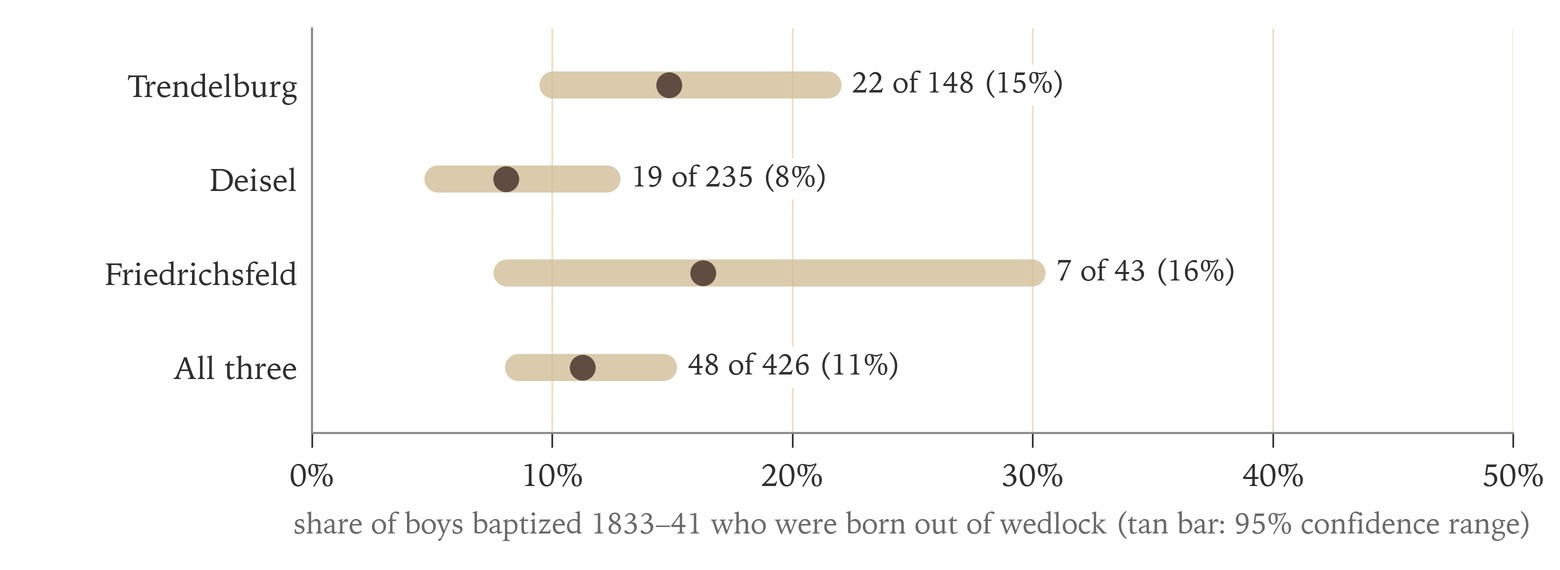
Two of those frequencies are charted here: the month of birth, and birth out of wedlock, among the 426 boys of the three home parishes.128
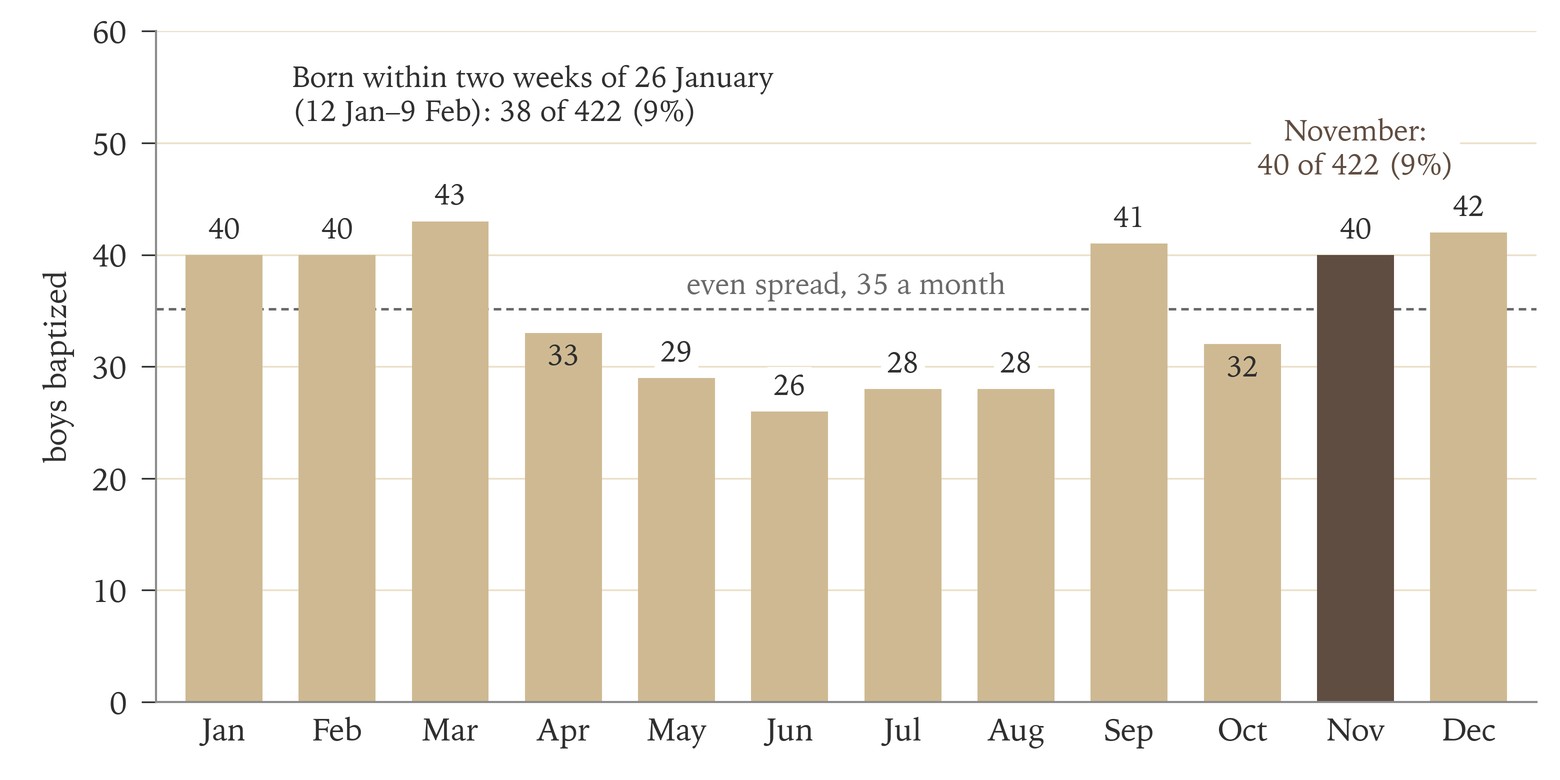
The last two rows of the table are the two standards described above. Their weights depend on each boy’s birth date and household, so the table gives the range among the open boys and Karl Ludwig’s own. Weights in the table are before the calibration described below.130
Multiply a boy’s weights together and they give his fit, the likelihood ratio. It states how many times better his records fit Charles’s clues than the records of a boy chosen at random from these villages would. The likelihood ratio is the main figure, because it does not depend on who else is on the list. To compare the open boys, each is then given the same starting chance, and the likelihood ratios are converted into shares that add up to 100 percent. That step assumes Charles is one of the twenty-seven. The judgments are uncertain, so the weighing was run 20,000 times. Each time, one of the three sets of judgments was selected at random, and every judgment in it was drawn at random between its low and high values. The range after each figure is an 80 percent uncertainty interval: in eight runs out of ten, the figure fell inside it.131
The calibration step. A weighing can be too sure of itself. So each fit is raised to the power 1/T before the shares are worked out, and the larger T is, the more cautious the shares. The weighing now uses two settings. The clues any emigrant can have, his forename, middle initial, parish and leaving, take T = 1.19. That setting was fitted on seventy-three men whose American lives are known, then raised until a wrong boy seldom looked sure. Charles’s own clues, chiefly his birth date and his surname, take T = 2.21. No other man has those clues, so their setting was fixed on 20,000 lists of twenty-seven traced boys, none of them Charles, where any boy the weighing favored was wrong. The calibration setting was adjusted until a wrong boy reached 80 percent or more in no more than two lists in a thousand. Both settings were fingerprinted (a checksum that shows any later change) before any new share was computed. Because the setting is chosen on the same lists that then test it, meeting that limit shows only that the rule was followed. Nothing measures the right setting for Charles’s own clues, so it is a judgment about caution, not a measurement.133
The setting for Charles’s own clues was raised once more on 12 November 2026, when the Konze ties of every open boy were weighed by one rule (see “Weighing the Konze ties evenly” below). With the ties weighed that way, the earlier setting, T = 1.85, let a wrong boy take 80 percent or more in about seven lists in a thousand. Adjusted again by the same rule, with the author’s written approval, the setting became 2.21. It has been fixed since 12 November 2026. Under a rule signed that day it will not be adjusted again, whatever the evidence, and a later rate of wrong leaders above the limit is reported, not corrected.134
Karl Ludwig’s share is now 88 percent (72–94). Resampling the traced boys gives a range of 1.6 to 2.76 for the setting of his own clues. Over that range his share runs from 83 to 93 percent. Every fit and share in this book is the calibrated one.135
Table C.8 gives every share the weighing has given Karl Ludwig, with each value the calibration setting has had and the reason for each change. The changes of 12 November were each made under a rule signed in advance. The two changes of 16 November were not: the author lifted the freeze for each, and each share was computed before its rule was signed (see the two sections “The year he left” below). None of the changes moved his grade.136
Table C.8. Karl Ludwig’s share as the weighing changed, November 2026
| Date, 2026 | Share if Charles is among the open boys, percent (80% interval) | Calibration setting: his own clues / general clues | What changed, and why |
|---|---|---|---|
| To 10 Nov | 80 (25–95) | none | The three sets of judgments pooled; no calibration step yet |
| 10 Nov | 91.3 (72–96) | 1.46, one setting for every clue | Birth date and surname weighed by the standards fixed in advance. The calibration step added, because without it a wrong boy took 80 percent far too often |
| 11 Nov | 92.8 (75–97) | 1.46 | The summons clue of 1858 added; setting unchanged |
| 12 Nov | 88.8 (62–95) | 1.81 / 1.21 | Measured rules for names and ages adopted after sealed tests; the general setting refitted, and the setting for his own clues raised after the check on lists with no Charles failed |
| 12 Nov | 88.3 (61–95) | 1.85 / 1.19 | Rules refitted on seventy-three known men; the setting for his own clues refitted after the general one, as the signed rule required, with no failed check. The court-judgment clue, added the same morning, changed no figure |
| 12 Nov | 68.1 (31–85) | 2.21 / 1.19 | Every open boy’s Konze ties weighed by one rule. The setting for his own clues raised, with the author’s written approval, after the check failed; fixed from then on |
| 16 Nov | 61.1 (25–76) | 2.21 / 1.19 | The 1900 census year of arrival weighed by how often such years were right. The author lifted the freeze for this one clue; no setting refitted; the share was computed before the rule was signed |
| 16 Nov | 87.6 (72–94) | 2.21 / 1.19 | Karl Ludwig’s leaving dated by the land act of 1857, which reports him in America by 5 December 1857, instead of the court’s notice of 1900. The author lifted the freeze for this one record; no setting refitted; the share was computed before the rule was signed |
Source: the weighing of the clues and its calibration files137; the sealed tests and the amendments that governed each change138.
Note: before 10 November there was one setting for all clues, or none; from 12 November the setting for Charles’s own clues is given first.
Table C.9. The five open boys who fit Charles’s clues best
| Open boy | Baptized at | Fit, pooled (80% interval) | Share if Charles is among the 27, pooled (80% interval) | Share, author’s judgments alone |
|---|---|---|---|---|
| Karl Ludwig Hofedietz | Deisel | 93 (47–192) | 88% (72–94) | 92% |
| Karl Brandau | Deisel | 5.3 (1.4–16) | 5% (1.3–14) | 1.9% |
| Carl Ludwig Martini | Trendelburg | 2 (0.24–4.1) | 1.9% (0.2–4.1) | 2.3% |
| Carl Wilhelm Lucas | Trendelburg | 1.2 (0.49–2.4) | 1.1% (0.4–2.5) | 0.7% |
| Heinrich Friedrich Carl Meier | Trendelburg | 0.94 (0.42–2) | 0.9% (0.3–2.2) | 0.6% |
Source: the weighing of the clues, calibrated, 20,000 simulation runs139.
Note: a share compares a boy’s fit with that of the other open boys, if Charles is one of them (see “What the numbers do not say” below). The range is the 80 percent uncertainty interval.
The numbers in plain words
- Fit (the likelihood ratio for all the clues together)
- How many times better a boy’s records fit Charles’s clues than a random boy’s would. Karl Ludwig’s pooled, calibrated fit is about 93.140 Forensic scientists call a ratio between 10 and 100 moderate support.141
- Share of the chance
- How well a boy fits Charles’s clues, compared with the other open boys, if Charles is one of them. A share orders the boys for the search; it is not proof of identity.
- What the numbers do not say
- A share of 88 percent is not the chance that Karl Ludwig was Charles. It means that among the twenty-seven open boys, and only if Charles is one of them, Karl Ludwig fits best by that much. If the chance that Charles is among them is between even and nine in ten, the share is between 70 and 85 percent. Taking the one for the other is the most common mistake made with numbers like these. The open boys are also not a fair sample of all the boys: they are the ones no later record has yet reached.
- Weight of a clue (the likelihood ratio for one clue)
- How much likelier the clue is if a boy is Charles than if he is not; a weight of 1 points neither way.
- Uncertainty interval (80 or 95 percent range)
- The range a figure could reasonably fall in. “93 (47–192)” means the central figure is 93, and in eight runs out of ten the figure fell between 47 and 192; a wide range means the figure is less certain.
- Median rank
- The middle rank: half the cases ranked higher, half lower.
- Agreement and kappa
- How often two readers who worked apart read an entry the same way; kappa corrects for agreement that luck alone would give.
- Reliability, accuracy and validity
- Reliability asks whether readings are consistent. Accuracy asks whether they are right; two readers can agree and both be wrong. Validity asks whether the method finds what it claims to find, tested here on men whose answers were known.
- p-value
- How surprising a result would be if nothing real were going on; it never proves anything by itself.
Statistics in this book help weigh the records and show where to spend time and money. They never replace a record, and who Charles was can be established only by documents or DNA. Mills makes the same point: a statistical norm cannot rebuild the life of one person, because any one person may be the exception.142
The eight Carls among the open boys account for about 98 percent between them. In checks made on 10 November 2026, before the revisions of 12 November, Hofedietz came first even when either standard was left out or the foster values were moved to the ends of their ranges.143
Two variants test how much his lead owes to the Konze foster-home tie. Treated like a boy whose parents were both living, with no Konze tie found, his share would be 71 percent (46–82). Treated like any other orphan, with no Konze tie of any kind, it would be 84 percent (63–91). He comes first in both.144
With the author’s judgments alone, Karl Ludwig’s records fit Charles’s clues 89 times better than chance (80 percent range 51 to 177), and his share is 92 percent (82–95). With the first blind reviewer’s, the likelihood ratio is 117 (58–231) and the share 88 percent (75–93). With the second reviewer’s, the likelihood ratio is 74 (39–155) and the share 81 percent (65–89), ahead of Karl Brandau of Deisel at 8.6 percent. Brandau is also a Carl of Deisel, and he very probably sailed for New York in 1856, close to Charles’s 1859.145
The three agree on most clues: Carl, the parish, birth out of wedlock, and how often an emigrant’s departure is on record. The birth date and the surname are no longer theirs to judge. They differ most on one question: how likely the L, the middle initial on his army papers, is to stand for Ludwig. They no longer judge the year he left. Since 16 November that clue is weighed by how often a census year matched a known departure (see “The year he left, weighed by its error” below). Agreement on the initial would change the range of Karl Ludwig’s share only from 72–94 to 75–91 percent. The three judges’ shares for him still differ, as given above, so the strength of the weighing depends on who weighs, and it is weaker than the author’s figures alone suggest, which is why the book gives the pooled figures first. Giving each judgment an equal weight is what O’Hagan calls mathematical aggregation, or pooling; SHELF itself has the experts meet and agree on one judgment. What all three agree on is who comes first: Karl Ludwig.146
How a reader takes the middle initial changes Karl Ludwig’s share, but since 16 November it decides who comes first only if the C is read as Brandau’s Konrad. Under the pooled judgments Karl Ludwig’s share is 88 percent if the initial is L, as every clerk recorded it (80 percent range 72–94). It is 65 percent if the initial is given no weight (47–75), and 62 percent if the C that some readers see in his 1862 signature is his true initial (39–72). In both of those cases he still comes first, ahead of Karl Brandau. Read as a C that stands for Konrad, the last of Brandau’s four names, the initial puts Brandau far ahead.147
Counting middle initials. The L counts for Karl Ludwig only if an American middle initial usually shows one of a man’s baptismal names. That was counted, by a rule signed on 12 November 2026 before the count was made, on the seventy-three men whose German baptisms and American lives are known.148 Of the twenty-eight who used a middle initial in a record of their lifetime, twenty-six used the first letter of a baptismal name other than the one they went by. That is a rate of 0.93 (80 percent range 0.84–0.97). In nineteen of them it was the name that came next, as Ludwig follows Carl. Another thirty-seven men gave no middle initial, and eight could not be coded. The rate is the same, thirteen of fourteen, among the men who had not been identified partly by a second name. Fifteen more sealed men, counted apart, give eight of eight.149 Under the signed rule, a rate of 0.70 or more keeps the weighing as it stands. So the book gives 87.6 percent first, and beside it 64.9 percent, the share with no weight on the initial. No new weight was fitted. The count shows that an American middle initial usually matches a baptismal name. It does not settle whether Charles’s own initial of 1862 is an L or a C (see “The Name He Signed”).
One caution belongs here: the weighing was written on 3 November 2026, after Karl Ludwig had come forward. He was already one of the open Carls, but what drew the search to him was a court notice of 1900, read in October 2026. It reported him gone to America in the early 1850s and named a Konze innkeeper as the keeper of his affairs. Two clues in the weighing come from that notice and the Konze tie: the chance that he was raised in a Konze household, and the date of leaving. The Konze tie is graded possibly. Since every open boy’s ties were weighed by one rule, it counts for less than it did, but it still helps him; the chapter “The Boy from the Goose Corner” gives its weight.150
Treat him as any other orphan, with no Konze tie of any kind, and set the court’s date aside, and he still comes first, with 80 percent (57–88) among the open boys. Leave out everything the notice adds, including the fact that his departure is on record, and he still comes first, with 70 percent (41–83). His records then still fit Charles’s about thirty-one times better than chance. His lead then rests on what Charles’s own records say: Carl, Ludwig, his birth date, and a parish where Carls were rare.151
Until 16 November the weighing adopted the stricter reading: that the court meant he left for America at the start of the 1850s, which counted against Karl Ludwig because the 1900 census gives 1859. Since then it uses the land act of 1857 instead (see “The year he left, from the 1857 land act” below). If the court meant instead the year he left Deisel, the date is neutral. He was confirmed at Deisel in April 1852, aged fourteen, so the court’s date would have him leaving at about fifteen.152 In the release index of the eight villages, few people that young left on their own. Of those born 1825–45, 7 of the 99 with no party recorded were sixteen or under, against 69 of the 112 listed in a party. The index lists only licensed emigrants and has no release for him.153 That favors the second reading but does not prove it. With the court’s date and the act both set aside, his records would fit Charles’s about 69 times better than chance, against ninety-three with the act. His share among the open boys would be 84 percent, against 88.154 A record read after the weighing was fixed bears on the question. On 5 December 1857 his guardian told the court at Karlshafen that he was in America (see “The Boy from the Goose Corner”).155 It places him in America by then, not the year he sailed, so it does not show which reading is right. Since 16 November the weighing uses it in place of the court’s date (see “The year he left, from the 1857 land act”).
Charles is possibly not among them at all, if the place or the years are wrong (see the assumptions above). The shares cannot show that, which is why the likelihood ratio comes first. Table C.10 shows Karl Ludwig’s pooled share for several starting chances that Charles is one of the twenty-seven. If Charles was born elsewhere, every open boy’s clues are chance, and the rest of the share goes to “born elsewhere.” A rule signed on 12 November 2026 fixes what the book reports. If the chance that Charles is among them is between even and nine in ten, Karl Ludwig’s share is between 70 and 85 percent. Nothing measures a most likely chance within that range, so no single figure is given for it.156
Table C.10. Karl Ludwig’s share for each chance that Charles is among the open boys
| Chance that Charles is one of the 27 | Karl Ludwig’s share, pooled judgments, calibrated | 80% uncertainty interval |
|---|---|---|
| Certain (the main case) | 88% | 72–94% |
| 9 in 10 | 85% | 69–92% |
| 8 in 10 | 82% | 66–90% |
| Even | 70% | 51–82% |
| 1 in 4 | 50% | 32–66% |
| 1 in 10 | 27% | 15–42% |
Source: the weighing of the clues, pooled judgments, calibrated157.
The grid sets out the weight of every clue for every open boy.158
The 241 boys of the home villages whose adult lives were known on 4 November 2026 were checked to see whether orphans emigrated more often. The boys traced since are not in this test. A parent’s death before the boy turned fourteen made no clear difference: about one orphan in three emigrated overseas, and about one other boy in four. The difference is well within chance, and smaller still once the boys’ parish, birth years, birth in or out of wedlock and fathers’ work are taken into account (odds ratio 1.09, 95 percent interval 0.56–2.06). Losing both parents was rare, one boy in twenty, and Karl Ludwig was one of them. That makes him unusual, but it does not make him more likely to have emigrated or more likely to be Charles.159
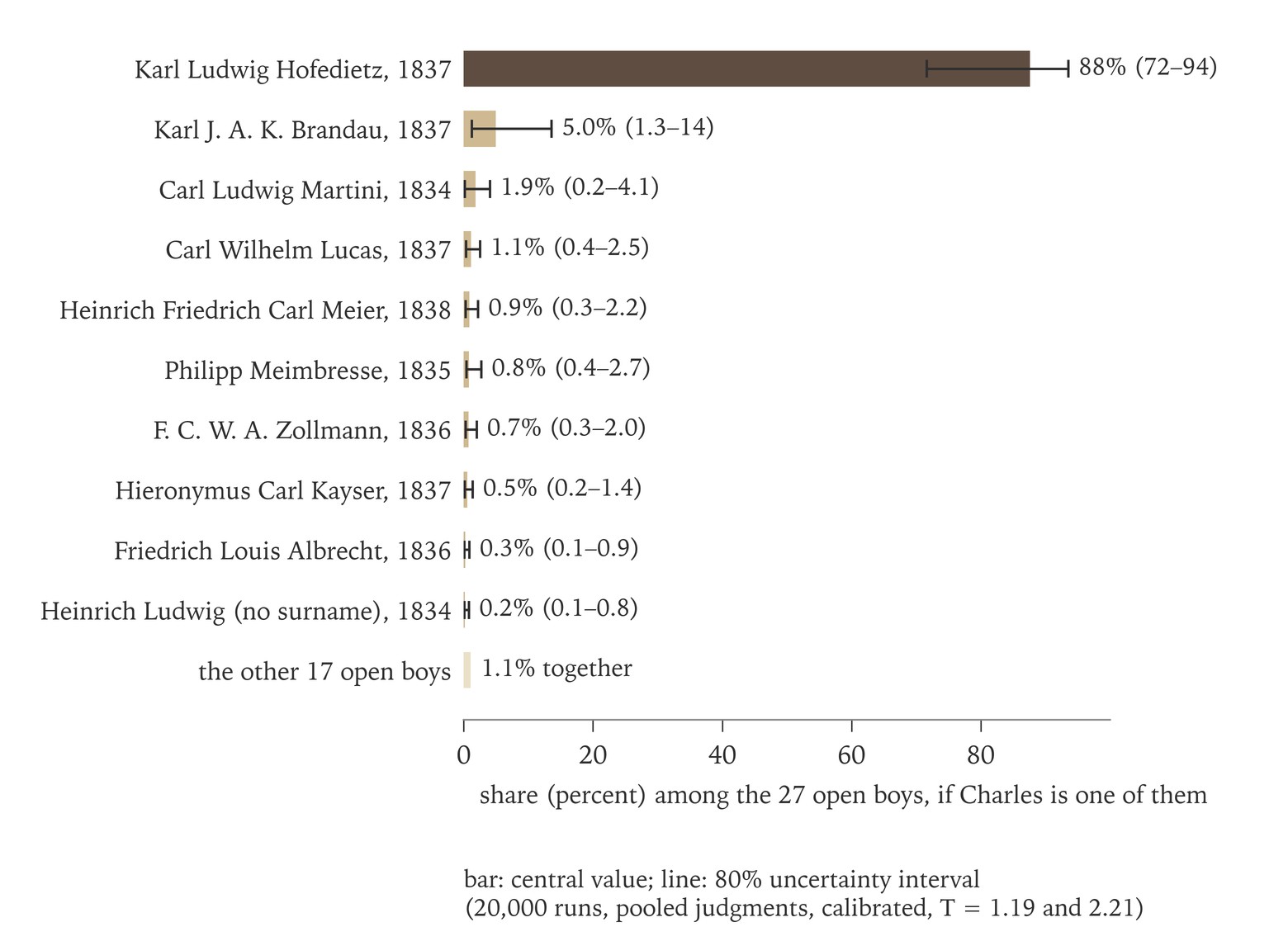
These are ranks, not proof: the shares determine the order of work but identify no one. Tested with the author’s judgments on the 247 boys whose later lives were known when it was run, the weighing ranked boys who stayed home as high as those who emigrated. About one boy in four who never emigrated would have ranked near the top, so a high rank is common among boys who were not Charles. An identification needs a proof argument built from the records, with all conflicting evidence resolved and the reasoning written out.161 No such argument yet exists for any boy. Karl Ludwig Hofedietz is the leading candidate, and he is possibly Charles, but he is no more than that until the records, or DNA compared with them, prove it.
Who did the blind work. The two blind reviewers of the weighing were AI models. Each set the clue judgments from a written brief. One reviewer came from the same family of models that assists with this research, so the brief left out the author’s values and the boys’ names. AI agents also drafted the birth-date standard and the surname model, wrote the code that brings them into the weighing, and fitted its calibration. Their judgments were set blind. The further blind reviewer of the foster values was also an AI model. So was the blind reviewer who priced the five kinds of Konze tie on 12 November 2026 (see “Weighing the Konze ties evenly” below). The blind reader of the test of the method, on 2 and 3 November, was also an AI model, given only the test folder, with the answers kept out of it.
The likelihood ratios of the DNA plan in “What DNA Can and Cannot Say” were set blind, with their reasons, on 10 November 2026, before any test was made. The AI model that set them did not see Karl Ludwig’s share or fit. The count of middle initials described above was coded by four AI sessions, two for the American records and two for the German, each working without seeing the others’ coding. A fifth settled their disagreements. Their working context named this project, so they were not fully blind. The signed rule gave the ten-case check of that count to the author. He delegated it to an AI model, which checked each case against the records, mostly in their images, and confirmed all ten codes.
AI agents also wrote the scripts that drew the maps and the pen-and-ink drawings, from the sources named in their credits where a credit names one. They later audited the maps’ place names, colors and credits. Of the entries whose readings differed, about 170 that stayed hard to read went last to a further AI model (the fourth step under “How the records were read”). It saw only an image of the entry, with no hint of the other readings. Those entries are listed in the dataset.
In a blind test in November 2026, two AI models read 98 register entries whose readings had already been settled. On the Deisel burial register of 1835 to 1875, the stronger model matched the settled reading in 97 percent of fields and the other in 94 percent. On 22 difficult entries the figures were 89 and 84 percent, and on names the stronger model matched four in five and the other three in four. Where the two models agreed, about 98 percent of fields matched; about one agreed field in sixty was wrong in both. The settled readings came from earlier AI-assisted reads, and the scoring was not blind. For these reasons no change to the list of boys rests on agreeing AI readings alone: each needs a corroborating record.162
Other ways of reading were tried. Machine text recognition on its own, from Archion or from the Transkribus service, garbled too many names to rely on: Archion’s read only about three names in four correctly. A second reading by the same AI model repeated the first reading’s mistakes somewhat more often in this test than a reading by a different model. Since 14 November 2026 the rule has therefore been that each entry is read by two different models. Where the two models disagreed, the machine text was used only as a pointer. It counted only when it matched one of the two readings letter for letter. It then chose the right one in 24 of 25 cases.164
Testing the method
The method was tested on men whose answers were already known: boys of the three parishes whose American lives are proven or very probably known. Each case hid the German surname and gave only what an American record shows. That is his forename and any initial, his stated birth date or ages, his stated birthplace and the year he gave for his arrival. On 2 and 3 November 2026 a reader who had not seen the answers selected the boy from the list of the home parishes’ boys (412 at the time of the test, 426 since). The answers remained sealed until scoring.165 The complete method, the ranking followed by reading the registers, found the right man in all three cases tested. With only three cases, the exact 95 percent range for that success rate runs from 29 to 100 percent.166 The ranking alone was tested on twelve men, and on 5 November 2026 the same twelve were weighed again, among all 426 boys, with the weighing as it now stands and the pooled judgments. The test closest to Charles’s case is the one without the birth date, among 34 to 200 boys; table C.11 gives the results.167
Most of the gain on 5 November comes from two clues the first test omitted. One is whether a boy’s leaving is on record in Germany; the other is whether its year agrees with the year the man gave in America. Several test men had been identified partly by that same agreement, so the gain overstates what the weighing can do for Charles. Without those two clues, the date-blind result is about the same as on 3 November.168
The test then grew to seventeen men. It includes every emigrant among the 247 boys whose later lives were then known. Each had to have an American life that is proven or very probable, and American records that could be set out this way. The author set out the cases for the five added men, from the American records alone but knowing the answers, so they are not blind. The weighing failed outright once: Carl Wilhelm Ferdinand Klapp of Friedrichsfeld lived in New York as Louis Klapp, a name his release list gives but his baptism entry does not. The weighing ranked him 67th of 183.169 The ranges are wide because the test is small, and Charles, whose name changed, is a more difficult case than most of the test men. That is why the ranking only orders the work, and the registers settle each boy.
Table C.11. How often the ranking found the right man
| Test | Men | Right man first | Right man in the top three | Median rank |
|---|---|---|---|---|
| With the birth date, 3 November | 12 | 6 of 12 (21–79) | 8 of 12 (35–90) | 1.5 |
| With the birth date, 5 November | 12 | 8 of 12 (35–90) | 11 of 12 (62–100) | 1 |
| Without the date, 3 November | 12 | – | 3 of 12 (5–57) | 6.5 |
| Without the date, 5 November | 12 | – | 9 of 12 (43–95) | 2 |
| Without the date or the two departure clues, 5 November | 12 | – | 4 of 12 (10–65) | 6 |
| Without the date, enlarged test, 5 November | 17 | – | 12 of 17 (44–90) | 2 |
| Without the date or the two departure clues, enlarged test, 5 November | 17 | – | 6 of 17 (14–62) | 7 |
Sources: test of the method170; exact ranges171.
Note: the exact 95 percent range, in percent, follows each count in parentheses. A dash means the table does not print the figure.
Do the percentages mean what they say? In the enlarged test, when the weighing gave one boy 80 percent or more, he was the right man every time: 11 of 11 (exact 95 percent range 72–100). All eleven had an exact birth date; without a date, the weighing gave one boy that much only once, and he too was right. Across the seventeen men, the shares added up to about as many first places as were found: 12.1 expected and 12 found with the date, 5.9 and 6 without it. So the test shows no sign that the percentages of the earlier weighing overstate, but it cannot show more than that: seventeen cases cannot distinguish 88 percent from 95. The test pools contained 34 to 200 boys of every fate, not 27 open boys, and each was known to hold the right man. The test on the 247 boys described above, which compared those who stayed with those who emigrated, asks a different question. The book therefore reads each likelihood ratio as the weight of the evidence, and each share only as a place in the order of work.172
Testing the changes on sealed cases. The weighing as a whole cannot be tested on new cases, because the birth-date and surname standards are Charles’s alone. Its general parts can be, and in November 2026 they were. Forty men whose answers had already been seen were used to measure how the weighing should treat names and ages. Proposed changes were then written down, with the rules for judging them, before the new cases that would test them were opened.173 The first two proposals were scored on eighteen sealed men. One, to make every share bolder, failed. The other, a clue from indirect evidence of leaving, could not yet be judged. Neither was adopted. Three more changes were then scored once, on fifteen new men from the next ring of parishes, whose answers stayed sealed until scoring.174
Two of the three passed. One uses how often, among the forty known men, an American forename or middle initial is missing from the baptism entry. The other drops the fixed window of birth years, outside which every boy was set aside. Each boy now counts by how often, among the forty, a stated age was off by as many years as it is from his birth. Together they put the right man first in five of the fifteen cases, against one before. The third change, a clue for a recorded departure from the next ring of parishes, did not help reliably and was rejected. Both rules were adopted on 12 November 2026. Neither touches Charles’s own judgments of his names or his birth date; they reach his case only through the calibration step above.175
A second round. A further amendment, signed on 12 November 2026, set a second round of tests.176 It proposed two more changes. One refitted the name and age rules on all seventy-three men whose answers were by then known. The other revised the departure clue. A release dated years after a man reached America now counts against a boy, but no longer nearly rules him out. Both changes were scored once, on fifteen more sealed men from the next ring of parishes, and both passed. Together they put the right man first in four of the fifteen cases, against two under the rules adopted in the first round. Both were adopted the same day.177
The revised clue’s gain rests mostly on three of those men, and two of the three had been flagged before scoring. Their flags concern a birth date seen while the cases were prepared, not their leaving. Without the five flagged men the clue still helped, but ten cases are too few to decide. The clue is used only for men whose American lives are known. It does not change Charles’s own judgment of when he left, as was decided before the scoring. So it cannot touch the twenty-seven open boys of the home parishes, Karl Ludwig among them. For them the second round changed only the two calibration settings, and their order stayed as the first round left it.178
The court judgment. One new piece of evidence was counted at the same time. The Kassel court’s published judgments on absconded conscripts were checked for all 390 boys of the home parishes called up in 1855–62. Five are named, each in the judgment for his own year; Karl Ludwig’s is that of 1858.179 The weight of such a judgment had been set blind, by a separate reviewer, hours before the one against him was found.180 Like the summons, the judgment counts on that blind weight, not on a test with known men. It adds nothing to his share, because a judgment followed the summons by law, and the summons already counts the same absence.181
Weighing the Konze ties evenly. A check made on 12 November 2026 found that the records read for Karl Ludwig’s Konze ties went much deeper than those read for the other open boys. His neighbors, grandmothers and curator had been worked through; for most of the others, only their godparents. So part of his lead came from where the search had looked.182
Every open boy was then searched to the same depth. A second reader checked most of the ties found and the disputed readings; the four still waiting for one count only as possible. Most of the searches that found no tie were read only once. Konze neighbors proved common: six of the other boys probably or possibly lived within two doors of a Konze household, and Brandau was probably born next door to one. Zollmann’s brother had a Konze godfather. Lucas possibly had a Konze tie through a curator named at his mother’s burial in 1847. No other boy had a Konze named as his curator, as Karl Ludwig did. But his curator was named in 1900, nearly fifty years after his childhood.183
A signed amendment then set one rule for all twenty-seven boys.184 Each is scored by five kinds of tie: a curator or guardian, a household, a godparent, kin, and a neighbor. A new blind reviewer priced each kind without knowing which boy had which tie. That reviewer judged that a curator named by a court in 1900 says little about where a boy grew up. Where a kind of tie was not searched or could not be settled, a boy counts at the average for that kind, not as having none.185
Under the new rule a wrong boy looked sure too often, so the setting for Charles’s own clues was refitted, as described above. Karl Ludwig’s share then fell from 88 to 68 percent (31–85). He was still first; Martini, Lucas and Meier followed. That lead then rested on the middle initial L: with the initial given no weight, or read as C, Brandau came first. Most of that fall came from the ties themselves: under that weighing of 12 November, with the old foster values at the new setting, his share would have been 82 percent.186
Like the summons and the judgment, the tie coding counts on blind weights, not on a test with known men. None of the men whose American lives are known shows a Konze tie, so no such test can be made. Every reading and weight was fingerprinted before the share was computed, and the share was computed once. His grade is unchanged: he was possibly Charles.187
The year he left, weighed by its error. On 16 November the author lifted the freeze for one clue, the year Charles left Germany. Until then the weighing split the 1900 census year, 1859, into two periods and asked three judges how likely each was. It now uses how often a census year of this kind matched a departure known from another record: exactly in 16 of 31 comparable men, and within two years in 23.188 Karl Ludwig’s share fell to 61 percent (25–76). The court’s “beginning of the 1850s” needs the census to be five or more years late, and few census years were. With the census measured only on men whose census year did not help identify them, it is 62 percent, and under other reasonable choices it lies between 57 and 72 percent. The main form of the new rule was named before any share under it was computed. The shares were then computed before the rule was signed, the main one twice (61.0, then 61.1 percent after an audit correction), and the other forms are printed beside it. He was still first, with about four times Brandau’s share, and his grade was still “possibly.”189
The year he left, from the 1857 land act. The same day the author lifted the freeze again, for one record: the guardian’s statement of 5 December 1857 to the court at Karlshafen (see above), which reports Karl Ludwig in America by then.190 It was read three times; “in Amerika” and the date agree, and the words between “Carl” and “in Amerika” are not settled. Until then the weighing dated his leaving by the court’s notice of 1900, “the beginning of the 1850s.” It now uses the limits the records set. He was confirmed at Deisel at Easter 1852 (see above)191 and reported in America by 5 December 1857, so his leaving falls in 1852–1857, each year alike. The census measure of the year before is unchanged. As before, the share was computed before the rule was signed. Karl Ludwig’s share rose to 88 percent (72–94), and under other reasonable choices it lies between 80 and 88 percent. If the court’s “beginning of the 1850s” is kept inside the act’s limit, it is 69 percent. He is first, with about eighteen times Brandau’s share, and he now stays first when the middle initial is given no weight (65 percent) or read as C (62 percent). The grade stays “possibly”: the act places him in America, but it does not tie him to St. Louis or to the name Gannsen or Konze, and the book raises a grade on a record of his leaving only if it does.192
The calibration method itself was first checked on 8 November 2026, with the project’s frozen record-linkage model for the next ring of parishes. The cases were sixteen grooms from the marriage registers of Dalhausen, Eberschütz and Lamerden, and Beverungen, none of which had been used to build that model. Each was read twice and matched to his baptism. The ranking held up: the right man came first about as often as in the earlier tests. The calibration held up less well. In one case of the sixteen, a groom with a rare forename in a small list, that model was confidently wrong, more often than in the lists on which it was calibrated. One case in sixteen could stand for anything from about 1 to 28 percent of such men. The range around Karl Ludwig’s share therefore matters more than its central figure.193
What these tests show is a careful weighing, not a measuring instrument. It is weakest on the next ring of parishes, where each test man was ranked among about three thousand boys. Even with the new rules, the right man came first there in only nine of the thirty sealed cases. These tests used only the clues every emigrant has.194
One limit belongs here: no emigrant of these villages is known to have changed his surname in America. Every man found there kept his baptismal surname or an English spelling of it, such as Bonhage for Bonhagen, Fredericks for Friedrichs and Koester for Köster. Three boys born out of wedlock took a stepfather’s surname, but in Germany, before they left, and they sailed under it. The one of them whose American life is known, Andreas, later Niemeyer, was in the test, and the weighing ranked him first. The method has therefore been tested on men like Charles in every way but the one that makes his case difficult. The two clues that exist only because his surname is unknown (birth out of wedlock, and Konze or Gans kin, a clue since replaced by the Konze ties) were never tested. Men who changed their names are the hardest to trace, which is one reason none is known, but that is not evidence that none did.195
The nearest case that could be tested comes from Sielen, next to Trendelburg. Karl Ludwig Köhler, born there on 19 March 1839, left for North America in 1857 and lived in Des Moines as Charles Koller and then Charles L. Kahler. The weighing was given only what his American records show, with his birth date hidden. It ranked him first of the 127 boys born in 1839 and 1840 in Sielen and the three home parishes (66 percent under the pooled judgments, with an 80 percent range of 48 to 76). With his birth date hidden, only the general clues enter, so the figure uses their calibration setting. Under the single earlier setting it was 53 percent (36–62), and under the first revision 65. The first run of the test, before any calibration, put it higher. Without the departure clues he tied for first with another Sielen Karl Ludwig, who died at fourteen. But his surname was only respelled, and the test was set up by someone who knew the answer. The method is therefore still untested on a man who took a wholly new surname, as Charles did if he was born a Hofedietz.196
How good the data are
Each set of readings gets a confidence level by fixed rules, so any reader can rate it again. High means read in the pages, read twice by readers who did not see each other’s work, an agreement score (kappa, explained below) of 0.90 or more and a measured error under 2 percent. Medium means read once, or a kappa of 0.80–0.89, or an error of 2–5 percent. Low means read only in an index or a secondary source, or an error over 5 percent. Cohen’s kappa measures how much better two readers agree than luck alone would give; 1 is perfect, and above 0.8 is usually called almost perfect.197
The first eleven Ring 1 parishes read twice (2 November 2026) hold 2,178 entries. In them the readers agreed on whether a child was a boy in 98.4 percent of entries (kappa 0.97) and on his fate in 97.3 percent (kappa 0.96).198 Surnames agreed less, and five parishes stay open on surnames. That set rates Medium, for a first-reading error of 2.7 percent on fates; Stammen and Langenthal rate High. The list of the 426 boys of the home parishes, on which the open boys rest, was read in full in the images but mostly once, and rates Medium. A sample of 36 of its entries found slips in dates and spellings but no wrong status. A random recheck of a tenth of the 426 entries has not yet been made. Sets read only in an index, such as the emigration-release index, rate Low.199
What would change the conclusion
These criteria were fixed on 3 November 2026, before the results of the searches now under way came in, so that no result could shape its own test. The dated criteria and an amendment of the same day are in the dataset. The amendment records the change to the weighing of Carl, made before any of those results arrived; it changed no grade. A second amendment, of 11 November 2026, was also made before any test result. It tightened the Big Y condition, as “What would raise him to ‘probably’” sets out below. It too is in the dataset. Five more amendments, of 11 and 12 November, set how changes to the weighing would be judged, how the court judgment of 1858 would be counted and how every open boy’s Konze ties would be weighed. Each was signed before it was put to use. Under the last, one setting was refitted after a check failed, with the author’s written approval. A further amendment, of 16 November, was not signed in advance. The author lifted the freeze of 12 November for one clue, the year Charles left. The new rule’s main form was named first, but its shares were computed before the rule was signed; the other forms are printed beside them. A second, the same day, was not signed in advance either. For it the author lifted the freeze for one record: the land act of 1857, which reports Karl Ludwig in America by 5 December 1857. Its share too was computed before the rule was signed. The changes adopted under them moved Karl Ludwig’s share but not his grade. Pooling the author’s judgments with those of two blind reviewers, on 5 November, lowered the figures and changed no grade either.200 The grades are those of “How to Read This Book,” and a move in the order of work is not a change of grade.201
What would close the case for Karl Ludwig. A record of a life that is not Charles’s would rule him out. That could be a marriage, a child or army service in Germany after his confirmation in 1852, or a death anywhere but St. Louis in 1903. It must tie the man to the 1837 baptism by three separate facts.202 So would an American record under his own name of a man who is plainly someone else. DNA that fails on both sides would rule him out too. That means a Big Y test of a proven male-line descendant of Andreas outside I-Y38863, the small Y-chromosome branch on which Charles’s line falls, and no shared DNA among three or more descendants of his sisters from two or more lines.203
What would raise him to “probably.” One of three results would raise him. The first is a sister-line match that meets the four conditions under “How a DNA result would be judged.” The second is a Big Y result that places a proven Andreas-line man on I-Y38863, sharing two or more of the five mutations now found only in Charles’s line. The criteria of 3 November counted any Big Y result on that branch. The DNA plan of 10 November rates a match with one of those mutations, or none, as weak support. An amendment of 11 November 2026, made before any test result, therefore requires two (see “What DNA Can and Cannot Say”).204 The third is one record that ties him to Charles, such as a paper saying he went to St. Louis or used the name Gannsen, Konze or Gonnsen. DNA on both sides, or two independent linking records, would raise him to “very probably.” No DNA result would be proof on its own. Proof would also need a written argument that resolves the 26 January birth date and the a he wrote in signing his surname, which a Konze origin does not explain.205
What would leave him at “possibly.” A passenger list that names him would show that he left, not that he became Charles. A new boy who fits better would come first in the order of work but would not close Karl Ludwig, and finding nothing in an incomplete record proves nothing.
The three parishes. The idea that Charles was born in Trendelburg, Deisel or Friedrichsfeld is disproved if a boy born elsewhere is proven to be Charles. It fails for 1833–41 if all twenty-seven open boys are closed and the recheck of a tenth of the closed boys finds no error. It is proven only if a baptism there is proven to be his. Five searches could still decide these points. They are the traces of the open boys, the Ring 1 burials, orders at the state archive at Marburg, and the DNA tests. The fifth is the trace of one boy born in January 1837 at the Marburg lying-in hospital (see “The Boy from the Goose Corner”). The technical appendix ties each search to the result that would change a grade.206
Making a negative search complete
Much of the German search ended in finding nothing, and a search that finds nothing is evidence only if it was complete. The baptism registers of Trendelburg, Deisel and Friedrichsfeld were therefore read entry by entry for 1833–41, from the body of the register and not from its index. Every boy born there, 426 in all, was followed forward in the records, and 399 of them have been traced to an adult record or an early death. The chapter “The Candidates and How They Were Ruled Out” describes the 27 still open, three of them probably traced, and six more boys found in the confirmation classes, three of them still open. A later reading covered the births of 1830–32 at Trendelburg and Deisel.207 Where a pastor closed each year with a count of the children baptized, as at Trendelburg in 1839–41, the count was checked against the entries.208 Where a pastor provided no totals, completeness rests on the unbroken run of entry numbers. One table, under “The search in one table” below, lists every group of records searched, in Germany and in America, with what each gave and what is still unread.
The chapter “The Candidates and How They Were Ruled Out” gives a rough estimate of the boys who went overseas without any record of it; the chart below sets out its figures.
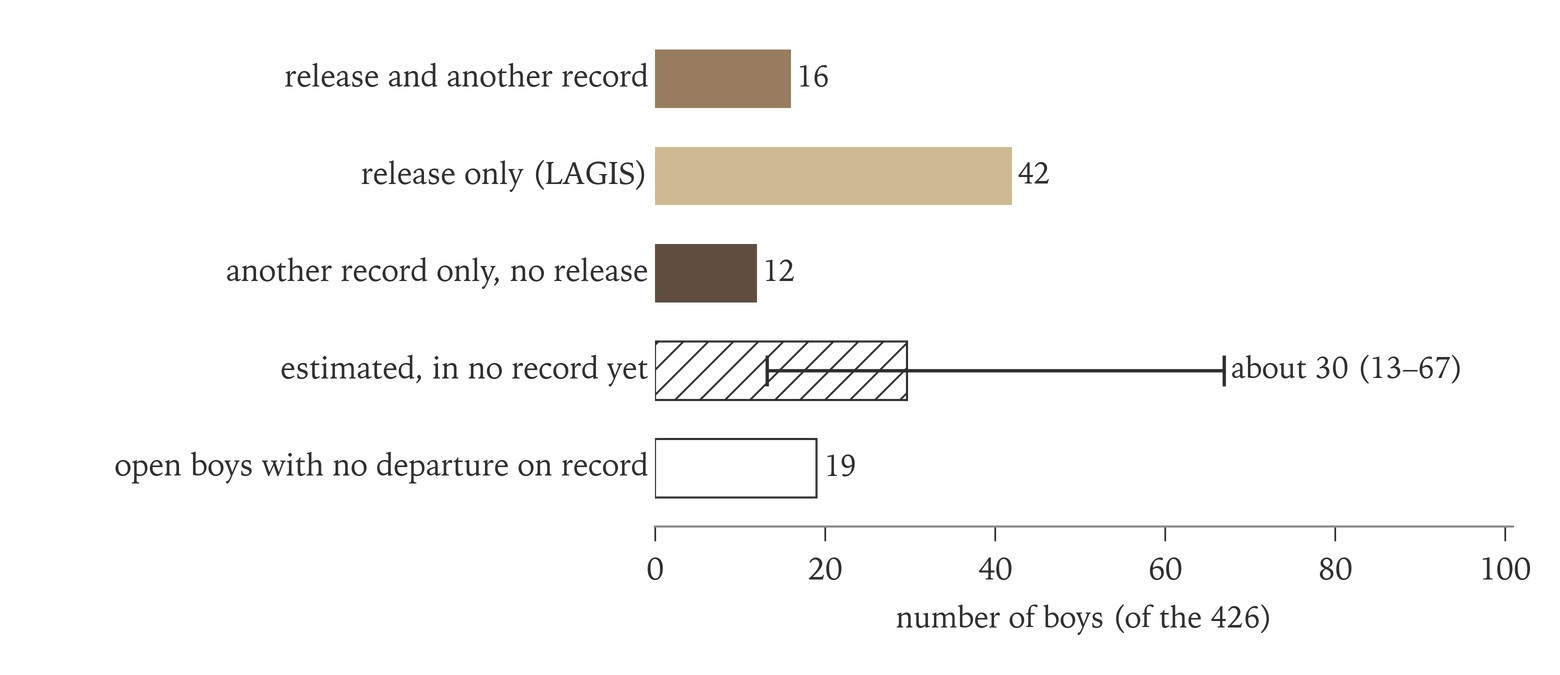
A search can only be as complete as the records that can be read. Some that could name Charles cannot be searched now. They are named under the table that follows, so that a reader can judge how far the search reached.
The search in one table
Table C.12 gathers the whole search for his origin in one place. Each row is a group of records, with the years covered, how the records were read and what they gave. The last column names the chapter or appendix that describes each search in full. The rows marked “not yet read” are the main gaps that remain. Until they are read, the search is wide but not complete.210
Table C.12. The search for his origin, record group by record group
| Records | Years | How they were read | Result | Described in |
|---|---|---|---|---|
| Baptism registers of Trendelburg, Deisel and Friedrichsfeld | 1833–41; also 1830–32 at Trendelburg and Deisel | Read in the pages, every entry. Every boy followed forward in the confirmation, marriage, burial and civil registers | 426 boys: 399 closed, 27 still open. No German record yet names Charles | “The Candidates and How They Were Ruled Out” |
| Baptism registers of the twenty neighboring parishes | 1833–41 | Read in the pages twice, boy by boy, in twenty-two registers. Some burial checks read once | No match. Five parishes have named gaps | This appendix; “The Data Behind This Book,” dataset D9 |
| Baptism registers of thirty-four more places of the district and the Weser | 1833–41 | Read in the pages for every Carl born near 26 January and every Konze or Gans; boy by boy in twenty-seven places and in part in two more | No match. Twenty-five places have named gaps | This appendix; “The Data Behind This Book,” dataset D9 |
| Confirmation classes of the home parishes, the parishes around them and eighteen further parishes | 1845–58; to 1860 in the outer parishes | Read in the registers | No Carl born on 26 January in any year from 1833 to 1841 | This appendix |
| Lying-in hospitals at Marburg, Kassel and Göttingen | 1833–41 | Read | One Marburg boy, born in January 1837, is still being traced | “The Boy from the Goose Corner,” “The case in brief”; “The Name He Used: Gans, Konze or Another Name” |
| Hessian emigration index (LAGIS), the eight villages of today’s Trendelburg | Releases of 1832–66 | Index only | 1,314 entries; none names Karl Ludwig. A release shows permission to leave, not a departure | “The Data Behind This Book,” dataset D2 |
| Martina Lüdicke’s study of emigration from Deisel, and the ministry’s emigration summaries at Marburg | 1833–66; 1858–61 | The study read in full; the summaries read in the images | The study’s list names no one under 1859 or 1860. For 1858–60 the summaries give district totals only | This appendix; “What We Still Do Not Know” |
| Release and emigration files of the district office at Hofgeismar, now at Marburg | 1832–70 | Not yet read. Searched in the catalog and the index only; the originals have not been copied | Open. Deisel’s release files are missing for 1859 and 1860 | “What We Still Do Not Know” |
| Kurhessian army books | 1855–59 | Not yet read. The originals are at Marburg | Open | “What We Still Do Not Know” |
| Deisel property, mortgage and redemption registers at Marburg, with their name index | 1843–60 | Index read for every Hofedietz entry; the family’s account and two of the three entries it cites read in the pages, twice. The third, of 1843, not found | Amalie guardian from 1843; Christoph Moritz guardian of the seven children in 1852 and 1860. In December 1857 he listed his ward Carl as in America. No sale of the family’s land, and no Konze buyer | “The Boy from the Goose Corner,” “The orphan, and the Konze house nearby” |
| Karlshafen court files on Karl Ludwig’s guardianship and his absence | 1843–60 and 1900 | Not yet read. The files are uncataloged and closed to readers | Open | “What We Still Do Not Know” |
| Deisel church-council minutes, and the parish archives of Deisel and Trendelburg at Kassel | 1828–66 (minutes) | Not yet read. The church archive’s catalog was searched; the minutes can be read only at Kassel | Open | “What We Still Do Not Know” |
| The provincial weeklies of Fulda and Oberhessen | 1858 | Fulda read page by page; Oberhessen searched | Karl Ludwig summoned as an absent conscript in February 1858, and judged an absconded conscript that summer | “The Boy from the Goose Corner,” “Gone without a word” |
| Eberhardt’s Allgemeiner Polizei-Anzeiger, a police gazette | 1853–66 | Searched in the full text for Hofgeismar, Deisel and Trendelburg; every hit read | No notice of him | This appendix |
| The provincial weekly of Niederhessen | 1855–62 | Not yet read in full. It survives on microfilm at Kassel, and the library is searching it; its first result is the issue of 16 February 1858 | The summons of February 1858, as in the Fulda weekly; the rest open | “What We Still Do Not Know” |
| Deutscher Reichsanzeiger, the court notices | 1900 | Read in the page image | The Karlshafen court summoned Karl Ludwig as missing in America. His curator was Heinrich Konze | “The Boy from the Goose Corner,” “Gone without a word” |
| Kassel civil marriage registers | 1874–1900 | Index of some 13,700 marriages, and a machine reading of the typed copies, searched for every open boy | None found. An index search is a pointer, not proof | “The Candidates and How They Were Ruled Out” |
| Passenger lists: Hamburg departures; New York, Baltimore and New Orleans arrivals; the Germans to America data | 1853–63 | Searched by place of origin as well as by surname; some lists read page by page, others in an index | Not found. Bremen’s own lists for these years are lost | “The Data Behind This Book,” dataset D5; this appendix |
| 1860 census of St. Louis city and county | 1860 | All 4,716 page images covered; every German-born man of eighteen to thirty-two screened, whatever his name | Not found | “St. Louis before the War, 1859–1862” |
| 1870 census of St. Louis | 1870 | Five wards read page by page, 3,351 pages; the rest by index | Not found | “The Data Behind This Book,” dataset D7 |
| Marriage registers of St. Marcus, Holy Ghost and St. Peter’s, three German Evangelical churches of St. Louis | St. Marcus 1850–80 (FamilySearch images 324–449); Holy Ghost 1855–80; St. Peter’s 1855–60 | Read in the pages, some 5,000 entries | 104 entries name Kurhessians. Three involve Kreis Hofgeismar, Charles’s own among them. No one else from Deisel, Trendelburg or Friedrichsfeld appears | “The Data Behind This Book,” dataset D11; “Marriage, 1866” |
| St. Louis city directories | 1860–1904 | Read year by year under every spelling of the surname and under Johnson | No entry for him in 1860; no directory was published for 1861 or 1862. Kennedy’s directory of 1859 has not yet been read | “St. Louis before the War, 1859–1862”; “What We Still Do Not Know” |
| His naturalization at St. Louis | 1868 | The court’s record of 21 October 1868 | He renounced the King of Prussia. The record names no place | “Where and When He Was Born” |
| Enlistment papers, compiled service record and pension file | 1862–65 and 1890–1904 | Read in the images | Trendelburg as his birthplace, on his own oath of 1862. He never named his parents. The battery’s descriptive book has been asked for | “Where and When He Was Born” |
| St. Louis newspapers, German and English | His St. Louis years | Searched for every form of his name; the pages for the key dates also read one by one | No St. Louis paper is known to have run a story about him | This appendix |
| St. Louis records searched for the boys of the home parishes | 1850–1900 | Index only, each search with a control | 1,076 searches for 358 boys. One possible match, since judged very probably not him | “The Data Behind This Book,” dataset D8 |
| DNA: a Big Y-700 test of a descendant in his male line, and autosomal tests at three companies | Match lists read in 2026 | Matches and their trees searched for the surnames and the villages | No relative in Germany identified. A small group of matches rooted in the Deisel area is weak evidence. The two tests that bear on Karl Ludwig have not been done | “What DNA Can and Cannot Say” |
Sources: search coverage211; ledger of the boys212; emigration index213; the archive’s replies214; the weeklies and the court notice215; passenger lists216; St. Marcus marriages217; naturalization218; military and pension records219; DNA220. The other searches are cited where the last column says they are described.
Note: the first three rows together are the fifty-seven places of the parish search.
Three rows of table C.12 are records that exist but have not yet been searched in full. The Karlshafen court files on Karl Ludwig’s guardianship and his absence are the largest gap. In November 2026 an archivist at Marburg looked at them for the researcher engaged to work there. They are a very large mass of loose, unsorted papers; they cannot be searched for lack of staff, and they will not be cataloged soon.221 The parish archive of Deisel, at the church archive in Kassel, is not cataloged either.222 The university library at Kassel agreed to search the Niederhessen weekly. A broken microfilm reader delayed the work, and the first result came on 17 November 2026: the summons of February 1858.223 Other files at Marburg are open but not yet read. In November 2026 the same researcher is to photograph the 1829–30 court file “Konze against the widow Hoffeditz,” Deisel’s release files, its poor-relief file and the district’s pass registers.224
The search by rings
The search worked outward in rings from the places Charles named. In the innermost ring every boy of the right years was identified and followed one by one. In the outer rings the registers were read for the boys who could be Charles. In Ring 1 that meant every Carl, Konze, Gans and boy born out of wedlock; in Ring 2, every Carl born near 26 January and every Konze or Gans. A ring is complete only when no lead in it is still open.225
The chart gives what became of the Ring 1 boys, parish by parish.226
The Dornette database’s records of godparents and marriages for 1820–60, which measure how far a family’s ties reached, give 289 ties with a known place. Half lay within three kilometers of home, three in four within ten, and nine in ten within about thirty. Kassel was the one large exception, as the capital always drew people. The search rings were drawn by judgment, but they fit this pattern: the first ring contains about four ties in five, and the second ring, together with Kassel, about nine in ten.227
Table C.13. The search, ring by ring, and what it found
| Ring | Places | Parishes (no.) | How they were searched | Result |
|---|---|---|---|---|
| 0 | Trendelburg, Deisel and Friedrichsfeld | 3 | Every baptism read; every boy born 1833–41 followed forward one by one | 426 boys born 1833–41: 399 closed (adult record or early death); 24 untraced and 3 probably traced, all still open |
| 1 | The neighboring parishes | 20 | Baptisms 1833–41 read for every Carl, Konze, Gans and boy born out of wedlock; confirmations to 1858–60; every boy’s baptism read twice, entry by entry | 15 read in the pages, no match; 5 read in the pages, no match, but with named gaps (listed years or pages missing from the film or not yet read). Baptisms read boy by boy, twice, in every month in all 20 (22 registers); some burial checks have been read only once |
| 2 | The district and the Weser parishes | 34 | Baptisms 1833–41 read for Carls near 26 January, Konze and Gans; confirmations; the full read is under way | 9 read in the pages, no match; 25 read in the pages, no match, but with named gaps (listed years or pages missing from the film or not yet read). Read boy by boy in every month in 27, and in part in 2 more |
Sources: search coverage228; ledger of the boys229.
The rings were also tested against the moves of men of Charles’s generation, in two ways. The first test used the marriage registers of Trendelburg and Friedrichsfeld for 1855–75. It took the 104 grooms born in 1825–45 whose birthplace both readings of the register give the same way. Of the ninety-seven whose birthplace could be placed on the map, nine in ten were born within 7.8 kilometers of the church where they married (95 percent interval 5.1–9.3 kilometers). Of these, ninety-five were born within fifteen kilometers, the outer limit of Ring 1.230
The second test followed the boys born at Trendelburg, Deisel and Friedrichsfeld in 1833–41 to their later lives in Germany. Of the ninety-four traced in the records to a named place, seventy-eight were found within fifteen kilometers of Trendelburg. Another thirteen were found at places outside the area mapped for this test, so their distance was not measured. The share within fifteen kilometers therefore lies between eighty-three and ninety-seven percent. Most of those thirteen places, such as Hamburg and Frankfurt, lie far beyond that distance, so the true share is nearer the lower figure.231 For fourteen of the sixteen men not found within that distance, the distant place comes from a record dated after 1866, when Kurhessen became part of Prussia. The rings therefore cover the usual range of marriage and settlement, but not long-distance moves, which were sought instead by birthplace in distant civil registers. The figures describe only the men whose later records were found, and the registers read lie near home, so long moves are undercounted.232
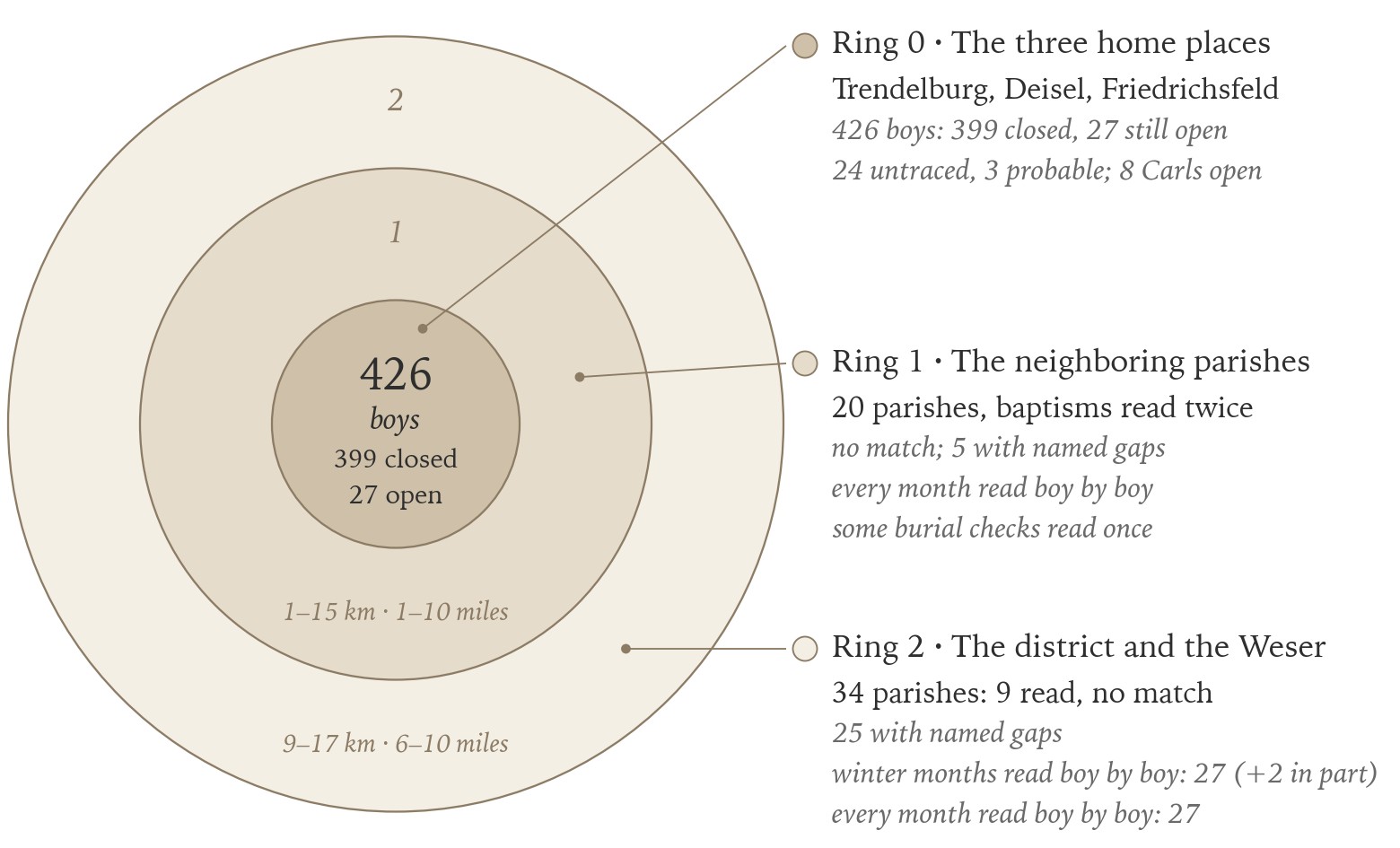
The confirmation classes were a second check. They were read from 1845 to 1858, and in the outer parishes to 1860, in the three parishes, the ring around them and eighteen further parishes of the church district. None holds a Carl born on 26 January in any year from 1833 to 1841. The chapter “The Name He Used: Gans, Konze or Another Name” describes the one Carl of a Konze family among them.234 In the eighteen parishes of the church district that a German paleographer who compiles village family books recommended, about 2,900 baptisms of 1833–41 were also read, and they name no Konze or Gans.235
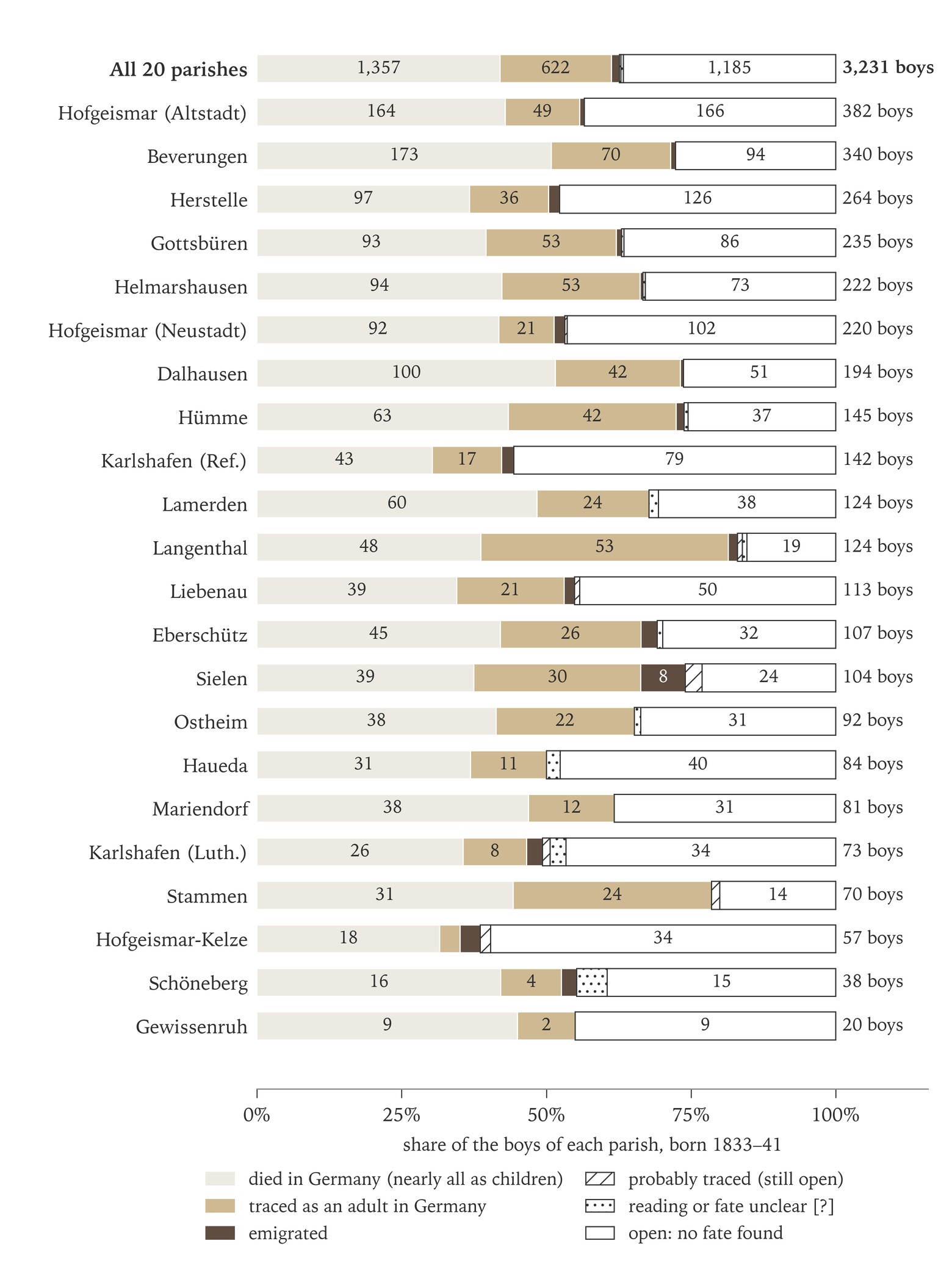
For a boy, this book says “ruled out” only in the sense set out above. For a parish it says “searched, no match”: the years read hold no baptism fitting Charles, which is negative evidence, not proof that he was not born there.
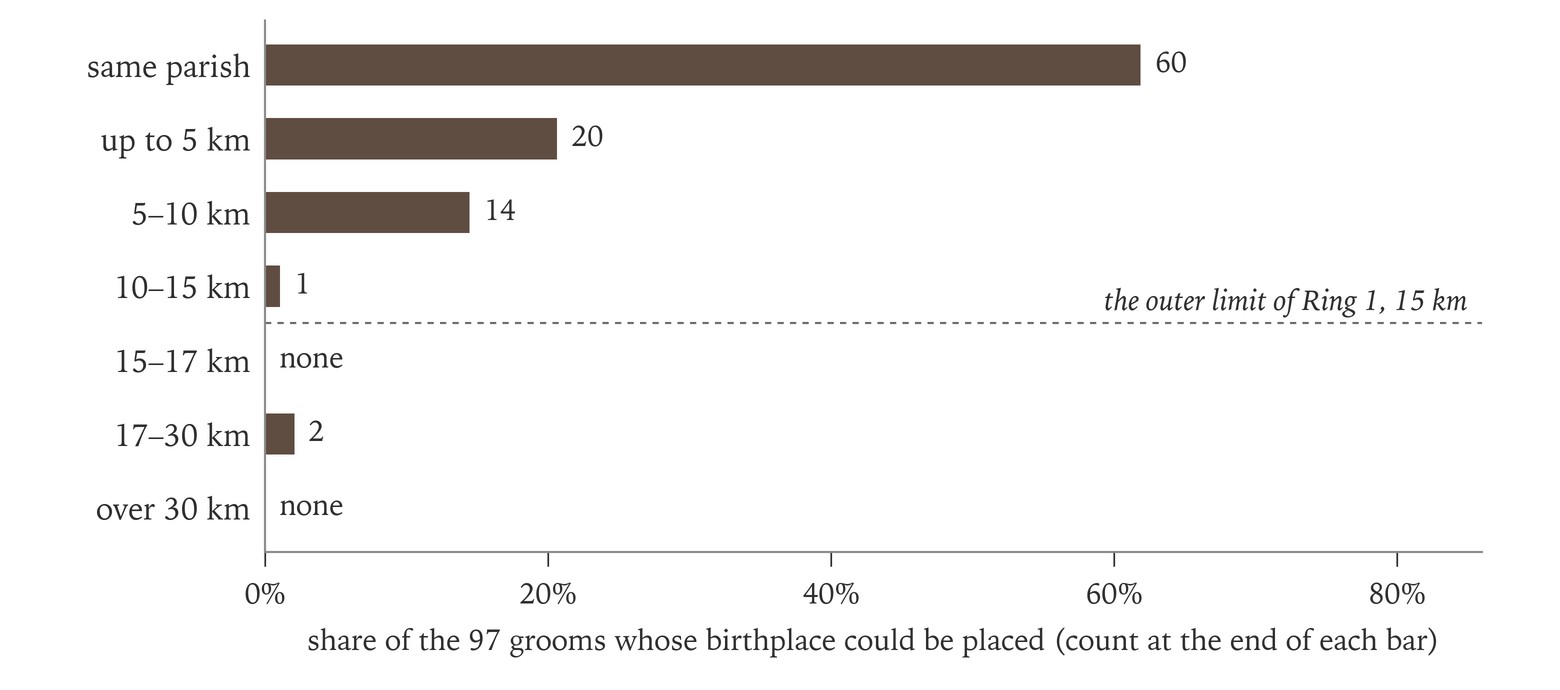
The finding aids and the American side
No database counted as negative evidence until its coverage had been measured. The Dornette regional birth database contains only about three in five of the Deisel baptisms, one in three at Trendelburg and one in four at Friedrichsfeld. It therefore served to point to records and never to rule a boy out.238 The American searches met the same test of completeness. The 1860 census of St. Louis city and county was covered through the index entries for every one of its 4,716 page images. Each German-born man of eighteen to thirty-two in it was screened, regardless of his name.239 In the 1870 census five wards were read page by page, 3,351 pages in all, and the rest of the city and the county were searched in the index only.240 The Hamburg passenger lists were searched by origin, age, and forename as well as by surname.241 None of these searches found him.
Tools, funding and data
How AI tools were used
AI assistants were used throughout this project, in the author’s own accounts and under his direction, and he is responsible for what the book says. They ran many of the searches and first readings of the records, transcribed and translated records, drafted much of the text, and wrote and ran the scripts behind the statistics, charts and maps. The surname emblems and the oak drawings at the chapter ends were made with an AI image tool. Second readings were made by another AI agent working blind, without seeing the first reading; the author did not check every image himself. Not every set of readings has had one yet; “How good the data are” shows which sets were read twice and how well the two readers agreed. The blind reviewers listed at the end of “The order of work” were AI models as well, and the author delegated his ten-case check of the middle-initial count to an AI model. AI readings of old German handwriting can be wrong, and two readers can agree and both be wrong. No AI output was treated as a source. Every citation names the original record, so any reader can check it without relying on the AI’s work. The conclusions and the grades of evidence are the author’s.
Funding
The author and his family funded the research and the printing. No supporter reviewed or shaped the findings.
Data and code
The data and scripts behind every count, chart and share in this book are being deposited as a dataset at Zenodo, an open research archive. Zenodo gives it a permanent link, listed on the research website. It holds the list of the boys of the home parishes, the table of what was searched, and the scripts. Every row names the original record it comes from, so anyone can recompute each count and check it against the pages.242 The technical appendix, on the research website (charles-research.netlify.app) and in the dataset, gives the full method. It holds the clue table, the statistical methods, the tables of reader agreement and data quality, the assumptions, and the gaps and threats to the results. It also holds the filled reporting checklists and a table that ties each printed number to the file and script that reproduce it.
Privacy
The public edition names no living member of the family other than the author and those thanked in the Acknowledgments. Living researchers are named only for their work. The family edition adds the later generations for the family’s own use and is not to be scanned or shared online; neither edition names a DNA match. Codes of ethics in genealogy require permission before a living person’s information, including genetic data, is published.243 Matches are therefore given only by code, with no name, kit number or close relative named, and the table of matches gives their family trees by region only.244 The book quotes records that mention sensitive matters, such as a birth out of wedlock, only for people who lived long ago.
Everything here can be checked, and much of it can still be carried further; “What We Still Do Not Know” lists the open leads.
Notes
244 notes
- AncestryProGenealogists, commissioned research journal on the German origin of Charles Johnson, February–June 2020 (unpublished). [PGJ]
- The Trendelburg researcher, transcriptions and family charts (Stammtafeln) for families of Deisel, Trendelburg, Friedrichsfeld, Hofgeismar (Altstadt) and Lippoldsberg, with families at Wehrden, Grebenstein and Schöneberg, and a list of emigrants from Deisel to 1859 (spreadsheet, 15 Oct 2025); spot-checked against the registers, 8 November 2026 (six entries: three agree; the birth dates of Deisel 1835 Nro 199, Hofgeismar Altstadt 1837 Nr. 469 and Friedrichsfeld 1831 Nro 6 differ from the register); emails between that researcher and Jed Johnson, 26 July–8 August 2019 and 24 August 2025–8 November 2026, privately held by the author. [Trendelburg researcher's charts, 2025]
- Klaus Kunze, Ortssippenbücher (HeiKun-Verlag) for Helmarshausen (1521–1950). [OSB]
- Database of births, deaths and marriages for Gottsbüren and the surrounding parishes (“Gottsbüren und Umgebung”). [Gottsbüren database (Dornette)]
- Board for Certification of Genealogists, Genealogy Standards, 2nd ed. rev. (Nashville, Tenn.: Ancestry, 2021). E-book edition (2nd ed., rev.), chapter 1, “The Genealogical Proof Standard.” Elizabeth Shown Mills, Evidence Explained. Chapters 1–3, pp. 17–134. [BCG] [MILLS]
- Roger P. Minert, Deciphering Handwriting in German Documents. [MINERT]
- Blaine T. Bettinger, The Family Tree Guide to DNA Testing and Genetic Genealogy, p. 68. Blaine T. Bettinger, The Shared cM Project, version 4.0 (March 2020), averages and ranges of shared centimorgans by relationship, as presented in DNA Painter’s Shared cM Project tool (dnapainter
.com/ , accessed 6 November 2026). [BETT] [SCP4]tools/ sharedcmv4 - Walter D. Kamphoefner, “St. Louis Germans and the Republican Party, 1848–1860,” Mid-America 57 (1975). [KAMPH]
- Simone A. Wegge, “Chain Migration and Information Networks,” Journal of Economic History 58, no. 4 (December 1998); Simone A. Wegge, “Occupational Self-Selection of European Emigrants,” European Review of Economic History 6, no. 3 (December 2002); Martina Lüdicke, „Verschwunden ist der Strand…“ Studien zur Auswanderung nach Amerika aus Kurhessen in den Jahren 1831–1866, dargestellt am Beispiel des Dorfes Deisel (Kreis Hofgeismar) [“The shore has vanished…”: studies of emigration to America from Kurhessen in the years 1831–1866, shown by the example of the village of Deisel (Kreis Hofgeismar)] Die Geschichte unserer Heimat 14 (Hofgeismar: Verein für hessische Geschichte und Landeskunde, Zweigverein Hofgeismar, 1994). Read in full in a copy borrowed through interlibrary loan, 5 Nov 2026; Walter D. Kamphoefner, “Who Went South? The German Ethnic Niche in the Northern and Southern Hemispheres,” Social Science History 41, no. 3 (2017). [WEGGE98C] [WEGGE02] [LUED] [KAMPH17]
- City of St. Louis, certificate of death, burial permit no. 10619 (register no. 4166), image 1009. [DC03]
- AncestryProGenealogists, commissioned research journal on the German origin of Charles Johnson, February–June 2020 (unpublished). [PGJ]
- Declaration of Recruit, Volunteer Enlistment and surgeon’s form for examining a recruit, 2 Dec 1862, St. Louis. [ENL62]
- Compiled Military Service Record, Charles Gannsen, Battery B., rolls 327 and 762; Charles Gannson (Private, Battery B, 2nd Missouri Light Artillery, Civil War), pension application no. Inv. 749,432, certificate no. 684,507; Case Files of Approved Pension Applications of Veterans Who Served in the Army and Navy Mainly in the Civil War and the War with Spain, 1861–1934; Civil War and Later Pension Files; Record Group 15: Records of the Department of Veterans Affairs; National Archives, Washington, D.C.; digital copy of the file supplied to the author by the National Archives, imaged at https://
charles-research : accessed 30 October 2026. Mail-order copies ordered by the author, first a partial file, order F21-314123835E, submitted 14 February 2017 and delivered electronically, and then the complete file, order F41-523680269E, submitted 8 September 2019 and sent by mail. Charles was a sergeant from 7 November 1863 until 15 March 1865. [CSR] [PEN].netlify .app/ pension-file .html - Working positions of the research, October 2026. [DEC]
- Working positions of the research, October 2026; The surname record: twenty-eight attestations of Charles’s surname in fourteen spellings. [DEC] [SURN]
- Declaration of Recruit, Volunteer Enlistment and surgeon’s form for examining a recruit, 2 Dec 1862, St. Louis. [ENL62]
- Working positions of the research, October 2026; Parish search coverage, 57 places of Kreis Hofgeismar. [DEC] [COVER]
- St. Marcus Evangelical Church (St. Louis, Missouri), marriage registers 1850–1880, images 324–449, image 331, image 355, p. 98, image 55. [WALL]
- Working positions of the research, October 2026. [DEC]
- Charles Gannson (Private, Battery B, 2nd Missouri Light Artillery, Civil War), pension application no. Inv. 749,432, certificate no. 684,507; Case Files of Approved Pension Applications of Veterans Who Served in the Army and Navy Mainly in the Civil War and the War with Spain, 1861–1934; Civil War and Later Pension Files; Record Group 15: Records of the Department of Veterans Affairs; National Archives, Washington, D.C.; digital copy of the file supplied to the author by the National Archives, imaged at https://
charles-research : accessed 30 October 2026. Mail-order copies ordered by the author, first a partial file, order F21-314123835E, submitted 14 February 2017 and delivered electronically, and then the complete file, order F41-523680269E, submitted 8 September 2019 and sent by mail. Charles was a sergeant from 7 November 1863 until 15 March 1865. [PEN].netlify .app/ pension-file .html - Compiled Military Service Record, Charles Gannsen, Battery B., rolls 327 and 762; Declaration of Recruit, Volunteer Enlistment and surgeon’s form for examining a recruit, 2 Dec 1862, St. Louis; Missouri Adjutant General, descriptive rolls, 2nd Regiment Artillery, images 20, 179, 183; Historical Register of National Homes for Disabled Volunteer Soldiers, p. 2072, no. 2072. [CSR] [ENL62] [AGO] [DAN]
- Roster of the Department of Missouri, Grand Army of the Republic, p. 39. [GAR]
- U.S. War Department, The War of the Rebellion, vol. 22, pp. 344, 417 and 765. [STATIONS]
- St. Marcus Evangelical Church (St. Louis, Missouri), registers of marriages, baptisms, confirmations, deaths and burials, 1850–1903, FamilySearch image group number (IGN) 007769184: marriage 1866, p. 135, entry 676/4 (image 381); confirmation classes 1881–1894; burial register no. 3393 (1903); imaged, FamilySearch (https://
www : accessed 29 October 2026); citing “St. Marcus Evangelical Church records, 1847-1981,” microfilm of originals at the Eden Archives in St. Louis, Missouri. [STM].familysearch .org/ ark:/ 61903/ 3:1:3Q9M-CSMZ-1NJC - St. Marcus Evangelical Church (St. Louis, Missouri), marriage registers 1850–1880, images 324–449, image 331, image 355, p. 98, image 55; St. Marcus Evangelical Church (St. Louis, Missouri), registers of marriages. Confirmation registers, classes 1881–1894, images 240–258. [WALL] [STM]
- 1880 U.S. census, first enumeration (5 June 1880), St. Louis, SD 1, ED 40, p. 14, dwelling 77, family 135, “Ganser, Charles,” 36. In June 1880 he was living at 1621 Jackson Street. 1880 U.S. census, second enumeration (9 November 1880), St. Louis, ED 137, p. 4D (penned), dwelling 15, image 204; 1890 U.S. census, Special Schedule of Surviving Soldiers, ED 55; 1900 U.S. census, St. Louis, Ward 9, enumeration district 129, sheet 5-B, line 96. In June 1900 he was boarding at 170 Sidney Street. [C1880J] [C1880] [VET90] [C1900]
- St. Louis city directories (Kennedy’s, Edwards’, Gould’s), 1860–1904, read year by year in the images under every spelling of the surname and under Johnson. [DIRS]
- St. Louis Recorder of Deeds, Book 382 pp. 392–393 (lease to “Charles Konson,” 1869); Book 391 pp. 478–479 (deed of trust of Rose Carstens, by her trustee Henry Carstens, 18 Oct 1869, on the barroom outfit he later bought); Book 400 pp. 170–171 (deed of trust, Charles Kanson to Louis A. Raum, a barroom outfit from Jacob Orlemann, 18 Jan 1870); imaged, FamilySearch, “Deed records of the city and county of St. Louis, Mo., 1804-1901”: Book 382, image group number (IGN) 008099520, image 239 (https://
www : accessed 4 November 2026); Book 391, IGN 008115150, image 599 (https://.familysearch .org/ search/ film/ 008099520 ?i =238 www : accessed 4 November 2026); Book 400, IGN 008115155, image 125 (https://.familysearch .org/ ark:/ 61903/ 3:1:3Q9M-CSV7-Y828 www : accessed 4 November 2026); St. Louis Court of Criminal Correction, naturalization record, 21 Oct 1868, vol. 10, p. 126; index card imaged, “Missouri, County Naturalization Records, 1830-1985,” FamilySearch, image group number (IGN) 007787201, image 4805 (https://.familysearch .org/ ark:/ 61903/ 3:1:3Q9M-CSV7-KSZK-2 www : accessed 9 November 2026); St. Louis Register of Voters, Ward 9, 1896-series book, line 22, image 191; City of St. Louis, certificate of death, burial permit no. 10619 (register no. 4166), image 1009. [DEEDS] [NAT] [VOTE] [DC03].familysearch .org/ ark:/ 61903/ 3:1:3Q9M-CSMB-S9W3-G - Westliche Post (St. Louis, Missouri), 23 Aug 1867, p. 2 (picnic notice, “Charles Gannsen”; image 641135228), and 15 Jun 1868, p. 2 (advertisement, “Charles Gansen”; image 640596759); Anzeiger des Westens (St. Louis, Missouri); St. Louis Globe-Democrat; St. Louis Post-Dispatch; Missouri Republican (St. Louis, Missouri); all read on ; the two Westliche Post pages imaged, (https://
www , https://.newspapers .com/ image/ 641135228/ www : accessed 7 November 2026); Westliche Post (St. Louis, Missouri), 19 Dec 1903, p. 8, image 640863401. [NEWS] [WP03].newspapers .com/ image/ 640596759/ - Steven Rowan, “The German Press in St. Louis and Missouri in the Nineteenth Century: The Establishment of a Tradition,” Papers of the Bibliographical Society of America 99, no. 3 (2005): 459–67, pp. 460–61, https://
www . JSTOR text layer, read 1 Nov 2026. [ROWAN05].jstor .org/ stable/ 24295912 - Steven Rowan, “The German Press in St. Louis and Missouri in the Nineteenth Century,” Papers of the Bibliographical Society of America 99, no. 3 (2005), p. 467. [ROWAN05]
- Landeskirchliches Archiv der Evangelischen Kirche von Kurhessen-Waldeck, Kassel, parish registers of Kirchenkreis Hofgeismar, read in the images on Archion (https://
www : accessed 11 November 2026). [ARCH].archion .de - Parish search coverage, 57 places of Kreis Hofgeismar. [COVER]
- The Trendelburg researcher, transcriptions and family charts (Stammtafeln) for families of Deisel. [Trendelburg researcher's charts, 2025]
- Hessisches Staatsarchiv Marburg (HStAM), Best. 180 Hofgeismar, Nr. 128, Nr. 841; “Periodische Übersichten über die stattgefundenen Auswanderungen” [Periodic summaries of the emigrations that took place], vol. 4 (1858–1861), image 207, fol. 204. [HSTAM] [H3243]
- Landesgeschichtliches Informationssystem Hessen (LAGIS), Hessische Auswanderer, Nr. 128. [LAGIS59]
- Eberhardt’s Allgemeiner Polizei-Anzeiger, vols. 36–64 (1853–1866), Bayerische Staatsbibliothek, Münchener Digitalisierungszentrum (https://
www , e.g. bsb10767130, vol. 36, 1853), also listed in the Deutsches Zeitungsportal (accessed 30 October 2026); every full-text hit for “Hofgeismar,” “Deisel” and “Trendelburg” read (71 hits for Hofgeismar on 8 Oct 2026; the portal counted 68 issues on 30 Oct 2026). [POLIZEI].digitale-sammlungen .de - Wochenblatt für die Provinz Fulda (Fulda), 1858, Nr. 8, p. 82, image 96. [WBFULDA58]
- Wochenblatt für die Provinz Oberhessen (Marburg), 1858, Nr. 39, p. 723, image 730. [WBOBERH58]
- Place-keyed and name-keyed searches of the Hamburg passenger lists (Ancestry collection 1068); Immigrant Ships Transcribers Guild, vol. 16. [SHIPS] [ISTG]
- Klaus Kunze, Ortssippenbücher (HeiKun-Verlag) for Helmarshausen (1521–1950); Database of births, deaths and marriages for Gottsbüren and the surrounding parishes (“Gottsbüren und Umgebung”). [OSB] [Gottsbüren database (Dornette)]
- Martina Lüdicke, „Verschwunden ist der Strand…“ Studien zur Auswanderung nach Amerika aus Kurhessen in den Jahren 1831–1866, dargestellt am Beispiel des Dorfes Deisel (Kreis Hofgeismar) [“The shore has vanished…”: studies of emigration to America from Kurhessen in the years 1831–1866, shown by the example of the village of Deisel (Kreis Hofgeismar)] Die Geschichte unserer Heimat 14 (Hofgeismar: Verein für hessische Geschichte und Landeskunde, Zweigverein Hofgeismar, 1994). Read in full in a copy borrowed through interlibrary loan, 5 Nov 2026. Pages 32 (the count), 60 (the letters), 69–70 (the sources) and 86–89 (the list). [LUED]
- Johannes Köster, letters to his wife and children at Kassel, 6 Nov 1858 – 2 Dec 1862, pp. 1–55. [KOESTER]
- FamilyTreeDNA Big Y-700 test of a direct male-line descendant of Charles; Autosomal tests of a descendant of Charles at FamilyTreeDNA, AncestryDNA and MyHeritage. [BIGY] [AUTO]
- Thomas W. Jones, “Writing about, Documenting, and Publishing DNA Test Results,” in Advanced Genetic Genealogy: Techniques and Case Studies, ed. Debbie Parker Wayne (Cushing, Tex.: Wayne Research, 2019), 277–302, p. 291 (standards and codes of ethics require permission to publish information, including genetic data, about living people), p. 292 (without permission, names, locations, close relatives and DNA kit numbers are withheld), p. 299 (sources readers cannot consult, such as a personal match list behind one password, carry little value; transfer or anonymized data where possible). Print copy, Harold B. Lee Library, Brigham Young University, via interlibrary loan; pages read in photographs, 8 November 2026; place, publisher and year from the title page and its verso. Page 299. [JONES19]
- Maarten H. D. Larmuseau, Pieter van den Berg, Sofie Claerhout, no. 23. [LARMUSEAU19]
- Ev. Kirchengemeinde Deisel, “Trauungen 1830–1901” [Marriages 1830–1901], image 1305, p. 12, no. 29. [AND1833]
- Autosomal tests of a descendant of Charles: FamilyTreeDNA Family Finder match list and segment export (7 Jun 2026; match list searched again 10 and 18 Oct 2026; close-relative link 18 Oct 2026; compared with a close relative of the tested descendant, 21 Oct 2026); AncestryDNA ethnicity estimate, match list, ThruLines and parental side assignment (28 Jun, 10 Oct, 18 Oct and 21 Oct 2026); MyHeritage DNA, Ethnicity Estimate v2.5, match list, AutoClusters and chromosome browser (7 Jun, 18–19 Jul, 10 Oct, 18 Oct and 22 Oct 2026); FamilyTreeDNA paternal assignment by Family Matching, 22 Oct 2026, reviewed again 23 Oct 2026; father’s-side matches searched for the surnames of all proposed candidate families, 22 Oct 2026; AncestryDNA father’s-side matches with trees in the villages of Kreis Hofgeismar checked for shared matches among themselves, 28 Oct 2026 (no group found); the close relative’s AncestryDNA match list searched for the sisters’ families and villages, 29 Oct 2026; MyHeritage chromosome browser, segment positions (build 37) and triangulation, 28 and 31 Oct 2026; AncestryDNA and MyHeritage match trees searched for the Hofedietz line, 2–3 Nov 2026; MyHeritage match sizes and segment counts read again 6 Nov 2026. Living matches are identified by code and not named. [AUTO53]
- Blaine T. Bettinger, The Shared cM Project, version 4.0 (March 2020), averages and ranges of shared centimorgans by relationship, as presented in DNA Painter’s Shared cM Project tool (dnapainter
.com/ ), read 29 Oct 2026, 31 Oct 2026 and 3 Nov 2026. The tool’s relationship probabilities come from AncestryDNA’s simulations, digitized by Leah Larkin, as given by DNA Painter; the simulations themselves were not read. [SCP453]tools/ sharedcmv4 - Patricia Lee Hobbs, “Correlating Documentary and DNA Evidence to Identify an Unknown Ancestor,” in Advanced Genetic Genealogy, p. 252, p. 253. [HOBBS19]
- Autosomal tests of a descendant of Charles. [AUTO53]
- Blaine T. Bettinger, The Shared cM Project, version 4.0 (March 2020), averages and ranges of shared centimorgans by relationship, as presented in DNA Painter’s Shared cM Project tool (dnapainter
.com/ ), read 29 Oct 2026, 31 Oct 2026 and 3 Nov 2026. The tool’s relationship probabilities come from AncestryDNA’s simulations, digitized by Leah Larkin, as given by DNA Painter; the simulations themselves were not read. [SCP453]tools/ sharedcmv4 - Ev. Kirchengemeinde Trendelburg, Taufen 1830–1863 (Archion register 220108), Nro 58–333 (1833–1841) read from the body leaves. [TBAP]
- Ev. Kirchengemeinde Trendelburg, Taufen 1830–1863 (Archion register 220108), Nro 58–333 (1833–1841) read from the body leaves. [TBAP]
- Evangelische Kirchengemeinde Deisel (Deisel, Kreis Hofgeismar, Kurhessen), “Taufen 1830–1861” [Baptisms 1830–1861] (Archion register 218842), image 51. [PERSON]
- 1870 U.S. census, St. Louis city and county, https://
www . [C1870].familysearch .org/ search/ collection/ 1438024 - Compiled Military Service Record, Charles Gannsen, Battery B., rolls 327 and 762. [CSR]
- Board for Certification of Genealogists, Genealogy Standards, 2nd ed. rev. (Nashville, Tenn.: Ancestry, 2021). E-book edition (2nd ed., rev.), chapter 1, “The Genealogical Proof Standard.” [BCG]
- Elizabeth Shown Mills, Evidence Explained. Page 11 (the Evidence Analysis Process Map). [MILLS]
- Declaration of Recruit, Volunteer Enlistment and surgeon’s form for examining a recruit, 2 Dec 1862, St. Louis; 1900 U.S. census, St. Louis, Ward 9, enumeration district 129, sheet 5-B, line 96; St. Marcus Evangelical Church (St. Louis, Missouri), burial register, pp. 240–241, no. 3393, image 943. [ENL62] [C1900] [BUR03]
- The surname record: twenty-eight attestations of Charles’s surname in fourteen spellings; St. Marcus Evangelical Church (St. Louis, Missouri), burial register, pp. 240–241, no. 3393, image 943; City of St. Louis, certificate of death, burial permit no. 10619 (register no. 4166), image 1009. [SURN] [BUR03] [DC03]
- Thomas W. Jones, Mastering Genealogical Proof, NGS Special Topics Series, no. 107, chap. 5, pp. 77–78. [JONESMGP]
- The certainty wording used in this book; see “How to Read This Book.” [CW]
- Leah Larkin and Jonny Perl, “What Are the Odds?” (WATO), version 2, DNA Painter (https://
dnapainter : accessed 8 November 2026), a tool that compares hypothetical family trees against shared-cM probabilities simulated by AncestryDNA, with odds calculated by Andrew Millard’s method; DNA Painter, “What Are the Odds? FAQ” (https://.com/ tools/ wato dnapainter : accessed 31 October 2026), on relative scores, on scores that “cannot provide proof on its own,” and on endogamy, which “may significantly affect the scores.” No odds threshold for accepting a hypothesis is given; the 100-to-1 threshold is the author’s. [WATO].com/ help/ wato-faq - Blaine T. Bettinger and Debbie Parker Wayne, Genetic Genealogy in Practice, pp. 13 and 18, pp. 84 and 87. [BETTWAYNE]
- Autosomal tests of a descendant of Charles at FamilyTreeDNA, AncestryDNA and MyHeritage; Blaine T. Bettinger, The Family Tree Guide to DNA Testing and Genetic Genealogy. [AUTO] [BETT]
- Blaine T. Bettinger and Debbie Parker Wayne, Genetic Genealogy in Practice, pp. 13 and 18, pp. 73–74. [BETTWAYNE]
- Autosomal tests of a descendant of Charles at FamilyTreeDNA, AncestryDNA and MyHeritage. [AUTO]
- Leah Larkin and Jonny Perl, “What Are the Odds?” (WATO), version 2. [WATO]
- Blaine T. Bettinger and Debbie Parker Wayne, Genetic Genealogy in Practice, pp. 13 and 18. [BETTWAYNE]
- European Network of Forensic Science Institutes, p. 17, pp. 7 and 22. Forensic scientists are asked to do the same: they list the findings a test could give, with their weight, before the examination. [ENFSI15]
- Brian A. Nosek, Charles R. Ebersole, Alexander C. DeHaven and David T. Mellor, “The Preregistration Revolution,” Proceedings of the National Academy of Sciences 115, no. 11 (13 March 2018): 2600–2606, https://
doi (abstract, p. 2600: the research questions and analysis plan defined “before observing the research outcomes”; section “Challenge 1: Changes to Procedure During Study Administration”: changes and deviations reported transparently); PubMed Central, PMC5856500 (https://.org/ 10 .1073/ pnas .1708274114 pmc : accessed 10 November 2026). Fixing the plan first is what researchers call preregistration. [NOSEK18].ncbi .nlm .nih .gov/ articles/ PMC5856500/ - Jed Johnson, comp., “What would change the conclusion: criteria fixed in advance, 3 November 2026,” and “Amendment 1 to the preregistration of 3 Nov 2026,” both in the docs folder of “The data behind Charles Gannsen and His Family” (dataset compiled for this book, version of 3 November 2026; see the dataset’s README), written before the results of the lying-in, Ring 1, Marburg, Duisburg and DNA searches it names; their SHA-256 checksums are in CHECKSUMS.sha256. “Amendment 2 to the preregistration of 3 Nov 2026,” dated 11 November 2026 and made before any DNA result, in the docs folder of the same dataset, changes the Big Y rule. “Amendment 3 to the preregistration of 3 Nov 2026: the 1855–62 conscript summonses,” dated 11 November 2026, adds the summons clue; its weights were set blind, but it was added after the result was seen. “Amendment 3b to the preregistration of 3 Nov 2026: validation of the candidate model,” of the same date, sets how the weighing is tested on known men. “Amendment 3c to the preregistration of 3 Nov 2026: two proposed changes to the candidate model, and how they will be judged,” dated 11 November 2026, sets how changes to the weighing are tested. “Amendment 3d to the preregistration of 3 Nov 2026: three proposed improvements to the candidate model, and how they will be judged,” of the same date, proposes three more changes. Each was signed before the sealed cases it governs were scored. “Amendment 3e to the preregistration of 3 Nov 2026: a revised departure clue and a refit of the model on 73 known men, and how they will be judged” sets the second round. It is dated and signed 12 November 2026, before its sealed cases were scored. “Amendment 3f to the preregistration of 3 Nov 2026: the Kassel court judgments of 1855–62,” dated and signed 12 November 2026 before the clue was run, adds the judgments as new evidence. Their weights were set blind on 11 November 2026. “Amendment 3g to the preregistration of 3 Nov 2026: Konze ties coded for every open boy at the same depth,” dated 12 November 2026 and signed that day before its share was computed, scores every open boy’s Konze ties by one rule, priced by a new blind setter. When its no-Charles check failed at the old setting for Charles’s own clues, that setting was refitted by the rule of Amendment 3c, as 3g allows, with the author’s written approval. “Amendment 3h to the preregistration of 3 Nov 2026: the final round, and the freeze,” dated and signed 12 November 2026 before the middle-initial count was made, fixes the form of the weighing, fixes the setting for Charles’s own clues at 2.21, sets the range printed for the chance that Charles is among the open boys, and sets the rule for counting middle initials and for using the count. Its ten-case check of the count, which it gives to the author, was delegated by him; the record of that deviation is kept beside it. “Amendment 3j to the preregistration of 3 Nov 2026: the 1900 census year as a measured spread,” dated 16 November 2026, was written after the author lifted the freeze of 3h for one clue, the year of leaving; its main form was named before any share under it was computed, but its shares were computed before it was signed. “Amendment 3k to the preregistration of 3 Nov 2026: the land act of 1857 in the model,” of the same date, was written after the author lifted the freeze again, for one record: Karl Ludwig’s departure window, taken from the act that reports him in America by 5 December 1857; its share too was computed before it was signed. All ten amendments are in the docs folder of the same dataset; Leah Larkin and Jonny Perl, “What Are the Odds?” (WATO), version 2; Jed Johnson, comp., “DNA decision plan, fixed 10 November 2026,” blind setting. [PREREG] [WATO] [DNAPLAN]
- Colin Aitken, Paul Roberts and Graham Jackson, Fundamentals of Probability and Statistical Evidence in Criminal Proceedings: Guidance for Judges, Lawyers, Forensic Scientists and Expert Witnesses, Communicating and Interpreting Statistical Evidence in the Administration of Criminal Justice, Practitioner Guide no. 1 (Royal Statistical Society, n.d.; dated November 2010 on the Society’s “Statistics law guides” page, https://
rss ), para. 2.28, p. 46 (posterior odds equal the likelihood ratio times the prior odds), and paras. 2.32–2.33, p. 50 (independent events and the product rule) (https://.org .uk/ news-publication/ publications/ law-guides/ rss : accessed 10 November 2026). Paragraph 2.28, p. 46. The odds after a piece of evidence are the odds before it multiplied by its likelihood ratio. Multiplying rests on an assumption: that the DNA result is independent of the record clues, given who Charles was. Nothing in the records can change what a cousin’s DNA shows, so the assumption is reasonable, but it is still an assumption (paragraphs 2.32–2.33, p. 50). [RSS10].org .uk/ RSS/ media/ News-and-publications/ Publications/ Reports %20and %20guides/ rss -fundamentals -probability -statistical -evidence .pdf - Jed Johnson, comp., likelihood-ratio model of the twenty-seven open boys of Trendelburg. [ODDS]
- European Network of Forensic Science Institutes, p. 17. [ENFSI15]
- Maarten H. D. Larmuseau, Joost Vanoverbeke, Anneleen Van Geystelen, no. 1772; Maarten H. D. Larmuseau, Koen Matthijs and Tom Wenseleers, no. 5; Maarten H. D. Larmuseau, Pieter van den Berg, Sofie Claerhout, no. 23; Blaine T. Bettinger, The Shared cM Project, version 4.0 (March 2020), averages and ranges of shared centimorgans by relationship, as presented in DNA Painter’s Shared cM Project tool (dnapainter
.com/ , accessed 6 November 2026). [LARMUSEAU13] [LARMUSEAU16] [LARMUSEAU19] [SCP4]tools/ sharedcmv4 - Jed Johnson, comp., “Branch facts for I-Y38863 (10 Nov 2026),” in “The data behind Charles Gannsen and His Family” (dataset compiled for this book; see the dataset’s README): tester counts and countries on I-Y38863 and the branches above it, from the FamilyTreeDNA Discover data files (tree version 2026.11.1; https://
discover ) and YFull YTree v14.07.00 (https://.familytreedna .com/ y-dna/ I-Y38863/ story www ), read 10 November 2026; living testers given as counts and countries only. [BRANCHF].yfull .com/ tree/ I-Y38863/ - YFull, “What Is YFull’s Age Estimation Methodology?,” FAQ, last updated 20 February 2021 (https://
www : accessed 10 November 2026): reliable SNPs counted in the combBED regions (8,473,821 base pairs) and an assumed rate of one SNP in 144.41 years, with an assumed age of 60 for living testers; the method is based on Adamov, Guryanov, Korzhavin, Tagankin and Urasin, “Defining a New Rate Constant for Y-Chromosome SNPs Based on Full Sequencing Data” (2015), as given in the FAQ (the paper itself not read); Jed Johnson, comp., “Branch facts for I-Y38863 (10 Nov 2026),” in “The data behind Charles Gannsen and His Family”. [YFULLFAQ] [BRANCHF].yfull .com/ faq/ what -yfulls -age -estimation -methodology/ - Genetic Genealogy Standards Committee, “Genetic Genealogy Standards” (10 January 2015), standards 15, “Limitations of Y-DNA Testing” (p. 2), 19, “Interpretation of DNA Test Results,” and 20, “DNA as Part of Genealogical Proof” (p. 3), PDF linked from the committee’s site, https://
www (https://.geneticgenealogystandards .com/ www : accessed 10 November 2026). Standards 15, 19 and 20. [GGS15].thegeneticgenealogist .com/ wp-content/ uploads/ 2015/ 01/ Genetic -Genealogy -Standards .pdf - European Network of Forensic Science Institutes, p. 17. [ENFSI15]
- Jed Johnson, comp., “DNA decision plan, fixed 10 November 2026,” blind setting; Jed Johnson, comp., “Branch facts for I-Y38863 (10 Nov 2026),” in “The data behind Charles Gannsen and His Family”. [DNAPLAN] [BRANCHF]
- Jed Johnson, comp., “DNA decision plan, fixed 10 November 2026,” blind setting. [DNAPLAN]
- Jed Johnson, comp., “DNA decision plan, fixed 10 November 2026,” blind setting. [DNAPLAN]
- Board for Certification of Genealogists, Genealogy Standards, 2nd ed. rev. (Nashville, Tenn.: Ancestry, 2021), standards 9, “Planned research” (p. 11); 17, “Extent” (p. 14); 38, “Source preference” (pp. 23–24); and 58–61, “Genealogical Proofs” (pp. 33–35). Standards 9, “Planned research,” and 17, “Extent.” [BCG21]
- Forward trace of every boy baptized at Trendelburg, Deisel and Friedrichsfeld born 1833–41. [LEDGER]
- Working positions of the research, October 2026. [DEC]
- Declaration of Recruit, Volunteer Enlistment and surgeon’s form for examining a recruit, 2 Dec 1862, St. Louis; 1900 U.S. census, St. Louis, Ward 9, enumeration district 129, sheet 5-B, line 96. [ENL62] [C1900]
- Declaration of Recruit, Volunteer Enlistment and surgeon’s form for examining a recruit, 2 Dec 1862, St. Louis; St. Marcus Evangelical Church (St. Louis, Missouri), marriage register 1866, p. 135, entry 676/4, image 381. [ENL62] [MAR66]
- Parish search coverage, 57 places of Kreis Hofgeismar. [COVER]
- St. Marcus Evangelical Church (St. Louis, Missouri), registers of marriages. [STM]
- Hessisches Staatsarchiv Marburg (HStAM), Best. 180 Hofgeismar, Nr. 128, Nr. 841. [HSTAM]
- The share is a place in the order of work if Charles is one of the open boys, not the chance that Karl Ludwig was Charles.
- Board for Certification of Genealogists, Genealogy Standards, 2nd ed. rev. (Nashville, Tenn.: Ancestry, 2021), standards 9, “Planned research” (p. 11). Standard 38, “Source preference.” [BCG21]
- Parish search coverage, 57 places of Kreis Hofgeismar; Baptism registers of the Ring 1 parishes read twice, 1833–41. [COVER] [R1READS]
- Database of births, deaths and marriages for Gottsbüren and the surrounding parishes (“Gottsbüren und Umgebung”); Klaus Kunze, Ortssippenbücher (HeiKun-Verlag) for Helmarshausen (1521–1950); Klaus Kunze, comp., “Gesamtpersonenregister der Ortssippenbücher: Oberes Weserbergland,” a combined name index of nineteen village family books edited by Klaus Kunze, André Ausmeyer and Rolf Nowak; it gives name, birth or death year and family number (https://
www : searched 24 and 26 October 2026; accessed 3 November 2026). [Gottsbüren database (Dornette)] [OSB] [KUNZEGPR].klauskunze .com/ familienforschung/ gesamtregister .htm - Working positions of the research, October 2026. [DEC]
- Elizabeth Shown Mills, “QuickLesson 11: Identity Problems & the FAN Principle,” Evidence Explained: Historical Analysis, Citation & Source Usage (https://
www : posted 26 August 2012; accessed 3 November 2026). [MILLSFAN].evidenceexplained .com/ content/ quicklesson -11 -identity -problems -fan -principle - Re-examination, 10 Oct 2026, of the eleven key eliminations against the three-identifier image standard. [AUDIT]
- Board for Certification of Genealogists, Genealogy Standards, 2nd ed. rev. (Nashville, Tenn.: Ancestry, 2021), standards 9, “Planned research” (p. 11). [BCG21]
- Board for Certification of Genealogists, Genealogy Standards, 2nd ed. rev. (Nashville, Tenn.: Ancestry, 2021), standards 9, “Planned research” (p. 11). [BCG21]
- Thomas W. Jones, Mastering Genealogical Proof, NGS Special Topics Series, no. 107, chap. 5. [JONESMGP]
- Elizabeth Shown Mills, Evidence Explained; Elizabeth Shown Mills, “QuickLesson 11: Identity Problems & the FAN Principle,” Evidence Explained: Historical Analysis. [MILLS] [MILLSFAN]
- The Chicago Manual of Style, 18th ed. (Chicago: University of Chicago Press, 2024), especially chap. 3, “Illustrations and Tables.” [CMOS18]
- Plain Language Action and Information Network (PLAIN), Federal Plain Language Guidelines, March 2011, rev. 1, May 2011 (Washington, D.C.: PLAIN, 2011); archived copy of the Guidelines’ table of contents on , CyberCemetery, University of North Texas Libraries (https://
cybercemetery : captured 6 October 2012; accessed 8 November 2026). [PLAIN11].unt .edu/ oilspill/ 20121006185804/ http:// www .plainlanguage .gov/ howto/ guidelines/ FederalPLGuidelines/ TOC .cfm - Ivan P. Fellegi and Alan B. Sunter, “A Theory for Record Linkage,” Journal of the American Statistical Association 64, no. 328 (December 1969): 1183–1210, https://
doi ; E. A. Wrigley, ed., Identifying People in the Past (London: Edward Arnold, 1973). [FELLEGI69] [WRIGLEY73].org/ 10 .1080/ 01621459 .1969 .10501049 - European Network of Forensic Science Institutes, p. 17. [ENFSI15]
- Anthony O’Hagan, “Expert Knowledge Elicitation: Subjective but Scientific,” The American Statistician 73, supplement 1 (2019): 69–81, https://
doi ; and Anthony O’Hagan and Jeremy Oakley, SHELF: The Sheffield Elicitation Framework, version 4 (2019) (https://.org/ 10 .1080/ 00031305 .2018 .1518265 tonyohagan : accessed 3 November 2026). [SHELF19].co .uk/ shelf/ - Ruth Gilbert, Rosemary Lafferty, Gareth Hagger-Johnson, Katie Harron, Li-Chun Zhang, Peter Smith, Chris Dibben and Harvey Goldstein, “GUILD: GUidance for Information about Linking Data Sets,” Journal of Public Health 40, no. 1 (March 2018): 191–198, https://
doi (accessed 3 November 2026). [GUILD18].org/ 10 .1093/ pubmed/ fdx037 - Gary S. Collins, Johannes B. Reitsma, Douglas G. Altman and Karel G. M. Moons, “Transparent Reporting of a Multivariable Prediction Model for Individual Prognosis or Diagnosis (TRIPOD): The TRIPOD Statement,” BMJ 350 (7 January 2015): g7594, https://
doi (accessed 3 November 2026). [TRIPOD15].org/ 10 .1136/ bmj .g7594 - Thomas A. Lang and Douglas G. Altman, “Basic Statistical Reporting for Articles Published in Biomedical Journals: The ‘Statistical Analyses and Methods in the Published Literature’ or the SAMPL Guidelines,” International Journal of Nursing Studies 52, no. 1 (January 2015): 5–9, https://
doi (accessed 3 November 2026); Ronald L. Wasserstein and Nicole A. Lazar, “The ASA Statement on p-Values: Context, Process, and Purpose,” The American Statistician 70, no. 2 (2016): 129–133, https://.org/ 10 .1016/ j .ijnurstu .2014 .09 .006 doi (accessed 3 November 2026). [SAMPL15] [ASA16].org/ 10 .1080/ 00031305 .2016 .1154108 - Yoav Benjamini and Yosef Hochberg, “Controlling the False Discovery Rate: A Practical and Powerful Approach to Multiple Testing,” Journal of the Royal Statistical Society, Series B (Methodological) 57, no. 1 (1995): 289–300, https://
doi (accessed 3 November 2026). [BH95].org/ 10 .1111/ j .2517-6161 .1995 .tb02031 .x - Mark D. Wilkinson, Michel Dumontier, IJsbrand Jan Aalbersberg and others, “The FAIR Guiding Principles for Scientific Data Management and Stewardship,” Scientific Data 3 (15 March 2016): article 160018, https://
doi (accessed 3 November 2026). [FAIR16].org/ 10 .1038/ sdata .2016 .18 - Carlo Ginzburg, “Microhistory: Two or Three Things That I Know about It,” trans. John and Anne C. Tedeschi, Critical Inquiry 20, no. 1 (1993): 10–35, at 23–24, https://
www . Read through UVU JSTOR, 4 Nov 2026; checked in the page images. [GINZBURG93].jstor .org/ stable/ 1343946 - William S. Cleveland, The Elements of Graphing Data, rev. ed. (Summit, N.J.: Hobart Press, 1994); William S. Cleveland and Robert McGill, “Graphical Perception: Theory, Experimentation, and Application to the Development of Graphical Methods,” Journal of the American Statistical Association 79, no. 387 (September 1984): 531–554, https://
doi ; Edward R. Tufte, The Visual Display of Quantitative Information, 2nd ed. (Cheshire, Conn.: Graphics Press, 2001). [CLEVE94] [CLEVMCG84] [TUFTE01].org/ 10 .1080/ 01621459 .1984 .10478080 - Ivan P. Fellegi and Alan B. Sunter. [FELLEGI69]
- E. A. Wrigley, ed., Identifying People in the Past (London: Edward Arnold, 1973). [WRIGLEY73]
- Anthony O’Hagan, “Expert Knowledge Elicitation: Subjective but Scientific,” The American Statistician 73. [SHELF19]
- 1900 U.S. census, St. Louis, Ward 9, enumeration district 129, sheet 5-B, line 96; St. Marcus Evangelical Church (St. Louis, Missouri), burial register, pp. 240–241, no. 3393, image 943. [C1900] [BUR03]
- Jed Johnson, comp., likelihood-ratio model of the twenty-seven open boys of Trendelburg; M405 roll 327 (roll image 1560), Gannsen file: Battery muster-out roll, St. Louis, image 228767518, p. 2. [ODDS] [CSRMO]
- Jed Johnson, comp., blind test of the search method on known emigrants of Trendelburg, Deisel and Friedrichsfeld, 2–3 November 2026: 3 full-method cases and 12 ranking cases (plus 2 sensitivity cases), answers sealed until scoring; rerun 5 November 2026 with the current weighing (the author’s and the pooled judgments) on the list of 426 boys, and enlarged to 17 ranking cases (plus 4 sensitivity cases), the 5 added cases set out from American records but not blind; exact Clopper–Pearson intervals, calibration of the shares against the true men, a check of the calibration method on the frozen Ring 1 record-linkage model of 8 November 2026 with 16 grooms from the Dalhausen, Eberschütz and Lamerden, and Beverungen marriage registers, each read twice and matched to his baptism (the calibrated weighing of the open boys has had no such test), AUC and point-biserial correlation with cluster-bootstrap ranges (test design, case files, scores and scoring scripts in the dataset; see the dataset’s README). [VALID]
- Jed Johnson, comp., likelihood-ratio model of the twenty-seven open boys of Trendelburg. [ODDS]
- Jed Johnson, comp., likelihood-ratio model of the twenty-seven open boys of Trendelburg. [ODDS]
- Jed Johnson, comp., blind test of the search method on known emigrants of Trendelburg. [VALID]
- Jed Johnson, comp., likelihood-ratio model of the twenty-seven open boys of Trendelburg. [ODDS]
- Jed Johnson, comp., likelihood-ratio model of the twenty-seven open boys of Trendelburg. [ODDS]
- Forward trace of every boy baptized at Trendelburg, Deisel and Friedrichsfeld born 1833–41. [LEDGER]
- Jed Johnson, comp., “Boys baptized at Deisel, Trendelburg and Friedrichsfeld, 1833–1841,” dataset compiled for this book. [DSFATES]
- Jed Johnson, comp., “Boys baptized at Deisel, Trendelburg and Friedrichsfeld, 1833–1841,” dataset compiled for this book. The 422 are those of the 426 boys baptized whose birth month is recorded. The forty (9 percent) and the thirty-eight (9 percent) are these shares of the 422. They are the base rates against which the ranking weighs the two dates. [DSFATES]
- Jed Johnson, comp., likelihood-ratio model of the twenty-seven open boys of Trendelburg. [ODDS]
- Jed Johnson, comp., likelihood-ratio model of the twenty-seven open boys of Trendelburg. [ODDS]
- Jed Johnson, comp., “Boys baptized at Deisel, Trendelburg and Friedrichsfeld, 1833–1841,” dataset compiled for this book. About one boy in nine was born out of wedlock, a little more often in Trendelburg and Friedrichsfeld than in Deisel: 48 of the 426 boys baptized in the three parishes. A span made this way holds the true share nineteen times in twenty, given how few cases there are; Friedrichsfeld’s is wide because it baptized so few boys. Twenty of the 48 died young, 42 percent against 35 percent of all the boys. [DSFATES]
- Jed Johnson, comp., likelihood-ratio model of the twenty-seven open boys of Trendelburg. [ODDS]
- Jed Johnson, comp., “What would change the conclusion: criteria fixed in advance, 3 November 2026,” and “Amendment 1 to the preregistration of 3 Nov 2026,” both in the docs folder of “The data behind Charles Gannsen and His Family” (dataset compiled for this book, version of 3 November 2026; see the dataset’s README), written before the results of the lying-in, Ring 1, Marburg, Duisburg and DNA searches it names; their SHA-256 checksums are in CHECKSUMS.sha256. “Amendment 2 to the preregistration of 3 Nov 2026,” dated 11 November 2026 and made before any DNA result, in the docs folder of the same dataset, changes the Big Y rule. “Amendment 3 to the preregistration of 3 Nov 2026: the 1855–62 conscript summonses,” dated 11 November 2026, adds the summons clue; its weights were set blind, but it was added after the result was seen. “Amendment 3b to the preregistration of 3 Nov 2026: validation of the candidate model,” of the same date, sets how the weighing is tested on known men. “Amendment 3c to the preregistration of 3 Nov 2026: two proposed changes to the candidate model, and how they will be judged,” dated 11 November 2026, sets how changes to the weighing are tested. “Amendment 3d to the preregistration of 3 Nov 2026: three proposed improvements to the candidate model, and how they will be judged,” of the same date, proposes three more changes. Each was signed before the sealed cases it governs were scored. “Amendment 3e to the preregistration of 3 Nov 2026: a revised departure clue and a refit of the model on 73 known men, and how they will be judged” sets the second round. It is dated and signed 12 November 2026, before its sealed cases were scored. “Amendment 3f to the preregistration of 3 Nov 2026: the Kassel court judgments of 1855–62,” dated and signed 12 November 2026 before the clue was run, adds the judgments as new evidence. Their weights were set blind on 11 November 2026. “Amendment 3g to the preregistration of 3 Nov 2026: Konze ties coded for every open boy at the same depth,” dated 12 November 2026 and signed that day before its share was computed, scores every open boy’s Konze ties by one rule, priced by a new blind setter. When its no-Charles check failed at the old setting for Charles’s own clues, that setting was refitted by the rule of Amendment 3c, as 3g allows, with the author’s written approval. “Amendment 3h to the preregistration of 3 Nov 2026: the final round, and the freeze,” dated and signed 12 November 2026 before the middle-initial count was made, fixes the form of the weighing, fixes the setting for Charles’s own clues at 2.21, sets the range printed for the chance that Charles is among the open boys, and sets the rule for counting middle initials and for using the count. Its ten-case check of the count, which it gives to the author, was delegated by him; the record of that deviation is kept beside it. “Amendment 3j to the preregistration of 3 Nov 2026: the 1900 census year as a measured spread,” dated 16 November 2026, was written after the author lifted the freeze of 3h for one clue, the year of leaving; its main form was named before any share under it was computed, but its shares were computed before it was signed. “Amendment 3k to the preregistration of 3 Nov 2026: the land act of 1857 in the model,” of the same date, was written after the author lifted the freeze again, for one record: Karl Ludwig’s departure window, taken from the act that reports him in America by 5 December 1857; its share too was computed before it was signed. All ten amendments are in the docs folder of the same dataset. [PREREG]
- Jed Johnson, comp., likelihood-ratio model of the twenty-seven open boys of Trendelburg; Jed Johnson, comp., sealed tests of proposed changes to the weighing of the open boys, and the run that added the court-judgment clue, 11–12 November 2026: “Model v2 HOLD test, pooled rounds 2 and 3: result, with a bookkeeping correction” (18 sealed cases, with the approved re-score on the Ring 1 pools); “Model 3d, round-4 HOLD scoring” (15 sealed cases, each change scored once, after a failed plumbing check was fixed); “Adopting model B23: T refit, tail check and Karl Ludwig’s new share,” 12 November 2026; “Model 3e, round-5 HOLD scoring” (15 sealed cases, each change scored once, after a preflight fix; five cases flagged before scoring); “Adopting B23r + 1r: tail check and Karl Ludwig’s new share,” 12 November 2026; for the court-judgment clue, “Amendment 3f run: the Kassel court judgments in the model,” 12 November 2026; and, for the Konze ties weighed by one rule, “Amendment 3g run: Karl Ludwig 68.1%,” 12 November 2026 (with the frozen settings, codings, scores and scripts, in the research dataset); and, for the year of leaving weighed by the measured error of census immigration years, “Amendment 3j: the 1900 census year as a measured spread,” 16 November 2026, with its two audits; and, for Karl Ludwig’s departure window, “Amendment 3k: the land act of 1857 in the model,” 16 November 2026 (same dataset). The search of all 390 boys is “Court judgments and summonses for all 390 boys,” 12 November 2026 (in the research dataset). The rules are Amendments 3c, 3d, 3e, 3f, 3g, 3j and 3k to the preregistration (see PREREG). [ODDS] [MODTEST]
- Jed Johnson, comp., likelihood-ratio model of the twenty-seven open boys of Trendelburg; Jed Johnson, comp., “What would change the conclusion: criteria fixed in advance, 3 November 2026,” and “Amendment 1 to the preregistration of 3 Nov 2026,” both in the docs folder of “The data behind Charles Gannsen and His Family” (dataset compiled for this book, version of 3 November 2026; see the dataset’s README), written before the results of the lying-in, Ring 1, Marburg, Duisburg and DNA searches it names; their SHA-256 checksums are in CHECKSUMS.sha256. “Amendment 2 to the preregistration of 3 Nov 2026,” dated 11 November 2026 and made before any DNA result, in the docs folder of the same dataset, changes the Big Y rule. “Amendment 3 to the preregistration of 3 Nov 2026: the 1855–62 conscript summonses,” dated 11 November 2026, adds the summons clue; its weights were set blind, but it was added after the result was seen. “Amendment 3b to the preregistration of 3 Nov 2026: validation of the candidate model,” of the same date, sets how the weighing is tested on known men. “Amendment 3c to the preregistration of 3 Nov 2026: two proposed changes to the candidate model, and how they will be judged,” dated 11 November 2026, sets how changes to the weighing are tested. “Amendment 3d to the preregistration of 3 Nov 2026: three proposed improvements to the candidate model, and how they will be judged,” of the same date, proposes three more changes. Each was signed before the sealed cases it governs were scored. “Amendment 3e to the preregistration of 3 Nov 2026: a revised departure clue and a refit of the model on 73 known men, and how they will be judged” sets the second round. It is dated and signed 12 November 2026, before its sealed cases were scored. “Amendment 3f to the preregistration of 3 Nov 2026: the Kassel court judgments of 1855–62,” dated and signed 12 November 2026 before the clue was run, adds the judgments as new evidence. Their weights were set blind on 11 November 2026. “Amendment 3g to the preregistration of 3 Nov 2026: Konze ties coded for every open boy at the same depth,” dated 12 November 2026 and signed that day before its share was computed, scores every open boy’s Konze ties by one rule, priced by a new blind setter. When its no-Charles check failed at the old setting for Charles’s own clues, that setting was refitted by the rule of Amendment 3c, as 3g allows, with the author’s written approval. “Amendment 3h to the preregistration of 3 Nov 2026: the final round, and the freeze,” dated and signed 12 November 2026 before the middle-initial count was made, fixes the form of the weighing, fixes the setting for Charles’s own clues at 2.21, sets the range printed for the chance that Charles is among the open boys, and sets the rule for counting middle initials and for using the count. Its ten-case check of the count, which it gives to the author, was delegated by him; the record of that deviation is kept beside it. “Amendment 3j to the preregistration of 3 Nov 2026: the 1900 census year as a measured spread,” dated 16 November 2026, was written after the author lifted the freeze of 3h for one clue, the year of leaving; its main form was named before any share under it was computed, but its shares were computed before it was signed. “Amendment 3k to the preregistration of 3 Nov 2026: the land act of 1857 in the model,” of the same date, was written after the author lifted the freeze again, for one record: Karl Ludwig’s departure window, taken from the act that reports him in America by 5 December 1857; its share too was computed before it was signed. All ten amendments are in the docs folder of the same dataset. [ODDS] [PREREG]
- Jed Johnson, comp., likelihood-ratio model of the twenty-seven open boys of Trendelburg. [ODDS]
- Jed Johnson, comp., sealed tests of proposed changes to the weighing of the open boys; Jed Johnson, comp., “What would change the conclusion: criteria fixed in advance, 3 November 2026,” and “Amendment 1 to the preregistration of 3 Nov 2026,” both in the docs folder of “The data behind Charles Gannsen and His Family” (dataset compiled for this book, version of 3 November 2026; see the dataset’s README), written before the results of the lying-in, Ring 1, Marburg, Duisburg and DNA searches it names; their SHA-256 checksums are in CHECKSUMS.sha256. “Amendment 2 to the preregistration of 3 Nov 2026,” dated 11 November 2026 and made before any DNA result, in the docs folder of the same dataset, changes the Big Y rule. “Amendment 3 to the preregistration of 3 Nov 2026: the 1855–62 conscript summonses,” dated 11 November 2026, adds the summons clue; its weights were set blind, but it was added after the result was seen. “Amendment 3b to the preregistration of 3 Nov 2026: validation of the candidate model,” of the same date, sets how the weighing is tested on known men. “Amendment 3c to the preregistration of 3 Nov 2026: two proposed changes to the candidate model, and how they will be judged,” dated 11 November 2026, sets how changes to the weighing are tested. “Amendment 3d to the preregistration of 3 Nov 2026: three proposed improvements to the candidate model, and how they will be judged,” of the same date, proposes three more changes. Each was signed before the sealed cases it governs were scored. “Amendment 3e to the preregistration of 3 Nov 2026: a revised departure clue and a refit of the model on 73 known men, and how they will be judged” sets the second round. It is dated and signed 12 November 2026, before its sealed cases were scored. “Amendment 3f to the preregistration of 3 Nov 2026: the Kassel court judgments of 1855–62,” dated and signed 12 November 2026 before the clue was run, adds the judgments as new evidence. Their weights were set blind on 11 November 2026. “Amendment 3g to the preregistration of 3 Nov 2026: Konze ties coded for every open boy at the same depth,” dated 12 November 2026 and signed that day before its share was computed, scores every open boy’s Konze ties by one rule, priced by a new blind setter. When its no-Charles check failed at the old setting for Charles’s own clues, that setting was refitted by the rule of Amendment 3c, as 3g allows, with the author’s written approval. “Amendment 3h to the preregistration of 3 Nov 2026: the final round, and the freeze,” dated and signed 12 November 2026 before the middle-initial count was made, fixes the form of the weighing, fixes the setting for Charles’s own clues at 2.21, sets the range printed for the chance that Charles is among the open boys, and sets the rule for counting middle initials and for using the count. Its ten-case check of the count, which it gives to the author, was delegated by him; the record of that deviation is kept beside it. “Amendment 3j to the preregistration of 3 Nov 2026: the 1900 census year as a measured spread,” dated 16 November 2026, was written after the author lifted the freeze of 3h for one clue, the year of leaving; its main form was named before any share under it was computed, but its shares were computed before it was signed. “Amendment 3k to the preregistration of 3 Nov 2026: the land act of 1857 in the model,” of the same date, was written after the author lifted the freeze again, for one record: Karl Ludwig’s departure window, taken from the act that reports him in America by 5 December 1857; its share too was computed before it was signed. All ten amendments are in the docs folder of the same dataset. [MODTEST] [PREREG]
- Jed Johnson, comp., likelihood-ratio model of the twenty-seven open boys of Trendelburg. [ODDS]
- Jed Johnson, comp., likelihood-ratio model of the twenty-seven open boys of Trendelburg. [ODDS]
- European Network of Forensic Science Institutes, p. 17. [ENFSI15]
- Elizabeth Shown Mills, Evidence Explained. Section 1.1, p. 20. [MILLS]
- Jed Johnson, comp., likelihood-ratio model of the twenty-seven open boys of Trendelburg. [ODDS]
- Jed Johnson, comp., likelihood-ratio model of the twenty-seven open boys of Trendelburg. [ODDS]
- Jed Johnson, comp., likelihood-ratio model of the twenty-seven open boys of Trendelburg; Staatsarchiv Hamburg, Auswanderungsamt, 373-7 I, VIII A 1 Band 010, p. 788; Passenger list of the Donau, arrived New York 15 November 1856, line 255, roll 168. [ODDS] [HAMB56] [NYARR56]
- Jed Johnson, comp., likelihood-ratio model of the twenty-seven open boys of Trendelburg; Anthony O’Hagan, “Expert Knowledge Elicitation: Subjective but Scientific,” The American Statistician 73. [ODDS] [SHELF19]
- Jed Johnson, comp., sensitivity of the open-boys weighing to the reading of the 1862 middle initial (L, no weight, C, and C standing for any later name), 12 November 2026, pooled and author’s judgments, 20,000 runs each, with 80 and 95 percent uncertainty intervals (script and output in the research dataset); Jed Johnson, comp., likelihood-ratio model of the twenty-seven open boys of Trendelburg. [INITSENS] [ODDS]
- Jed Johnson, comp., “What would change the conclusion: criteria fixed in advance, 3 November 2026,” and “Amendment 1 to the preregistration of 3 Nov 2026,” both in the docs folder of “The data behind Charles Gannsen and His Family” (dataset compiled for this book, version of 3 November 2026; see the dataset’s README), written before the results of the lying-in, Ring 1, Marburg, Duisburg and DNA searches it names; their SHA-256 checksums are in CHECKSUMS.sha256. “Amendment 2 to the preregistration of 3 Nov 2026,” dated 11 November 2026 and made before any DNA result, in the docs folder of the same dataset, changes the Big Y rule. “Amendment 3 to the preregistration of 3 Nov 2026: the 1855–62 conscript summonses,” dated 11 November 2026, adds the summons clue; its weights were set blind, but it was added after the result was seen. “Amendment 3b to the preregistration of 3 Nov 2026: validation of the candidate model,” of the same date, sets how the weighing is tested on known men. “Amendment 3c to the preregistration of 3 Nov 2026: two proposed changes to the candidate model, and how they will be judged,” dated 11 November 2026, sets how changes to the weighing are tested. “Amendment 3d to the preregistration of 3 Nov 2026: three proposed improvements to the candidate model, and how they will be judged,” of the same date, proposes three more changes. Each was signed before the sealed cases it governs were scored. “Amendment 3e to the preregistration of 3 Nov 2026: a revised departure clue and a refit of the model on 73 known men, and how they will be judged” sets the second round. It is dated and signed 12 November 2026, before its sealed cases were scored. “Amendment 3f to the preregistration of 3 Nov 2026: the Kassel court judgments of 1855–62,” dated and signed 12 November 2026 before the clue was run, adds the judgments as new evidence. Their weights were set blind on 11 November 2026. “Amendment 3g to the preregistration of 3 Nov 2026: Konze ties coded for every open boy at the same depth,” dated 12 November 2026 and signed that day before its share was computed, scores every open boy’s Konze ties by one rule, priced by a new blind setter. When its no-Charles check failed at the old setting for Charles’s own clues, that setting was refitted by the rule of Amendment 3c, as 3g allows, with the author’s written approval. “Amendment 3h to the preregistration of 3 Nov 2026: the final round, and the freeze,” dated and signed 12 November 2026 before the middle-initial count was made, fixes the form of the weighing, fixes the setting for Charles’s own clues at 2.21, sets the range printed for the chance that Charles is among the open boys, and sets the rule for counting middle initials and for using the count. Its ten-case check of the count, which it gives to the author, was delegated by him; the record of that deviation is kept beside it. “Amendment 3j to the preregistration of 3 Nov 2026: the 1900 census year as a measured spread,” dated 16 November 2026, was written after the author lifted the freeze of 3h for one clue, the year of leaving; its main form was named before any share under it was computed, but its shares were computed before it was signed. “Amendment 3k to the preregistration of 3 Nov 2026: the land act of 1857 in the model,” of the same date, was written after the author lifted the freeze again, for one record: Karl Ludwig’s departure window, taken from the act that reports him in America by 5 December 1857; its share too was computed before it was signed. All ten amendments are in the docs folder of the same dataset. [PREREG]
- Jed Johnson, comp., “Amendment 3h §4: the middle-initial count (run 12–13 November 2026),” with its briefs, coding sheets, joining script and output; and “Middle-initial count: the ten-case check, as made by the delegated checker (12 November 2026),” with the record of that deviation from the signed amendment; all in the research dataset, with the count’s result for each case. American middle initials from records of each man’s lifetime only; baptismal names from the sealed keys and the ledger of the boys; the ten check cases read in the record images. [INITCOUNT]
- Jed Johnson, comp., likelihood-ratio model of the twenty-seven open boys of Trendelburg. [ODDS]
- Jed Johnson, comp., likelihood-ratio model of the twenty-seven open boys of Trendelburg. [ODDS]
- Ev. Kirchengemeinde Deisel, “Konfirmationen 1831–1926” [Confirmations 1831–1926], image 931, no. 12, image 941, no. 14. [DCONF]
- Landesgeschichtliches Informationssystem Hessen (LAGIS), Hessische Auswanderer, Nr. 128. [LAGIS59]
- Jed Johnson, comp., likelihood-ratio model of the twenty-seven open boys of Trendelburg. [ODDS]
- Hessisches Staatsarchiv Marburg (HStAM), Protokolle, II Deisel 3 Bd. 3c, pp. 1019–1020, images 229 and 230. [PROT57]
- Jed Johnson, comp., likelihood-ratio model of the twenty-seven open boys of Trendelburg; Jed Johnson, comp., “What would change the conclusion: criteria fixed in advance, 3 November 2026,” and “Amendment 1 to the preregistration of 3 Nov 2026,” both in the docs folder of “The data behind Charles Gannsen and His Family” (dataset compiled for this book, version of 3 November 2026; see the dataset’s README), written before the results of the lying-in, Ring 1, Marburg, Duisburg and DNA searches it names; their SHA-256 checksums are in CHECKSUMS.sha256. “Amendment 2 to the preregistration of 3 Nov 2026,” dated 11 November 2026 and made before any DNA result, in the docs folder of the same dataset, changes the Big Y rule. “Amendment 3 to the preregistration of 3 Nov 2026: the 1855–62 conscript summonses,” dated 11 November 2026, adds the summons clue; its weights were set blind, but it was added after the result was seen. “Amendment 3b to the preregistration of 3 Nov 2026: validation of the candidate model,” of the same date, sets how the weighing is tested on known men. “Amendment 3c to the preregistration of 3 Nov 2026: two proposed changes to the candidate model, and how they will be judged,” dated 11 November 2026, sets how changes to the weighing are tested. “Amendment 3d to the preregistration of 3 Nov 2026: three proposed improvements to the candidate model, and how they will be judged,” of the same date, proposes three more changes. Each was signed before the sealed cases it governs were scored. “Amendment 3e to the preregistration of 3 Nov 2026: a revised departure clue and a refit of the model on 73 known men, and how they will be judged” sets the second round. It is dated and signed 12 November 2026, before its sealed cases were scored. “Amendment 3f to the preregistration of 3 Nov 2026: the Kassel court judgments of 1855–62,” dated and signed 12 November 2026 before the clue was run, adds the judgments as new evidence. Their weights were set blind on 11 November 2026. “Amendment 3g to the preregistration of 3 Nov 2026: Konze ties coded for every open boy at the same depth,” dated 12 November 2026 and signed that day before its share was computed, scores every open boy’s Konze ties by one rule, priced by a new blind setter. When its no-Charles check failed at the old setting for Charles’s own clues, that setting was refitted by the rule of Amendment 3c, as 3g allows, with the author’s written approval. “Amendment 3h to the preregistration of 3 Nov 2026: the final round, and the freeze,” dated and signed 12 November 2026 before the middle-initial count was made, fixes the form of the weighing, fixes the setting for Charles’s own clues at 2.21, sets the range printed for the chance that Charles is among the open boys, and sets the rule for counting middle initials and for using the count. Its ten-case check of the count, which it gives to the author, was delegated by him; the record of that deviation is kept beside it. “Amendment 3j to the preregistration of 3 Nov 2026: the 1900 census year as a measured spread,” dated 16 November 2026, was written after the author lifted the freeze of 3h for one clue, the year of leaving; its main form was named before any share under it was computed, but its shares were computed before it was signed. “Amendment 3k to the preregistration of 3 Nov 2026: the land act of 1857 in the model,” of the same date, was written after the author lifted the freeze again, for one record: Karl Ludwig’s departure window, taken from the act that reports him in America by 5 December 1857; its share too was computed before it was signed. All ten amendments are in the docs folder of the same dataset. [ODDS] [PREREG]
- Jed Johnson, comp., likelihood-ratio model of the twenty-seven open boys of Trendelburg. [ODDS]
- Jed Johnson, comp., likelihood-ratio model of the twenty-seven open boys of Trendelburg. [ODDS]
- Forward trace of every boy baptized at Trendelburg, Deisel and Friedrichsfeld born 1833–41; Database of births, deaths and marriages for Gottsbüren and the surrounding parishes (“Gottsbüren und Umgebung”). [LEDGER] [Gottsbüren database (Dornette)]
- Jed Johnson, comp., likelihood-ratio model of the twenty-seven open boys of Trendelburg. The shares use the judgments of the author and two blind reviewers pooled and the result calibrated. If it is not certain that he is one of them, every share is smaller (see the table above). The interval is the 10th to 90th percentile of 20,000 runs; in each, one of the three sets of judgments was picked at random and each judgment drawn between its low and high value. The clues are treated as independent, except Carl and the parish, which are weighed together because Carls were much rarer at Deisel. Base rates come from the 276 boys of the three home parishes who lived to fourteen (birth dates: all 426 baptisms). n = 27 open boys. [ODDS]
- Thomas W. Jones, Mastering Genealogical Proof, NGS Special Topics Series, no. 107, chap. 5; Board for Certification of Genealogists, Genealogy Standards, 2nd ed. rev. (Nashville, Tenn.: Ancestry, 2021), standards 9, “Planned research” (p. 11). Standards 58–61, under “Genealogical Proofs.” [JONESMGP] [BCG21]
- Jed Johnson, comp., “Kurrent reading test, 13–14 November 2026”: blind readings of 98 Deisel, Sielen, Stammen and Langenthal register entries (Archion registers 218851, 218842, 218845, 218854, 218824, 219703, 220033, 220045, 220069, 220078) by two AI models, scored field by field against readings settled earlier (two agreeing reads, or a disagreement settled by Kunze’s family books or another record) and corrected by an image check; with Archion’s and Transkribus’s machine text on the disputed fields. Score sheets, script and corrections in the research dataset. [READTEST]
- Jed Johnson, comp., likelihood-ratio model of the twenty-seven open boys of Trendelburg. The twenty-seven are in the order of the weighing; the three marked * are from the confirmation classes of the neighboring parishes and are outside it. Each cell gives the weight in bits, after calibration; the key gives the signs. One bit doubles or halves the odds. The share is each boy’s chance, pooled and calibrated, if Charles is one of the open boys, with its 80 percent uncertainty interval in parentheses; a share under 1 percent is given as “under 1.” The clues are treated as independent, except Carl and the parish, which are weighed together. [ODDS]
- Jed Johnson, comp., “Kurrent reading test, 13–14 November 2026”. [READTEST]
- Jed Johnson, comp., blind test of the search method on known emigrants of Trendelburg. [VALID]
- C. J. Clopper and E. S. Pearson, “The Use of Confidence or Fiducial Limits Illustrated in the Case of the Binomial,” Biometrika 26, no. 4 (1934): 404–413, https://
doi . [CLOPPER34].org/ 10 .1093/ biomet/ 26 .4 .404 - Jed Johnson, comp., blind test of the search method on known emigrants of Trendelburg. [VALID]
- Jed Johnson, comp., blind test of the search method on known emigrants of Trendelburg. [VALID]
- Jed Johnson, comp., blind test of the search method on known emigrants of Trendelburg. [VALID]
- Jed Johnson, comp., blind test of the search method on known emigrants of Trendelburg. [VALID]
- C. J. Clopper and E. S. Pearson. [CLOPPER34]
- Jed Johnson, comp., blind test of the search method on known emigrants of Trendelburg; C. J. Clopper and E. S. Pearson. [VALID] [CLOPPER34]
- Jed Johnson, comp., “What would change the conclusion: criteria fixed in advance, 3 November 2026,” and “Amendment 1 to the preregistration of 3 Nov 2026,” both in the docs folder of “The data behind Charles Gannsen and His Family” (dataset compiled for this book, version of 3 November 2026; see the dataset’s README), written before the results of the lying-in, Ring 1, Marburg, Duisburg and DNA searches it names; their SHA-256 checksums are in CHECKSUMS.sha256. “Amendment 2 to the preregistration of 3 Nov 2026,” dated 11 November 2026 and made before any DNA result, in the docs folder of the same dataset, changes the Big Y rule. “Amendment 3 to the preregistration of 3 Nov 2026: the 1855–62 conscript summonses,” dated 11 November 2026, adds the summons clue; its weights were set blind, but it was added after the result was seen. “Amendment 3b to the preregistration of 3 Nov 2026: validation of the candidate model,” of the same date, sets how the weighing is tested on known men. “Amendment 3c to the preregistration of 3 Nov 2026: two proposed changes to the candidate model, and how they will be judged,” dated 11 November 2026, sets how changes to the weighing are tested. “Amendment 3d to the preregistration of 3 Nov 2026: three proposed improvements to the candidate model, and how they will be judged,” of the same date, proposes three more changes. Each was signed before the sealed cases it governs were scored. “Amendment 3e to the preregistration of 3 Nov 2026: a revised departure clue and a refit of the model on 73 known men, and how they will be judged” sets the second round. It is dated and signed 12 November 2026, before its sealed cases were scored. “Amendment 3f to the preregistration of 3 Nov 2026: the Kassel court judgments of 1855–62,” dated and signed 12 November 2026 before the clue was run, adds the judgments as new evidence. Their weights were set blind on 11 November 2026. “Amendment 3g to the preregistration of 3 Nov 2026: Konze ties coded for every open boy at the same depth,” dated 12 November 2026 and signed that day before its share was computed, scores every open boy’s Konze ties by one rule, priced by a new blind setter. When its no-Charles check failed at the old setting for Charles’s own clues, that setting was refitted by the rule of Amendment 3c, as 3g allows, with the author’s written approval. “Amendment 3h to the preregistration of 3 Nov 2026: the final round, and the freeze,” dated and signed 12 November 2026 before the middle-initial count was made, fixes the form of the weighing, fixes the setting for Charles’s own clues at 2.21, sets the range printed for the chance that Charles is among the open boys, and sets the rule for counting middle initials and for using the count. Its ten-case check of the count, which it gives to the author, was delegated by him; the record of that deviation is kept beside it. “Amendment 3j to the preregistration of 3 Nov 2026: the 1900 census year as a measured spread,” dated 16 November 2026, was written after the author lifted the freeze of 3h for one clue, the year of leaving; its main form was named before any share under it was computed, but its shares were computed before it was signed. “Amendment 3k to the preregistration of 3 Nov 2026: the land act of 1857 in the model,” of the same date, was written after the author lifted the freeze again, for one record: Karl Ludwig’s departure window, taken from the act that reports him in America by 5 December 1857; its share too was computed before it was signed. All ten amendments are in the docs folder of the same dataset. [PREREG]
- Jed Johnson, comp., sealed tests of proposed changes to the weighing of the open boys. [MODTEST]
- Jed Johnson, comp., sealed tests of proposed changes to the weighing of the open boys. [MODTEST]
- Jed Johnson, comp., sealed tests of proposed changes to the weighing of the open boys; Wochenblatt für die Provinz Oberhessen (Marburg), 1858, Nr. 39, p. 723, image 730. [MODTEST] [WBOBERH58]
- Jed Johnson, comp., “What would change the conclusion: criteria fixed in advance, 3 November 2026,” and “Amendment 1 to the preregistration of 3 Nov 2026,” both in the docs folder of “The data behind Charles Gannsen and His Family” (dataset compiled for this book, version of 3 November 2026; see the dataset’s README), written before the results of the lying-in, Ring 1, Marburg, Duisburg and DNA searches it names; their SHA-256 checksums are in CHECKSUMS.sha256. “Amendment 2 to the preregistration of 3 Nov 2026,” dated 11 November 2026 and made before any DNA result, in the docs folder of the same dataset, changes the Big Y rule. “Amendment 3 to the preregistration of 3 Nov 2026: the 1855–62 conscript summonses,” dated 11 November 2026, adds the summons clue; its weights were set blind, but it was added after the result was seen. “Amendment 3b to the preregistration of 3 Nov 2026: validation of the candidate model,” of the same date, sets how the weighing is tested on known men. “Amendment 3c to the preregistration of 3 Nov 2026: two proposed changes to the candidate model, and how they will be judged,” dated 11 November 2026, sets how changes to the weighing are tested. “Amendment 3d to the preregistration of 3 Nov 2026: three proposed improvements to the candidate model, and how they will be judged,” of the same date, proposes three more changes. Each was signed before the sealed cases it governs were scored. “Amendment 3e to the preregistration of 3 Nov 2026: a revised departure clue and a refit of the model on 73 known men, and how they will be judged” sets the second round. It is dated and signed 12 November 2026, before its sealed cases were scored. “Amendment 3f to the preregistration of 3 Nov 2026: the Kassel court judgments of 1855–62,” dated and signed 12 November 2026 before the clue was run, adds the judgments as new evidence. Their weights were set blind on 11 November 2026. “Amendment 3g to the preregistration of 3 Nov 2026: Konze ties coded for every open boy at the same depth,” dated 12 November 2026 and signed that day before its share was computed, scores every open boy’s Konze ties by one rule, priced by a new blind setter. When its no-Charles check failed at the old setting for Charles’s own clues, that setting was refitted by the rule of Amendment 3c, as 3g allows, with the author’s written approval. “Amendment 3h to the preregistration of 3 Nov 2026: the final round, and the freeze,” dated and signed 12 November 2026 before the middle-initial count was made, fixes the form of the weighing, fixes the setting for Charles’s own clues at 2.21, sets the range printed for the chance that Charles is among the open boys, and sets the rule for counting middle initials and for using the count. Its ten-case check of the count, which it gives to the author, was delegated by him; the record of that deviation is kept beside it. “Amendment 3j to the preregistration of 3 Nov 2026: the 1900 census year as a measured spread,” dated 16 November 2026, was written after the author lifted the freeze of 3h for one clue, the year of leaving; its main form was named before any share under it was computed, but its shares were computed before it was signed. “Amendment 3k to the preregistration of 3 Nov 2026: the land act of 1857 in the model,” of the same date, was written after the author lifted the freeze again, for one record: Karl Ludwig’s departure window, taken from the act that reports him in America by 5 December 1857; its share too was computed before it was signed. All ten amendments are in the docs folder of the same dataset. [PREREG]
- Jed Johnson, comp., sealed tests of proposed changes to the weighing of the open boys. [MODTEST]
- Jed Johnson, comp., the Konze ties of the twenty-seven open boys searched to the same depth, 12 November 2026. [KTIES]
- Jed Johnson, comp., the Konze ties of the twenty-seven open boys searched to the same depth, 12 November 2026. [KTIES]
- Jed Johnson, comp., “What would change the conclusion: criteria fixed in advance, 3 November 2026,” and “Amendment 1 to the preregistration of 3 Nov 2026,” both in the docs folder of “The data behind Charles Gannsen and His Family” (dataset compiled for this book, version of 3 November 2026; see the dataset’s README), written before the results of the lying-in, Ring 1, Marburg, Duisburg and DNA searches it names; their SHA-256 checksums are in CHECKSUMS.sha256. “Amendment 2 to the preregistration of 3 Nov 2026,” dated 11 November 2026 and made before any DNA result, in the docs folder of the same dataset, changes the Big Y rule. “Amendment 3 to the preregistration of 3 Nov 2026: the 1855–62 conscript summonses,” dated 11 November 2026, adds the summons clue; its weights were set blind, but it was added after the result was seen. “Amendment 3b to the preregistration of 3 Nov 2026: validation of the candidate model,” of the same date, sets how the weighing is tested on known men. “Amendment 3c to the preregistration of 3 Nov 2026: two proposed changes to the candidate model, and how they will be judged,” dated 11 November 2026, sets how changes to the weighing are tested. “Amendment 3d to the preregistration of 3 Nov 2026: three proposed improvements to the candidate model, and how they will be judged,” of the same date, proposes three more changes. Each was signed before the sealed cases it governs were scored. “Amendment 3e to the preregistration of 3 Nov 2026: a revised departure clue and a refit of the model on 73 known men, and how they will be judged” sets the second round. It is dated and signed 12 November 2026, before its sealed cases were scored. “Amendment 3f to the preregistration of 3 Nov 2026: the Kassel court judgments of 1855–62,” dated and signed 12 November 2026 before the clue was run, adds the judgments as new evidence. Their weights were set blind on 11 November 2026. “Amendment 3g to the preregistration of 3 Nov 2026: Konze ties coded for every open boy at the same depth,” dated 12 November 2026 and signed that day before its share was computed, scores every open boy’s Konze ties by one rule, priced by a new blind setter. When its no-Charles check failed at the old setting for Charles’s own clues, that setting was refitted by the rule of Amendment 3c, as 3g allows, with the author’s written approval. “Amendment 3h to the preregistration of 3 Nov 2026: the final round, and the freeze,” dated and signed 12 November 2026 before the middle-initial count was made, fixes the form of the weighing, fixes the setting for Charles’s own clues at 2.21, sets the range printed for the chance that Charles is among the open boys, and sets the rule for counting middle initials and for using the count. Its ten-case check of the count, which it gives to the author, was delegated by him; the record of that deviation is kept beside it. “Amendment 3j to the preregistration of 3 Nov 2026: the 1900 census year as a measured spread,” dated 16 November 2026, was written after the author lifted the freeze of 3h for one clue, the year of leaving; its main form was named before any share under it was computed, but its shares were computed before it was signed. “Amendment 3k to the preregistration of 3 Nov 2026: the land act of 1857 in the model,” of the same date, was written after the author lifted the freeze again, for one record: Karl Ludwig’s departure window, taken from the act that reports him in America by 5 December 1857; its share too was computed before it was signed. All ten amendments are in the docs folder of the same dataset. [PREREG]
- Jed Johnson, comp., likelihood-ratio model of the twenty-seven open boys of Trendelburg. [ODDS]
- Jed Johnson, comp., likelihood-ratio model of the twenty-seven open boys of Trendelburg; Jed Johnson, comp., sealed tests of proposed changes to the weighing of the open boys. [ODDS] [MODTEST]
- Jed Johnson, comp., “What would change the conclusion: criteria fixed in advance, 3 November 2026,” and “Amendment 1 to the preregistration of 3 Nov 2026,” both in the docs folder of “The data behind Charles Gannsen and His Family” (dataset compiled for this book, version of 3 November 2026; see the dataset’s README), written before the results of the lying-in, Ring 1, Marburg, Duisburg and DNA searches it names; their SHA-256 checksums are in CHECKSUMS.sha256. “Amendment 2 to the preregistration of 3 Nov 2026,” dated 11 November 2026 and made before any DNA result, in the docs folder of the same dataset, changes the Big Y rule. “Amendment 3 to the preregistration of 3 Nov 2026: the 1855–62 conscript summonses,” dated 11 November 2026, adds the summons clue; its weights were set blind, but it was added after the result was seen. “Amendment 3b to the preregistration of 3 Nov 2026: validation of the candidate model,” of the same date, sets how the weighing is tested on known men. “Amendment 3c to the preregistration of 3 Nov 2026: two proposed changes to the candidate model, and how they will be judged,” dated 11 November 2026, sets how changes to the weighing are tested. “Amendment 3d to the preregistration of 3 Nov 2026: three proposed improvements to the candidate model, and how they will be judged,” of the same date, proposes three more changes. Each was signed before the sealed cases it governs were scored. “Amendment 3e to the preregistration of 3 Nov 2026: a revised departure clue and a refit of the model on 73 known men, and how they will be judged” sets the second round. It is dated and signed 12 November 2026, before its sealed cases were scored. “Amendment 3f to the preregistration of 3 Nov 2026: the Kassel court judgments of 1855–62,” dated and signed 12 November 2026 before the clue was run, adds the judgments as new evidence. Their weights were set blind on 11 November 2026. “Amendment 3g to the preregistration of 3 Nov 2026: Konze ties coded for every open boy at the same depth,” dated 12 November 2026 and signed that day before its share was computed, scores every open boy’s Konze ties by one rule, priced by a new blind setter. When its no-Charles check failed at the old setting for Charles’s own clues, that setting was refitted by the rule of Amendment 3c, as 3g allows, with the author’s written approval. “Amendment 3h to the preregistration of 3 Nov 2026: the final round, and the freeze,” dated and signed 12 November 2026 before the middle-initial count was made, fixes the form of the weighing, fixes the setting for Charles’s own clues at 2.21, sets the range printed for the chance that Charles is among the open boys, and sets the rule for counting middle initials and for using the count. Its ten-case check of the count, which it gives to the author, was delegated by him; the record of that deviation is kept beside it. “Amendment 3j to the preregistration of 3 Nov 2026: the 1900 census year as a measured spread,” dated 16 November 2026, was written after the author lifted the freeze of 3h for one clue, the year of leaving; its main form was named before any share under it was computed, but its shares were computed before it was signed. “Amendment 3k to the preregistration of 3 Nov 2026: the land act of 1857 in the model,” of the same date, was written after the author lifted the freeze again, for one record: Karl Ludwig’s departure window, taken from the act that reports him in America by 5 December 1857; its share too was computed before it was signed. All ten amendments are in the docs folder of the same dataset; Jed Johnson, comp., sealed tests of proposed changes to the weighing of the open boys. [PREREG] [MODTEST]
- Jed Johnson, comp., “How firm is ‘immigrated 1859’? A test of census immigration years against known departures,” 16 November 2026: the 1900 (or 1910) census immigration year of 31 men of Deisel, Trendelburg, Friedrichsfeld and the next ring of parishes who arrived in 1840–66, each scored against a departure or arrival year from another record (a passenger list, a release in the emigration index, a register remark), with the tables of every pair (in the research dataset). [CENS59]
- Jed Johnson, comp., likelihood-ratio model of the twenty-seven open boys of Trendelburg; Jed Johnson, comp., “What would change the conclusion: criteria fixed in advance, 3 November 2026,” and “Amendment 1 to the preregistration of 3 Nov 2026,” both in the docs folder of “The data behind Charles Gannsen and His Family” (dataset compiled for this book, version of 3 November 2026; see the dataset’s README), written before the results of the lying-in, Ring 1, Marburg, Duisburg and DNA searches it names; their SHA-256 checksums are in CHECKSUMS.sha256. “Amendment 2 to the preregistration of 3 Nov 2026,” dated 11 November 2026 and made before any DNA result, in the docs folder of the same dataset, changes the Big Y rule. “Amendment 3 to the preregistration of 3 Nov 2026: the 1855–62 conscript summonses,” dated 11 November 2026, adds the summons clue; its weights were set blind, but it was added after the result was seen. “Amendment 3b to the preregistration of 3 Nov 2026: validation of the candidate model,” of the same date, sets how the weighing is tested on known men. “Amendment 3c to the preregistration of 3 Nov 2026: two proposed changes to the candidate model, and how they will be judged,” dated 11 November 2026, sets how changes to the weighing are tested. “Amendment 3d to the preregistration of 3 Nov 2026: three proposed improvements to the candidate model, and how they will be judged,” of the same date, proposes three more changes. Each was signed before the sealed cases it governs were scored. “Amendment 3e to the preregistration of 3 Nov 2026: a revised departure clue and a refit of the model on 73 known men, and how they will be judged” sets the second round. It is dated and signed 12 November 2026, before its sealed cases were scored. “Amendment 3f to the preregistration of 3 Nov 2026: the Kassel court judgments of 1855–62,” dated and signed 12 November 2026 before the clue was run, adds the judgments as new evidence. Their weights were set blind on 11 November 2026. “Amendment 3g to the preregistration of 3 Nov 2026: Konze ties coded for every open boy at the same depth,” dated 12 November 2026 and signed that day before its share was computed, scores every open boy’s Konze ties by one rule, priced by a new blind setter. When its no-Charles check failed at the old setting for Charles’s own clues, that setting was refitted by the rule of Amendment 3c, as 3g allows, with the author’s written approval. “Amendment 3h to the preregistration of 3 Nov 2026: the final round, and the freeze,” dated and signed 12 November 2026 before the middle-initial count was made, fixes the form of the weighing, fixes the setting for Charles’s own clues at 2.21, sets the range printed for the chance that Charles is among the open boys, and sets the rule for counting middle initials and for using the count. Its ten-case check of the count, which it gives to the author, was delegated by him; the record of that deviation is kept beside it. “Amendment 3j to the preregistration of 3 Nov 2026: the 1900 census year as a measured spread,” dated 16 November 2026, was written after the author lifted the freeze of 3h for one clue, the year of leaving; its main form was named before any share under it was computed, but its shares were computed before it was signed. “Amendment 3k to the preregistration of 3 Nov 2026: the land act of 1857 in the model,” of the same date, was written after the author lifted the freeze again, for one record: Karl Ludwig’s departure window, taken from the act that reports him in America by 5 December 1857; its share too was computed before it was signed. All ten amendments are in the docs folder of the same dataset. [ODDS] [PREREG]
- Hessisches Staatsarchiv Marburg (HStAM), Protokolle, II Deisel 3 Bd. 3c, pp. 1019–1020, images 229 and 230. [PROT57]
- Ev. Kirchengemeinde Deisel, “Konfirmationen 1831–1926” [Confirmations 1831–1926], image 931, no. 12, image 941, no. 14. [DCONF]
- Jed Johnson, comp., likelihood-ratio model of the twenty-seven open boys of Trendelburg; Jed Johnson, comp., “What would change the conclusion: criteria fixed in advance, 3 November 2026,” and “Amendment 1 to the preregistration of 3 Nov 2026,” both in the docs folder of “The data behind Charles Gannsen and His Family” (dataset compiled for this book, version of 3 November 2026; see the dataset’s README), written before the results of the lying-in, Ring 1, Marburg, Duisburg and DNA searches it names; their SHA-256 checksums are in CHECKSUMS.sha256. “Amendment 2 to the preregistration of 3 Nov 2026,” dated 11 November 2026 and made before any DNA result, in the docs folder of the same dataset, changes the Big Y rule. “Amendment 3 to the preregistration of 3 Nov 2026: the 1855–62 conscript summonses,” dated 11 November 2026, adds the summons clue; its weights were set blind, but it was added after the result was seen. “Amendment 3b to the preregistration of 3 Nov 2026: validation of the candidate model,” of the same date, sets how the weighing is tested on known men. “Amendment 3c to the preregistration of 3 Nov 2026: two proposed changes to the candidate model, and how they will be judged,” dated 11 November 2026, sets how changes to the weighing are tested. “Amendment 3d to the preregistration of 3 Nov 2026: three proposed improvements to the candidate model, and how they will be judged,” of the same date, proposes three more changes. Each was signed before the sealed cases it governs were scored. “Amendment 3e to the preregistration of 3 Nov 2026: a revised departure clue and a refit of the model on 73 known men, and how they will be judged” sets the second round. It is dated and signed 12 November 2026, before its sealed cases were scored. “Amendment 3f to the preregistration of 3 Nov 2026: the Kassel court judgments of 1855–62,” dated and signed 12 November 2026 before the clue was run, adds the judgments as new evidence. Their weights were set blind on 11 November 2026. “Amendment 3g to the preregistration of 3 Nov 2026: Konze ties coded for every open boy at the same depth,” dated 12 November 2026 and signed that day before its share was computed, scores every open boy’s Konze ties by one rule, priced by a new blind setter. When its no-Charles check failed at the old setting for Charles’s own clues, that setting was refitted by the rule of Amendment 3c, as 3g allows, with the author’s written approval. “Amendment 3h to the preregistration of 3 Nov 2026: the final round, and the freeze,” dated and signed 12 November 2026 before the middle-initial count was made, fixes the form of the weighing, fixes the setting for Charles’s own clues at 2.21, sets the range printed for the chance that Charles is among the open boys, and sets the rule for counting middle initials and for using the count. Its ten-case check of the count, which it gives to the author, was delegated by him; the record of that deviation is kept beside it. “Amendment 3j to the preregistration of 3 Nov 2026: the 1900 census year as a measured spread,” dated 16 November 2026, was written after the author lifted the freeze of 3h for one clue, the year of leaving; its main form was named before any share under it was computed, but its shares were computed before it was signed. “Amendment 3k to the preregistration of 3 Nov 2026: the land act of 1857 in the model,” of the same date, was written after the author lifted the freeze again, for one record: Karl Ludwig’s departure window, taken from the act that reports him in America by 5 December 1857; its share too was computed before it was signed. All ten amendments are in the docs folder of the same dataset. [ODDS] [PREREG]
- Jed Johnson, comp., blind test of the search method on known emigrants of Trendelburg. [VALID]
- Jed Johnson, comp., sealed tests of proposed changes to the weighing of the open boys. [MODTEST]
- Jed Johnson, comp., blind test of the search method on known emigrants of Trendelburg. [VALID]
- Karl Ludwig Köhler, baptism, 19 March 1839, p. 38, no. 175. [KAHLER]
- Jacob Cohen, “A Coefficient of Agreement for Nominal Scales,” Educational and Psychological Measurement 20, no. 1 (April 1960): 37–46, https://
doi ; J. Richard Landis and Gary G. Koch, “The Measurement of Observer Agreement for Categorical Data,” Biometrics 33, no. 1 (March 1977): 159–174, at 165 (the benchmarks, 0.81–1.00 “Almost Perfect”), https://.org/ 10 .1177/ 001316446002000104 doi . [COHEN60] [LANDIS77].org/ 10 .2307/ 2529310 - Baptism registers of the Ring 1 parishes read twice, 1833–41. [R1READS]
- Jed Johnson, comp., data-quality table of the Charles Gannsen project, 3 November 2026: agreement, Cohen’s kappa with bootstrap ranges and first-reading accuracy with Wilson ranges, computed from the second-reading files of the Ring 1 parishes and the logged sample reads of the Ring 0 ledger (file and script in the dataset; see the dataset’s README). [DQ]
- Jed Johnson, comp., “What would change the conclusion: criteria fixed in advance, 3 November 2026,” and “Amendment 1 to the preregistration of 3 Nov 2026,” both in the docs folder of “The data behind Charles Gannsen and His Family” (dataset compiled for this book, version of 3 November 2026; see the dataset’s README), written before the results of the lying-in, Ring 1, Marburg, Duisburg and DNA searches it names; their SHA-256 checksums are in CHECKSUMS.sha256. “Amendment 2 to the preregistration of 3 Nov 2026,” dated 11 November 2026 and made before any DNA result, in the docs folder of the same dataset, changes the Big Y rule. “Amendment 3 to the preregistration of 3 Nov 2026: the 1855–62 conscript summonses,” dated 11 November 2026, adds the summons clue; its weights were set blind, but it was added after the result was seen. “Amendment 3b to the preregistration of 3 Nov 2026: validation of the candidate model,” of the same date, sets how the weighing is tested on known men. “Amendment 3c to the preregistration of 3 Nov 2026: two proposed changes to the candidate model, and how they will be judged,” dated 11 November 2026, sets how changes to the weighing are tested. “Amendment 3d to the preregistration of 3 Nov 2026: three proposed improvements to the candidate model, and how they will be judged,” of the same date, proposes three more changes. Each was signed before the sealed cases it governs were scored. “Amendment 3e to the preregistration of 3 Nov 2026: a revised departure clue and a refit of the model on 73 known men, and how they will be judged” sets the second round. It is dated and signed 12 November 2026, before its sealed cases were scored. “Amendment 3f to the preregistration of 3 Nov 2026: the Kassel court judgments of 1855–62,” dated and signed 12 November 2026 before the clue was run, adds the judgments as new evidence. Their weights were set blind on 11 November 2026. “Amendment 3g to the preregistration of 3 Nov 2026: Konze ties coded for every open boy at the same depth,” dated 12 November 2026 and signed that day before its share was computed, scores every open boy’s Konze ties by one rule, priced by a new blind setter. When its no-Charles check failed at the old setting for Charles’s own clues, that setting was refitted by the rule of Amendment 3c, as 3g allows, with the author’s written approval. “Amendment 3h to the preregistration of 3 Nov 2026: the final round, and the freeze,” dated and signed 12 November 2026 before the middle-initial count was made, fixes the form of the weighing, fixes the setting for Charles’s own clues at 2.21, sets the range printed for the chance that Charles is among the open boys, and sets the rule for counting middle initials and for using the count. Its ten-case check of the count, which it gives to the author, was delegated by him; the record of that deviation is kept beside it. “Amendment 3j to the preregistration of 3 Nov 2026: the 1900 census year as a measured spread,” dated 16 November 2026, was written after the author lifted the freeze of 3h for one clue, the year of leaving; its main form was named before any share under it was computed, but its shares were computed before it was signed. “Amendment 3k to the preregistration of 3 Nov 2026: the land act of 1857 in the model,” of the same date, was written after the author lifted the freeze again, for one record: Karl Ludwig’s departure window, taken from the act that reports him in America by 5 December 1857; its share too was computed before it was signed. All ten amendments are in the docs folder of the same dataset; Jed Johnson, comp., likelihood-ratio model of the twenty-seven open boys of Trendelburg. [PREREG] [ODDS]
- The certainty wording used in this book. [CW]
- Working positions of the research, October 2026. [DEC]
- FamilyTreeDNA Big Y-700 test of a direct male-line descendant of Charles; Autosomal tests of a descendant of Charles at FamilyTreeDNA, AncestryDNA and MyHeritage. [BIGY] [AUTO]
- Jed Johnson, comp., “What would change the conclusion: criteria fixed in advance, 3 November 2026,” and “Amendment 1 to the preregistration of 3 Nov 2026,” both in the docs folder of “The data behind Charles Gannsen and His Family” (dataset compiled for this book, version of 3 November 2026; see the dataset’s README), written before the results of the lying-in, Ring 1, Marburg, Duisburg and DNA searches it names; their SHA-256 checksums are in CHECKSUMS.sha256. “Amendment 2 to the preregistration of 3 Nov 2026,” dated 11 November 2026 and made before any DNA result, in the docs folder of the same dataset, changes the Big Y rule. “Amendment 3 to the preregistration of 3 Nov 2026: the 1855–62 conscript summonses,” dated 11 November 2026, adds the summons clue; its weights were set blind, but it was added after the result was seen. “Amendment 3b to the preregistration of 3 Nov 2026: validation of the candidate model,” of the same date, sets how the weighing is tested on known men. “Amendment 3c to the preregistration of 3 Nov 2026: two proposed changes to the candidate model, and how they will be judged,” dated 11 November 2026, sets how changes to the weighing are tested. “Amendment 3d to the preregistration of 3 Nov 2026: three proposed improvements to the candidate model, and how they will be judged,” of the same date, proposes three more changes. Each was signed before the sealed cases it governs were scored. “Amendment 3e to the preregistration of 3 Nov 2026: a revised departure clue and a refit of the model on 73 known men, and how they will be judged” sets the second round. It is dated and signed 12 November 2026, before its sealed cases were scored. “Amendment 3f to the preregistration of 3 Nov 2026: the Kassel court judgments of 1855–62,” dated and signed 12 November 2026 before the clue was run, adds the judgments as new evidence. Their weights were set blind on 11 November 2026. “Amendment 3g to the preregistration of 3 Nov 2026: Konze ties coded for every open boy at the same depth,” dated 12 November 2026 and signed that day before its share was computed, scores every open boy’s Konze ties by one rule, priced by a new blind setter. When its no-Charles check failed at the old setting for Charles’s own clues, that setting was refitted by the rule of Amendment 3c, as 3g allows, with the author’s written approval. “Amendment 3h to the preregistration of 3 Nov 2026: the final round, and the freeze,” dated and signed 12 November 2026 before the middle-initial count was made, fixes the form of the weighing, fixes the setting for Charles’s own clues at 2.21, sets the range printed for the chance that Charles is among the open boys, and sets the rule for counting middle initials and for using the count. Its ten-case check of the count, which it gives to the author, was delegated by him; the record of that deviation is kept beside it. “Amendment 3j to the preregistration of 3 Nov 2026: the 1900 census year as a measured spread,” dated 16 November 2026, was written after the author lifted the freeze of 3h for one clue, the year of leaving; its main form was named before any share under it was computed, but its shares were computed before it was signed. “Amendment 3k to the preregistration of 3 Nov 2026: the land act of 1857 in the model,” of the same date, was written after the author lifted the freeze again, for one record: Karl Ludwig’s departure window, taken from the act that reports him in America by 5 December 1857; its share too was computed before it was signed. All ten amendments are in the docs folder of the same dataset. [PREREG]
- Thomas W. Jones, Mastering Genealogical Proof, NGS Special Topics Series, no. 107, chap. 5. [JONESMGP]
- Parish search coverage, 57 places of Kreis Hofgeismar. [COVER]
- Forward trace of every boy baptized at Trendelburg, Deisel and Friedrichsfeld born 1833–41; Trendelburg baptisms Jul 1830 – 1832 (Archion 220099, image 1267–1273; 220108, image 1378–1395), read in the images; Deisel baptisms 1830–1832 (218824, image 1746–1749 and 1783; 218842, image 4–22), read entry by entry; confirmation classes 1842–1844 at Trendelburg (220102, image 2254–2260) and 1843–1845 at Deisel (218836, image 923–927). Carl Heinrich Steitz of Deisel (born 19 Nov 1830, confirmed 1845) was Henry Steitz of Charleston, South Carolina, who swore in 1880 that he was born at “Deissel, Hessen” on 19 Nov 1830 (U.S. passport application no. 16913, NARA M1372; FamilySearch ark 1:1:QV5Y-7K38). Read 11–12 Oct 2026; imaged, Archion (https://
www ), by the register numbers and images given; citing Landeskirchliches Archiv der EKKW, Kassel. [LEDGER] [B1830].archion .de - Ev. Kirchengemeinde Trendelburg, Taufen 1830–1863 (Archion register 220108), Nro 58–333 (1833–1841) read from the body leaves. The totals for those three years are 37, 35 and 26 children, and they agree with the entries by number and by sex. [TBAP]
- Landesgeschichtliches Informationssystem Hessen (LAGIS), Hessische Auswanderer, Nr. 128; Jed Johnson, comp., “Boys baptized at Deisel, Trendelburg and Friedrichsfeld, 1833–1841,” dataset compiled for this book. LAGIS is the Hessian state’s online historical information system. The bars count 70 boys: 62 of the 67 traced overseas and 8 open boys with a departure on record. The other five of the 67 are on neither list. The hatched bar is a capture–recapture estimate (Chapman) with its 95 percent confidence interval: a range made this way holds the true number of unseen emigrants nineteen times in twenty; the open bar is the 19 open boys with no departure on record. The method’s assumptions are only partly met: the two kinds of record were not searched independently. [LAGIS59] [DSFATES]
- Parish search coverage, 57 places of Kreis Hofgeismar; Forward trace of every boy baptized at Trendelburg, Deisel and Friedrichsfeld born 1833–41. [COVER] [LEDGER]
- Parish search coverage, 57 places of Kreis Hofgeismar. [COVER]
- Forward trace of every boy baptized at Trendelburg, Deisel and Friedrichsfeld born 1833–41. [LEDGER]
- Landesgeschichtliches Informationssystem Hessen (LAGIS), Hessische Auswanderer, Nr. 128. [LAGIS59]
- Hessisches Staatsarchiv Marburg, replies to Jed Johnson, 26–28 Oct 2026, Nr. 1546. [HSTAM28]
- Wochenblatt für die Provinz Fulda (Fulda), 1858, Nr. 8, p. 82, image 96; Wochenblatt für die Provinz Oberhessen (Marburg), 1858, Nr. 39, p. 723, image 730; Deutscher Reichsanzeiger und Preußischer Staatsanzeiger, Nr. 54, 1 Mar 1900, images 14–15. [WBFULDA58] [WBOBERH58] [RA1900]
- Place-keyed and name-keyed searches of the Hamburg passenger lists (Ancestry collection 1068). [SHIPS]
- St. Marcus Evangelical Church (St. Louis, Missouri), marriage registers 1850–1880, images 324–449, image 331, image 355, p. 98, image 55. [WALL]
- St. Louis Court of Criminal Correction, naturalization, 21 Oct 1868, p. 126. [NAT68]
- Declaration of Recruit, Volunteer Enlistment and surgeon’s form for examining a recruit, 2 Dec 1862, St. Louis; Compiled Military Service Record, Charles Gannsen, Battery B., rolls 327 and 762; Charles Gannson (Private, Battery B, 2nd Missouri Light Artillery, Civil War), pension application no. Inv. 749,432, certificate no. 684,507; Case Files of Approved Pension Applications of Veterans Who Served in the Army and Navy Mainly in the Civil War and the War with Spain, 1861–1934; Civil War and Later Pension Files; Record Group 15: Records of the Department of Veterans Affairs; National Archives, Washington, D.C.; digital copy of the file supplied to the author by the National Archives, imaged at https://
charles-research : accessed 30 October 2026. Mail-order copies ordered by the author, first a partial file, order F21-314123835E, submitted 14 February 2017 and delivered electronically, and then the complete file, order F41-523680269E, submitted 8 September 2019 and sent by mail. Charles was a sergeant from 7 November 1863 until 15 March 1865. [ENL62] [CSR] [PEN].netlify .app/ pension-file .html - FamilyTreeDNA Big Y-700 test of a direct male-line descendant of Charles; Autosomal tests of a descendant of Charles at FamilyTreeDNA, AncestryDNA and MyHeritage. [BIGY] [AUTO]
- Professional researcher engaged by the author to work at the Hessisches Staatsarchiv Marburg, emails to Jed Johnson, 13 Nov 2026, Nr. 1546, 180, Nr. 128, Nr. 1998. [MRES1113]
- Landeskirchliches Archiv Kassel (Az. 43.1) to Jed Johnson, email, 30 Oct 2026. [LKAK1030]
- Universitätsbibliothek Kassel to Jed Johnson, email, 2 Nov 2026; Wochenblatt für die Provinz Niederhessen (Kassel), Nr. 20, 16 Feb 1858. [UBK1102] [WB1858]
- Professional researcher engaged by the author to work at the Hessisches Staatsarchiv Marburg, emails to Jed Johnson, 13 Nov 2026, Nr. 1546, 180, Nr. 128, Nr. 1998. [MRES1113]
- Parish search coverage, 57 places of Kreis Hofgeismar; Forward trace of every boy baptized at Trendelburg, Deisel and Friedrichsfeld born 1833–41. [COVER] [LEDGER]
- Baptism registers of the Ring 1 parishes read twice, 1833–41. [R1READS]
- Database of births, deaths and marriages for Gottsbüren and the surrounding parishes (“Gottsbüren und Umgebung”). [Gottsbüren database (Dornette)]
- Parish search coverage, 57 places of Kreis Hofgeismar. [COVER]
- Forward trace of every boy baptized at Trendelburg, Deisel and Friedrichsfeld born 1833–41. [LEDGER]
- Jed Johnson, comp., measurement of how far men of the generation born about 1825–45 moved. [RADIUS]
- Jed Johnson, comp., measurement of how far men of the generation born about 1825–45 moved; Forward trace of every boy baptized at Trendelburg, Deisel and Friedrichsfeld born 1833–41. [RADIUS] [LEDGER]
- Jed Johnson, comp., measurement of how far men of the generation born about 1825–45 moved. [RADIUS]
- Jed Johnson, comp., measurement of how far men of the generation born about 1825–45 moved, 8 November 2026: the birthplaces of the grooms born in 1825–45 in the marriage registers of Trendelburg and Friedrichsfeld, 1855–75 (Archion 220120 and 218959), used only where two independent readings of the register agree; the later German places of the boys born at Trendelburg, Deisel and Friedrichsfeld in 1833–41, from the ledger (index-only entries left out); great-circle distances from place coordinates, percentiles with 95 percent percentile-bootstrap intervals (5,000 resamples, seed 20261108), and lower and upper bounds for the places without coordinates; of the 104 grooms of the first test, 16 had a birthplace inferred (from residence, the parents or the register’s own parish) rather than stated, and on stated birthplaces alone 81 of the 82 that could be placed were born within 15 km of the parish where they married; the script, its output and the data for each man are in the research dataset. [RADIUS]
- Confirmation registers read entry by entry for every class 1845–1858, image 427–438; Confirmation registers of Ehrsten (Archion 218917), Fürstenwald (218983), Wilhelmshausen (220324), Schachten (Kirchenbuch 219991), Burguffeln (Kirchenbuch 218749), Ersen (218947), Mönchehof (Kirchenbuch 219850), Eberschütz (218884), Niedermeiser (219874) and Veckerhagen (220207), the classes of 1856 or 1857 to 1860, read entry by entry with the pastors’ totals, about 280 boys, Oct 2026 (at Ersen no class was held in 1857). No Konze, Kontze, Conze, Konzen, Gans or Gansen; no Carl born on or near 26 January; no note of emigration. The one Trendelburg-born boy, Heinrich August Carl Kreßling, born 29 June 1844 and confirmed at Burguffeln on 11 April 1858 (image 1444), is of another family. LKA Kassel via Archion; imaged, Archion (https://
www : accessed 2 November 2026), by the register numbers and images given; Confirmation registers read entry by entry, with the pastors’ year totals, for every class 1845–1858: Hümme (Archion 219529), Gottsbüren (219046), Bad Karlshafen Lutheran (218674) and Reformed (218707); Confirmation registers read entry by entry, with the pastors’ year totals: Zwergen (Archion register 220357), Udenhausen (220141) and Vaake (220171), classes 1845–1858; Hohenkirchen (219412), 1845–1857; Obermeiser (219907), 1845–1856; Westuffeln (220300), Carlsdorf (218806), Calden (218776), Griemelsheim (Kirchenbuch 219145) and Knickhagen (Kirchenbuch 219643), classes 1845–1858; Ehrsten (218917), Fürstenwald (218983), Wilhelmshausen (220324) and Schachten (Kirchenbuch 219991), 1845–1856; Burguffeln (Kirchenbuch 218749), 1845–1857; Ersen (218947) and Mönchehof (Kirchenbuch 219850), 1845–1855; Wilhelmsthal (Kirchenbuch 220345, images 390–393), classes 1845–1858, in which no boy was confirmed. Carl Osterberg: Schachten, class of 1847, image 511, no. 1; baptism Kirchenbuch 219991, image 389, 1833 no. 17 (born at Schachten). The classes of these outer parishes from 1856 or 1857 to 1860 were read later, without result (Oct 2026): Ehrsten, Fürstenwald, Wilhelmshausen, Schachten, Burguffeln, Ersen, Mönchehof, Eberschütz, Niedermeiser and Veckerhagen; imaged, Archion (https://.archion .de www : accessed 2 November 2026) > Hessen > Landeskirchliches Archiv der Evangelischen Kirche von Kurhessen-Waldeck > Kirchenkreis Hofgeismar, by the register numbers given; citing Landeskirchliches Archiv der Evangelischen Kirche von Kurhessen-Waldeck, Kassel; Evangelische Kirchengemeinde Grebenstein (Grebenstein, Kreis Hofgeismar, Kurhessen), “Taufen 1840–1854” [Baptisms 1840–1854] (Archion register 219109), image 45. [CONF401] [CONF60] [CONFRING] [Confirmation registers, 1845–58] [KONTZEGR].archion .de - Baptism registers 1833–1841 of eighteen parishes of Kirchenkreis Hofgeismar. [KBAP]
- Baptism registers of the Ring 1 parishes read twice, 1833–41; Jed Johnson, comp., searches of American records for the boys of the Ring 1 parishes. The twenty Ring 1 parishes have twenty-two baptism registers. Of the 1,357 who died in Germany, nearly all died as children. Of the 44 who emigrated, 22 are known only from American records. Of the 1,194 still open, 9 are probably traced. The open boys were also checked against the burials to about 1855: at a second reading for Stammen, Langenthal, Ostheim, Liebenau, Hofgeismar, Herstelle, Beverungen and Dalhausen, and for the rest at a single reading or a partial second reading. [R1READS] [R1US]
- Jed Johnson, comp., measurement of how far men of the generation born about 1825–45 moved. [RADIUS]
- Database of births, deaths and marriages for Gottsbüren and the surrounding parishes (“Gottsbüren und Umgebung”). [Gottsbüren database (Dornette)]
- 1860 U.S. census, St. Louis city and county. [C1860]
- 1870 U.S. census, St. Louis city and county. [C1870]
- Place-keyed and name-keyed searches of the Hamburg passenger lists (Ancestry collection 1068). [SHIPS]
- Jed Johnson, comp., “The data behind Charles Gannsen and His Family,” version of 3 November 2026; Forward trace of every boy baptized at Trendelburg, Deisel and Friedrichsfeld born 1833–41; Parish search coverage, 57 places of Kreis Hofgeismar. [DSREADME] [LEDGER] [COVER]
- Thomas W. Jones, “Writing about, Documenting, and Publishing DNA Test Results,” in Advanced Genetic Genealogy, p. 291. [JONES19]
- Thomas W. Jones, “Writing about, Documenting, and Publishing DNA Test Results,” in Advanced Genetic Genealogy, p. 292. [JONES19]
Supplements
Records, images and data on this website that go with this chapter.