Karl Ludwig Hofedietz, born at Deisel on 13 November 1837, was possibly Charles Gannsen. He is the author’s leading candidate among the open boys of Trendelburg, Deisel and Friedrichsfeld. He was a coachman’s son, orphaned at six, who probably left his village after his confirmation and was never heard from there again. The search found him late: for years it looked for a boy born a Gans or a Konze, and by birth he was neither. No record yet proves that he was Charles, so this chapter presents the evidence for it and against it, and the tests that could resolve it.1
In this chapter
- How the search came to him
- Who he was
- The goose corner
- A crowded village
- The orphan, and the Konze house nearby
- The children scatter
- Karl Ludwig’s circumstances when he left
- Gone without a word
- The name Gannsen: still unexplained
- How the pieces fit Charles
- What stands against it
- Where the records disagree
- What would settle it
- What a DNA match would show
- Two men, 1900
- Notes
- His German family, in full
- The evidence at a glance
The case in brief
The question. Charles Gannsen never said who his parents were, but he named Trendelburg in Kurhessen as his birthplace, and his marriage entry gives Deisel as his last home.2 No record in Germany has been found that names him, and no family of his American surname there.3
The possible answers. Eight boys named Carl from Trendelburg, Deisel and Friedrichsfeld, born 1833–41, are still open, because no record yet documents their later lives, and Karl Ludwig Hofedietz of Deisel is one. The others include Friedrich Carl Wilhelm August Zollmann of Trendelburg, whose grandmother was a Konze, and Carl Wilhelm Lucas of Trendelburg. Another is Karl Brandau of Deisel, who very probably sailed for New York in 1856 and is Karl Ludwig’s nearest rival. Carl Ludwig Martini of Trendelburg, who left for America in 1854, is one more. Karl Ludwig’s brother Friedrich Wilhelm (1833) is open too, and his brother Heinrich, born in 1843, after the years searched, has not been traced. Charles was also possibly born somewhere not yet searched.4
The search. The search followed every boy baptized in those three parishes in those years, 426 in all, forward through the records. It also read the confirmation classes around them and searched the baptisms of fifty-seven places. Every group of records searched is listed in one table in the appendix “How the Research Was Done.”5
The main evidence for him. Two clues carry most of the case, and each is graded Moderate below:
- His names, Carl Ludwig, fit the “Charles L.” of more than a dozen American records.6
- He was born in November, the month the 1900 census gives for Charles, though the census gives the year as 1836.7
Among the eight open Carls only Karl Ludwig has both. Such a count is no test, because it does not say how common each clue is. The test is the weighing in the appendix “How the Research Was Done,” which counts how often each clue occurs among all the boys. It puts him first, and his lead rests on the initial L.8
Two records made in Germany say that he went to America. On 5 December 1857 his guardian told the court at Karlshafen that he was in America, and in 1900 the court there summoned him as missing in America.9 Neither names St. Louis. His curator in 1900 (the man appointed to administer his affairs) was a Konze, a tie graded Weak below.10
Other points fit him but fit other open boys as well: his birthplace, his birth year, his early orphanhood, the Konze neighbors and church elders of his childhood and a small group of DNA matches.11 Two of Charles’s own ages, at muster-out in 1865 and in a sworn declaration of 1891, fit a birth in 1837.12 Each is evaluated under “How the pieces fit Charles.”
The conclusion. Karl Ludwig Hofedietz, the leading candidate among the open boys, was possibly Charles. Some of the conflicting evidence (facts that do not fit that conclusion) is still unresolved, above all the vowel a in the name Charles signed, and the table later in this chapter presents each conflict. Because conflicting evidence remains, the case does not yet satisfy the Genealogical Proof Standard, and it remains a hypothesis until new records, or DNA tests of his relatives read together with the records, resolve it.13
How the search came to him
The chapters before this one followed every boy baptized at Trendelburg, Deisel, and Friedrichsfeld between 1833 and 1841. Eight boys born in wedlock and named Carl are still open: two were baptized Carl Ludwig, two were born in November and two were summoned by German courts in 1900. Only Karl Ludwig is in all three groups.14
How the search closed a boy matters here: it removed a boy from the list only when a record documented his later life. That record could be a death in Germany, a marriage, a godfather’s entry in Germany after 1862, or an American life that could not be Charles’s. A boy with no later record remains open. The rule closes no boy without a record, but it also means that an open boy is not yet a candidate in any stronger sense. Most of the eight open Carls are open only because no later record of them has been found, and any of the others could yet prove to be Charles.15
Karl Ludwig had been on the list of open boys for months, one name among many, and his case became stronger when the district’s court notices were read in full. One of them named this Deisel boy of the right years, with his affairs in the care of a Konze. The Kon- name his family and neighbors used for him in America was possibly the name of the family that took him in.16 Since then his family’s records in the Deisel registers have been read, the most important of them twice.
Who he was
Karl Ludwig Hofedietz was born at Deisel on 13 November 1837 and baptized there on the 26th. The baptism entry lists the family as living in rented rooms. His godfather was his mother’s half-brother, Ludwig Rohmann of Langenthal.17
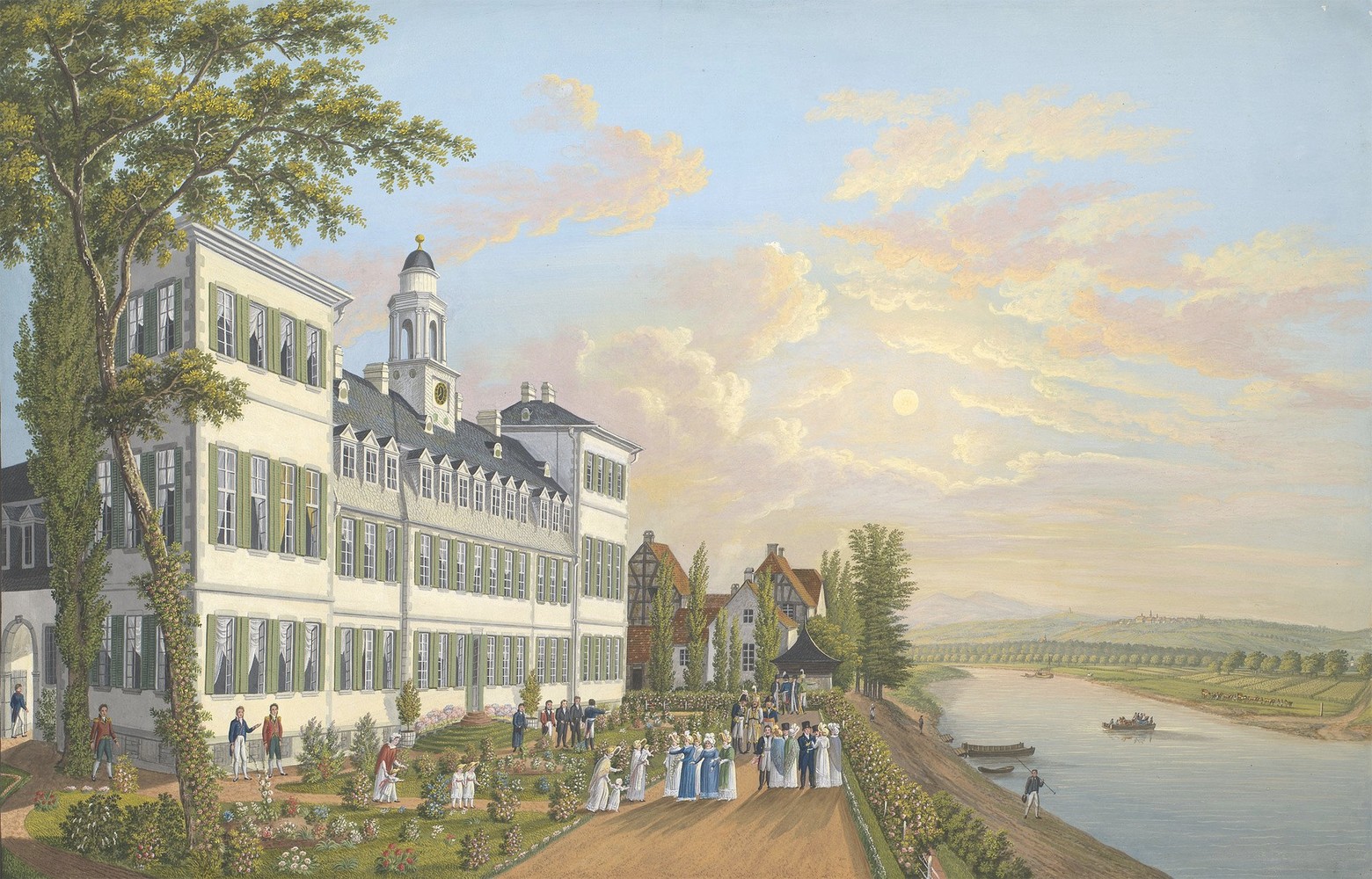
His father, Henricus Hofedietz, called Ricus, was born at Deisel in 1789, the son of a day laborer. As a young man he had served Landgrave Friedrich of Hesse-Kassel, a younger brother of the first Elector, as a coachman (figure 28.1).18 At his wedding he still named that service, to “His Serene Highness.”19 In August 1830, at forty, he married Amalie Weller of Langenthal, who was twenty-one, and the marriage entry lists both bride and groom as members of the Reformed church.20
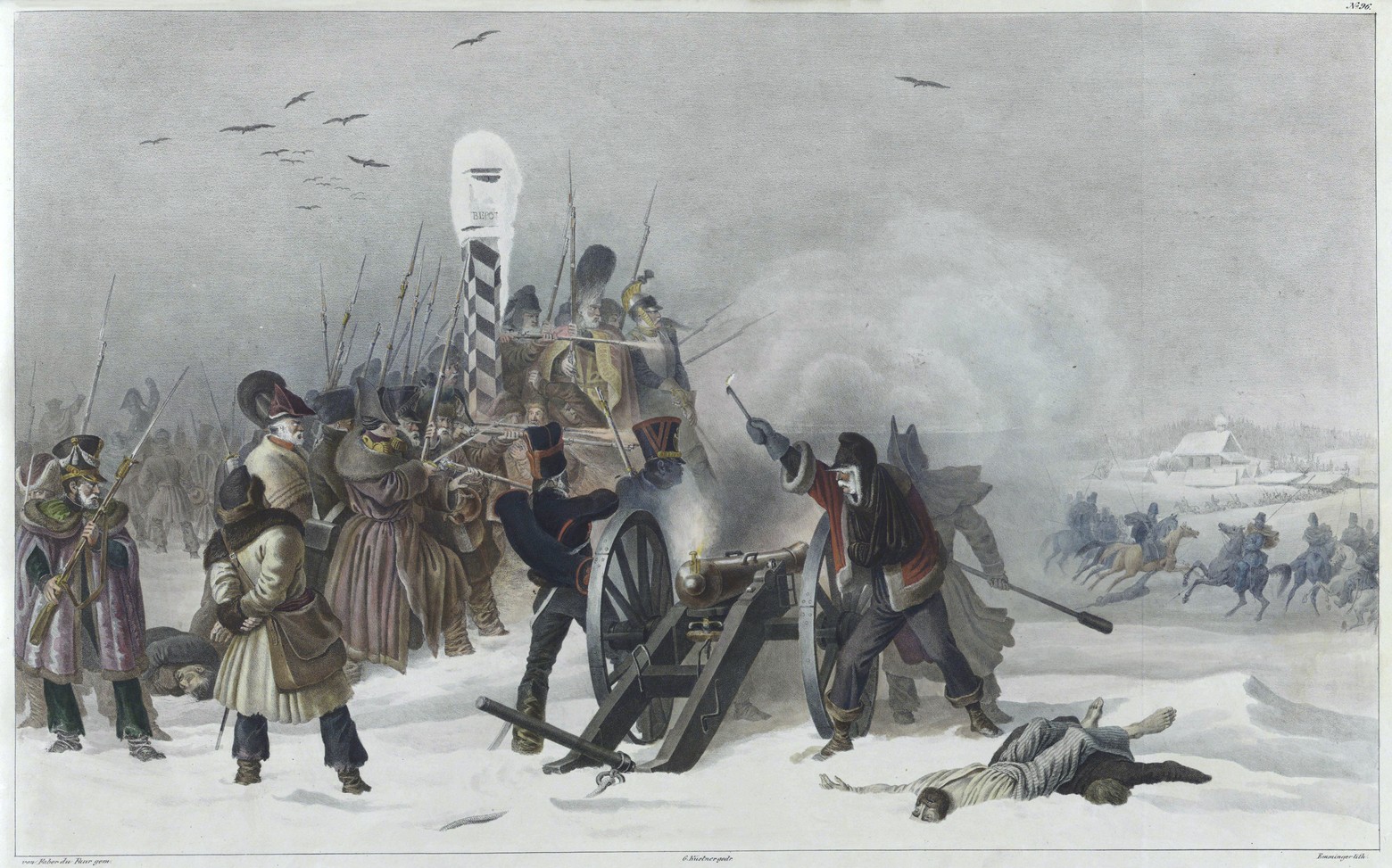
Amalie had grown up without her father. Johann Conrad Weller, a linen weaver at Deisel, had “remained in Russia,” one of the men of the district who never came home from Napoleon’s campaign of 1812. Deisel then belonged to the Kingdom of Westphalia, the state Napoleon made for his brother Jérôme, and its young men were drafted into Jérôme’s army. In 1812 that army marched into Russia and was almost wholly lost in the retreat from Moscow (figure 28.2). When twin girls were baptized at Deisel that November, the register named their mother, Anna Gertrud née Strecker, as “the wife of the soldier Conrad Weller.” It called the twins children conceived in adultery.21 No record of his death has been found. Amalie’s mother married again at Langenthal, to Georg Rohmann, and their son Ludwig, Amalie’s half-brother, later became Karl Ludwig’s godfather.22
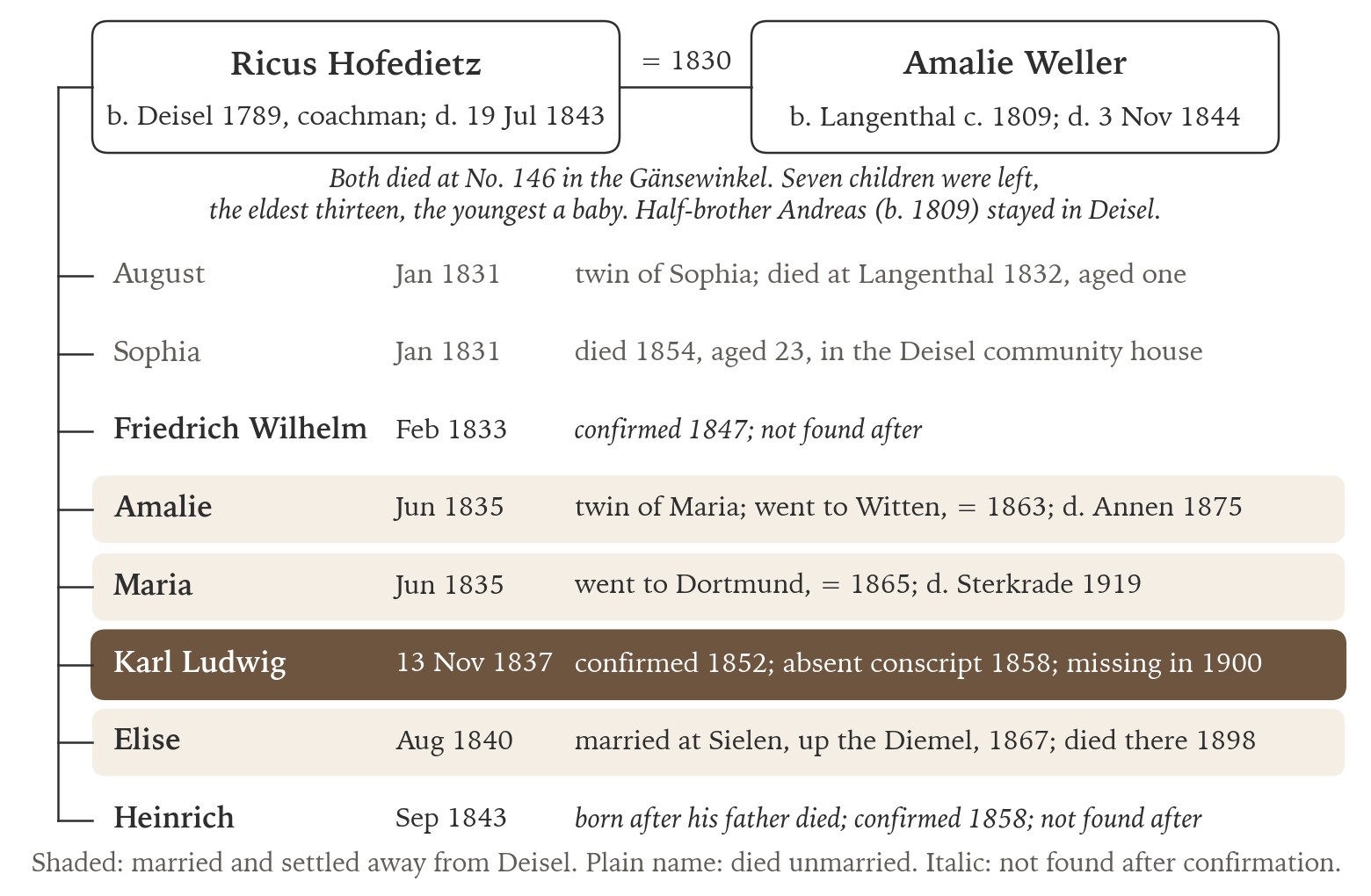
Ricus and Amalie had eight children over thirteen years (chart 28.1):
- twins, August and Sophia, in January 1831; August died the next year at Langenthal, his mother’s village;24
- Friedrich Wilhelm, in February 1833;
- twin girls, Amalie and Maria, in June 1835;
- Karl Ludwig, in November 1837;
- Elise, in August 1840;
- Heinrich, in September 1843.25
Ricus also had an older son, Andreas, born in 1809 before his marriage, and when Andreas married in 1833 the pastor recorded him as Ricus’s son born out of wedlock. Andreas later worked for the railway as a lineman and spent his last years at Deisel. In February 1880 he consented before a notary to a son’s marriage near Brussels, and he died at Deisel on 22 May 1884, a pensioner.26
Andreas and his future wife open the historian Martina Lüdicke’s study of church discipline at Deisel. In March 1832 two elders told the pastor of a village rumor that Philipp Wiegand’s daughter Amalie was pregnant. Some weeks later she came to the parsonage and said that she was five months pregnant by Andreas Hofedietz, a bachelor. He was there too, confirmed it and admitted his fault, and both were barred from Communion until they had done penance.28 Their son Heinrich was born that August. At the baptism Andreas, then a journeyman carpenter, declared himself the father and signed the register. The baby died the following January, almost a year before his parents married.29
Hofedietz was a common name at Deisel and at Sielen, and not every Hofedietz in this book is Karl Ludwig’s kin. His family is that of his father Ricus (born 1789, son of the day laborer Conrad): his mother, Amalie Weller; his brothers Friedrich Wilhelm and Heinrich; and his half-brother Andreas. Other Hofedietz households in Deisel in the 1830s came from the Sielen family, among them the turner and innkeeper Ludwig, born at Sielen in 1801. His son Johann Heinrich went to New York. No record connects those families to Ricus’s.30
The goose corner
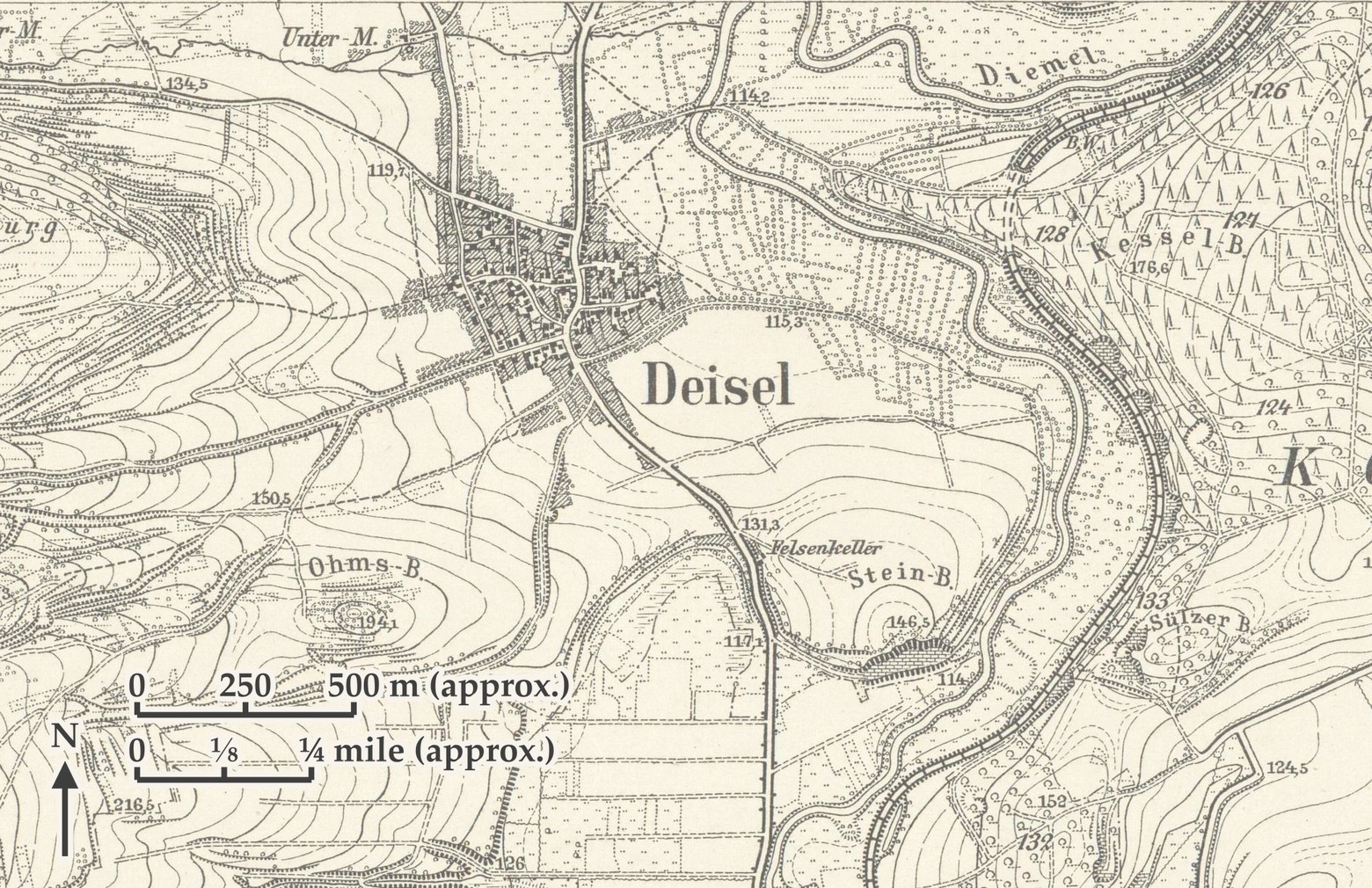
By the early 1840s the family lived at house No. 146 in the Gänsewinkel (map 28.1), the quarter of Deisel described in the chapter “Kurhessen: Deisel and Trendelburg, c. 1835–1858”.31 The Gänsewinkel was named for the village’s geese, not for a family, because Deisel was a goose village. The villagers kept a large flock of geese on the meadows by the Narrenbach and were nicknamed the “graute Gössel,” the big goslings.32 In the 1830s the baptism register places twelve couples in the quarter, shepherds and day laborers among them.33
Ricus, a pensioned coachman who now worked by the day, died at No. 146 on 19 July 1843, and Heinrich was born that September.35 Amalie died in the same house on 3 November 1844.36 Seven children were left, the eldest thirteen and the youngest a baby. Karl Ludwig was six.37
A crowded village
The hunger of 1846–47, described in the chapter “Kurhessen: Deisel and Trendelburg, c. 1835–1858,” severely affected Deisel. It was a crowded village when Karl Ludwig was small: the December 1846 count gives 1,420 people there, more than at any later count before 1946.38
The harvest of 1846 had failed, and so had the potatoes, the food of the poor. A report from Kassel stated that the distress was worse than in the hunger year of 1817.39 In May 1847 the government instructed the district offices that, where a village ran short of grain or potatoes, owners were to surrender any stores beyond what they needed until the next harvest.40
In March 1847 the people of Meimbressen, south of Hofgeismar in the same district, offered all the village’s land to the state so that they could buy land in America instead.41 Mass emigration occurred in the 1850s, and by 1858 Deisel had 1,139 people, a fifth fewer than twelve years before.42
The Hofedietz children grew up in those years with no parents to support them; Karl Ludwig was nine in the hunger winter and fourteen when he was confirmed in 1852.43 Kurhessen had no general poor law, so a poor child or an old pauper depended on his home village, and the village helped only when the need was demonstrated.44
The orphan, and the Konze house nearby
The Deisel property registers show who answered for the children after their father died. On 19 August 1843, a month after Ricus’s death, Amalie was sworn in as guardian of her children, and that November she was made guardian also of the baby born after his death.45
After her death, the court appointed a man of the village as the children’s guardian: Christoph Moritz, very probably the Deisel farmer of that name. The registers first name him in 1852, so when he was appointed is not known. On 11 April 1852, Easter Sunday, Karl Ludwig was confirmed at Deisel.46 Three weeks later, on 1 May 1852, Moritz acted for the seven Hofeditz children. The register lists them as Sophie, Amalie, Marie, a fourth child who was probably Friedrich Wilhelm, born in 1833 (the name is hard to read), Carl, Elise and Heinrich. Carl was Karl Ludwig, fourteen years old and still his ward.47
Moritz’s business that day concerned a small field. The children owned a quarter of a Hessian acre at the Rainberg, and it still carried dues owed to the Elector’s revenue office at Trendelburg. In 1852 dozens of Deisel landholders bought their land free of such dues by contract with that office, and Moritz did the same for the orphans. The price was 26 silver groschen and 8 heller, less than one thaler, or about six days’ pay for a day laborer of the district in the 1840s.48 The sum stood as a debt on the field for eight years. In August 1860 Moritz, still “guardian of the children of Ricus Hofeditz,” paid it off, and on 30 August the court at Karlshafen ordered the debt struck out and a copy sent “to the guardian Moritz of Deisel” as proof.49 The registers show the guardian caring for the children’s land; they do not say where the children lived.
The guardian links the boy to the Konze curator of 1900. Christoph Moritz, born at Deisel in 1796, died in 1865 at house No. 53, in the middle of the village. His daughter Wilhelmine married the farmer Philipp Konze in 1850. Their son Heinrich was born at No. 53 in 1858, and Wilhelmine’s brother Philipp Moritz was his godfather.50 That Heinrich Konze was the innkeeper whom the court made curator of Karl Ludwig’s affairs in 1900.51 So the man who answered for Karl Ludwig as a boy was very probably the grandfather of the man who answered for him nearly fifty years later. The curator was born in the house where the guardian died. Possibly the care of Karl Ludwig’s affairs stayed in that family, and that would explain why a Konze was his curator. No record yet shows how the court came to choose Heinrich Konze. The tie is one of guardianship, not of blood: no kinship between the Moritz family and Ricus’s has been found.52
Karl Ludwig was born in wedlock, so the rules for a child of an unmarried mother did not apply to him, but the rules for orphans did. In 1861 the Reformed orphanage at Kassel took only children whose fathers had died, as Ricus had in 1843; whether the rule was the same in 1843 is not known. When an orphan was boarded with a family, the village officers made a written foster contract. From 1838 they could not sign it until the pastor had given his opinion of the foster parents, and where the orphanage paid, the boarding money went through the pastor.53 If the village officers made such a contract for Karl Ludwig, it would name the household that raised him, but none has come to light.
The registers do show who lived around the family. In 1841 the baptism register places the household of the farmer Johannes Sasse and his wife Amalie, born Konze, at No. 148 of the Gänsewinkel, two numbers from the house where Ricus and Amalie died.54 Amalie Sasse was a daughter of Christoph Konze, a Deisel farmer, church elder and former mayor. She died in August 1845, nine months after Karl Ludwig’s mother. If this household took him in, he possibly grew up with the widower Johannes Sasse or with Amalie’s Konze parents, if they were still living. His half-brother Andreas, who was living in the village, possibly also helped raise him.55 The Sasses’ son Ludwig, born in 1841, also emigrated to America, but not until 1889. He died in New York in 1913, and nothing links him to Charles.56
Who placed the orphans is not recorded, but in Deisel the care of orphans was part of the church council’s work. In the Reformed church of Kurhessen the church’s care of the poor fell to the elders. Kurhessian church law, as collected in 1861, kept a destitute orphan at the cost of the state, the village and the church, a third each. Each of the four elders watched over his own district of the village, in 1843 about 330 people apiece.57 When Karl Ludwig was orphaned, two of the four were Konzes. Andreas Konze, a farmer, had been an elder since 1827 and in 1843 was also the village mayor. Christoph Konze, Amalie Sasse’s father, had been an elder since 1834.58
A Konze elder therefore possibly had a say in where the boy went, and that would fit a Konze household’s taking him in. It is no more than a possibility: no record shows which elder’s district held the Gänsewinkel, and no record of the placement has been found. The council minutes of 1843–52 and the church’s poor accounts could test it; the Deisel property registers at Marburg name the guardian but not the household.59
A Konze household possibly took the boy in, this one or the house of Amalie’s parents, and that would explain three things at once. It would explain why a Konze looked after his interests in Deisel more than fifty years later. It would account, too, for his family in St. Louis twice giving his daughters’ maiden name as Konzen when they died in 1890. It would also explain why canvassers and pastors recorded his household as Konsen and Koncen.60
It is a hypothesis: the search has found no foster record and no blood relationship between the Hofedietz and Konze families of his time. A foster home would not have changed his name, because under Kurhessian law a surname belonged to the family a person was born or married into. From 1835 any change needed the government’s permission.61 A boy raised by the Konzes would still have been Hofedietz in every German record. Konze could only have been a name he was known by among neighbors, or one he took up in America. That would explain why no German record shows him as Konze; it does not establish that he used the name.
The curator of 1900 came of a Konze line with no known Hofedietz marriage. A Konze curator was not unusual in Deisel (see table 28.1).62 Two Hofedietz sisters did marry into an older Konze family of Friedrichsfeld, but they were of another branch, not Ricus’s.63 Nevertheless, a Konze foster home fits a Deisel orphan better than any other explanation of the Kon- forms in his American records.
The curator’s family has one possible link to Ricus. In 1831 the godfather of his son August was a Johannes, probably Johannes Köster. The hand is hard to read, and the word that could give the godfather’s trade cannot be made out. Deisel’s innkeeper at the time was a Johannes Köster, but the register does not show whether the innkeeper was the godfather. The curator’s own grandmother was a Köster, though no record yet shows that she was of the innkeeper’s family.64
Karl Ludwig ranks first of the twenty-seven open boys when all are weighed by one rule.65 The Konze tie is graded possibly, and the weighing counts it modestly. The search for Konze ties first went much deeper for Karl Ludwig than for the other open boys. Searched to the same depth, six of the others also probably or possibly lived within two doors of a Konze household. Brandau was probably born next door to one, and Lucas possibly had a Konze tie through a curator.66 Karl Ludwig’s own tie is the curator of 1900. A blind reviewer, who did not know which boy had which tie, judged that so late a curator says little about where a boy grew up. In the surname clue (see “How the Research Was Done”), his orphanhood and ties count for him. They now make a change of name about three times easier to explain than for a boy whose parents were living and who had no Konze tie found. His lead still leans in part on ties that no record yet proves.67
The children scatter
The children were confirmed at Deisel one after another: Friedrich Wilhelm in 1847, Karl Ludwig in 1852 and Heinrich in 1858. At least some of them therefore grew up in or near the village.68 After that they lived apart.
- Sophia died on 1 October 1854, aged twenty-three, in the Deisel Gemeindehaus, the community house, where villages of this kind probably lodged their poor.69 In August 1853 an unmarried Sophie Hofedietz of Deisel, probably she, had a son at Hofgeismar, and he was baptized in the jail there. He died at ten weeks.70
- The twins, Amalie and Maria, later moved west to the mines and mills of the Ruhr. Amalie married Johann Heinrich Junker at Witten in February 1863, and her marriage entry says of her parents, “both dead.” She had children there until 1875 and died that year at Annen, aged thirty-nine. Maria married Johann Hermann Kleine-Döve, a factory worker, at Dortmund in November 1865, and had children there from 1867. She was living at Hörde in 1881. She was widowed at Osterfeld in 1891 and died at Sterkrade on 8 August 1919.71
- Elise stayed nearest home: she married Christian Wilhelm Wiegand at Sielen, a few miles up the Diemel valley, in August 1867, raised a family there and died there in 1898.72
- Friedrich Wilhelm and Heinrich have not been found after their confirmations.73
- Karl Ludwig is named in no Deisel parish record after his confirmation.74
His sisters show a pattern: at least one of them went into service. In 1853 Maria was a maidservant, and that October she was godmother at Langenthal to a daughter born to her unmarried twin, Amalie. The baby died the next February. In 1856 Amalie had a son, Carl, at Deisel, and he died at eight weeks.75 The twins are first found in the Ruhr at their marriages, in 1863 and 1865.76 An orphan boy confirmed in 1852 possibly also went into service or work away from home within a year or two. The same pattern could explain the date the court later gave for his departure (see the section “What stands against it” below).
Karl Ludwig’s circumstances when he left
No record says why Karl Ludwig left, but three facts of his life would explain it. He was the orphan of a coachman who had ended as a day laborer in rented rooms, so he had no farm or workshop to inherit.78 Residents were emigrating from Deisel to America: the emigration index records about 248 people leaving Deisel, nearly all between 1833 and 1866 (figure 28.3).79 And under the recruitment law of 1848 a young man of Kurhessen became liable for service on 1 January of the year he completed his twenty-first year. He stayed liable through his thirtieth, and for a boy born in November 1837, that meant from 1 January 1858.80 The chapters “Kurhessen: Deisel and Trendelburg, c. 1835–1858” and “Leaving Hesse, c. 1858–1859” describe that world.
By 1859 his parents had been dead fifteen years, so he had no parents’ house to write to. Sophia had died in the community house, the twins had left the village, no record names his brothers after their confirmations, and Elise was not yet married.81 Charles left no letters, and no one from home is known to have written to him. If Charles was Karl Ludwig, these circumstances possibly explain why no letter home is known.
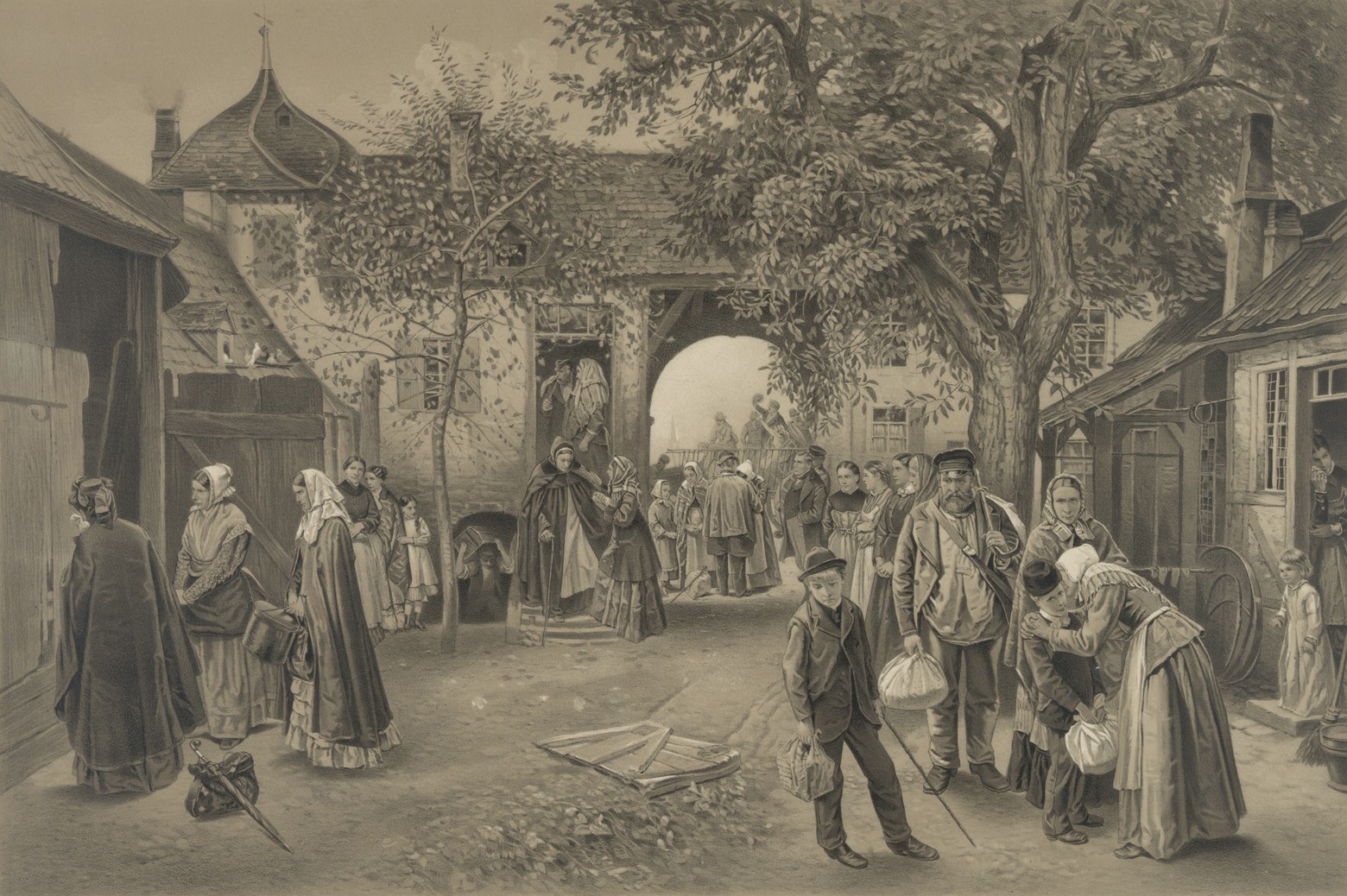
Gone without a word
The first record of his absence is his guardian’s. On 5 December 1857 the guardian came before the court at Karlshafen about a quarter of a Hessian acre that had come to Ricus’s children from Johann Conrad Hofedietz, who had died in 1837. He listed his wards, and the first was “Carl … in Amerika.”83 Friedrich Wilhelm, who was of age, and Marie approved the transfer in 1858, and Karl Ludwig did not.84 He had turned twenty in November. This is the earliest record that places him in America, and the only one made at the time.
The state’s own records begin a few weeks later, in early 1858, the year he became liable for service. On 21 January 1858 the local court at Karlshafen fined him five thaler for missing that year’s muster, and it had its order printed in the newspapers “wegen Abwesenheit der Verurtheilten” (because the convicted men were absent).85 On 6 February the district office at Hofgeismar summoned fifteen conscripts who had missed the muster, under § 68 of the recruitment law of 1848 (described below). The ninth was “Carl Ludwig Hofeditz aus Deisel” (Carl Ludwig Hofeditz of Deisel).86 Both notices appeared that February in the Wochenblatt für die Provinz Fulda, a provincial weekly. The Wochenblatt für die Provinz Niederhessen, the weekly of his home province, also printed the summons, on 16 February.87 They show that by early 1858 he was absent from home, summoned and fined. Fourteen other young men were on the same list.
He did not come. That summer the criminal court at Kassel took up the cases of forty-four young men who had missed the 1858 muster and ignored their summonses. On 30 July and 10 August 1858 it declared them absconded conscripts. Number thirty-seven on the list was “Carl Ludwig Hofeditz aus Deisel.”88 The court fined each man a hundred thaler, or six months in prison if he had no property, and ordered each to pay its costs of ten thaler. It could not hand its judgment to men who were gone, so on 4 September it ordered the judgment printed. It appeared that autumn in the Wochenblatt für die Provinz Oberhessen, another provincial weekly.89
The judgment shows that by the summer of 1858 he had still not reported, and that the state now counted him as absconded. None of the three notices says where he had gone, when he left or whether he owned anything, and nothing in them ties him to Charles. The guardian’s statement of 1857 says where: America.90 That is two years before 1859 by the calendar, the year the 1900 census gives for Charles’s arrival, and table 28.1 weighs the difference.91 Under the grading rules the search fixed in advance, a record of his leaving raises him above “possibly” only if it ties him to St. Louis or to the name Gannsen or Konze. Neither the guardian’s statement nor the notices do that, so Karl Ludwig remains possibly Charles (see “What would change the conclusion” in the appendix “How the Research Was Done”).
On 23 February 1900 the district court at Karlshafen issued a public summons, printed on 1 March in the Reichsanzeiger, the German government’s official gazette. It listed twenty-four cases, naming thirty-four missing people of the district. Item eight was Karl Ludwig Hofedietz (spelled Hofeditz), born in November 1837, who had “emigrated to America at the beginning of the 1850s.” Unless he came forward by 24 October 1900, or someone provided news of him, the court would declare him dead. His curator, the innkeeper Heinrich Konze of Deisel, had made the application.92
The notice was routine: the new German civil code, in force from 1 January 1900, let a court declare a man dead after ten years without news, and courts at once began summoning people long missing. But a court appointed a curator for an absent man only when there was something of his to administer.93
Kurhessian law had used such curators long before 1900, for the property of a conscript declared absconded (see “Kurhessen: Deisel and Trendelburg, c. 1835–1858”).94 The law of 1848 kept the rule. A conscript who did not report within three weeks of the draw (the lottery that chose men for service) was summoned to report within three months. The summons was posted in his home village and at the district seat and printed in the official weekly papers. If he did not come, he was punished as an absconder. The civil court placed his property under a curator, to be handed to his heirs only after his death or a declaration of death.95 Karl Ludwig was summoned in this way in 1858, and that summer he was declared absconded, as told above.96 Under the law, any small share of his at Deisel was then to be placed under a curator. The curator of 1900 was possibly only the last in that line. That curator could as well have been named that year for an inheritance. So something of his, possibly a share of an inheritance, was probably waiting for him in Deisel, but no record shows that he claimed it. The court sat on 24 October 1900, the day it had set, and declared at least one of the missing people on its list dead that day: Johanne Sophie Schwalm, listed in the same summons. No judgment for Karl Ludwig has come to light.97
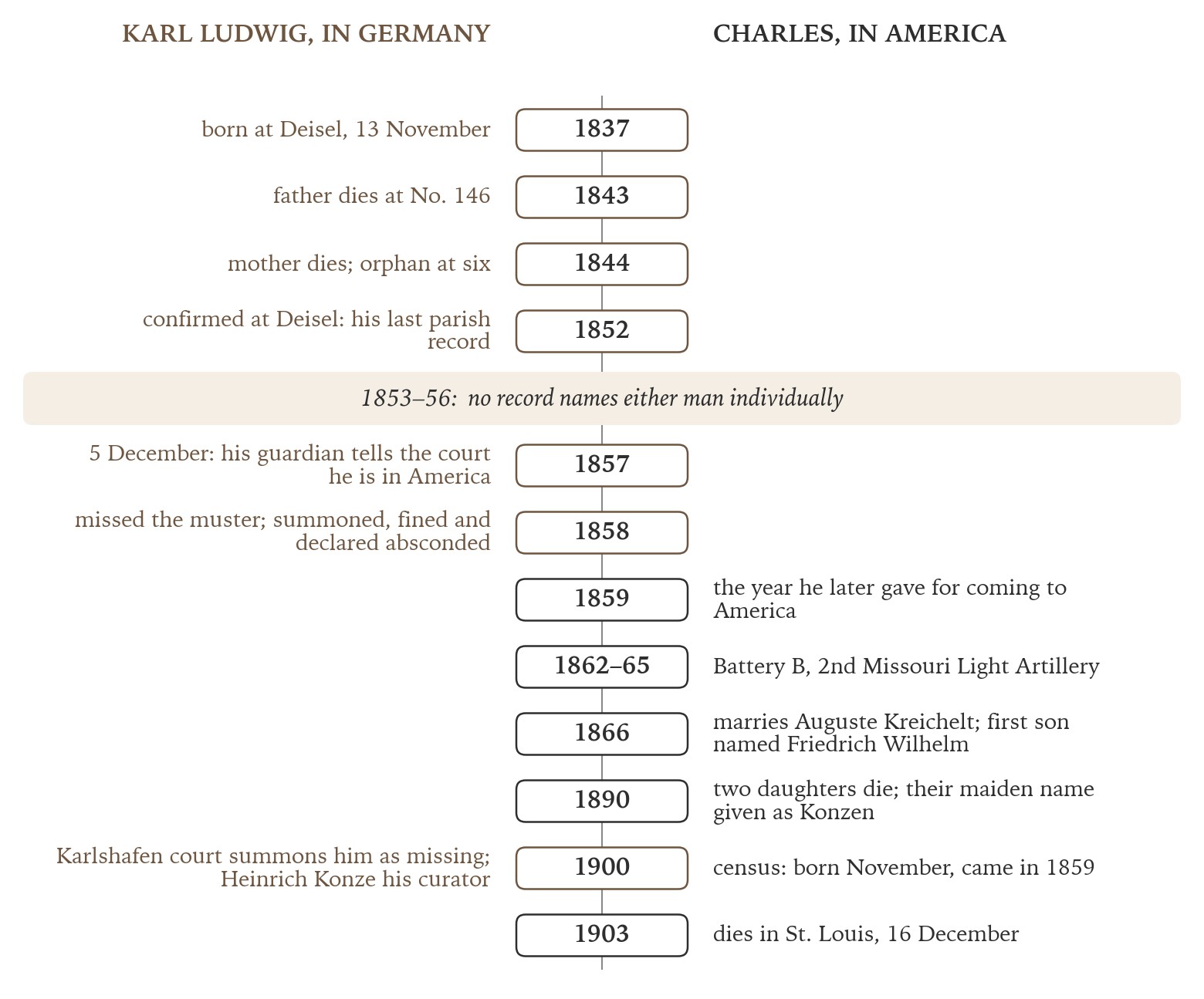
The name Gannsen: still unexplained
No record explains how a Hofedietz came to sign himself Gannsen. If Charles was Karl Ludwig, he did not use his baptismal name in America: he signed himself Gannsen, and the St. Louis records list his family as Konsen and Konzen. One hypothesis fits the Kon- forms: a Konze household possibly raised him (see the section “The orphan, and the Konze house nearby” above). This is the explanation the author favors, but it does not explain the a that Charles wrote himself (see the section “What stands against it” below).99
If Charles was Karl Ludwig, the records give his name in two streams: his own signatures have G- forms, and most government papers have G- or J- forms. The clerk who enlisted him in December 1862 recorded him as “Charles L. Johnsen,” and he signed his own name Gannsen.100 Charles possibly wrote down the name as it had been heard, and he kept close to it from then on. He signed “Gannson” on his 1890 pension declaration, and the voter register of about 1900 lists him as “Gansen.”101 Records that are probably or very probably his give K- forms from 1868, “Kausen” and “Kanson,” and the Kon- form “Konson” from 1869 (see “The Saloon Years, 1866–1870”). Kon- forms appear in the directories from 1874 and at St. Marcus Church from 1875, alongside G- forms.102 The Kon- name was possibly one he took up in America, after the Deisel family of that name. In 1900 a Konze was curator of his affairs.103
The judgment of 1858 bears on a different question: why Charles, if he was Karl Ludwig, gave up the name Hofeditz. From that autumn the name stood in print on a list of absconded conscripts.104 An absconder could also be sought by warrant.105 So the judgment possibly gave him a reason to stop using the name. In her survey of German emigrants’ name changes, Anna-Maria Balbach reasons that a man who fled military service would be very willing to change his name.106 No record says that he changed his name for this reason.
The danger had a limit in time. In February 1868 the United States and the North German Confederation, led by Prussia, signed a treaty on naturalization, known as the Bancroft Treaty after the American envoy George Bancroft. Under it, a German who became an American citizen and had lived in the United States for five unbroken years was to be treated as an American.107 In July 1868 the ministers of justice and of the interior at Berlin ordered that such men, if they came home, should not be prosecuted or punished for having emigrated without leave. The justice minister’s order went, among others, to the state prosecutor at Kassel.108 On 21 October 1868 Charles became an American citizen at St. Louis.109 By then he had signed himself Gannsen for six years.110 The first K- forms also date from 1868. The year the danger eased is also the year of those forms and of his citizenship. No record links these events, and none shows that he knew of the order.
Other points narrow what the judgment can explain. The 1900 notice says he left at the beginning of the 1850s, years before he became liable, and his guardian placed him in America before his liability began. So the draft was possibly not why he went, although the court later judged him an absconder.111 In the emigrants’ letters Balbach studied, the writers changed their forenames but kept their surnames, or changed them only slightly.112 As the appendix “How the Research Was Done” notes, no emigrant of these villages is known to have taken a new surname in America. And in America Charles named his homeland whenever a record asked (see “Was He Hiding?”). The historian Kurt Günther found that most absent conscripts had left on a passport, and that true flight across the Atlantic was a rare exception.113 That is a fact about absent conscripts as a whole. For Karl Ludwig the judgment of 1858 records that he was declared absconded, so the rarity no longer counts against him.114 No record explains why he used either name, and both explanations remain possibilities.
How the pieces fit Charles
Each clue below ends with how strongly it links Charles to Karl Ludwig. The evidence grid in the appendix “How the Research Was Done” sets the same clues side by side for every open boy.
- The name. Carl Ludwig fits Charles L. More than a dozen American records, from his enlistment in 1862 to the Pension Bureau’s 1890 papers, give him the middle initial L, and one 1862 docket has “Charles L[o?].” It can be read “Lo.” or “L.”115 His own signature of 1862 is read two ways (see table 28.1 and “The Name He Signed”).116 Moderate.
- The place. Charles named Trendelburg, and his marriage entry says he came “aus Deiße”, from Deisel, the village next door, where Karl Ludwig was born (see table 28.1).117 Moderate, since many boys fit.
- The month and year. The 1900 census, the only record of Charles’s lifetime that names a month, gives November 1836, and Karl Ludwig was born in November 1837. Charles’s other stated ages fall between about 1833 and 1841. Two of them fit Karl Ludwig’s birth exactly: his age on the battery’s muster-out roll of December 1865 and his sworn age of February 1891. They speak to the year, not the month.118 Moderate.
- No word home. No letter or inheritance from Germany is known to have reached Charles. Karl Ludwig’s parents were dead by 1844, his sisters scattered and his brothers untraced, and in 1900 his curator could not say where he was.119 Weak: an argument from silence, since many emigrants lost touch with home for other reasons.
- The Konze ties. His curator in 1900 was a Konze, and a farmer and his Konze wife lived two house numbers from the house where his parents died. Clerks and pastors in St. Louis also recorded his family as Konzen and Konsen, and the foster hypothesis would explain all three. But when every open boy was searched as deeply, Konze neighbors proved common.120 Weak.
- The departure. By his guardian’s statement Karl Ludwig was in America by December 1857, and Charles came to America too.121 He left before his army service began (see above), and the emigration index contains no release for him.122 Weak as a link, since emigrants from Deisel were many. But it closes a gap: until this record was read, only the court notice of 1900 said that he had gone to America.
- A small DNA group from the Deisel area. On MyHeritage a small group of German matches on the father’s side of the family has its roots in the Deisel area, where Karl Ludwig’s mother was born. It counts as a single link, possibly a distant one, and it has not yet been placed on Charles’s own line rather than another side of the family (see “What DNA Can and Cannot Say”).123 Weak; not yet specific to the Hofedietz family.
- The eliminations. Of the fifty-five Hofedietz boys born at Deisel and nearby from 1830 to 1844, forty-five have been closed, each read a second time in the record image and confirmed, and one more, a Christian Hofeditz of Iowa City, has probably been traced. Of the ten Hofedietz boys not closed, Karl Ludwig is the only Carl.124 Moderate, but only if Charles was a Hofedietz: it clears the field inside the family and does not show that he belonged to it.
What stands against it
The first and hardest point is the surname: nothing yet explains how a Hofedietz became Gannsen. The foster hypothesis would account for the Kon- forms, but not for the a that Charles wrote himself in 1862 and 1890, and probably in 1900.125 The goose-corner explanations in this chapter are ideas, not evidence.126 By the search’s own finding, emigrants from these villages usually kept their German names in America, so Charles would have been an exception. But an orphan raised by another family, if he was one, possibly had more reason than most to choose his name.127
The second is the birth date: the 1900 census, taken in Charles’s lifetime, gives November 1836, Karl Ludwig’s month. The 1903 burial register gives 26 January 1835, a date the family supplied after his death, and nothing yet explains it. His own stated ages vary by several years, and table 28.1 compares each date and age against Karl Ludwig’s.128
The third is the date of departure. His guardian placed him in America by December 1857, and the court’s notice gives “the beginning of the 1850s,” while the 1900 census gives 1859 as the year Charles came to America.129 A census year of this kind matched the known year in 16 of 31 comparable cases; the weighing allows for that, and since 16 November it dates his leaving by the guardian’s statement (see “How the Research Was Done”). The court’s date possibly marks the year he left Deisel, not the year he sailed, because young unmarried men were among the most mobile people. One set of figures for the 1850s comes from a Prussian city, not from Kurhessen. In Düsseldorf in 1851–66, four-fifths of migrants were temporary, and most of those were single men and women, probably in their late teens or twenties.130 In the old rural order farm servants were hired annually, so many moved on from place to place.131 These rural studies describe mainly the years before about 1800; they are applied here to the 1850s by extension. Karl Ludwig’s own sisters did just that, as described above.
He was confirmed in 1852, and after that he is not found as a godparent at Deisel, Sielen or Langenthal. Two independent readings of the godparents in every surviving baptism entry, at Deisel from 1844 to 1870 and at Sielen and Langenthal from 1851 to 1870, did not find his name. Three Sielen entries of 1859 are missing from the register images. Of the three godfathers named Ludwig Hofedietz, the farmer of 1848 was a grown man when Karl Ludwig was ten. The farmer of 1867 was a married man whose children had been baptized at Deisel since 1844. The turner of 1857 was probably an older man of that name too.132 Godparents were usually relatives or neighbors (see “Kurhessen: Deisel and Trendelburg, c. 1835–1858”), so his absence is negative evidence: it fits his having left, but it does not prove it.
A boy who left Deisel at fifteen or sixteen could have emigrated years later.133 For Karl Ludwig that was not as late as 1859, since his guardian placed him in America by December 1857.134 If he was Charles, the census year is two years or more too late. It is one answer, given forty-one years after the event by an informant who is not named, and table 28.1 weighs it.135
The fourth is the Y-DNA, read together with the name. Charles’s male line falls on a branch whose other testers have Ashkenazi Jewish roots, and his own signatures have the a of Gans, a name that Jewish as well as Christian families of the district bore.136 Together the two facts suggest a rival account: that Charles was the son of a Jewish father, possibly a Gans, born out of wedlock to a Christian mother and baptized under her surname. Karl Ludwig was born in wedlock to parents of the Reformed church, so on that account he was not Charles.137
The rival account has been tested in the records read so far, and none supports it. A Jewish man named Ganß lived at Trendelburg under a letter of protection of 1720, but the lists of Jewish households of 1823 and 1858 show no Gans at Trendelburg or Deisel. In 1858 the only Gans among the district’s self-supporting Jewish households was Nathan Wolf Gans of Grebenstein.138 The Jewish birth registers of the neighboring communities for 1833–41 name no son of a Gans father.139 A son of a Christian mother would be among the boys baptized out of wedlock. Of the 48 such boys of the three parishes, 45 have been followed to a later record or an early death.140 The test is not complete. The district’s register of Jewish marriages for 1829–56 has not been read. The Karlshafen court files, where a paternity case could lie, are closed.141 The account stays open. A Y-DNA test of a man of the Hofedietz male line would help to choose between this account and Karl Ludwig (see “What DNA Can and Cannot Say”).
The fifth is another open boy, who fits the birthplace Charles swore to better than Karl Ludwig does. Carl Ludwig Martini, a surgeon’s son, was born at Trendelburg on 1 December 1834 and left for America in 1854.142 He too was a Carl Ludwig, and his birth date fits the age of sixty-nine on Charles’s death certificate.143 Index entries name a Charles Martini of about his age in St. Louis in 1870 and in 1880, and one naturalized there in 1878.144 Read in the images, the census entries are of one man, a cigar maker and dealer on Broadway. The city directories list a Charles L. Martini in the cigar trade from 1865 to 1897, on Broadway until 1885. The censuses give his birthplace as Prussia or Saxony and his parents’ as Hamburg and Hesse-Darmstadt or Saxony, never Kurhessen, so he was very probably not the Trendelburg boy. A saloon keeper of the name and age, born in Saxony, was in the city in 1860; he was possibly the same man.145 In the weighing Martini ranks third to fifth, with a share of 1.9 percent against Karl Ludwig’s 88, for three reasons. Carl was a common name at Trendelburg and a rare one at Deisel. His birthday misses November by a day and the census year by two. And the model of the surname, which counts each boy’s Konze ties, weighs for Karl Ludwig and against him.146 These are weights, not proof, and no record rules him out. The court notice of 1900 named two men who were very probably his brothers as missing, and did not name him; no record yet explains why.147
Finally, his two brothers, Friedrich Wilhelm (1833) and Heinrich (1843), have not been traced, and either could in principle be the man in St. Louis, though neither was a Carl. The guardian’s statement of 1857, the notices of 1858 and the court notice of 1900 are the only records found that name Karl Ludwig after 1852, in Germany or in America.148 No American record of a Hofedietz under any spelling that could be Karl Ludwig has been found.149
Where the records disagree
Some records about Charles disagree with one another, and some disagree with the case for Karl Ludwig. Table 28.1 presents each conflict, who made each record and when, and how far the disagreement can be explained. A record made at the time by someone with first-hand knowledge of the fact carries more weight than one made years later, or after his death, or copied from another paper. Where a conflict cannot yet be resolved, the case for Karl Ludwig remains a hypothesis, not a proof. The reason is that under the Genealogical Proof Standard a conclusion cannot be called proven while a conflict remains unresolved. Until 26 January and the a of his signatures are explained, Karl Ludwig is possibly Charles, and no more.150
Table 28.1. Where the records disagree, and how each conflict stands
| Conflict | Sources on each side | How it is resolved, or why it stays open |
|---|---|---|
| Day and month of birth: November 1836, 13 November, 10 November or 26 January | November 1836: the 1900 census, made in his lifetime; the informant is not named.151 26 January 1835: the St. Marcus burial register, 19 December 1903, an original entry. But the family gave the date after his death, and the age in it was worked out from that date.152 13 November 1837: Karl Ludwig’s baptism at Deisel, written at the time; the day was first written as the 11th and corrected.153 10 November 1837: the 1900 court notice, written sixty-two years later.154 | For Karl Ludwig the baptism is the best witness, and the court’s 10 November is probably a copying slip. For Charles, November, from a record of his own lifetime, ranks above 26 January, a date given after his death, and it is Karl Ludwig’s month. The 1900 census was the only one of its time to ask the month.155 But nothing yet explains 26 January. Quality of evidence and explanation settle the court’s 10 November; 26 January stays unresolved. |
| His age: 23 at enlistment, when Karl Ludwig was 25, and other ages that disagree | Charles’s sworn ages: 23 on 2 December 1862, which points to about 1839; 56 on 15 January 1890 (about 1833); 53 on 9 February 1891 (1837 or early 1838).156 Other records: 36 and 39 in the two 1880 censuses; 63 in June and October 1900; 69 on the 1903 death certificate.157 The muster-out roll: 28 on 20 December 1865, on a clerk’s copy whose 8 was possibly written over another figure.158 Karl Ludwig: born 13 November 1837.159 | His own sworn ages, thirteen months apart, imply birth years about four years apart, so Charles probably did not know his age to the year.160 Karl Ludwig’s 1837 lies inside the spread. It matches the 1891 declaration exactly and the 1900 census within a year, and the enlistment age is two years too young. The muster-out age fits a birth between 21 December 1836 and 20 December 1837, so it too fits 1837. So two records of Charles’s lifetime agree with 1837; the earliest, made at enlistment, points to about 1839, and the rest scatter. The weighing of the clues does not count the card: its birth-date standard was fixed from an earlier age table that did not include the card. Explanation: the spread; it leans a little toward 1837 but does not settle the year. |
| When he left: “the beginning of the 1850s,” by December 1857, or about 1859 | In America by 5 December 1857: his guardian’s statement to the court at Karlshafen, made at the time.161 Early 1850s: the 1900 court notice, written about fifty years later on the curator’s application.162 1859: the 1900 census, forty-one years after the event, informant unknown.163 Census years like this one are often off by a year or more. For 17 emigrants of the three home villages, each with a year of leaving dated by another record, the census year was exact for 7 (41 percent; 95 percent range 22–64 percent). Each range here is a Wilson interval: a range made this way holds the true share nineteen times in twenty. For 31 men of these villages and the parishes around them, it was exact for 16 (52 percent; 35–68). It was within two years for 13 of the 17 (76 percent; 53–90) and for 23 of the 31 (74 percent; 57–86). Men whose year disagreed with other records were more often set aside as not the right man, so these shares are, if anything, too high.164 Karl Ludwig was confirmed at Deisel in 1852.165 He was absent from the muster of early 1858, and that summer he was declared an absconded conscript.166 Martina Lüdicke counted about two Deisel emigrants in 1859 and about four in 1860, and names none.167 | The guardian’s statement is the only one of the three made at the time, by the man who answered for him, so it ranks first: by his statement Karl Ludwig was in America by December 1857. The court notice agrees on the country. Its “beginning of the 1850s” possibly remembers when he left Deisel after his confirmation, not when he sailed. His twin sisters left Deisel in the 1850s and are first found in the Ruhr in 1863 and 1865.168 The census’s 1859 is a recollection, and if Karl Ludwig was Charles it is two years or more too late, an error 7 of the 31 men tested made (23 percent; 11–40).169 A sailing at the beginning of the 1850s would make it late by six years or more, as it was for one of the 31 (3 percent; 1–16).170 Charles was a boarder in another man’s household, and someone else there possibly gave his answers.171 The notices of 1858 show him gone from home, not when he left. The records that would date his leaving, the Deisel release file to 1858, the district emigration file of 1852–70 and the army books, survive only as originals at Marburg and have not yet been copied. The district muster lists of the 1850s are lost. Quality of evidence: the German records agree, and the census year is the weakest of the three. A small conflict, explained but not resolved. |
| His middle initial: L or C | L: the clerk who filled in his enlistment on the same day (“Charles L. Johnsen”), the descriptive book (“L. Charles Gannsen”), the 1862 docket (“Charles L[o?].”), the 1865 army cards (“C. L.”) and the Pension Bureau (“Chs. L.,” pension file, p. 7, 4 June 1890): more than a dozen records.172 A fellow researcher reads the initial in his own 1862 signature as L.173 C: A German paleographer’s reading of that same letter.174 | Probably L. Every record that gives an initial gives L, and the two readers of the signature disagree on one letter. In the signature the tall loop of the initial is formed like the two l’s of “Karll” beside it, and a small open bowl leads into it. The loop fits L and the bowl C, so the signature alone does not settle the letter.175 In the “C. L.” of 1865 and the “Chs. L.” of 1890, the C or Chs. stands for Charles, so the middle initial is still L. L fits Ludwig. The battery’s descriptive book, which could give his name in full, can be seen only in the reading room of the National Archives in Washington; record agents there have been asked to copy it. Quality of evidence: probably L, but not resolved. Who comes first in the weighing depends on it (see “The order of work” in the appendix “How the Research Was Done”). |
| The vowel of the surname: the a of Gannsen against Hofedietz and Konze | The a: his own signatures, “Gannsen” in 1862 and “Gannson” in 1890 (in 1900 the vowel is unclear: more like e in one signature, o or a in the other); eighteen of the twenty-eight recorded forms of the name have the a or a J.176 The o and the K: “Gonnson” at his wedding (with the G of the a-forms, halfway between), “Konsen” in 1875 (and in an uncounted 1874 directory line), “Konzen” for his daughters in 1890, “Gonnsen” on the 1890 veterans’ census and “Koncen” in 1900, ten of the twenty-eight, all written by others.177 His baptism: Hofedietz.178 | A Konze foster home would explain the o and the K that others wrote, but not the a he wrote himself. The goose-corner explanations are ideas, not evidence.179 Unresolved. This is the hardest point against the case. |
| His birthplace: Trendelburg or Deisel | Trendelburg (“Trennelburg”): his own sworn statement, 1862; the descriptive book’s “Freundburg” is a copy of it.180 Deisel (“aus Deiße”): the 1866 St. Marcus marriage entry, where “aus” usually names the last home.181 Karl Ludwig was born and baptized at Deisel.182 | Deisel lies about a mile and a half from Trendelburg. It belonged to the Amt Trendelburg until 1821 and stayed in the church district of Trendelburg, so a Deisel man could name the town.183 But a man born in Trendelburg who later lived at Deisel fits the two records just as well. The Deisel church-council minutes, readable only at Kassel, have not been read. Explanation; it favors Deisel boys in general, not Karl Ludwig alone. |
| “Kreis Caßel,” though Deisel was in Kreis Hofgeismar | The 1866 marriage entry gives “Kreis Caßel”.184 Deisel lay in Kreis Hofgeismar.185 | The same pastor placed Immenhausen, also in Kreis Hofgeismar, and Metze, in another district, by Kassel, so it was probably his loose label for the region.186 Explanation: probably resolved. |
| Sweden as his birthplace | Sweden: three censuses of his daughter Louise’s household, 1910–30, and a later family tradition.187 Kurhessen, Prussia, or Germany: every record of his own lifetime.188 | The Sweden answers came decades after his death, from someone who also gave the wrong birthplace for his wife, and the surname Johnson sounded Swedish. Quality of evidence: resolved against Sweden. |
| The Konze curator: a family tie, or a routine choice? | For a tie: Karl Ludwig’s affairs were in the care of the innkeeper Heinrich Konze in 1900.189 His guardian of 1852–60 was very probably Heinrich Konze’s grandfather, who died in the house where Heinrich was born.190 Against: the same notice names two other Konze men as curators for other missing villagers, and Heinrich Konze, born in 1858, has no known Hofedietz kin.191 A blind reviewer judged that a curator named so late says little about where a boy grew up.192 | A Konze foster home possibly explains the Kon- forms in St. Louis, but no foster record has been found. Unresolved. The closed Karlshafen court files could settle it.193 |
| The Y-DNA: an Ashkenazi Jewish branch, and a Reformed Christian family | Charles’s male line, tested through a direct male-line descendant (see “What DNA Can and Cannot Say”), falls on a small Y-chromosome branch, I-Y38863, whose other testers have Ashkenazi Jewish roots.194 Ricus and Amalie Hofedietz were members of the Reformed church at Deisel.195 | It does not tell Karl Ludwig from any other boy born to a Christian couple. Any Christian family of the district, Hofedietz, Konze, or Gans, would need the same explanation: a Jewish ancestor centuries back, or an unrecorded father in some generation. One rival account needs neither: that Charles was the son of a Jewish father, born out of wedlock and baptized under his mother’s surname (see the section “What stands against it” above). No record has been found for it, but the test is not complete. No Hofedietz man has tested. Unresolved, until he does (see “What DNA Can and Cannot Say”). |
Sources: the records in conflict, as cited in each row; table compiled by the author.
Note: on the three ways a conflict between records can be resolved, see Thomas W. Jones, Mastering Genealogical Proof, chap. 6.196
One table in the appendix “How the Research Was Done” gathers the whole search for his origin, record group by record group. Three groups of records exist but have not yet been searched in full: the Karlshafen court files on Karl Ludwig’s guardianship and his absence, the parish archive of Deisel, and the Niederhessen weekly. The library at Kassel has begun to search the weekly.197 Until they are read, the search is wide but not complete.
What would settle it
The list takes each conflict that table 28.1 leaves open or only partly explained. It names the record or test that would settle the conflict, and says whether it has been sought.
- The birth date, 26 January or November, and the year. What would resolve it: his own baptism entry, which only a proved identification can supply. If he was Karl Ludwig, the date is 13 November 1837, and 26 January is an error still to be explained.198 The January baptisms of the home parishes and their nearest neighbors were read for 1833–41; the result is in “Where and When He Was Born.” The battery’s carded medical records could narrow the year. A record agent was asked for a price in November 2026 and has not answered, so they are not yet ordered.
- When he left. What would resolve it: a dated record of his leaving. It could be a release in the district files at Marburg, an entry in the Kurhessian army books of 1855–59, or a later notice in the Niederhessen weekly paper. The release files and the army books have not been read. A researcher was engaged in November 2026 to work at Marburg. The library at Kassel was asked in October and November 2026 to search the weekly. On 17 November it sent its first result, the summons of February 1858, already known from the Fulda weekly. It gives no date of leaving, and the search goes on (see “What We Still Do Not Know”).199
- The middle initial. What would resolve it: a sharper copy of his 1862 signature, and the battery’s descriptive book, which could give his name in full.200 Both were ordered from record agents at the National Archives in November 2026. Neither has come.
- The a of Gannsen. What would resolve it: no one record is known that would. A record of him made before 1862 would show what name he went by when he arrived. No passenger list has been found.201 Kennedy’s St. Louis directory of 1859, the one pre-war directory not yet read for him, can be seen only at the Family History Library.
- Trendelburg or Deisel. What would resolve it: the identification itself. His baptism entry would name the parish, so no separate record is being sought.
- The Konze curator. What would resolve it: the Karlshafen court files on his guardianship of 1843–60 and his absence in 1900, or a Deisel record of who raised the Hofedietz orphans. The court files are closed to readers.202 The Deisel church-council minutes, readable only at Kassel, have not been read.
- The Y-DNA. What would resolve it: a Y-DNA test of a man of the Hofedietz male line. A Hofeditz man has agreed to take one, but how his line joins Ricus’s family is not yet proven, and no result has come (see “What DNA Can and Cannot Say”).203
Two DNA tests could resolve the identification itself: one of a descendant of his sisters and one of a Hofedietz man. The chapter “What DNA Can and Cannot Say” specifies the result each would need.204
The documents could resolve it as well. The Karlshafen court files on his guardianship and on his absence would name the property held for him and could indicate where he went. If his guardian ever asked for his release as a subject, the request went through the district office, and the release was printed by name in the provincial weekly paper. Releases for minors, applied for by their guardians, rose from fifteen in 1846 to eighty-one in 1851.205 No such notice for him has been found, and the Niederhessen weekly, the provincial paper that printed such releases, has so far been searched only in part. The chapter “What We Still Do Not Know” keeps the full list of what would resolve the case and where each record is. Among them is a Marburg court file of 1829–30, a Konze against a Hofedietz widow over a pregnancy, which ties the two names together. Which Konze and which widow have not yet been identified, and the case is seven years older than Karl Ludwig.206
What a DNA match would show
If DNA tests and the records bear it out, the boy from the goose corner of Deisel crossed the ocean, served the Union, kept a saloon on the south side, and gave his name, in a new form, to a family that lives today from St. Louis to Texas and Utah. If they do not, the search returns to the open boys of the chapter “The Candidates and How They Were Ruled Out.” Until then Karl Ludwig is the leading candidate.
Two men, 1900
In 1900 the two men stand side by side in the records. That June the census listed Charles, as Charles Johnson, aged sixty-three, a widower boarding at 170 Sidney Street in St. Louis.207 On 15 September he asked the Probate Court in St. Louis to appoint a guardian for the orphaned Gottlob boys, half-brothers of his son’s wife, Katie Misch. He signed the application twice.208 On 18 October the soldiers’ home at Danville admitted him on paper.209 Six days later, on 24 October, the court at Karlshafen sat on the day it had set for declaring the missing Karl Ludwig Hofedietz dead.210 If Charles was Karl Ludwig, his home court was ready to declare him dead while he was alive in St. Louis, and no record indicates that he ever knew it. Karl Ludwig is possibly Charles. Only new records, or DNA tests of his relatives read with the records, can say more. If he was, the man who asked a court that September for a guardian for two orphaned boys had himself been left an orphan at six, with a man of his village as his guardian.
Notes
210 notes
- Working positions of the research, October 2026. The surname also appears in the registers as Hofeditz and Hoffeditz; this book uses Hofedietz, the form of his own baptism. [DEC]
- Declaration of Recruit, Volunteer Enlistment and surgeon’s form for examining a recruit, 2 Dec 1862, St. Louis; St. Marcus Evangelical Church (St. Louis, Missouri), marriage register 1866, p. 135, entry 676/4, image 381. [ENL62] [MAR66]
- Forward trace of every boy baptized at Trendelburg, Deisel and Friedrichsfeld born 1833–41. [LEDGER]
- Forward trace of every boy baptized at Trendelburg, Deisel and Friedrichsfeld born 1833–41; The Hofedietz (Hofeditz, Hoffeditz) boys born 1830–44 at Deisel and in the neighboring parishes, fifty-five in all, each traced forward in the registers, civil records and emigration indexes, with the records that closed forty-five of them and probably traced one more; and the Konze and Hofedietz families of Deisel and Friedrichsfeld, with the marriages of Andreas Konze of Friedrichsfeld to two daughters of Ludwig Hofeditz of Friedrichsfeld, and the 1788 marriage of Conrad Hofedietz, his only marriage; in the docs folder of the book’s dataset, 26–28 Oct 2026. Its summary gives forty-two closed; its later rounds bring the count to forty-six, with nine open (section 13); second reads of the forty-six closures, 5 November 2026, forty-five confirmed (two session logs of 5 November 2026, held by the author). The ranking compares the boys of the three home parishes. The Ring 1 parishes around them have now been read twice, every entry of 1833–41, though some of the burial checks have so far been read only once. The release files at Marburg (HStAM 180 Hofgeismar Nr. 128 and 841) could place the other open Carls and could name Friedrich Wilhelm and Heinrich. They have been searched by index only; the pages have not been copied. [LEDGER] [HOFELIM]
- Parish search coverage, 57 places of Kreis Hofgeismar. [COVER]
- Declaration of Recruit, Volunteer Enlistment and surgeon’s form for examining a recruit, 2 Dec 1862, St. Louis; Regimental Descriptive Book card, “L. Charles Gannsen,” Pvt., roll 762; Compiled Military Service Record, Charles Gannsen, Battery B., rolls 327 and 762, image 154. [ENL62] [RDB62] [CSR]
- Evangelische Kirchengemeinde Deisel (Deisel, Kreis Hofgeismar, Kurhessen), “Taufen 1830–1861” [Baptisms 1830–1861] (Archion register 218842), images 22–101; 1900 U.S. census, City of St. Louis, Missouri, population schedule, Ward 9, ED 129, sheet 5-B (penned). [DBAP] [C1900]
- Jed Johnson, comp., likelihood-ratio model of the twenty-seven open boys of Trendelburg. [ODDS]
- Hessisches Staatsarchiv Marburg (HStAM), Protokolle, II Deisel 3 Bd. 3c, pp. 1019–1020, images 229 and 230; Deutscher Reichsanzeiger und Preußischer Staatsanzeiger, Nr. 54, 1 Mar 1900, images 14–15. [PROT57] [RA1900]
- Deutscher Reichsanzeiger und Preußischer Staatsanzeiger, Nr. 54, 1 Mar 1900, images 14–15. [RA1900]
- Martina Lüdicke, Kirchenzucht und Alltagsleben. [LUED03]
- M405 roll 327 (roll image 1560), Gannsen file: Battery muster-out roll, St. Louis, image 228767518, p. 2; Charles Gannson (Private, Battery B, 2nd Missouri Light Artillery, Civil War), pension application no. Inv. 749,432, certificate no. 684,507; Case Files of Approved Pension Applications of Veterans Who Served in the Army and Navy Mainly in the Civil War and the War with Spain, 1861–1934; Civil War and Later Pension Files; Record Group 15: Records of the Department of Veterans Affairs; National Archives, Washington, D.C.; digital copy of the file supplied to the author by the National Archives, imaged at https://
charles-research : accessed 30 October 2026. Mail-order copies ordered by the author, first a partial file, order F21-314123835E, submitted 14 February 2017 and delivered electronically, and then the complete file, order F41-523680269E, submitted 8 September 2019 and sent by mail. Charles was a sergeant from 7 November 1863 until 15 March 1865. Pension file p. 11. [CSRMO] [PEN].netlify .app/ pension-file .html - Board for Certification of Genealogists, Genealogy Standards, 2nd ed. rev. (Nashville, Tenn.: Ancestry, 2021). E-book edition (2nd ed., rev.), chapter 1; standard 49, “Unresolved evidence inconsistencies.” [BCG]
- Deutscher Reichsanzeiger und Preußischer Staatsanzeiger, Nr. 54, 1 Mar 1900, images 14–15; Forward trace of every boy baptized at Trendelburg, Deisel and Friedrichsfeld born 1833–41; 1900 U.S. census, City of St. Louis, Missouri, population schedule, Ward 9, ED 129, sheet 5-B (penned). [RA1900] [LEDGER] [C1900]
- Forward trace of every boy baptized at Trendelburg, Deisel and Friedrichsfeld born 1833–41. [LEDGER]
- Deutscher Reichsanzeiger und Preußischer Staatsanzeiger, Nr. 54, 1 Mar 1900, images 14–15. [RA1900]
- Evangelische Kirchengemeinde Deisel (Deisel, Kreis Hofgeismar, Kurhessen), “Taufen 1830–1861” [Baptisms 1830–1861] (Archion register 218842), images 22–101; Evangelische Kirchengemeinde Langenthal (Langenthal, Kreis Hofgeismar, Kurhessen), “Trauungen 1830–1928” [Marriages 1830–1928] (Archion register 219727), image 1908, 1848/49 no. 97: Ludwig Rohmann, day laborer, aged thirty-three, son of the day laborer Georg Rohmann and Gertrud geb. Strecker. Gertrude Strecker, the wife of the lost Conrad Weller, later married Johann Georg Rohmann at Langenthal; Ludwig Rohmann was born on 15 Apr 1815 (written in the margin of his marriage entry, “× Lthl. 15.4.1815”); imaged, Archion (https://
www : accessed 26 October 2026) > Hessen > Landeskirchliches Archiv der Evangelischen Kirche von Kurhessen-Waldeck > Kirchenkreis Hofgeismar > Langenthal > Trauungen 1830-1928; citing Landeskirchliches Archiv der Evangelischen Kirche von Kurhessen-Waldeck, Kassel. Read in the image. The day was first written as the 11th, then struck through and corrected to the 13th; the 1900 court notice gives the 10th. [DBAP] [ROHM].archion .de/ de/ viewer/ churchRegister/ 219727 - Landesamt für Denkmalpflege Hessen, DenkXweb, “Schloss und Schlosspark” (Offenbach-Rumpenheim), object 78463, https://
denkxweb (accessed 6 November 2026). [DENKX].denkmalpflege-hessen .de/ 78463/ - Deisel baptisms, 16 Oct 1789, Ricus, son of the day laborer Conrad Hoffeditz and Catharina Elisabeth Bonn, born 10 Oct (Archion register 218821, image 1455), read in the image; Deisel marriage register, 1830 no. 2; the Kurhessian state calendars and handbooks (Staats- und Adress-Kalender [State and address calendar], 1814, 1817–19; Handbuch des Kurhessischen Militair-, Hof- und Civil-Staats [Handbook of the Kurhessian military, court and civil establishment], 1820–21; Staats- und Addreß-Handbuch [State and address handbook], 1824, 1827–29; Münchener Digitalisierungszentrum, e.g. https://
www , 1824, pp. 82–83), household lists; Hessische Biografie, “Friedrich, Landgraf von Hessen-Kassel (1747–1837),” LAGIS Hessen; HStAM Best. 9 a Nr. 3620–3622 (catalog titles, Arcinsys, read 28 Oct 2026). The printed state handbooks list the Elector’s own coachmen by name but never the Landgrave’s private servants, so Ricus is not in them. A list of the Rumpenheim servants of 1835–36 (HStAM Best. 9 a Nr. 3622) has not yet been read. Research notes of 28 Oct 2026; imaged, Archion (https://.digitale-sammlungen .de/ en/ view/ bsb11040895 ?page =102 www : accessed 30 October 2026) > Hessen > Landeskirchliches Archiv der Evangelischen Kirche von Kurhessen-Waldeck > Kirchenkreis Hofgeismar > Deisel > Kirchenbuch 1736-1796; citing Landeskirchliches Archiv der Evangelischen Kirche von Kurhessen-Waldeck, Kassel. [RICUS].archion .de/ de/ viewer/ churchRegister/ 218821 - Evangelische Kirchengemeinde Deisel (Deisel, Kreis Hofgeismar, Kurhessen), “Trauungen 1830–1901” [Marriages 1830–1901] (Archion register 218860), image 1296, p. 3, 1830 no. 2, 13 Aug 1830: Henricus Hofedietz, formerly coachman in the service of Landgrave Friedrich of Hesse, son of Conrad Hofedietz and Catharine Elisabeth Bonn, aged forty, of the Evangelical Reformed confession, and Amalie Weller of Langenthal, daughter of “the Conrad Weller who remained in Russia” and Gertrude Strecker, aged twenty-one, of the same confession; imaged, Archion (https://
www : accessed 26 April 2026) > Hessen > Landeskirchliches Archiv der Evangelischen Kirche von Kurhessen-Waldeck > Kirchenkreis Hofgeismar > Deisel > Trauungen 1830-1901; citing Landeskirchliches Archiv der Evangelischen Kirche von Kurhessen-Waldeck, Kassel. Read in the image. [DMAR30].archion .de/ de/ viewer/ churchRegister/ 218860 - Johann Conrad Weller: Deisel marriages and baptisms (Archion register 218824), including the baptism of the twins Wilhelmine and Anna Catharine, 17 Nov 1812 (image 1692, https://
www : accessed 29 October 2026; “der Anna Gertrud, des Soldat Conrad Weller Ehefrau geb. Streckerin, im Ehebruch erzeugte Kinder”), read in the image; Langenthal burials (Archion register 219703, image 779), Wilhelmine, April 1813; Dornette database, Deisel, no. 32782 [index]; Gazetteer GOV () for Kanton Trendelburg, Distrikt Höxter, Département der Fulda, 1807–13; the Westphalian corps in 1812 after D. Chandler, The Campaigns of Napoleon, and M. Klöffler, (2009); court summonses of missing soldiers in the Deutsches Zeitungsportal: Pies (1824), Höhmann (1828), Schildknecht (Allgemeiner Anzeiger und Nationalzeitung der Deutschen, 31 Jan 1843); HStAM Best. 330 Trendelburg A 1768 and Best. 9 a Nr. 1355 and 2404 (catalog titles, Arcinsys, read 28 Oct 2026); the canton’s file of military losses, 1809–13 (Best. 330 Trendelburg A 1768), has not yet been read. Research notes of 28 Oct 2026; imaged, Archion (https://.archion .de/ de/ viewer/ churchRegister/ 218824 www , https://.archion .de/ de/ viewer/ churchRegister/ 218824 www ); citing Landeskirchliches Archiv der EKKW, Kassel. [WELLER12].archion .de/ de/ viewer/ churchRegister/ 219703 - Evangelische Kirchengemeinde Langenthal (Langenthal, Kreis Hofgeismar, Kurhessen), “Trauungen 1830–1928” [Marriages 1830–1928] (Archion register 219727), image 1908. [ROHM]
- A ferry is taking a carriage and horses across the river.
- Evangelische Kirchengemeinde Deisel (Deisel, Kreis Hofgeismar, Kurhessen), “Taufen 1830–1861” [Baptisms 1830–1861] (Archion register 218842), images 22–101. Image 8, 1831 nos. 23–24. Evangelische Kirchengemeinde Langenthal (Langenthal, Kreis Hofgeismar, Kurhessen), “Beerdigungen 1830–1926” [Burials 1830–1926] (Archion register 219721), image 2232 no. 18: August Hofedietz, died 15 Feb 1832 in house 34; the remark beside his baptism (Deisel 1831 no. 23) gives the same date and place; imaged, Archion (https://
www : accessed 2 November 2026) > Hessen > Landeskirchliches Archiv der Evangelischen Kirche von Kurhessen-Waldeck > Kirchenkreis Hofgeismar > Langenthal > Beerdigungen 1830-1926; citing Landeskirchliches Archiv der Evangelischen Kirche von Kurhessen-Waldeck, Kassel. Read in the images, 26 Oct 2026. [DBAP] [LBUR32].archion .de/ de/ viewer/ churchRegister/ 219721 - Evangelische Kirchengemeinde Deisel (Deisel, Kreis Hofgeismar, Kurhessen), “Taufen 1830–1861” [Baptisms 1830–1861] (Archion register 218842), images 22–101. Also image 117, p. 116, 1843 no. 637 (Heinrich). [DBAP]
- Ev. Kirchengemeinde Deisel, “Trauungen 1830–1901” [Marriages 1830–1901], image 37. Deisel burials 1876–1956 (Archion register 218854), image 37, p. 33, no. 256; Molenbeek-Saint-Jean, marriages 1880, no. 62. [AND1833]
- Most of the Westphalian army, in which Conrad Weller served, was lost on roads like this one.
- Martina Lüdicke, Kirchenzucht und Alltagsleben. Page 1, citing the council minutes, PP II, 7 Mar and 20 Apr 1832, as one example of many in the minutes. [LUED03]
- Ev. Kirchengemeinde Deisel, “Taufen 1830–1861” [Baptisms 1830–1861] (Archion register 218842), image 19, p. 18, 1832 no. 83: Heinrich Hofeditz, born 18 Aug 1832, baptized 26 Aug, son of “der Zimmergeselle Andreas Hofeditz” [the journeyman carpenter Andreas Hofeditz] and “die noch ledige Amalie Wiegand” [Amalie Wiegand, still unmarried]; Andreas, present, acknowledged himself the father, consented to the entry and signed it; godfather Philipp Wiegand, linen weaver, the mother’s brother; in the remarks column, died January 1833; imaged, Archion (https://
www : accessed 12 November 2026) > Hessen > Landeskirchliches Archiv der Evangelischen Kirche von Kurhessen-Waldeck > Kirchenkreis Hofgeismar > Deisel; citing Landeskirchliches Archiv der Evangelischen Kirche von Kurhessen-Waldeck, Kassel. Read twice in the image; Ev. Kirchengemeinde Deisel, “Trauungen 1830–1901” [Marriages 1830–1901], image 37. Deisel marriages 1830–1901 (Archion register 218860), image 1305, p. 12, no. 29. [HOF32] [AND1833].archion .de/ de/ viewer/ churchRegister/ 218842 - Deisel baptisms, 16 Oct 1789, Ricus; Evangelische Kirchengemeinde Deisel (Deisel, Kreis Hofgeismar, Kurhessen), “Beerdigungen 1830–1876” [Burials 1830–1876] (Archion register 218851): image 1859 no. 403 (Ricus Hofedietz, “… Pensionair, Tagelöhner,” the first word of the description not read; died 19 Jul 1843, Gänsewinkel 146); image 1864 no. 434 (Amalie Florentine Hofedietz geb. Weller, died 3 Nov 1844, Gänsewinkel 146); image 1930 no. 853 (Sophia Hofedietz, died 1 Oct 1854 in the Gemeindehaus); image 1872, p. 88, no. 484 (Christoph Konze, former mayor, church elder and farmer, died 21 Apr 1846); image 1869, p. 85, no. 465 (Amalie Sasse geb. Konze, died 17 Aug 1845); imaged, Archion (https://
www : accessed 19 July 2026) > Hessen > Landeskirchliches Archiv der Evangelischen Kirche von Kurhessen-Waldeck > Kirchenkreis Hofgeismar > Deisel > Beerdigungen 1830-1876; citing Landeskirchliches Archiv der Evangelischen Kirche von Kurhessen-Waldeck, Kassel. Read twice in the images. Also 1885 no. 277, the burial of Ludwig Hofedietz, turner and innkeeper, born at Sielen in 1801 (project research files, 26–28 Oct 2026); The Hofedietz (Hofeditz, Hoffeditz) boys born 1830–44 at Deisel and in the neighboring parishes; New York City Municipal Archives, Historical Vital Records, Manhattan marriage certificate no. 346 (1866), M-M-1866-0000346, John Henry Hofeditz and Nanette Wilhelmina Bonhag, 28 May 1866, certificate and return of marriage (groom born “1833 2 February” at “Deisel, Hesse Cassel, Germany,” son of Ludwig Hofeditz and Mary Koester), https://.archion .de/ de/ viewer/ churchRegister/ 218851 a . Read in the image twice, 1–2 Nov 2026. [RICUS] [DBUR] [HOFELIM] [HOFNYC66]860 -historicalvitalrecords .nyc .gov/ view/ 7727815 - Evangelische Kirchengemeinde Deisel (Deisel, Kreis Hofgeismar, Kurhessen), “Taufen 1830–1861” [Baptisms 1830–1861] (Archion register 218842), images 22–101; Evangelische Kirchengemeinde Deisel (Deisel, Kreis Hofgeismar, Kurhessen), “Beerdigungen 1830–1876” [Burials 1830–1876] (Archion register 218851): image 1859. Where the family lived before the early 1840s is not known. The Deisel land-tax and land-register files at Marburg, which could show it, have not been copied, and the fire-insurance registers of these years do not survive. [DBAP] [DBUR]
- Dorfleben. Ein Blick in die Geschichte von Deisel [Village life: a look into the history of Deisel], p. 98. [NICK]
- Evangelische Kirchengemeinde Deisel (Deisel, Kreis Hofgeismar, Kurhessen), “Taufen 1830–1861” [Baptisms 1830–1861] (Archion register 218842), images 22–101. [DBAP]
- The main road runs north and south through the village, past the church, and the Diemel and the railway pass to the east. A lane still called the Gänsewinkel leaves the main road on its east side, across from the church. Credit: Messtischblatt 4422 Trendelburg, 1898. SLUB Dresden / Deutsche Fotothek. Public domain. North arrow and scale bar added by the author.
- Evangelische Kirchengemeinde Deisel (Deisel, Kreis Hofgeismar, Kurhessen), “Taufen 1830–1861” [Baptisms 1830–1861] (Archion register 218842), images 22–101. [DBAP]
- Evangelische Kirchengemeinde Deisel (Deisel, Kreis Hofgeismar, Kurhessen), “Beerdigungen 1830–1876” [Burials 1830–1876] (Archion register 218851): image 1859. Image 1864, no. 434. [DBUR]
- Evangelische Kirchengemeinde Deisel (Deisel, Kreis Hofgeismar, Kurhessen), “Taufen 1830–1861” [Baptisms 1830–1861] (Archion register 218842), images 22–101; Evangelische Kirchengemeinde Deisel (Deisel, Kreis Hofgeismar, Kurhessen), “Beerdigungen 1830–1876” [Burials 1830–1876] (Archion register 218851): image 1859. Image 1864, no. 434. [DBAP] [DBUR]
- LAGIS Hessen, Historisches Ortslexikon, “Deisel, Kassel” (ID 2054), vol. 1. [LAGISD]
- Deutsche Allgemeine Zeitung, 9 Jan 1847, report from Kassel of 5 Jan 1847, p. 2 (Deutsches Zeitungsportal, item C6M7IG3ODXEUHBIRZZ4VJG55ZNNQHXM6, https://
www : accessed 30 October 2026), read in the page image: the distress “ist nur dem zu vergleichen, das man im Hungerjahr 1817 erlebt hatte, aber es ist jetzt noch größer.” [DAZ47].deutsche -digitale -bibliothek .de/ newspaper/ item/ C 6M 7IG 3ODXEUHBIRZZ 4VJG 55ZNNQHXM 6 - Schwäbischer Merkur and Berlinische Nachrichten, 19 May 1847, report from Kassel of 15 May (order of 5 May 1847 to the Kreisämter, under §§ 16–18 of the law of 30 Oct 1834); Deutsches Zeitungsportal, items ZJ6TBNJ32U7CYFAXY3OYZF4C7LXT5V5H and OWROZPKQUQQF3UVCBQR47ZNS5XUBSMQ4, machine text (accessed 30 October 2026). [KUR47]
- Frankfurter Ober-Post-Amts-Zeitung, 3 Apr 1847, p. 2, report from Kassel of 26 Mar 1847; Westfälischer Merkur, 30 Mar 1847, p. 3 (“80 Häuser mit circa 600 Einw.”); Deutsches Zeitungsportal (https://
www and https://.deutsche -digitale -bibliothek .de/ newspaper/ item/ 3HODDVIQFL 4MVH 2MOW 2NLTZL 4D 6LCWN 3 ?issuepage =2 www : accessed 11 November 2026). What became of the offer was not found; the village still stands. [MEIM47].deutsche -digitale -bibliothek .de/ newspaper/ item/ F 6R 7Y 4FSQTD 32OJJ 3RCBJXC 3QZIB 5HPH ?issuepage =3 - LAGIS Hessen, Historisches Ortslexikon, “Deisel, Kassel” (ID 2054), vol. 1; Landesgeschichtliches Informationssystem Hessen (LAGIS), Hessische Auswanderer. [LAGISD] [LAGIS59]
- Evangelische Kirchengemeinde Deisel (Deisel, Kreis Hofgeismar, Kurhessen), “Beerdigungen 1830–1876” [Burials 1830–1876] (Archion register 218851): image 1859. [DBUR]
- Susanne Grindel, Armenpolitik und Staatlichkeit. Das öffentliche Armenwesen im Kurfürstentum Hessen (1803–1866) [Poor policy and statehood: public poor relief in the Electorate of Hesse (1803–1866)] (Darmstadt and Marburg, 2000), as summarized by Christina Vanja, Zeitschrift des Vereins für hessische Geschichte 106 (2001), pp. 340–342, http://
www (accessed 6 November 2026). [GRINDEL].vhghessen .de/ inhalt/ zhg/ ZHG_106/ 17_Besprechungen %202001 .pdf - Hessisches Staatsarchiv Marburg (HStAM), Protokolle, Deisel property, mortgage and redemption registers (Kreis and Amtsgericht Hofgeismar): II Deisel 1 Bd. 1, General-Währschafts- und Hypotheken-Buch, 1803–1871, Blatt 56a, “Die Wittwe des Ricus Hofeditz, Amalie geborne Weller, in Deisel,” columns I, III and V (image 60); II Deisel 3 Bd. 3b, Spezial-Währschafts-Protokoll, 1852–1854, p. 418, heading of the redemption contracts registered at Carlshafen on 6 Aug 1853 (image 67), and p. 420, entry 13, “Der Ricus Hofeditz Erben … unter Vormundschaft des Christoph Moritz zu Deisel stehend” (image 68); II Deisel 3 Bd. 3d, Spezial-Währschafts-Protokoll, 1858–1861, pp. 1345–46, 30 Aug 1860, “Christoph Moritz zu Deisel als Vormund der Kinder des Ricus Hofeditz” (images 142–143); II Deisel 2, name index, images 12–14; digital images, Arcinsys Hessen (https://
arcinsys , detailid=v5454131, detailid=v520106 and detailid=v925064; images at https://.hessen .de/ arcinsys/ detailAction ?detailid =v2050272 digitalisate-he , …/ii_deisel_3_bd._3b/hstam_protokolle_nr_ii_deisel_3_bd._3b_0067.jpg and _0068.jpg, and …/ii_deisel_3_bd._3d/hstam_protokolle_nr_ii_deisel_3_bd._3d_0142.jpg and _0143.jpg: accessed 13 November 2026). Each entry read twice in the image, 13 Nov 2026, the second reading made blind (the author’s translation). The readings agree on the guardian, the date 1 May 1852, the field of a quarter Acker at the Rainberg, the sum of 26 silver groschen 8 heller and the cancellation of 1860. They differ on the fourth child (Andreas or Friedrich) and the seventh (Heinrich or Hermann); on Blatt 56a the second child was first read as Engel (Amalie on p. 420), and the guardian’s surname as Moritz or as Menck or Mentz, settled by the entry of 1860, where it is written out in full. The heading on p. 418 gives the day of the contracts as the “1[?]ten Mai”; Blatt 56a gives 1 May. Early readings of Blatt 56a gave the sum as 26 thaler 8 groschen or as 3 thaler 26 groschen 8 heller; the second is the sum of the half-brother Andreas’s own contract of 1853 (II Deisel 1 Bd. 6, Blatt 232). Blatt 56a’s cross-reference reads “pag. 420,” first taken for 429. Blatt 56a, column III, entries 1 and 2. The two readings differ on the day in November (the 9th or the 6th) and on the baby’s name (Heinrich, his baptized name, or Friedrich). [DPROT].arcinsys .de/ hstam/ protokolle/ ii_deisel_1_bd ._1/ hstam _protokolle _nr _ii _deisel _1 _bd ._1_0060 .jpg - Ev. Kirchengemeinde Deisel, “Konfirmationen 1831–1926” [Confirmations 1831–1926], image 931, no. 12. Image 941, no. 14. [DCONF]
- Hessisches Staatsarchiv Marburg (HStAM), Protokolle, Deisel property. Spezial-Währschafts-Protokoll III, p. 420, entry 13, and Blatt 56a, each read twice. For the fourth child one reading gives Andreas and the other Friedrich. He is probably Ricus’s son Friedrich Wilhelm, born in February 1833 and confirmed in 1847, because he is the only other child of the marriage known to have been living in 1852. His brother August had died in 1832. The half-brother Andreas, born in 1809, was then a married man of forty-three, of full age and no one’s ward. For the seventh child the readings are Heinrich, his baptized name, and Hermann. Evangelische Kirchengemeinde Deisel (Deisel, Kreis Hofgeismar, Kurhessen), “Taufen 1830–1861” [Baptisms 1830–1861] (Archion register 218842), images 22–101; Ev. Kirchengemeinde Deisel, “Konfirmationen 1831–1926” [Confirmations 1831–1926], image 931, no. 12. [DPROT] [DBAP] [DCONF]
- Hessisches Staatsarchiv Marburg (HStAM), Protokolle, Deisel property; Bruno Hildebrand, Statistische Mittheilungen über die volkswirthschaftlichen Zustände Kurhessens, p. 64. Hildebrand, pages 100–101: in Kreis Hofgeismar a day laborer earned 4 silver groschen 6 heller a day, the average for 1841–47. Thirty silver groschen made a thaler, and twelve heller a silver groschen. The contracts are in Spezial-Währschafts-Protokoll III, pp. 418–37. [DPROT] [HILDE53]
- Hessisches Staatsarchiv Marburg (HStAM), Protokolle, Deisel property. The Deisel church-council minutes, which could name the household that took the orphans in, can be read only in the reading room of the church archive at Kassel and have not yet been read. [DPROT]
- Evangelische Kirchengemeinde Deisel (Deisel, Kreis Hofgeismar, Kurhessen): “Beerdigungen 1830–1876” [Burials 1830–1876] (Archion register 218851), image 1991, p. 207, 1865 no. 1199, Christoph Moritz, farmer (Ackermann), husband of Catharina Elisabeth née Hose, born at Deisel 28 Jan 1796, died 2 Feb 1865, house no. 53 “mitten im Dorfe,” and the register’s name index, images 2056–57 (the only Moritz man); “Kirchenbuch 1796–1831” [Church book 1796–1831] (Archion register 218824), image 1723, p. 142, Wilhelmine, born 28 Feb 1823, baptized 9 Mar 1823, daughter of the farmer [Joh.?] Christoph Moritz and Catharina Elisabeth née [Hose?]; “Trauungen 1830–1901” [Marriages 1830–1901] (Archion register 218860), image 1347, p. 54, 1850 no. 193, Wilhelmine Moritz, aged 27, daughter of “des Einwohners und Ackermanns Christoph Moritz und dessen Ehefrau Catharina Elisabeth, geb. Hose,” and Philipp Konze; “Taufen 1830–1861” [Baptisms 1830–1861] (Archion register 218842), image 238, 1858 no. 1343, Heinrich Wilhelm Ludwig Konze, house no. 53, godfather Philipp Moritz, “Sohn des Ackermanns Johann Christoph Moritz”; imaged, Archion (https://
www , https://.archion .de/ de/ viewer/ churchRegister/ 218851 www , https://.archion .de/ de/ viewer/ churchRegister/ 218824 www and https://.archion .de/ de/ viewer/ churchRegister/ 218860 www : accessed 13 November 2026) > Hessen > Landeskirchliches Archiv der Evangelischen Kirche von Kurhessen-Waldeck > Kirchenkreis Hofgeismar > Deisel, by the register numbers given; citing Landeskirchliches Archiv der Evangelischen Kirche von Kurhessen-Waldeck, Kassel. Read in the images, 13 Nov 2026: the marriage twice (the second reading blind), the burial and the 1823 baptism once; the 1858 baptism three times, 28 Oct – 13 Nov 2026 (one reading of 8 Nov gave the godfather’s father as Johann Philipp, a slip). The Deisel births index of the Gottsbüren database (Dornette) has the farmer Christoph Moritz and Catharina Elisabeth Hose as the only Christoph Moritz among the fathers of 1800–55; Evangelische Kirchengemeinde Deisel (Deisel, Kreis Hofgeismar, Kurhessen): “Taufen 1830–1861” [Baptisms 1830–1861] (Archion register 218842), image 238, no. 1343, Heinrich Wilhelm Ludwig Konze, born 12 Aug 1858, son of Philipp Konze II, farmer, and Wilhelmine Moritz; “Kirchenbuch 1796–1831” [Church book 1796–1831] (Archion register 218824), image 1728, Philipp Konze, born 7 Oct 1824, son of Johann Heinrich Konze and Anna Catharina Köster; “Trauungen 1830–1901” [Marriages 1830–1901] (Archion register 218860), image 1347, no. 193, 14 Jun 1850, Philipp Konze and Wilhelmine Moritz; imaged, Archion (https://.archion .de/ de/ viewer/ churchRegister/ 218842 www , https://.archion .de/ de/ viewer/ churchRegister/ 218842 www , https://.archion .de/ de/ viewer/ churchRegister/ 218824 www : accessed 2 November 2026) > Hessen > Landeskirchliches Archiv der Evangelischen Kirche von Kurhessen-Waldeck > Kirchenkreis Hofgeismar > Deisel, by the register numbers given; citing Landeskirchliches Archiv der Evangelischen Kirche von Kurhessen-Waldeck, Kassel. Read in the images, 28 Oct 2026. [MORITZ] [KONZE58].archion .de/ de/ viewer/ churchRegister/ 218860 - Deutscher Reichsanzeiger und Preußischer Staatsanzeiger, Nr. 54, 1 Mar 1900, images 14–15. The guardian is graded very probably, not proven, because the registers call him only “Christoph Moritz of Deisel” and give no trade, house or wife. The farmer is the only father of that name in the Deisel baptisms of 1800–55 and the only Moritz man in the Deisel burials of 1830–76, and he was living, of age and of standing to serve through 1860. An entry giving the guardian’s trade, house or wife would settle it: the 1843 guardianship entry that Blatt 56a cites (“Spez. Hyp. Prot. N. 96,” not yet found), the mortgage registers of 1851–61, or the Karlshafen court files, which the archive at Marburg wrote in October 2026 are not yet open for use. [RA1900]
- Evangelische Kirchengemeinde Deisel (Deisel, Kreis Hofgeismar, Kurhessen): “Beerdigungen 1830–1876” [Burials 1830–1876] (Archion register 218851), image 1991; Database of births, deaths and marriages for Gottsbüren and the surrounding parishes (“Gottsbüren und Umgebung”), compiled by the late Mr. Dornette (first name not known); Microsoft Works files, copy from a German compiler of village family books by email, 30 June 2026, held by the author, Deisel entries for the Köster and Konze innkeepers [index]; the 1831 Hofedietz baptism read in part in the register image, the godfather’s surname probably Köster and the word before his name not readable (Deisel, Taufen 1830–1861, Archion register 218842, image 8, 1831 nos. 23–24; https://
www : accessed 29 October 2026); Hessisches Staatsarchiv Marburg, replies to Jed Johnson, 26–28 Oct 2026, Nr. 1546. [MORITZ] [Gottsbüren database (Dornette)] [HSTAM28].archion .de/ de/ viewer/ churchRegister/ 218842 - Georg Ludwig Büff, Kurhessisches Kirchenrecht [Kurhessian church law]. [BUFF61]
- Evangelische Kirchengemeinde Deisel (Deisel, Kreis Hofgeismar, Kurhessen), “Taufen 1830–1861” [Baptisms 1830–1861] (Archion register 218842), images 22–101. [DBAP]
- Evangelische Kirchengemeinde Deisel (Deisel, Kreis Hofgeismar, Kurhessen), “Taufen 1830–1861” [Baptisms 1830–1861] (Archion register 218842), images 22–101; Evangelische Kirchengemeinde Deisel (Deisel, Kreis Hofgeismar, Kurhessen), “Beerdigungen 1830–1876” [Burials 1830–1876] (Archion register 218851): image 1859. [DBAP] [DBUR]
- Ludwig Sasse: Deisel baptisms 1863–82 of his children (Archion register 218845, “Taufen 1861–1906” [Baptisms 1861–1906]; e.g. image 309, no. 97, 1863/64, and image 430, no. 961, 1882, both giving him as Ackermann at house no. 135½, read 29 Oct 2026); New York passenger list, ship Aller, arrived 16 Mar 1889 [index]; New York directories and censuses 1892–1910 [index]; New York City death certificate 2232 of 1913 (Bronx), born 25 Feb 1841, father “Sasse,” mother not named [index]. Research notes of 28 Oct 2026; imaged, Archion (https://
www : accessed 2 November 2026) > Hessen > Landeskirchliches Archiv der Evangelischen Kirche von Kurhessen-Waldeck > Kirchenkreis Hofgeismar > Deisel > Taufen 1861-1906; citing Landeskirchliches Archiv der Evangelischen Kirche von Kurhessen-Waldeck, Kassel. [SASSE13].archion .de/ de/ viewer/ churchRegister/ 218845 - Martina Lüdicke, Kirchenzucht und Alltagsleben. Pages 92 (the districts; table 3 gives 1,283 people and 327 per elder in 1843), 119 and note 32 (the elders’ care of orphans in Deisel; the orphans’ keep, citing Büff 1861, 466 and 468 ff., as given in Lüdicke; the date of the rule is not given, so whether it applied in 1843 is not known) and 120 (in 1902 the court asked the Deisel elders whether a family was fit to take in an orphaned foster child). [LUED03]
- Martina Lüdicke, Kirchenzucht und Alltagsleben. Pages 371 (table 13, the elders) and 192 (Andreas Konze as mayor and elder, citing PP II, 5 Apr 1843). Lüdicke’s table 13 gives Christoph Konze’s years as an elder as 1834–48, but the Deisel burial register records Christoph Konze, former mayor, church elder and farmer, as dying on 21 April 1846. He is taken to be Amalie Sasse’s father because the baptism register calls her father a church elder in 1837, and table 13 has no other Christoph Konze serving then. The other two elders were Hellwig Weifenbach and Christoph Hillebrand. Evangelische Kirchengemeinde Deisel (Deisel, Kreis Hofgeismar, Kurhessen), “Beerdigungen 1830–1876” [Burials 1830–1876] (Archion register 218851): image 1859; Evangelische Kirchengemeinde Deisel (Deisel, Kreis Hofgeismar, Kurhessen), “Taufen 1830–1861” [Baptisms 1830–1861] (Archion register 218842), images 22–101. [LUED03] [DBUR] [DBAP]
- Martina Lüdicke, Kirchenzucht und Alltagsleben. Pages 382–83 (the minutes, PP II, 1828–1866; the poor funds, ST H X Nr. 3, 1823–1857; both listed in 2003 among the records of the Deisel parish archive) and 387 (HStAM Protokolle II Deisel 1, property-transfer and mortgage registers, 1803–1874). [LUED03]
- Deutscher Reichsanzeiger und Preußischer Staatsanzeiger, Nr. 54, 1 Mar 1900, images 14–15; St. Marcus Evangelical Church (St. Louis, Missouri), death register, entry 1897, “Josephine Herr geb. Konzen.”, image 824, entry 1961; St. Louis directories, 1873–74 (Gould’s, title year 1874) and 1874, p. 509, p. 212; St. Marcus baptism register, p. 453, entry 282 (running no. 8854); Gould’s St. Louis Directory, 1900, p. 1034. [RA1900] [DTH90] [D1874] [BAP75] [D1900]
- Georg Ludwig Büff, Kurhessisches Kirchenrecht [Kurhessian church law]. [BUFF61]
- Evangelische Kirchengemeinde Deisel (Deisel, Kreis Hofgeismar, Kurhessen): “Taufen 1830–1861” [Baptisms 1830–1861] (Archion register 218842), image 238; Deutscher Reichsanzeiger und Preußischer Staatsanzeiger, Nr. 54, 1 Mar 1900, images 14–15. [KONZE58] [RA1900]
- The Hofedietz (Hofeditz, Hoffeditz) boys born 1830–44 at Deisel and in the neighboring parishes. [HOFELIM]
- Evangelische Kirchengemeinde Deisel (Deisel, Kreis Hofgeismar, Kurhessen), “Taufen 1830–1861” [Baptisms 1830–1861] (Archion register 218842), images 22–101; Database of births, deaths and marriages for Gottsbüren and the surrounding parishes (“Gottsbüren und Umgebung”), compiled by the late Mr. Dornette (first name not known); Evangelische Kirchengemeinde Deisel (Deisel, Kreis Hofgeismar, Kurhessen): “Taufen 1830–1861” [Baptisms 1830–1861] (Archion register 218842), image 238. [DBAP] [Gottsbüren database (Dornette)] [KONZE58]
- The weighing, its figures and their ranges are in the appendix “How the Research Was Done.” A rank orders the work; it is not the chance that he was Charles.
- Jed Johnson, comp., the Konze ties of the twenty-seven open boys searched to the same depth, 12 November 2026. Without that advantage he would still come first. He would also come first if treated like any other orphan, with no Konze tie of any kind. The appendix “How the Research Was Done” gives the figures for both cases. [KTIES]
- Jed Johnson, comp., likelihood-ratio model of the twenty-seven open boys of Trendelburg. [ODDS]
- Ev. Kirchengemeinde Deisel, “Konfirmationen 1831–1926” [Confirmations 1831–1926], image 931, no. 12. [DCONF]
- Evangelische Kirchengemeinde Deisel (Deisel, Kreis Hofgeismar, Kurhessen), “Beerdigungen 1830–1876” [Burials 1830–1876] (Archion register 218851): image 1859. Image 1930, no. 853. [DBUR]
- Ev. Kirchengemeinde Hofgeismar Altstadt, “Taufen 1843–1860” [Baptisms 1843–1860] (Archion register 219268), image 1161, p. 159, 1853 no. 774: Heinrich Georg Hofed[ie]tz, born 3 Aug 1853, baptized 17 Aug “im Gefangenhause” [in the jail], son of “die ledige Sophie Hofed[ie]tz aus Deisel” [the unmarried Sophie Hofedietz of Deisel], the surname read as Hofeditz in one reading and Hofedietz in the other; her parents are not named; in the remarks column, died 13 Oct 1853; imaged, Archion (https://
www : accessed 12 November 2026) > Hessen > Landeskirchliches Archiv der Evangelischen Kirche von Kurhessen-Waldeck > Kirchenkreis Hofgeismar > Hofgeismar; citing Landeskirchliches Archiv der Evangelischen Kirche von Kurhessen-Waldeck, Kassel. Read twice in the image. [HOFG53].archion .de/ de/ viewer/ churchRegister/ 219268 - Kath. Pfarrei St. Marien, Witten, Trauungen (Erzbistumsarchiv Paderborn, KB002-01-H, Matricula, image 32, https://
data : accessed 4 November 2026), 1863 no. 7, 14 Feb 1863, Johann Heinrich Junker and Amalie Hofedietz, her parents “Ricus Hofedietz, Kutscher in Deisel, Amts Carlshafen, Kurhessen, et Amalie Weller,” “Eltern todt”; Propstei St. Johann Baptist, Dortmund, Trauungen (KB009-01-H, image 82, https://.matricula-online .eu/ de/ deutschland/ paderborn/ DE_EBAP_44902/ KB002-01-H/ ?pg =32 data : accessed 4 November 2026), 1865 no. 154, 21 Nov 1865, Johann Hermann Kleine-Döve, factory worker, and Maria Hofedietz, born 2 Jun 1835; the baptisms of their children at Witten (1863–75) and Dortmund (from 1867); civil death register of Annen, 1875 no. 21 (Amalie Junker), died 8 Feb 1875 (Landesarchiv NRW Abt. OWL, P 6/24 Nr. 526, image 32, https://.matricula-online .eu/ de/ deutschland/ paderborn/ DE_EBAP_51601/ KB009-01-H/ ?pg =82 www : accessed 4 November 2026; the entry gives her age as 41, by her baptism she was 39); imaged, Archion (https://.landesarchiv-nrw .de/ data01/ Abt_Ostwestfalen-Lippe/ P6/ P6-24/ ~005/ P6-24_00526/ OWL_P6-24_00526_00032 .jpg www : accessed 2 November 2026) > Hessen > Landeskirchliches Archiv der Evangelischen Kirche von Kurhessen-Waldeck > Kirchenkreis Hofgeismar > Langenthal > Taufen 1830-1898; citing Landeskirchliches Archiv der Evangelischen Kirche von Kurhessen-Waldeck, Kassel. Read in the images. Ev. Kirchengemeinde Langenthal, Taufen (Archion register 219715), image 1183, p. 108, Nr 590, a child born 3 Oct and baptized 16 Oct 1853: godmother “Maria Hofedietz, Dienstmagd.” Standesamt Hörde, Heiratsregister 1881 no. 28, 26 Mar 1881, the marriage of Maria’s daughter, which names the bride’s mother as “Maria Hofeditz, jetzt verehelichte Fabrikarbeiter Hermann Dowe, wohnhaft zu Hoerde” (Landesarchiv NRW Abt. OWL, P 6/6 Nr. 3472, images 58–59, https://.archion .de/ de/ viewer/ churchRegister/ 219715 www : accessed 14 November 2026); Standesamt Osterfeld, Sterberegister 1891 no. 39, Hermann Dowe, “Fabrikinvalide,” born Borbeck, died 16 Apr 1891, “zuletzt verheirathet mit der lebenden Maria geborene Hofetiz zu Osterfeld” (Landesarchiv NRW Abt. Rheinland, PA 3103 Nr. 23170, image 42, https://.landesarchiv-nrw .de/ data01/ Abt_Ostwestfalen-Lippe/ P6/ P6-06/ ~034/ P6-06_03472/ OWL_P6-06_03472_00058 .jpg www : accessed 14 November 2026); Standesamt Sterkrade, Sterberegister 1919 no. 366, “Maria Kleinedowe geborene Howeditz,” widow, aged 87, born at Hofgeismar, parents unknown, died 8 Aug 1919 (PA 3103 Nr. 23285, image 370, https://.landesarchiv-nrw .de/ digitalisate/ Abt_Rheinland/ PA_3103/ ~231/ 23170/ mets .xml www : accessed 14 November 2026); by her baptism she was 84. Each read in the images twice, the second reading made without sight of the first. [RUHR].landesarchiv-nrw .de/ digitalisate/ Abt_Rheinland/ PA_3103/ ~232/ 23285/ mets .xml - Ev. Kirchengemeinde Sielen: Trauungen (Archion register 220054), image 1034, no. 174, 18 Aug 1867, Christian Wilhelm Wiegand and Elise Hofedietz; Taufen (Archion register 220042 and 220045), their children, 1867–81; Beerdigungen (Archion register 220048), image 1564, 1898 no. 1121, Elise Wiegand, died 5 Sep 1898. LKA Kassel via Archion; imaged, Archion (https://
www , https://.archion .de/ de/ viewer/ churchRegister/ 220054 www , https://.archion .de/ de/ viewer/ churchRegister/ 220042 www and https://.archion .de/ de/ viewer/ churchRegister/ 220045 www : accessed 4 November 2026), by the register numbers and images given. [SIELEN].archion .de/ de/ viewer/ churchRegister/ 220048 - Forward trace of every boy baptized at Trendelburg, Deisel and Friedrichsfeld born 1833–41; The Hofedietz (Hofeditz, Hoffeditz) boys born 1830–44 at Deisel and in the neighboring parishes. [LEDGER] [HOFELIM]
- Ev. Kirchengemeinde Deisel, “Konfirmationen 1831–1926” [Confirmations 1831–1926], image 931, no. 12. Image 941, no. 14. [DCONF]
- Ev. Kirchengemeinde Langenthal, “Taufen 1830–1898” [Baptisms 1830–1898] (Archion register 219715), image 1183, p. 108, 1853 no. 590: Maria Wilhelmine, born 3 Oct 1853, baptized 16 Oct, illegitimate daughter of “Amalie Hofedietz aus Deisel, eheliche Tochter des verstorbenen pensionirten Kutschers Ricus Hofedietz” [Amalie Hofedietz of Deisel, legitimate daughter of the late pensioned coachman Ricus Hofedietz]; godmother Maria Hofedietz, maidservant, daughter of the same Ricus; in the remarks column, died 22 Feb 1854; imaged, Archion (https://
www : accessed 12 November 2026) > Hessen > Landeskirchliches Archiv der Evangelischen Kirche von Kurhessen-Waldeck > Kirchenkreis Hofgeismar > Langenthal. Ev. Kirchengemeinde Deisel, “Taufen 1830–1861” (Archion register 218842), image 224, p. 222, 1856 no. 1264: Carl, born 3 Sep 1856, baptized 12 Oct, illegitimate son of Amalie Hofedietz, unmarried daughter of the late pensioned coachman Ricus Hofedietz, in a rented dwelling (“Miethwohnung”); in the remarks column, died 30 Oct 1856; imaged, Archion (https://.archion .de/ de/ viewer/ churchRegister/ 219715 www : accessed 12 November 2026) > Hessen > Landeskirchliches Archiv der Evangelischen Kirche von Kurhessen-Waldeck > Kirchenkreis Hofgeismar > Deisel; citing Landeskirchliches Archiv der Evangelischen Kirche von Kurhessen-Waldeck, Kassel. Each entry read twice in the image. [HOFSIS].archion .de/ de/ viewer/ churchRegister/ 218842 - Kath. Pfarrei St. Marien, Witten, Trauungen (Erzbistumsarchiv Paderborn, KB002-01-H, Matricula, image 32, https://
data : accessed 4 November 2026), 1863 no. 7, 14 Feb 1863, Johann Heinrich Junker and Amalie Hofedietz, her parents “Ricus Hofedietz, Kutscher in Deisel, Amts Carlshafen, Kurhessen, et Amalie Weller,” “Eltern todt”; Propstei St. Johann Baptist, Dortmund, Trauungen (KB009-01-H, image 82, https://.matricula-online .eu/ de/ deutschland/ paderborn/ DE_EBAP_44902/ KB002-01-H/ ?pg =32 data : accessed 4 November 2026), 1865 no. 154, 21 Nov 1865, Johann Hermann Kleine-Döve, factory worker, and Maria Hofedietz, born 2 Jun 1835; the baptisms of their children at Witten (1863–75) and Dortmund (from 1867); civil death register of Annen, 1875 no. 21 (Amalie Junker), died 8 Feb 1875 (Landesarchiv NRW Abt. OWL, P 6/24 Nr. 526, image 32, https://.matricula-online .eu/ de/ deutschland/ paderborn/ DE_EBAP_51601/ KB009-01-H/ ?pg =82 www : accessed 4 November 2026; the entry gives her age as 41, by her baptism she was 39); imaged, Archion (https://.landesarchiv-nrw .de/ data01/ Abt_Ostwestfalen-Lippe/ P6/ P6-24/ ~005/ P6-24_00526/ OWL_P6-24_00526_00032 .jpg www : accessed 2 November 2026) > Hessen > Landeskirchliches Archiv der Evangelischen Kirche von Kurhessen-Waldeck > Kirchenkreis Hofgeismar > Langenthal > Taufen 1830-1898; citing Landeskirchliches Archiv der Evangelischen Kirche von Kurhessen-Waldeck, Kassel. Read in the images. Ev. Kirchengemeinde Langenthal, Taufen (Archion register 219715), image 1183, p. 108, Nr 590, a child born 3 Oct and baptized 16 Oct 1853: godmother “Maria Hofedietz, Dienstmagd.” Standesamt Hörde, Heiratsregister 1881 no. 28, 26 Mar 1881, the marriage of Maria’s daughter, which names the bride’s mother as “Maria Hofeditz, jetzt verehelichte Fabrikarbeiter Hermann Dowe, wohnhaft zu Hoerde” (Landesarchiv NRW Abt. OWL, P 6/6 Nr. 3472, images 58–59, https://.archion .de/ de/ viewer/ churchRegister/ 219715 www : accessed 14 November 2026); Standesamt Osterfeld, Sterberegister 1891 no. 39, Hermann Dowe, “Fabrikinvalide,” born Borbeck, died 16 Apr 1891, “zuletzt verheirathet mit der lebenden Maria geborene Hofetiz zu Osterfeld” (Landesarchiv NRW Abt. Rheinland, PA 3103 Nr. 23170, image 42, https://.landesarchiv-nrw .de/ data01/ Abt_Ostwestfalen-Lippe/ P6/ P6-06/ ~034/ P6-06_03472/ OWL_P6-06_03472_00058 .jpg www : accessed 14 November 2026); Standesamt Sterkrade, Sterberegister 1919 no. 366, “Maria Kleinedowe geborene Howeditz,” widow, aged 87, born at Hofgeismar, parents unknown, died 8 Aug 1919 (PA 3103 Nr. 23285, image 370, https://.landesarchiv-nrw .de/ digitalisate/ Abt_Rheinland/ PA_3103/ ~231/ 23170/ mets .xml www : accessed 14 November 2026); by her baptism she was 84. Each read in the images twice, the second reading made without sight of the first. [RUHR].landesarchiv-nrw .de/ digitalisate/ Abt_Rheinland/ PA_3103/ ~232/ 23285/ mets .xml - One died as a baby at Langenthal, his mother’s village, and one died at Deisel as a young woman. Three married and settled away from Deisel, and three, Karl Ludwig among them, disappear from the parish records after their confirmations.
- Evangelische Kirchengemeinde Deisel (Deisel, Kreis Hofgeismar, Kurhessen), “Taufen 1830–1861” [Baptisms 1830–1861] (Archion register 218842), images 22–101; Evangelische Kirchengemeinde Deisel (Deisel, Kreis Hofgeismar, Kurhessen), “Beerdigungen 1830–1876” [Burials 1830–1876] (Archion register 218851): image 1859. [DBAP] [DBUR]
- Landesgeschichtliches Informationssystem Hessen (LAGIS), Hessische Auswanderer. [LAGIS59]
- “Rekrutirungs-Gesetz vom 29sten September 1848,” in Sammlung von Gesetzen, vol. 11, no. XXIII. [KHGS48]
- Evangelische Kirchengemeinde Deisel (Deisel, Kreis Hofgeismar, Kurhessen), “Beerdigungen 1830–1876” [Burials 1830–1876] (Archion register 218851): image 1859; Kath. Pfarrei St. Marien, Witten, Trauungen (Erzbistumsarchiv Paderborn, KB002-01-H, Matricula, image 32, https://
data : accessed 4 November 2026), 1863 no. 7, 14 Feb 1863, Johann Heinrich Junker and Amalie Hofedietz, her parents “Ricus Hofedietz, Kutscher in Deisel, Amts Carlshafen, Kurhessen, et Amalie Weller,” “Eltern todt”; Propstei St. Johann Baptist, Dortmund, Trauungen (KB009-01-H, image 82, https://.matricula-online .eu/ de/ deutschland/ paderborn/ DE_EBAP_44902/ KB002-01-H/ ?pg =32 data : accessed 4 November 2026), 1865 no. 154, 21 Nov 1865, Johann Hermann Kleine-Döve, factory worker, and Maria Hofedietz, born 2 Jun 1835; the baptisms of their children at Witten (1863–75) and Dortmund (from 1867); civil death register of Annen, 1875 no. 21 (Amalie Junker), died 8 Feb 1875 (Landesarchiv NRW Abt. OWL, P 6/24 Nr. 526, image 32, https://.matricula-online .eu/ de/ deutschland/ paderborn/ DE_EBAP_51601/ KB009-01-H/ ?pg =82 www : accessed 4 November 2026; the entry gives her age as 41, by her baptism she was 39); imaged, Archion (https://.landesarchiv-nrw .de/ data01/ Abt_Ostwestfalen-Lippe/ P6/ P6-24/ ~005/ P6-24_00526/ OWL_P6-24_00526_00032 .jpg www : accessed 2 November 2026) > Hessen > Landeskirchliches Archiv der Evangelischen Kirche von Kurhessen-Waldeck > Kirchenkreis Hofgeismar > Langenthal > Taufen 1830-1898; citing Landeskirchliches Archiv der Evangelischen Kirche von Kurhessen-Waldeck, Kassel. Read in the images. Ev. Kirchengemeinde Langenthal, Taufen (Archion register 219715), image 1183, p. 108, Nr 590, a child born 3 Oct and baptized 16 Oct 1853: godmother “Maria Hofedietz, Dienstmagd.” Standesamt Hörde, Heiratsregister 1881 no. 28, 26 Mar 1881, the marriage of Maria’s daughter, which names the bride’s mother as “Maria Hofeditz, jetzt verehelichte Fabrikarbeiter Hermann Dowe, wohnhaft zu Hoerde” (Landesarchiv NRW Abt. OWL, P 6/6 Nr. 3472, images 58–59, https://.archion .de/ de/ viewer/ churchRegister/ 219715 www : accessed 14 November 2026); Standesamt Osterfeld, Sterberegister 1891 no. 39, Hermann Dowe, “Fabrikinvalide,” born Borbeck, died 16 Apr 1891, “zuletzt verheirathet mit der lebenden Maria geborene Hofetiz zu Osterfeld” (Landesarchiv NRW Abt. Rheinland, PA 3103 Nr. 23170, image 42, https://.landesarchiv-nrw .de/ data01/ Abt_Ostwestfalen-Lippe/ P6/ P6-06/ ~034/ P6-06_03472/ OWL_P6-06_03472_00058 .jpg www : accessed 14 November 2026); Standesamt Sterkrade, Sterberegister 1919 no. 366, “Maria Kleinedowe geborene Howeditz,” widow, aged 87, born at Hofgeismar, parents unknown, died 8 Aug 1919 (PA 3103 Nr. 23285, image 370, https://.landesarchiv-nrw .de/ digitalisate/ Abt_Rheinland/ PA_3103/ ~231/ 23170/ mets .xml www : accessed 14 November 2026); by her baptism she was 84. Each read in the images twice, the second reading made without sight of the first; Ev. Kirchengemeinde Sielen. [DBUR] [RUHR] [SIELEN].landesarchiv-nrw .de/ digitalisate/ Abt_Rheinland/ PA_3103/ ~232/ 23285/ mets .xml - Credit: Lithograph after Ludwig Bokelmann’s painting of 1882, The Emigrants’ Farewell / Abschied der Auswanderer (New York: Major & Knapp, published by S. Zickel, 1883). Library of Congress, Prints and Photographs Division, LCCN 2013646644. No known restrictions on publication.
- Hessisches Staatsarchiv Marburg (HStAM), Protokolle, II Deisel 3 Bd. 3c, pp. 1019–1020, images 229 and 230. The words between “Carl” and “in Amerika” are not settled; one reading gives “Ludwig, abwesend” (Ludwig, absent). The same reading makes Johann Conrad the brother of the children’s father. This act alone does not establish the guardian’s name or the father’s. That the guardian was Christoph Moritz and the wards were Ricus’s children rests on the registers of 1852 and 1860. Hessisches Staatsarchiv Marburg (HStAM), Protokolle, Deisel property. [PROT57] [DPROT]
- Hessisches Staatsarchiv Marburg (HStAM), Protokolle, II Deisel 3 Bd. 3c, pp. 1019–1020, images 229 and 230. [PROT57]
- Wochenblatt für die Provinz Fulda (Fulda), 1858, Nr. 8, p. 82, image 96. [WBFULDA58]
- Wochenblatt für die Provinz Fulda (Fulda), 1858, Nr. 8, p. 82, image 96. [WBFULDA58]
- Wochenblatt für die Provinz Niederhessen (Kassel), Nr. 20, 16 Feb 1858. [WB1858]
- Wochenblatt für die Provinz Oberhessen (Marburg), 1858, Nr. 39, p. 723, image 730. [WBOBERH58]
- Wochenblatt für die Provinz Oberhessen (Marburg), 1858, Nr. 39, p. 723, image 730. The judgment rests on §§ 68 and 69 of the recruitment law of 1848. Three members of the court signed it: Göbell, Calckhof and Schimmelpfeng. It allowed an appeal to the criminal senate of the superior court at Kassel. It counted as published eight days after the date of the last paper to print it. The Oberhessen weekly printed it on 25 September and 2 October 1858. Twelve of the fifteen men of the February summons are on it, one of them under another forename, and Karl Ludwig stands between two of the men fined with him at Karlshafen. Wochenblatt für die Provinz Oberhessen (Marburg), 1858, Nr. 39, p. 723, image 730; Wochenblatt für die Provinz Fulda (Fulda), 1858, Nr. 8, p. 82, image 96. [WBOBERH58] [WBOBERH58] [WBFULDA58]
- Hessisches Staatsarchiv Marburg (HStAM), Protokolle, II Deisel 3 Bd. 3c, pp. 1019–1020, images 229 and 230. [PROT57]
- 1900 U.S. census, City of St. Louis, Missouri, population schedule, Ward 9, ED 129, sheet 5-B (penned). [C1900]
- Deutscher Reichsanzeiger und Preußischer Staatsanzeiger, Nr. 54, 1 Mar 1900, images 14–15. [RA1900]
- Bürgerliches Gesetzbuch, in force 1 Jan 1900, §§ 13–20 (declaration of death after ten years without news) and § 1911 (curator for an absent adult’s property); Zivilprozessordnung, 1898 text, §§ 960–976 (the public summons and the judgment). [BGB1900]
- Kurt Günther, “Beiträge zum Problem der kurhessischen Auswanderung im 18. und 19. Jahrhundert, insbesondere nach Nordamerika” [Contributions to the problem of Kurhessian emigration in the 18th and 19th centuries, especially to North America], Zeitschrift des Vereins für hessische Geschichte und Landeskunde 75/76 (1964/65): 489–538, at 495 (releases published in the Wochenblatt für die Provinz Niederhessen; releases of minors applied for by the guardian, 15 in 1846, 27 in 1847, 51 in 1849, 44 in 1850, 81 in 1851), 522–26 (the recruitment laws of 1834 and 1848: service from the completed twentieth year, from 1848 the twenty-first; four years active and one in the reserve; substitutes under a court-certified contract; the substitution society of 1839 and its 100-thaler stake; the conscript who ignored the summons declared “ausgetreten,” fined 100 thaler or six months, sought by warrant, his property frozen by the criminal court and placed “unter Curatel” until his death, when his nearest heirs could take it) and 533 (emigration fell in 1849/50 and rose after the constitution of 1852; most absent conscripts had left on a passport; “Die echte Desertion über den Atlantik ist und bleibt ein seltener Ausnahmefall”); PDF, Verein für hessische Geschichte und Landeskunde, https://
www (accessed 4 November 2026). Günther dates the recruitment law 23 October 1834; the law itself is dated 25 October 1834 (“Rekrutirungs-Gesetz vom 25sten October 1834,” signed at Kassel the same day, issued 27 October): Sammlung von Gesetzen, Verordnungen, Ausschreiben und anderen allgemeinen Verfügungen für Kurhessen, Jahr 1834, Nr. XX, pp. 113 and 141, Internet Archive, bub_gb_XSxGAAAAcAAJ, https://.vhghessen .de/ inhalt/ zhg/ ZHG_75_76/ Guenther_Auswanderung .pdf archive (accessed 4 November 2026), read in the page images. The 23 October date belongs to the community ordinance (same volume, p. 181). [GUENTHER65].org/ details/ bub_gb_XSxGAAAAcAAJ - “Rekrutirungs-Gesetz vom 29sten September 1848,” in Sammlung von Gesetzen, vol. 11, no. XXIII. [KHGS48]
- Wochenblatt für die Provinz Oberhessen (Marburg), 1858, Nr. 39, p. 723, image 730. The court file that would say what was waiting for him has not been read. It is in the unlisted part of the Karlshafen court records, which the archive at Marburg cannot produce; the archive has been asked whether the 1900 file is in a listed series. [WBOBERH58]
- Deutscher Reichsanzeiger, No. 191, 13 Aug 1901, Zweite Beilage, image 9: notice of the Amtsgericht Karlshafen that Johanne Sophie Schwalm, one of those named in the summons of 23 Feb 1900, was declared dead by judgment of 24 Oct 1900 (Deutsches Zeitungsportal, page image https://
digi : accessed 8 November 2026). The Reichsanzeiger and the other papers in the portal, 1900–1903, were searched for a judgment on Karl Ludwig Hofeditz without result; Deutscher Reichsanzeiger und Preußischer Staatsanzeiger, Nr. 54, 1 Mar 1900, images 14–15. [RA1901] [RA1900].bib .uni-mannheim .de/ periodika/ fileadmin/ data/ Deut Reun P _856399094 _19010813/ default/ 856399094_1901_191_09 .jpg - Karl Ludwig’s parish records stop in 1852, and Charles’s records start about 1859. In December 1857 Karl Ludwig’s guardian reported him in America. The notices of 1858 record him only as absent, and the 1900 court notice as a man missing for many years.
- St. Marcus Evangelical Church (St. Louis, Missouri), death register, entry 1897, “Josephine Herr geb. Konzen.”, image 824, entry 1961; Deutscher Reichsanzeiger und Preußischer Staatsanzeiger, Nr. 54, 1 Mar 1900, images 14–15. Two other ideas tie the name to geese, but no record applies either one to this family. Deisel families were often known by house names, many of them ending in -s or -ens, such as “Schorsens” for the house of a Georg. So a boy orphaned in the Gänsewinkel, the goose corner, could have been one of the “Gansens” to his neighbors. And outside the village a Deisel man was one of the goose people, for Gans is the ordinary German word for goose. Evangelische Kirchengemeinde Deisel (Deisel, Kreis Hofgeismar, Kurhessen), “Beerdigungen 1830–1876” [Burials 1830–1876] (Archion register 218851): image 1859; Dorfleben. Ein Blick in die Geschichte von Deisel [Village life: a look into the history of Deisel], p. 98. [DTH90] [RA1900] [DBUR] [NICK]
- Declaration of Recruit, Volunteer Enlistment and surgeon’s form for examining a recruit, 2 Dec 1862, St. Louis. [ENL62]
- Charles Gannson (Private, Battery B, 2nd Missouri Light Artillery, Civil War), pension application no. Inv. 749,432, certificate no. 684,507; Case Files of Approved Pension Applications of Veterans Who Served in the Army and Navy Mainly in the Civil War and the War with Spain, 1861–1934; Civil War and Later Pension Files; Record Group 15: Records of the Department of Veterans Affairs; National Archives, Washington, D.C.; digital copy of the file supplied to the author by the National Archives, imaged at https://
charles-research : accessed 30 October 2026. Mail-order copies ordered by the author, first a partial file, order F21-314123835E, submitted 14 February 2017 and delivered electronically, and then the complete file, order F41-523680269E, submitted 8 September 2019 and sent by mail. Charles was a sergeant from 7 November 1863 until 15 March 1865. Pension file p. 14. St. Louis Register of Voters, Ward 9, 1896-series book, line 22, image 191. [PEN] [VOTE].netlify .app/ pension-file .html - St. Louis directories, 1873–74 (Gould’s, title year 1874) and 1874, p. 509, p. 212; St. Marcus baptism register, p. 453, entry 282 (running no. 8854); St. Marcus Evangelical Church (St. Louis, Missouri), death register, entry 1897, “Josephine Herr geb. Konzen.”, image 824, entry 1961; Gould’s St. Louis Directory, 1900, p. 1034. [D1874] [BAP75] [DTH90] [D1900]
- Deutscher Reichsanzeiger und Preußischer Staatsanzeiger, Nr. 54, 1 Mar 1900, images 14–15. [RA1900]
- Wochenblatt für die Provinz Oberhessen (Marburg), 1858, Nr. 39, p. 723, image 730. [WBOBERH58]
- “Rekrutirungs-Gesetz vom 29sten September 1848,” in Sammlung von Gesetzen, vol. 11, no. XXIII; Kurt Günther, “Beiträge zum Problem der kurhessischen Auswanderung im 18. und 19. Jahrhundert, insbesondere nach Nordamerika” [Contributions to the problem of Kurhessian emigration in the 18th and 19th centuries, especially to North America], Zeitschrift des Vereins für hessische Geschichte und Landeskunde 75/76 (1964/65): 489–538, at 495 (releases published in the Wochenblatt für die Provinz Niederhessen; releases of minors applied for by the guardian, 15 in 1846, 27 in 1847, 51 in 1849, 44 in 1850, 81 in 1851), 522–26 (the recruitment laws of 1834 and 1848: service from the completed twentieth year, from 1848 the twenty-first; four years active and one in the reserve; substitutes under a court-certified contract; the substitution society of 1839 and its 100-thaler stake; the conscript who ignored the summons declared “ausgetreten,” fined 100 thaler or six months, sought by warrant, his property frozen by the criminal court and placed “unter Curatel” until his death, when his nearest heirs could take it) and 533 (emigration fell in 1849/50 and rose after the constitution of 1852; most absent conscripts had left on a passport; “Die echte Desertion über den Atlantik ist und bleibt ein seltener Ausnahmefall”); PDF, Verein für hessische Geschichte und Landeskunde, https://
www (accessed 4 November 2026). Günther dates the recruitment law 23 October 1834; the law itself is dated 25 October 1834 (“Rekrutirungs-Gesetz vom 25sten October 1834,” signed at Kassel the same day, issued 27 October): Sammlung von Gesetzen, Verordnungen, Ausschreiben und anderen allgemeinen Verfügungen für Kurhessen, Jahr 1834, Nr. XX, pp. 113 and 141, Internet Archive, bub_gb_XSxGAAAAcAAJ, https://.vhghessen .de/ inhalt/ zhg/ ZHG_75_76/ Guenther_Auswanderung .pdf archive (accessed 4 November 2026), read in the page images. The 23 October date belongs to the community ordinance (same volume, p. 181). [KHGS48] [GUENTHER65].org/ details/ bub_gb_XSxGAAAAcAAJ - Anna-Maria Balbach, “New Land – New Name? About the Name Changes of German Emigrants to North America,” in Antje Dammel. [BALB25]
- Convention between the United States of America and His Majesty the King of Prussia, relative to naturalization [for the North German Confederation], concluded at Berlin 22 Feb 1868, ratifications exchanged at Berlin 9 May 1868, proclaimed 27 May 1868; George Bancroft for the United States; Art. I: citizens of the North German Confederation who become naturalized citizens of the United States “and shall have resided uninterruptedly within the United States five years” are to be held American citizens. The Statutes at Large of the United States of America, vol. 18, pt. 2, “Public Treaties,” p. 575; read in the page image (https://
dheller : accessed 11 November 2026). [TREATY68].org/ Timeline-files/ US-Statutes/ v18-2/ v18-2-Treaties/ Treaties/ North-German-Union .pdf - George Bancroft to William H. Seward, No. 71, Berlin, 25 Aug 1868, enclosing the circular of the minister of justice, Dr. Leonhardt, Berlin, 5 Jul 1868 (the punishment for unauthorized emigration “is not to be brought to execution” on the emigrant’s return if he has been naturalized under Art. I of the treaty of 22 Feb 1868; addressed among others to “the state attornys general in Kiel, Cassel, Wiesbaden, and Frankfurt a. m.”), and the circular of the minister of the interior, for the minister Sulzer, Berlin, 6 Jul 1868 (no penal prosecution after an absence “of not less than five years” of a man naturalized under Art. I). Papers Relating to Foreign Affairs, Accompanying the Annual Message of the President to the Third Session of the Fortieth Congress, pt. 2, doc. 57, pp. 55–56; read in the page images (HathiTrust Digital Library, University of California copy, uc1.31210011004650, seq. 115–116, https://
babel : accessed 12 November 2026); also transcribed by the Office of the Historian, U.S. Department of State (https://.hathitrust .org/ cgi/ pt ?id =uc1 .31210011004650 &seq =115 history : accessed 11 November 2026). [FRUS68].state .gov/ historicaldocuments/ frus1868p2/ d57 - St. Louis Court of Criminal Correction, naturalization, 21 Oct 1868, p. 126. [NAT68]
- Declaration of Recruit, Volunteer Enlistment and surgeon’s form for examining a recruit, 2 Dec 1862, St. Louis. [ENL62]
- Deutscher Reichsanzeiger und Preußischer Staatsanzeiger, Nr. 54, 1 Mar 1900, images 14–15; Hessisches Staatsarchiv Marburg (HStAM), Protokolle, II Deisel 3 Bd. 3c, pp. 1019–1020, images 229 and 230. [RA1900] [PROT57]
- Anna-Maria Balbach, “New Land – New Name? About the Name Changes of German Emigrants to North America,” in Antje Dammel. [BALB25]
- Kurt Günther, “Beiträge zum Problem der kurhessischen Auswanderung im 18. und 19. Jahrhundert, insbesondere nach Nordamerika” [Contributions to the problem of Kurhessian emigration in the 18th and 19th centuries, especially to North America], Zeitschrift des Vereins für hessische Geschichte und Landeskunde 75/76 (1964/65): 489–538, at 495 (releases published in the Wochenblatt für die Provinz Niederhessen; releases of minors applied for by the guardian, 15 in 1846, 27 in 1847, 51 in 1849, 44 in 1850, 81 in 1851), 522–26 (the recruitment laws of 1834 and 1848: service from the completed twentieth year, from 1848 the twenty-first; four years active and one in the reserve; substitutes under a court-certified contract; the substitution society of 1839 and its 100-thaler stake; the conscript who ignored the summons declared “ausgetreten,” fined 100 thaler or six months, sought by warrant, his property frozen by the criminal court and placed “unter Curatel” until his death, when his nearest heirs could take it) and 533 (emigration fell in 1849/50 and rose after the constitution of 1852; most absent conscripts had left on a passport; “Die echte Desertion über den Atlantik ist und bleibt ein seltener Ausnahmefall”); PDF, Verein für hessische Geschichte und Landeskunde, https://
www (accessed 4 November 2026). Günther dates the recruitment law 23 October 1834; the law itself is dated 25 October 1834 (“Rekrutirungs-Gesetz vom 25sten October 1834,” signed at Kassel the same day, issued 27 October): Sammlung von Gesetzen, Verordnungen, Ausschreiben und anderen allgemeinen Verfügungen für Kurhessen, Jahr 1834, Nr. XX, pp. 113 and 141, Internet Archive, bub_gb_XSxGAAAAcAAJ, https://.vhghessen .de/ inhalt/ zhg/ ZHG_75_76/ Guenther_Auswanderung .pdf archive (accessed 4 November 2026), read in the page images. The 23 October date belongs to the community ordinance (same volume, p. 181). [GUENTHER65].org/ details/ bub_gb_XSxGAAAAcAAJ - Wochenblatt für die Provinz Oberhessen (Marburg), 1858, Nr. 39, p. 723, image 730. [WBOBERH58]
- Declaration of Recruit, Volunteer Enlistment and surgeon’s form for examining a recruit, 2 Dec 1862, St. Louis; Regimental Descriptive Book card, “L. Charles Gannsen,” Pvt., roll 762; Compiled Military Service Record, Charles Gannsen, Battery B., rolls 327 and 762, image 154; Charles Gannson (Private, Battery B, 2nd Missouri Light Artillery, Civil War), pension application no. Inv. 749,432, certificate no. 684,507; Case Files of Approved Pension Applications of Veterans Who Served in the Army and Navy Mainly in the Civil War and the War with Spain, 1861–1934; Civil War and Later Pension Files; Record Group 15: Records of the Department of Veterans Affairs; National Archives, Washington, D.C.; digital copy of the file supplied to the author by the National Archives, imaged at https://
charles-research : accessed 30 October 2026. Mail-order copies ordered by the author, first a partial file, order F21-314123835E, submitted 14 February 2017 and delivered electronically, and then the complete file, order F41-523680269E, submitted 8 September 2019 and sent by mail. Charles was a sergeant from 7 November 1863 until 15 March 1865. Pension file pp. 7 and 29. [ENL62] [RDB62] [CSR] [PEN].netlify .app/ pension-file .html - A German paleographer and compiler of village family books, letters to the author by email; A fellow researcher, reading of the 1862 signature. [Paleographer's letters, 2026] [Fellow researcher's reading, 2026]
- Declaration of Recruit, Volunteer Enlistment and surgeon’s form for examining a recruit, 2 Dec 1862, St. Louis; St. Marcus Evangelical Church (St. Louis, Missouri), marriage register 1866, p. 135, entry 676/4, image 381; LAGIS Hessen, Historisches Ortslexikon, “Deisel, Kassel” (ID 2054), vol. 1. [ENL62] [MAR66] [LAGISD]
- 1900 U.S. census, City of St. Louis, Missouri, population schedule, Ward 9, ED 129, sheet 5-B (penned); Comparison of the eleven American records that state Charles’s age or birth date; M405 roll 327 (roll image 1560), Gannsen file: Battery muster-out roll, St. Louis, image 228767518, p. 2; Charles Gannson (Private, Battery B, 2nd Missouri Light Artillery, Civil War), pension application no. Inv. 749,432, certificate no. 684,507; Case Files of Approved Pension Applications of Veterans Who Served in the Army and Navy Mainly in the Civil War and the War with Spain, 1861–1934; Civil War and Later Pension Files; Record Group 15: Records of the Department of Veterans Affairs; National Archives, Washington, D.C.; digital copy of the file supplied to the author by the National Archives, imaged at https://
charles-research : accessed 30 October 2026. Mail-order copies ordered by the author, first a partial file, order F21-314123835E, submitted 14 February 2017 and delivered electronically, and then the complete file, order F41-523680269E, submitted 8 September 2019 and sent by mail. Charles was a sergeant from 7 November 1863 until 15 March 1865. Pension file p. 11. [C1900] [BD] [CSRMO] [PEN].netlify .app/ pension-file .html - Evangelische Kirchengemeinde Deisel (Deisel, Kreis Hofgeismar, Kurhessen), “Beerdigungen 1830–1876” [Burials 1830–1876] (Archion register 218851): image 1859. Images 1859, no. 403 (Ricus, 1843), and 1864, no. 434 (Amalie, 1844). Forward trace of every boy baptized at Trendelburg, Deisel and Friedrichsfeld born 1833–41; Deutscher Reichsanzeiger und Preußischer Staatsanzeiger, Nr. 54, 1 Mar 1900, images 14–15. [DBUR] [LEDGER] [RA1900]
- Deutscher Reichsanzeiger und Preußischer Staatsanzeiger, Nr. 54, 1 Mar 1900, images 14–15; Evangelische Kirchengemeinde Deisel (Deisel, Kreis Hofgeismar, Kurhessen), “Taufen 1830–1861” [Baptisms 1830–1861] (Archion register 218842), images 22–101; St. Marcus Evangelical Church (St. Louis, Missouri), death register, entry 1897, “Josephine Herr geb. Konzen.”, image 824, entry 1961; Jed Johnson, comp., the Konze ties of the twenty-seven open boys searched to the same depth, 12 November 2026. [RA1900] [DBAP] [DTH90] [KTIES]
- Hessisches Staatsarchiv Marburg (HStAM), Protokolle, II Deisel 3 Bd. 3c, pp. 1019–1020, images 229 and 230; 1900 U.S. census, City of St. Louis, Missouri, population schedule, Ward 9, ED 129, sheet 5-B (penned). [PROT57] [C1900]
- Pierer’s Universal-Lexikon, 4th ed., vol. 8 (Altenburg, 1859), pp. 323–328; Landesgeschichtliches Informationssystem Hessen (LAGIS), Hessische Auswanderer. [PIERER] [LAGIS59]
- Autosomal tests of a descendant of Charles at FamilyTreeDNA, AncestryDNA and MyHeritage. [AUTO]
- The Hofedietz (Hofeditz, Hoffeditz) boys born 1830–44 at Deisel and in the neighboring parishes. [HOFELIM]
- The surname record: twenty-eight attestations of Charles’s surname in fourteen spellings. [SURN]
- Dorfleben. Ein Blick in die Geschichte von Deisel [Village life: a look into the history of Deisel], p. 98. [NICK]
- Forward trace of every boy baptized at Trendelburg, Deisel and Friedrichsfeld born 1833–41. [LEDGER]
- St. Marcus Evangelical Church (St. Louis, Missouri), burial register, pp. 240–241, no. 3393, image 943; 1900 U.S. census, City of St. Louis, Missouri, population schedule, Ward 9, ED 129, sheet 5-B (penned); Declaration of Recruit, Volunteer Enlistment and surgeon’s form for examining a recruit, 2 Dec 1862, St. Louis; Charles Gannson (Private, Battery B, 2nd Missouri Light Artillery, Civil War), pension application no. Inv. 749,432, certificate no. 684,507; Case Files of Approved Pension Applications of Veterans Who Served in the Army and Navy Mainly in the Civil War and the War with Spain, 1861–1934; Civil War and Later Pension Files; Record Group 15: Records of the Department of Veterans Affairs; National Archives, Washington, D.C.; digital copy of the file supplied to the author by the National Archives, imaged at https://
charles-research : accessed 30 October 2026. Mail-order copies ordered by the author, first a partial file, order F21-314123835E, submitted 14 February 2017 and delivered electronically, and then the complete file, order F41-523680269E, submitted 8 September 2019 and sent by mail. Charles was a sergeant from 7 November 1863 until 15 March 1865. [BUR03] [C1900] [ENL62] [PEN].netlify .app/ pension-file .html - Hessisches Staatsarchiv Marburg (HStAM), Protokolle, II Deisel 3 Bd. 3c, pp. 1019–1020, images 229 and 230; Deutscher Reichsanzeiger und Preußischer Staatsanzeiger, Nr. 54, 1 Mar 1900, images 14–15; 1900 U.S. census, City of St. Louis, Missouri, population schedule, Ward 9, ED 129, sheet 5-B (penned). [PROT57] [RA1900] [C1900]
- Steve Hochstadt, Mobility and Modernity: Migration in Germany, 1820–1989 (Ann Arbor: University of Michigan Press, 1999), 60 n. 12 (young single men, “the most mobile segment of the population,” in a note on city registration rules) and 192 (in the rural order before about 1800, west of the Elbe, single servants and married day laborers hired for at least a year, “from harvest to harvest”), 103 and 105 (Düsseldorf, 1851–66: four-fifths of migrants temporary and nearly all of those single; the author treats their age and their coming and going as hypothesis); Internet Archive (https://
archive : accessed 6 November 2026); read in the page images. Page 60, note 12; pages 103, 105. [HOCHSTADT99].org/ details/ mobilitymodernit0000hoch - Steve Hochstadt, Mobility and Modernity, p. 192. Leslie Page Moch, “Internal Migration before and during the Industrial Revolution: The Case of France and Germany,” European History Online (EGO) (Mainz: Leibniz Institute of European History, 25 July 2011), sections “Migration in the preindustrial era, 1650–1750” (young people who left home went mostly into farm service, on one-year contracts that allowed them to move on) and “Migration in the age of urbanization and industrialization” (the internal streams and the stream to North America as connected systems) (https://
www : accessed 5 November 2026). [HOCHSTADT99] [MOCH11].ieg-ego .eu/ mochl-2011-en - Karl Ludwig Hofedietz sought as a godparent; the godparent column of every baptism read in the images twice, the second reading made without sight of the first: Ev. Kirchengemeinde Deisel, “Taufen 1830–1861” [Baptisms 1830–1861] (Archion register 218842), images 121–260 (January 1844 – June 1861), including image 155, no. 867, 4 Jun 1848 (godfather “Ludwig Hofedietz, Ackermann”), image 227, no. 1278, 1 Feb 1857 (godfather “Ludwig Hofedietz, Drechsler”), and “Taufen 1861–1906” [Baptisms 1861–1906] (Archion register 218845), images 291–354 (June 1861 – December 1870), including image 332, no. 242, 7 Jun 1867 (godfather “Ludwig Hofedietz 4r, Ackermann”; the same name, number and occupation stand as a father with his wife Wilhelmine geb. Gräbe in register 218842 from 1844, no. 687); Ev. Kirchengemeinde Sielen, “Taufen 1830–1876” [Baptisms 1830–1876] (Archion register 220042), images 1929–2052 (July 1851 – December 1870; nos. 633–635, p. 142, March–April 1859, are not in the images); Ev. Kirchengemeinde Langenthal, “Taufen 1830–1898” [Baptisms 1830–1898] (Archion register 219715), images 1177–1260 (December 1851 – December 1870); imaged, Archion (https://
www : accessed 10 November 2026). The farmer of 1867 was Ludwig Hofedietz “the fourth.” The turner of 1857 was probably the Ludwig Hofedietz who had a second wife by 1851. The missing Sielen entries are nos. 633–635, of March and April 1859. [GODKL].archion .de - Deutscher Reichsanzeiger und Preußischer Staatsanzeiger, Nr. 54, 1 Mar 1900, images 14–15; Kath. Pfarrei St. Marien, Witten, Trauungen (Erzbistumsarchiv Paderborn, KB002-01-H, Matricula, image 32, https://
data : accessed 4 November 2026), 1863 no. 7, 14 Feb 1863, Johann Heinrich Junker and Amalie Hofedietz, her parents “Ricus Hofedietz, Kutscher in Deisel, Amts Carlshafen, Kurhessen, et Amalie Weller,” “Eltern todt”; Propstei St. Johann Baptist, Dortmund, Trauungen (KB009-01-H, image 82, https://.matricula-online .eu/ de/ deutschland/ paderborn/ DE_EBAP_44902/ KB002-01-H/ ?pg =32 data : accessed 4 November 2026), 1865 no. 154, 21 Nov 1865, Johann Hermann Kleine-Döve, factory worker, and Maria Hofedietz, born 2 Jun 1835; the baptisms of their children at Witten (1863–75) and Dortmund (from 1867); civil death register of Annen, 1875 no. 21 (Amalie Junker), died 8 Feb 1875 (Landesarchiv NRW Abt. OWL, P 6/24 Nr. 526, image 32, https://.matricula-online .eu/ de/ deutschland/ paderborn/ DE_EBAP_51601/ KB009-01-H/ ?pg =82 www : accessed 4 November 2026; the entry gives her age as 41, by her baptism she was 39); imaged, Archion (https://.landesarchiv-nrw .de/ data01/ Abt_Ostwestfalen-Lippe/ P6/ P6-24/ ~005/ P6-24_00526/ OWL_P6-24_00526_00032 .jpg www : accessed 2 November 2026) > Hessen > Landeskirchliches Archiv der Evangelischen Kirche von Kurhessen-Waldeck > Kirchenkreis Hofgeismar > Langenthal > Taufen 1830-1898; citing Landeskirchliches Archiv der Evangelischen Kirche von Kurhessen-Waldeck, Kassel. Read in the images. Ev. Kirchengemeinde Langenthal, Taufen (Archion register 219715), image 1183, p. 108, Nr 590, a child born 3 Oct and baptized 16 Oct 1853: godmother “Maria Hofedietz, Dienstmagd.” Standesamt Hörde, Heiratsregister 1881 no. 28, 26 Mar 1881, the marriage of Maria’s daughter, which names the bride’s mother as “Maria Hofeditz, jetzt verehelichte Fabrikarbeiter Hermann Dowe, wohnhaft zu Hoerde” (Landesarchiv NRW Abt. OWL, P 6/6 Nr. 3472, images 58–59, https://.archion .de/ de/ viewer/ churchRegister/ 219715 www : accessed 14 November 2026); Standesamt Osterfeld, Sterberegister 1891 no. 39, Hermann Dowe, “Fabrikinvalide,” born Borbeck, died 16 Apr 1891, “zuletzt verheirathet mit der lebenden Maria geborene Hofetiz zu Osterfeld” (Landesarchiv NRW Abt. Rheinland, PA 3103 Nr. 23170, image 42, https://.landesarchiv-nrw .de/ data01/ Abt_Ostwestfalen-Lippe/ P6/ P6-06/ ~034/ P6-06_03472/ OWL_P6-06_03472_00058 .jpg www : accessed 14 November 2026); Standesamt Sterkrade, Sterberegister 1919 no. 366, “Maria Kleinedowe geborene Howeditz,” widow, aged 87, born at Hofgeismar, parents unknown, died 8 Aug 1919 (PA 3103 Nr. 23285, image 370, https://.landesarchiv-nrw .de/ digitalisate/ Abt_Rheinland/ PA_3103/ ~231/ 23170/ mets .xml www : accessed 14 November 2026); by her baptism she was 84. Each read in the images twice, the second reading made without sight of the first. [RA1900] [RUHR].landesarchiv-nrw .de/ digitalisate/ Abt_Rheinland/ PA_3103/ ~232/ 23285/ mets .xml - Hessisches Staatsarchiv Marburg (HStAM), Protokolle, II Deisel 3 Bd. 3c, pp. 1019–1020, images 229 and 230. [PROT57]
- 1900 U.S. census, City of St. Louis, Missouri, population schedule, Ward 9, ED 129, sheet 5-B (penned). [C1900]
- FamilyTreeDNA Big Y-700 test of a direct male-line descendant of Charles; The surname record: twenty-eight attestations of Charles’s surname in fourteen spellings; Hessisches Staatsarchiv Marburg, Best. 18 Nr. 2631. [BIGY] [SURN] [JEW]
- Evangelische Kirchengemeinde Deisel (Deisel, Kreis Hofgeismar, Kurhessen), “Taufen 1830–1861” [Baptisms 1830–1861] (Archion register 218842), images 22–101; Evangelische Kirchengemeinde Deisel (Deisel, Kreis Hofgeismar, Kurhessen), “Trauungen 1830–1901” [Marriages 1830–1901] (Archion register 218860), image 1296. [DBAP] [DMAR30]
- Hessisches Staatsarchiv Marburg, Best. 18 Nr. 2631. [JEW]
- HHStAW Abt. 365, Jewish civil registers, Nr. 455, Nr. 375, Nr. 429. [JEWREG]
- Forward trace of every boy baptized at Trendelburg, Deisel and Friedrichsfeld born 1833–41. HStAM 180 Hofgeismar Nr. 666; it is neither filmed nor digitized. [LEDGER]
- Hessisches Staatsarchiv Marburg, replies to Jed Johnson, 26–28 Oct 2026, Nr. 1546. Best. 275 Karlshafen, the unlisted nineteenth-century part. [HSTAM28]
- Forward trace of every boy baptized at Trendelburg, Deisel and Friedrichsfeld born 1833–41; Landesgeschichtliches Informationssystem Hessen (LAGIS), Hessische Auswanderer. That is five years before 1859, the year the 1900 census gives for Charles’s arrival. Of the 31 emigrants tested, only one had a census year that much too late (see “When he left” in the table of conflicts in this chapter). Jed Johnson, comp., “How firm is ‘immigrated 1859’? A test of census immigration years against known departures,” 16 November 2026: the immigration year in the 1900 census (the 1910 census where no 1900 year is on file) for 31 emigrants of Trendelburg, Deisel, Friedrichsfeld and the parishes around them who arrived in 1840–66 and are identified as probably or better, each compared with the year of leaving or arrival in another record: a passenger list or a release in the Hessian emigration index (LAGIS), and in one case the man’s own later passport; 17 of the 31 are from the three villages; the 95 percent ranges are Wilson intervals; leaving out the six men whose census year helped identify them, the year was exact for 11 of 25 (44 percent; 95 percent range 27–63 percent); the tables, with the source of each pair, and the script that recomputes the figures from them are in the research dataset. Census years and arrival lists as the file gives them, some read in the image and some in the index only. [LEDGER] [LAGIS59] [CENSYR]
- City of St. Louis, certificate of death, burial permit no. 10619 (register no. 4166), image 1009. [DC03]
- The 336 people named as principals in the release index for Deisel. [COLONY]
- Charles L. Martini of St. Louis, cigar maker and dealer, p. 9, dwelling 40, lines 1–5. [MARTSTL]
- Jed Johnson, comp., likelihood-ratio model of the twenty-seven open boys of Trendelburg. [ODDS]
- Deutscher Reichsanzeiger und Preußischer Staatsanzeiger, Nr. 54, 1 Mar 1900, images 14–15. [RA1900]
- Hessisches Staatsarchiv Marburg (HStAM), Protokolle, II Deisel 3 Bd. 3c, pp. 1019–1020, images 229 and 230; Wochenblatt für die Provinz Fulda (Fulda), 1858, Nr. 8, p. 82, image 96; Wochenblatt für die Provinz Oberhessen (Marburg), 1858, Nr. 39, p. 723, image 730; Deutscher Reichsanzeiger und Preußischer Staatsanzeiger, Nr. 54, 1 Mar 1900, images 14–15. [PROT57] [WBFULDA58] [WBOBERH58] [RA1900]
- Forward trace of every boy baptized at Trendelburg, Deisel and Friedrichsfeld born 1833–41; The Hofedietz (Hofeditz, Hoffeditz) boys born 1830–44 at Deisel and in the neighboring parishes. [LEDGER] [HOFELIM]
- Thomas W. Jones, Mastering Genealogical Proof, NGS Special Topics Series, no. 107, chap. 5. [JONESMGP]
- 1900 U.S. census, City of St. Louis, Missouri, population schedule, Ward 9, ED 129, sheet 5-B (penned). [C1900]
- St. Marcus Evangelical Church (St. Louis, Missouri), burial register, pp. 240–241, no. 3393, image 943. [BUR03]
- Evangelische Kirchengemeinde Deisel (Deisel, Kreis Hofgeismar, Kurhessen), “Taufen 1830–1861” [Baptisms 1830–1861] (Archion register 218842), images 22–101. [DBAP]
- Deutscher Reichsanzeiger und Preußischer Staatsanzeiger, Nr. 54, 1 Mar 1900, images 14–15. [RA1900]
- Census Office, Twelfth Census of the United States, 1900. [INSTR1900]
- Declaration of Recruit, Volunteer Enlistment and surgeon’s form for examining a recruit, 2 Dec 1862, St. Louis; Charles Gannson (Private, Battery B, 2nd Missouri Light Artillery, Civil War), pension application no. Inv. 749,432, certificate no. 684,507; Case Files of Approved Pension Applications of Veterans Who Served in the Army and Navy Mainly in the Civil War and the War with Spain, 1861–1934; Civil War and Later Pension Files; Record Group 15: Records of the Department of Veterans Affairs; National Archives, Washington, D.C.; digital copy of the file supplied to the author by the National Archives, imaged at https://
charles-research : accessed 30 October 2026. Mail-order copies ordered by the author, first a partial file, order F21-314123835E, submitted 14 February 2017 and delivered electronically, and then the complete file, order F41-523680269E, submitted 8 September 2019 and sent by mail. Charles was a sergeant from 7 November 1863 until 15 March 1865. Pension file pp. 11 and 14. [ENL62] [PEN].netlify .app/ pension-file .html - 1880 U.S. census, first enumeration (5 June 1880), St. Louis, SD 1, ED 40, p. 14, dwelling 77, family 135, “Ganser, Charles,” 36. In June 1880 he was living at 1621 Jackson Street. 1880 U.S. census, second enumeration (9 November 1880), St. Louis, ED 137, p. 4D (penned), dwelling 15, sheet 4-D, image 204; 1900 U.S. census, City of St. Louis, Missouri, population schedule, Ward 9, ED 129, sheet 5-B (penned); Historical Register of National Homes for Disabled Volunteer Soldiers, p. 2072, no. 2072; City of St. Louis, certificate of death, burial permit no. 10619 (register no. 4166), image 1009. [C1880J] [C1880] [C1900] [DAN] [DC03]
- M405 roll 327 (roll image 1560), Gannsen file: Battery muster-out roll, St. Louis, image 228767518, p. 2. [CSRMO]
- Evangelische Kirchengemeinde Deisel (Deisel, Kreis Hofgeismar, Kurhessen), “Taufen 1830–1861” [Baptisms 1830–1861] (Archion register 218842), images 22–101. [DBAP]
- Comparison of the eleven American records that state Charles’s age or birth date. [BD]
- Hessisches Staatsarchiv Marburg (HStAM), Protokolle, II Deisel 3 Bd. 3c, pp. 1019–1020, images 229 and 230. [PROT57]
- Deutscher Reichsanzeiger und Preußischer Staatsanzeiger, Nr. 54, 1 Mar 1900, images 14–15. [RA1900]
- 1900 U.S. census, City of St. Louis, Missouri, population schedule, Ward 9, ED 129, sheet 5-B (penned). [C1900]
- Jed Johnson, comp., “How firm is ‘immigrated 1859’? A test of census immigration years against known departures,” 16 November 2026: the immigration year in the 1900 census (the 1910 census where no 1900 year is on file) for 31 emigrants of Trendelburg, Deisel, Friedrichsfeld and the parishes around them who arrived in 1840–66 and are identified as probably or better, each compared with the year of leaving or arrival in another record: a passenger list or a release in the Hessian emigration index (LAGIS), and in one case the man’s own later passport; 17 of the 31 are from the three villages; the 95 percent ranges are Wilson intervals; leaving out the six men whose census year helped identify them, the year was exact for 11 of 25 (44 percent; 95 percent range 27–63 percent); the tables, with the source of each pair, and the script that recomputes the figures from them are in the research dataset. Census years and arrival lists as the file gives them, some read in the image and some in the index only. [CENSYR]
- Ev. Kirchengemeinde Deisel, “Konfirmationen 1831–1926” [Confirmations 1831–1926], image 931, no. 12. [DCONF]
- Wochenblatt für die Provinz Fulda (Fulda), 1858, Nr. 8, p. 82, image 96; Wochenblatt für die Provinz Oberhessen (Marburg), 1858, Nr. 39, p. 723, image 730. [WBFULDA58] [WBOBERH58]
- Martina Lüdicke, „Verschwunden ist der Strand…“: Studien zur Auswanderung nach Amerika aus Kurhessen in den Jahren 1831–1866, dargestellt am Beispiel des Dorfes Deisel (Kreis Hofgeismar), Die Geschichte unserer Heimat 14 (Hofgeismar: Verein für hessische Geschichte und Landeskunde, Zweigverein Hofgeismar, 1994), 18 (the consent of parents or guardian for a minor; illegal emigration in the 1850s about as large as legal, after Auerbach 1985, 21; the rule of 1853 sending home travelers without a release or an overseas passport, citing HStAM 180 Hofgeismar Nr. 640), 26 (population 1852–58; the mayor, Köster, in 1856, citing HStAM 180 Hofgeismar Nr. 57), 32–34 (249 emigrants, 1833–66; emigrants by year, figure 2 on p. 33; single persons and families), 43 (the military obligation from 1 January of the year a man reached the age of service, after Auerbach 1985, 20f.; Philipp Feuring, 1861, citing HStAM 180 Hofgeismar Nr. 116), 48–49 (Leimbach; Helwig Carl; the petition of 1862, citing HStAM 180 Hofgeismar Nr. 1998), 50 (places where the Deisel emigrants settled), 57 (the Deisel emigrants’ song), 78–79 (tables 3 and 5, population and births), 81 (tables 9 and 10: loss of population to emigration, and occupations of the emigrants, 1833–66), 86–89 (list of the emigrants, with none named for 1859 or 1860; its sources include HStAM 180 Hofgeismar Nr. 115) (the author’s translation). [LUEDCTX]
- Kath. Pfarrei St. Marien, Witten, Trauungen (Erzbistumsarchiv Paderborn, KB002-01-H, Matricula, image 32, https://
data : accessed 4 November 2026), 1863 no. 7, 14 Feb 1863, Johann Heinrich Junker and Amalie Hofedietz, her parents “Ricus Hofedietz, Kutscher in Deisel, Amts Carlshafen, Kurhessen, et Amalie Weller,” “Eltern todt”; Propstei St. Johann Baptist, Dortmund, Trauungen (KB009-01-H, image 82, https://.matricula-online .eu/ de/ deutschland/ paderborn/ DE_EBAP_44902/ KB002-01-H/ ?pg =32 data : accessed 4 November 2026), 1865 no. 154, 21 Nov 1865, Johann Hermann Kleine-Döve, factory worker, and Maria Hofedietz, born 2 Jun 1835; the baptisms of their children at Witten (1863–75) and Dortmund (from 1867); civil death register of Annen, 1875 no. 21 (Amalie Junker), died 8 Feb 1875 (Landesarchiv NRW Abt. OWL, P 6/24 Nr. 526, image 32, https://.matricula-online .eu/ de/ deutschland/ paderborn/ DE_EBAP_51601/ KB009-01-H/ ?pg =82 www : accessed 4 November 2026; the entry gives her age as 41, by her baptism she was 39); imaged, Archion (https://.landesarchiv-nrw .de/ data01/ Abt_Ostwestfalen-Lippe/ P6/ P6-24/ ~005/ P6-24_00526/ OWL_P6-24_00526_00032 .jpg www : accessed 2 November 2026) > Hessen > Landeskirchliches Archiv der Evangelischen Kirche von Kurhessen-Waldeck > Kirchenkreis Hofgeismar > Langenthal > Taufen 1830-1898; citing Landeskirchliches Archiv der Evangelischen Kirche von Kurhessen-Waldeck, Kassel. Read in the images. Ev. Kirchengemeinde Langenthal, Taufen (Archion register 219715), image 1183, p. 108, Nr 590, a child born 3 Oct and baptized 16 Oct 1853: godmother “Maria Hofedietz, Dienstmagd.” Standesamt Hörde, Heiratsregister 1881 no. 28, 26 Mar 1881, the marriage of Maria’s daughter, which names the bride’s mother as “Maria Hofeditz, jetzt verehelichte Fabrikarbeiter Hermann Dowe, wohnhaft zu Hoerde” (Landesarchiv NRW Abt. OWL, P 6/6 Nr. 3472, images 58–59, https://.archion .de/ de/ viewer/ churchRegister/ 219715 www : accessed 14 November 2026); Standesamt Osterfeld, Sterberegister 1891 no. 39, Hermann Dowe, “Fabrikinvalide,” born Borbeck, died 16 Apr 1891, “zuletzt verheirathet mit der lebenden Maria geborene Hofetiz zu Osterfeld” (Landesarchiv NRW Abt. Rheinland, PA 3103 Nr. 23170, image 42, https://.landesarchiv-nrw .de/ data01/ Abt_Ostwestfalen-Lippe/ P6/ P6-06/ ~034/ P6-06_03472/ OWL_P6-06_03472_00058 .jpg www : accessed 14 November 2026); Standesamt Sterkrade, Sterberegister 1919 no. 366, “Maria Kleinedowe geborene Howeditz,” widow, aged 87, born at Hofgeismar, parents unknown, died 8 Aug 1919 (PA 3103 Nr. 23285, image 370, https://.landesarchiv-nrw .de/ digitalisate/ Abt_Rheinland/ PA_3103/ ~231/ 23170/ mets .xml www : accessed 14 November 2026); by her baptism she was 84. Each read in the images twice, the second reading made without sight of the first. [RUHR].landesarchiv-nrw .de/ digitalisate/ Abt_Rheinland/ PA_3103/ ~232/ 23285/ mets .xml - Hessisches Staatsarchiv Marburg (HStAM), Protokolle, II Deisel 3 Bd. 3c, pp. 1019–1020, images 229 and 230; Jed Johnson, comp., “How firm is ‘immigrated 1859’? A test of census immigration years against known departures,” 16 November 2026: the immigration year in the 1900 census (the 1910 census where no 1900 year is on file) for 31 emigrants of Trendelburg, Deisel, Friedrichsfeld and the parishes around them who arrived in 1840–66 and are identified as probably or better, each compared with the year of leaving or arrival in another record: a passenger list or a release in the Hessian emigration index (LAGIS), and in one case the man’s own later passport; 17 of the 31 are from the three villages; the 95 percent ranges are Wilson intervals; leaving out the six men whose census year helped identify them, the year was exact for 11 of 25 (44 percent; 95 percent range 27–63 percent); the tables, with the source of each pair, and the script that recomputes the figures from them are in the research dataset. Census years and arrival lists as the file gives them, some read in the image and some in the index only. [PROT57] [CENSYR]
- Jed Johnson, comp., “How firm is ‘immigrated 1859’? A test of census immigration years against known departures,” 16 November 2026: the immigration year in the 1900 census (the 1910 census where no 1900 year is on file) for 31 emigrants of Trendelburg, Deisel, Friedrichsfeld and the parishes around them who arrived in 1840–66 and are identified as probably or better, each compared with the year of leaving or arrival in another record: a passenger list or a release in the Hessian emigration index (LAGIS), and in one case the man’s own later passport; 17 of the 31 are from the three villages; the 95 percent ranges are Wilson intervals; leaving out the six men whose census year helped identify them, the year was exact for 11 of 25 (44 percent; 95 percent range 27–63 percent); the tables, with the source of each pair, and the script that recomputes the figures from them are in the research dataset. Census years and arrival lists as the file gives them, some read in the image and some in the index only. [CENSYR]
- 1900 U.S. census, City of St. Louis, Missouri, population schedule, Ward 9, ED 129, sheet 5-B (penned). [C1900]
- Declaration of Recruit, Volunteer Enlistment and surgeon’s form for examining a recruit, 2 Dec 1862, St. Louis; Regimental Descriptive Book card, “L. Charles Gannsen,” Pvt., roll 762; Compiled Military Service Record, Charles Gannsen, Battery B., rolls 327 and 762, image 154; Charles Gannson (Private, Battery B, 2nd Missouri Light Artillery, Civil War), pension application no. Inv. 749,432, certificate no. 684,507; Case Files of Approved Pension Applications of Veterans Who Served in the Army and Navy Mainly in the Civil War and the War with Spain, 1861–1934; Civil War and Later Pension Files; Record Group 15: Records of the Department of Veterans Affairs; National Archives, Washington, D.C.; digital copy of the file supplied to the author by the National Archives, imaged at https://
charles-research : accessed 30 October 2026. Mail-order copies ordered by the author, first a partial file, order F21-314123835E, submitted 14 February 2017 and delivered electronically, and then the complete file, order F41-523680269E, submitted 8 September 2019 and sent by mail. Charles was a sergeant from 7 November 1863 until 15 March 1865. [ENL62] [RDB62] [CSR] [PEN].netlify .app/ pension-file .html - A fellow researcher, reading of the 1862 signature. [Fellow researcher's reading, 2026]
- A German paleographer and compiler of village family books, letters to the author by email. [Paleographer's letters, 2026]
- Declaration of Recruit, Volunteer Enlistment and surgeon’s form for examining a recruit, 2 Dec 1862, St. Louis. [ENL62]
- The surname record: twenty-eight attestations of Charles’s surname in fourteen spellings; Charles Gannson (Private, Battery B, 2nd Missouri Light Artillery, Civil War), pension application no. Inv. 749,432, certificate no. 684,507; Case Files of Approved Pension Applications of Veterans Who Served in the Army and Navy Mainly in the Civil War and the War with Spain, 1861–1934; Civil War and Later Pension Files; Record Group 15: Records of the Department of Veterans Affairs; National Archives, Washington, D.C.; digital copy of the file supplied to the author by the National Archives, imaged at https://
charles-research : accessed 30 October 2026. Mail-order copies ordered by the author, first a partial file, order F21-314123835E, submitted 14 February 2017 and delivered electronically, and then the complete file, order F41-523680269E, submitted 8 September 2019 and sent by mail. Charles was a sergeant from 7 November 1863 until 15 March 1865. Pension file p. 14. St. Louis Probate Court, application for guardianship, 15 Sep 1900, images 984–985. [SURN] [PEN] [GUARD].netlify .app/ pension-file .html - St. Marcus Evangelical Church (St. Louis, Missouri), marriage register 1866, p. 135, entry 676/4, image 381; St. Louis directories, 1873–74 (Gould’s, title year 1874) and 1874, p. 509, p. 212; St. Marcus baptism register, p. 453, entry 282 (running no. 8854); St. Marcus Evangelical Church (St. Louis, Missouri), death register, entry 1897, “Josephine Herr geb. Konzen.”, image 824, entry 1961; Gould’s St. Louis Directory, 1900, p. 1034. [MAR66] [D1874] [BAP75] [DTH90] [D1900]
- Evangelische Kirchengemeinde Deisel (Deisel, Kreis Hofgeismar, Kurhessen), “Taufen 1830–1861” [Baptisms 1830–1861] (Archion register 218842), images 22–101. [DBAP]
- Dorfleben. Ein Blick in die Geschichte von Deisel [Village life: a look into the history of Deisel], p. 98. [NICK]
- Declaration of Recruit, Volunteer Enlistment and surgeon’s form for examining a recruit, 2 Dec 1862, St. Louis; Regimental Descriptive Book card, “L. Charles Gannsen,” Pvt., roll 762. [ENL62] [RDB62]
- St. Marcus Evangelical Church (St. Louis, Missouri), marriage register 1866, p. 135, entry 676/4, image 381. [MAR66]
- Evangelische Kirchengemeinde Deisel (Deisel, Kreis Hofgeismar, Kurhessen), “Taufen 1830–1861” [Baptisms 1830–1861] (Archion register 218842), images 22–101. [DBAP]
- LAGIS Hessen, Historisches Ortslexikon, “Deisel, Kassel” (ID 2054), vol. 1. [LAGISD]
- St. Marcus Evangelical Church (St. Louis, Missouri), marriage register 1866, p. 135, entry 676/4, image 381. [MAR66]
- LAGIS Hessen, Historisches Ortslexikon, “Deisel, Kassel” (ID 2054), vol. 1. [LAGISD]
- St. Marcus Evangelical Church (St. Louis, Missouri), marriage registers 1850–1880, images 324–449, image 331, image 355, no. 604, p. 98, image 55. [WALL]
- Census answers for Louise (Johnson) Fletcher, with her father’s and mother’s birthplaces, ED 265. [SWELOU]
- Declaration of Recruit, Volunteer Enlistment and surgeon’s form for examining a recruit, 2 Dec 1862, St. Louis; St. Marcus Evangelical Church (St. Louis, Missouri), marriage register 1866, p. 135, entry 676/4, image 381; 1880 U.S. census, first enumeration (5 June 1880), St. Louis, SD 1, ED 40, p. 14, dwelling 77, family 135, “Ganser, Charles,” 36; 1900 U.S. census, City of St. Louis, Missouri, population schedule, Ward 9, ED 129, sheet 5-B (penned). [ENL62] [MAR66] [C1880J] [C1900]
- Deutscher Reichsanzeiger und Preußischer Staatsanzeiger, Nr. 54, 1 Mar 1900, images 14–15. [RA1900]
- Hessisches Staatsarchiv Marburg (HStAM), Protokolle, Deisel property; Evangelische Kirchengemeinde Deisel (Deisel, Kreis Hofgeismar, Kurhessen): “Beerdigungen 1830–1876” [Burials 1830–1876] (Archion register 218851), image 1991. [DPROT] [MORITZ]
- Evangelische Kirchengemeinde Deisel (Deisel, Kreis Hofgeismar, Kurhessen): “Taufen 1830–1861” [Baptisms 1830–1861] (Archion register 218842), image 238; The Hofedietz (Hofeditz, Hoffeditz) boys born 1830–44 at Deisel and in the neighboring parishes. [KONZE58] [HOFELIM]
- Jed Johnson, comp., likelihood-ratio model of the twenty-seven open boys of Trendelburg. [ODDS]
- Hessisches Staatsarchiv Marburg, replies to Jed Johnson, 26–28 Oct 2026, Nr. 1546. Best. 275 Karlshafen, the unlisted nineteenth-century part. [HSTAM28]
- FamilyTreeDNA Big Y-700 test of a direct male-line descendant of Charles. [BIGY]
- Evangelische Kirchengemeinde Deisel (Deisel, Kreis Hofgeismar, Kurhessen), “Trauungen 1830–1901” [Marriages 1830–1901] (Archion register 218860), image 1296. [DMAR30]
- Thomas W. Jones, Mastering Genealogical Proof, NGS Special Topics Series, no. 107, chap. 5. Chap. 6 (resolving conflicting evidence). [JONESMGP]
- Professional researcher engaged by the author to work at the Hessisches Staatsarchiv Marburg, emails to Jed Johnson, 13 Nov 2026, Nr. 1546, 180, Nr. 128, Nr. 1998; Landeskirchliches Archiv Kassel (Az. 43.1) to Jed Johnson, email, 30 Oct 2026; Universitätsbibliothek Kassel to Jed Johnson, email, 2 Nov 2026; Wochenblatt für die Provinz Niederhessen (Kassel), Nr. 20, 16 Feb 1858. [MRES1113] [LKAK1030] [UBK1102] [WB1858]
- Evangelische Kirchengemeinde Deisel (Deisel, Kreis Hofgeismar, Kurhessen), “Taufen 1830–1861” [Baptisms 1830–1861] (Archion register 218842), images 22–101; St. Marcus Evangelical Church (St. Louis, Missouri), burial register, pp. 240–241, no. 3393, image 943. [DBAP] [BUR03]
- Wochenblatt für die Provinz Niederhessen (Kassel), Nr. 20, 16 Feb 1858. [WB1858]
- Regimental Descriptive Book card, “L. Charles Gannsen,” Pvt., roll 762. [RDB62]
- Place-keyed and name-keyed searches of the Hamburg passenger lists (Ancestry collection 1068). [SHIPS]
- Hessisches Staatsarchiv Marburg, replies to Jed Johnson, 26–28 Oct 2026, Nr. 1546. Best. 275 Karlshafen, the unlisted nineteenth-century part. [HSTAM28]
- FamilyTreeDNA Big Y-700 test of a direct male-line descendant of Charles. [BIGY]
- Autosomal tests of a descendant of Charles at FamilyTreeDNA, AncestryDNA and MyHeritage. [AUTO]
- Kurt Günther, “Beiträge zum Problem der kurhessischen Auswanderung im 18. und 19. Jahrhundert, insbesondere nach Nordamerika” [Contributions to the problem of Kurhessian emigration in the 18th and 19th centuries, especially to North America], Zeitschrift des Vereins für hessische Geschichte und Landeskunde 75/76 (1964/65): 489–538, at 495 (releases published in the Wochenblatt für die Provinz Niederhessen; releases of minors applied for by the guardian, 15 in 1846, 27 in 1847, 51 in 1849, 44 in 1850, 81 in 1851), 522–26 (the recruitment laws of 1834 and 1848: service from the completed twentieth year, from 1848 the twenty-first; four years active and one in the reserve; substitutes under a court-certified contract; the substitution society of 1839 and its 100-thaler stake; the conscript who ignored the summons declared “ausgetreten,” fined 100 thaler or six months, sought by warrant, his property frozen by the criminal court and placed “unter Curatel” until his death, when his nearest heirs could take it) and 533 (emigration fell in 1849/50 and rose after the constitution of 1852; most absent conscripts had left on a passport; “Die echte Desertion über den Atlantik ist und bleibt ein seltener Ausnahmefall”); PDF, Verein für hessische Geschichte und Landeskunde, https://
www (accessed 4 November 2026). Günther dates the recruitment law 23 October 1834; the law itself is dated 25 October 1834 (“Rekrutirungs-Gesetz vom 25sten October 1834,” signed at Kassel the same day, issued 27 October): Sammlung von Gesetzen, Verordnungen, Ausschreiben und anderen allgemeinen Verfügungen für Kurhessen, Jahr 1834, Nr. XX, pp. 113 and 141, Internet Archive, bub_gb_XSxGAAAAcAAJ, https://.vhghessen .de/ inhalt/ zhg/ ZHG_75_76/ Guenther_Auswanderung .pdf archive (accessed 4 November 2026), read in the page images. The 23 October date belongs to the community ordinance (same volume, p. 181). [GUENTHER65].org/ details/ bub_gb_XSxGAAAAcAAJ - Hessisches Staatsarchiv Marburg, replies to Jed Johnson, 26–28 Oct 2026, Nr. 1546. [HSTAM28]
- 1900 U.S. census, City of St. Louis, Missouri, population schedule, Ward 9, ED 129, sheet 5-B (penned). [C1900]
- St. Louis Probate Court, application for guardianship, 15 Sep 1900, images 984–985. [GUARD]
- Historical Register of National Homes for Disabled Volunteer Soldiers, p. 2072, no. 2072. [DAN]
- Deutscher Reichsanzeiger und Preußischer Staatsanzeiger, Nr. 54, 1 Mar 1900, images 14–15; Deutscher Reichsanzeiger, No. 191, 13 Aug 1901. [RA1900] [RA1901]
Also on this page
His German family, in full
The printed chapter gives the Hofedietz family in one section. The fuller history is kept here (28 October 2026). These are the family of Karl Ludwig Hofedietz, the leading candidate among the open boys, who was possibly Charles; they are not yet proven to be Charles’s kin. Facts rest on register images read twice, except where a single reading is noted. Living people are not named. Brought up to date for the website on 28 October 2026.
The tailor of Deisel
The Hofedietz family had lived at Deisel for generations, and the pastors wrote the name in many ways: Hofeditz, Hoffeditz, Hofedietz. The line that leads to Karl Ludwig can be followed back, very probably, to a tailor. Johann Conrad Hoffeditz was a master tailor at Deisel, born about 1721. His first wife was Carolina, whose maiden name the pastor wrote as something like Schlintzing. They had a daughter, Elisabetha, in October 1759, and a son, Johann Conrad, on 20 October 1762; the boy’s godfather was a dragoon. By March 1778 Carolina had died, and the tailor, “tailor and widower”, married Anna Elisabeth Metz, the daughter of a dead dragoon from Altenburg near Felsberg. He died at Deisel on 9 April 1780, aged fifty-nine. His widow lived on in the village until 1789.
Hofedietz families were at Deisel and Trendelburg long before him: the registers follow the name back into the early 1600s, to a Christian Hofedietz who was a master shepherd at Trendelburg. But the tailor’s own parents have not been proven. No Deisel baptism of about 1721 fits him, and two Hofedietz fathers of the village are possible, so the older generations are not joined to him here.
The day laborer
The son, known simply as Conrad, did not follow his father’s trade. He was a day laborer. On 20 December 1788 he married Catharina Elisabeth Bonn, the daughter of a Deisel joiner; it was his only marriage. Their first son, Henricus, called Ricus, was born on 10 October 1789. A second son, Johann Conrad, followed in 1795 and died at Deisel in 1837. Conrad and Catharina Elisabeth died within a fortnight of each other in October 1832.
The coachman
Ricus served Landgrave Friedrich of Hesse as a coachman, a post he still named at his wedding. Before he married he had a son, Andreas, born in 1809 to Maria Elisabeth Schildknecht; when Andreas married in 1833, the pastor wrote him down as Ricus’s son born out of wedlock. In August 1830, at forty, Ricus married Amalie Florentine Weller of Langenthal, who was twenty-one. Her father, Johann Conrad Weller, a linen weaver, had “remained in Russia”, one of the Hessian soldiers who never came home from Napoleon’s campaign of 1812. Her mother, Anna Gertraut Strecker, was the daughter of a Langenthal glass dealer, and later married Johann Georg Rohmann; their son Ludwig Rohmann stood godfather to Karl Ludwig.
The couple lived in rented rooms, and the children came quickly: twins, August and Sophia, on 4 January 1831 (August died at Langenthal in February 1832); Friedrich Wilhelm, 17 February 1833, whose godfather was his great-grandfather, the glass dealer Johannes Strecker; twin girls, Amalie and Maria, on 2 June 1835; Karl Ludwig, 13 November 1837; Elise, 16 August 1840; and Heinrich, 21 September 1843, two months after his father died.
The goose corner, and the children
By the early 1840s the family lived at house No. 146 in the Gänsewinkel, the “goose corner” of Deisel. Ricus died there on 19 July 1843 and Amalie on 3 November 1844. The children were confirmed at Deisel: Friedrich Wilhelm in 1847, Karl Ludwig in 1852 and Heinrich in 1858.
- Sophia died on 1 October 1854, aged twenty-three, in the Deisel Gemeindehaus, the house where the village lodged its poor.
- Amalie went into service. She was back at Deisel in 1856, when she had a son, Carl, born on 3 September, who died that autumn. She then went to the Ruhr. She married Johann Heinrich Junker at Witten on 14 February 1863 and had children at Witten and Annen from 1863 to 1875. She died at Annen in 1875; her husband, reporting the death, did not know her parents’ names, and he married again in February 1876.
- Maria married Johann Hermann Kleine-Döve, a factory worker and widower, at Dortmund on 21 November 1865. Their children Maria Lucia (1867), Wilhelmine Julie (1868), Hermann (1869) and Johanna (1872) were baptized at Dortmund. Before her marriage she had a daughter, Elisabeth, born at Marburg on 27 December 1860, who married Johann Christoph Pferner, a factory worker, at Hörde on 26 March 1881. Maria was widowed in 1891 and died at Sterkrade, near Oberhausen, on 8 August 1919, in the household of the miner Reinhard Umbach; the death entry, given by him, says she was born at Hofgeismar and that her parents were unknown (one reading of the image).
- Elise stayed nearest home. She had a daughter, Sophie Marie, in November 1864, born in the Deisel Gemeindehaus. On 18 August 1867 she married Christian Wilhelm Wiegand at Sielen, a few miles up the Diemel valley. They lived in house No. 101 at Sielen, where six children were born between 1867 and 1881. Elise died there on 5 September 1898, aged fifty-eight; her husband died in 1908. Her descendants live in Germany today.
- Friedrich Wilhelm and Heinrich have not been found after their confirmations.
- Karl Ludwig left. In 1900 the court at Karlshafen said he had emigrated to America at the beginning of the 1850s and had not been heard from since.
The half-brother’s line
Andreas, Ricus’s eldest son, was a linen weaver at Deisel. He married Amalia Wiegand in December 1833 and had thirteen children, several of them born at Helmarshausen in the 1850s. He ended his working life as a railway watchman and died at Deisel in May 1884. His daughter Wilhelmine married Johannes Pies of Sielen. His sons Johann Heinrich Philipp (1854) and Wilhelm Heinrich (1857) were confirmed at Deisel and then vanish from the records. His son Andreas Heinrich, born in 1850, went to the Ruhr like his cousins, and became a master tailor at Dortmund and then Hörde. He married Auguste Schlebusch in 1874 and, after her death, Maria Dorothea Wicke in 1893. His sons were Otto (1888), wounded in 1918; Heinrich Bernhard August (1894), who lived six months; Wilhelm (1895), very probably the Willy Hofeditz of Hörde killed in 1915; and Bernhard Paul Fritz (1898), who married at Kirchhörde in 1920 and probably settled in Duisburg. Andreas Heinrich died at Hörde on 16 December 1898.
This line carries the Hofedietz Y chromosome, so a man of it could take the Y test described in the printed chapter. Because Andreas was born out of wedlock and is named as Ricus’s son only in his marriage entry, such a test would test Andreas’s father as well as Ricus’s line.
Sources
- Deisel Kirchenbuch 1736–96 (Archion 218821): Bild 1408 (baptism 1762), 1455 (Ricus, 1789), 1504 (marriage 1778), 1510 no. 7 (marriage 1788), 1549 and 1556 (burials 1780, 1789).
- Deisel Trauungen (Archion 218860), Bild 1296 no. 2 (1830); marriage of Andreas Hofedietz, 1 Dec 1833. Langenthal Kirchenbuch 1796–1831 (Archion 219703), Bild 676 (Amalie Weller, 1809).
- Deisel Taufen 1830–61 (Archion 218842): 1831 nos. 23–24; 1833 no. 108; 1835 nos. 215–216; 1837 no. 327; 1840 no. 469; 1843 no. 637. Deisel burials (Archion 218851): Bild 1798 nos. 64–65 (1832); Bild 1859 no. 403 (1843); Bild 1864 no. 434 (1844); Bild 1930 no. 853 (1854). Langenthal burials (Archion 219721), Bild 2232 no. 18 (1832). Deisel confirmations (Archion 218836): 1847 no. 12; 1852 Bild 941 no. 14; 1858 Bild 955 no. 8.
- Witten St. Marien, marriages 1863 no. 7, and baptisms 1863–75; Dortmund Propstei St. Johann Baptist, marriages 1865 no. 154, and baptisms 1867–72 (Matricula, Erzbistumsarchiv Paderborn); civil death register of Annen, 1875 no. 21.
- Sielen (Archion): marriages 220054 Bild 1034 no. 174 (1867); baptisms 220042 and 220045; burials 220048 Bild 1564, 1898 no. 1121, and 220051 Bild 1616, 1908 no. 5.
- Hörde: baptisms (Archion 140360, 140384, 140387), 1888–98; burial 1894 (140453); civil death register of Hörde, 1898 no. 549; Kirchhörde marriages (144839), 1920 no. 37; Prussian casualty lists, 1915 and 1918.
- Deisel Taufen (Archion 218842), Bild 224 no. 1264 (1856) and Bild 255 no. 1436 (Elisabeth, born Marburg 1860). Hörde, civil marriage register, 26 Mar 1881 (Pferner and Hofeditz). Standesamt Sterkrade, deaths 1919 no. 366 (Landesarchiv NRW, Abt. Rheinland, PA 3103 Nr. 23285).
- Trendelburg Kirchenbuch 1613–55 (Archion 220084) and Deisel Kirchenbuch (Archion 218818), for the earlier Hofedietz generations.
- Deutscher Reichsanzeiger, Nr. 54, 1 Mar 1900, notice 87495, item 8.
The evidence at a glance
This table was in the printed chapter until 28 October 2026 and is now kept here, where it can be brought up to date: a new record goes in as a new row, and a row's strength changes when the evidence does. The printed chapter sets out the same points as a numbered list.
| Point | For or against | Source | Strength |
|---|---|---|---|
| Carl Ludwig = Charles L.: the American records give the initial L, about a dozen times | For | [ENL62] [RDB62] [PEN] [DC03] | Moderateall written by clerks |
| The initial in his own 1862 signature: C (a German paleographer) or L (a fellow researcher) | Open | [Paleographer's letters, 2026] [Fellow researcher's reading, 2026] | Debatedan L would make it his own |
| A Deisel boy; Charles came “aus Deiße” and named Trendelburg next door | For | [MAR66] [ENL62] [DBAP] | Moderatemany boys fit |
| Born November 1837; the 1900 census gives November 1836 | For | [C1900] [DBAP] | Moderate |
| The burial register gives 26 January 1835 | Against | [BUR03] | Weak to moderatesupplied by the family after his death |
| Orphaned at six; brothers and sisters scattered; no letters home | For | [DBUR] [DCONF] | Moderatecircumstantial |
| The village never heard from him; court summons of 1900 | For | [RA1900] | Moderate |
| A Konze his curator; a Konze household nearby; Konzen and Konsen in St. Louis | For | [RA1900] [DBAP] [DTH90] [KONZE58] | Weak to moderatethe foster hypothesis; no blood tie shown |
| The only Carl among the open Hofedietz boys; the only one of the eight open Carls who is both a Carl Ludwig and born in November | For | [HOFELIM] [LEDGER] | Moderate |
| Liable to the draw from about 1857; left about 1859; no release found | For | [PIERER] [LAGIS59] | Weakthe index only |
| Charles's first son (1866) was named Friedrich Wilhelm, the name of Karl Ludwig's eldest surviving full brother | For | [RECS] | Weakthe register says he was named for his godfather |
| Nothing explains how a Hofedietz became Gannsen | Against | [SURN] | Strong, until explained |
| The court said he left “at the beginning of the 1850s”; Charles came about 1859 | Against | [RA1900] [C1900] | Weakleft the village first, sailed later? |
| His brothers Friedrich Wilhelm and Heinrich are untraced; no record names him after 1852 | Open | [LEDGER] [DCONF] | Open |
| DNA and the Deisel area: on MyHeritage a small group of German matches on the father's side of the family has roots at Deisel (about 55 cM) and at Langenthal, his mother's village (about 45 cM); the two are kin, and their DNA in common with the family lies on one stretch of chromosome 17 that many other testers also share, so they count as one link, perhaps a distant one; not yet placed on Charles's own line rather than the Misch or Hahl side; AncestryDNA shows no such group | For a Deisel origin | [AUTO] | Weak to moderate |
| DNA for the Hofedietz family itself: no descendant of his sisters or of the Hofedietz male line has tested yet | Neither | [AUTO] [BIGY] | Open |