About this document
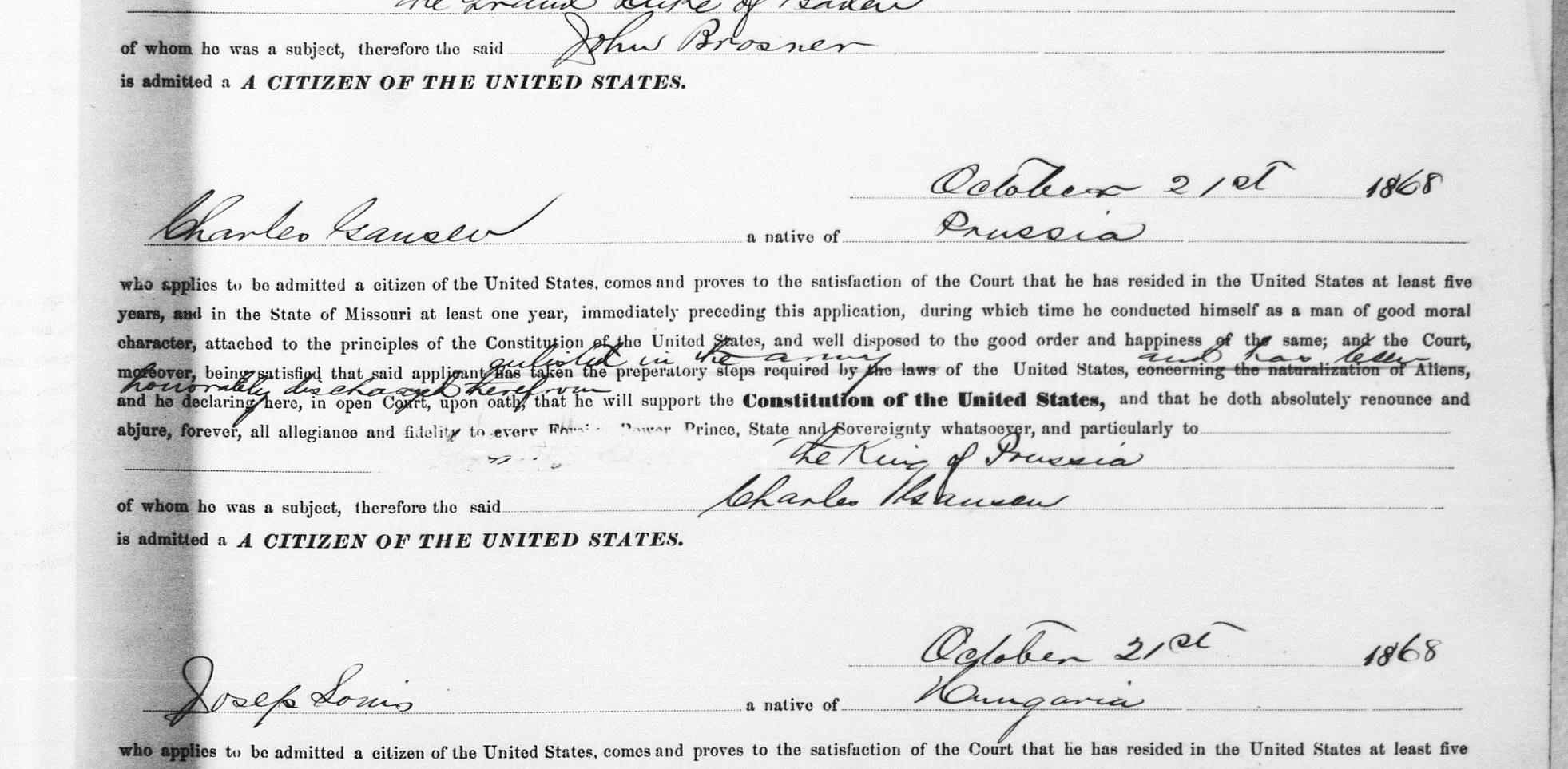
Image of Charles Gannsen's naturalization record. The 1900 federal census records Charles as naturalized, which corroborates the existence of a citizenship-grant document; this scan is the image record sourced for the project.
Naturalization records of this period typically document: the petitioner's name, age, country of origin, date of arrival in the U.S., date of declaration of intent (the "first papers"), date of naturalization (the "final papers"), and the court that granted the petition.
Citation. Charles Gannsen, U.S. naturalization, 21 October 1868 — St. Louis Court of Criminal Correction, Naturalization Records, Vol. 10, p. 126 (Missouri State Archives reel C 46598). The petitioner is indexed as “Gausen”. The record carries no signature of Charles: both occurrences of the name are in the court clerk’s hand (see the re-read below). Retrieved by record lookup from the St. Louis library; the same record is indexed in the FamilySearch collection “Missouri, County Marriage, Naturalization, and Court Records, 1800–1991.” The 1868 date is independently corroborated by the 1900 federal census “naturalized” entry.
Archival citation (Missouri State Archives). “Gausen, Charles” [Charles Gannsen], naturalization card, record date 21 October 1868, native country “Prussia” — Naturalization Records, 1816–1955; Record Group: St. Louis City Court of Criminal Corrections (CCC), 1866–; Series: Second & Soldiers Papers; Subseries: Naturalization Cards; County: St. Louis City; Vol. 10, p. 126; Missouri State Archives microfilm reel C 46598 (record-search requests via sos.mo.gov/archives). Index published by the partnership between the Missouri State Archives, the St. Louis Genealogical Society, and the St. Louis Circuit Court. The record group places the card in the Court of Criminal Correction’s Soldiers Papers series; only the index is published in partnership with the Circuit Court. Citation provided by a fellow researcher (email to Jed Johnson, 2 July 2026).
Ancestry database. “Gausen, Charles” [Charles Gannsen], record date 21 October 1868, native country “Prussia” — Missouri, U.S., Naturalizations, 1802–1956 [database on-line], Ancestry.com Operations, Inc. (Provo, UT); St. Louis City Court of Criminal Corrections, Vol. 10, p. 126, Missouri State Archives microfilm reel C 46598. Original data: Naturalization Records, 1816–1955, Missouri State Archives, Jefferson City. This is the Ancestry index of the same Missouri State Archives record above; the entry was located and shared by a fellow researcher (email to Jed Johnson, 2 July 2026).
Re-read of the entry (8 October 2026)
The entry was re-read from the image below (research note, 8 Oct 2026). It is a printed form with the clerk’s fill-ins, Court of Criminal Correction, St. Louis, Vol. 10 p. 126, dated 21 October 1868:
“Charles Gausen [or Gansen] a native of Prussia … has resided in the United States at least five years, and in the State of Missouri at least one year … [printed text struck:]has taken the preparatory steps required by the laws of the United States, concerning the naturalization of Aliens[interlined:] enlisted in the army and has been honorably discharged therefrom … and particularly to the King of Prussia of whom he was a subject, therefore the said Charles [G/K]ausen is admitted a citizen of the United States.”
- A soldier’s naturalization. The interlined clause applies the Act of 17 July 1862, under which an honorably discharged volunteer needed no declaration of intent (“first papers”). No first papers should be expected.
- Not an autograph. Both name occurrences, and the neighboring entries (John Brosner, Joseph Louis), are in the same clerk’s hand. The record does not carry Charles’s signature.
- The surname: “Gausen” or “Gansen”. There is only one minim pair between the a and the s, so the entry reads neither Gaunsen nor Gannsen. This clerk writes u and n identically (compare “Hungaria” in the next entry), so Gausen and Gansen cannot be told apart; the second occurrence has a K-like capital. Gansen matches the 1868 deeds (“Carl Gansen”) and the c. 1899–1900 voter register (“Gansen Charles … papers Oct 68 … C.C.C.”). The form is not a surname-canon attestation.
- Nothing else. No witnesses, no age, no prior residence, no port or date of arrival. The five-year and one-year residence terms are the printed text, not facts about Charles.
- Still to request: the loose “Soldiers Papers” packet (Missouri State Archives), which is not digitized and is the only place a petition or witnesses could survive.
The c. 1899–1900 St. Louis Register of Voters (Ward 9, line 22, “Gansen Charles … Germany … naturalized … Oct 68 … C.C.C.”) cites this naturalization as his citizenship papers.
Original document