On Tuesday, 2 December 1862, Charles Gannsen went before a notary in St. Louis and signed on for three years in the 2nd Missouri Light Artillery, a German regiment of the city.1 He joined a regiment in trouble. That same week about 120 of its men were arrested for mutiny, and by 6 December the mutineers had been moved from the Gratiot Street prison to Schofield Barracks.2
In this chapter
- The enlistment papers
- The German artillery of St. Louis
- The men sworn with him
- Why he enlisted
- Sick within three weeks
- The smallpox hospital
- The forts of St. Louis
- Guns, horses and equipment
- Third corporal, May 1863
- The regiment rebuilt
- Corporal and sergeant
- Notes
- About the pictures
- Life in a light battery, in full
- More of the chapter, as printed in the book until 6 November 2026
- Enlistment: Battery B at St. Louis, 1862–1863: more from the sources
- Supplements
The Missouri Democrat of the next morning, Wednesday 3 December, found business on the St. Louis levee “very dull.” “The weather was chilly, the sky was draped in unusual darkness,” its river column said. Its city news carried the court-martial of General McKinstry and a police-court docket of nine State and twenty-one city cases.3
The papers of Charles’s first year in the army show a recruit who had probably worked the land in Kurhessen and who signed his name himself, in the German script.4 They show the army making him a corporal within six months and a sergeant within a year.5
The enlistment papers
Charles enlisted at St. Louis as a private and was mustered in the same day.6 His enlistment produced three papers: a Declaration of Recruit, a Volunteer Enlistment and the surgeon’s Form for Examining a Recruit.7 The clerk who filled in the Volunteer Enlistment recorded in English that he was “born in Trennelburg in the State of Kur hessen aged twenty three years, and by occupation a Farmer.” The name in the oath is Charles L. Johnsen.8
Two of the papers needed his signature, and Charles signed both himself, in Kurrent.9 On the Volunteer Enlistment his signature reads “Karll,” an initial, and “Gannsen”; on the Declaration of Recruit the forename is “Karl,” with one l. He wrote the German Karl where the clerk had written Charles.10
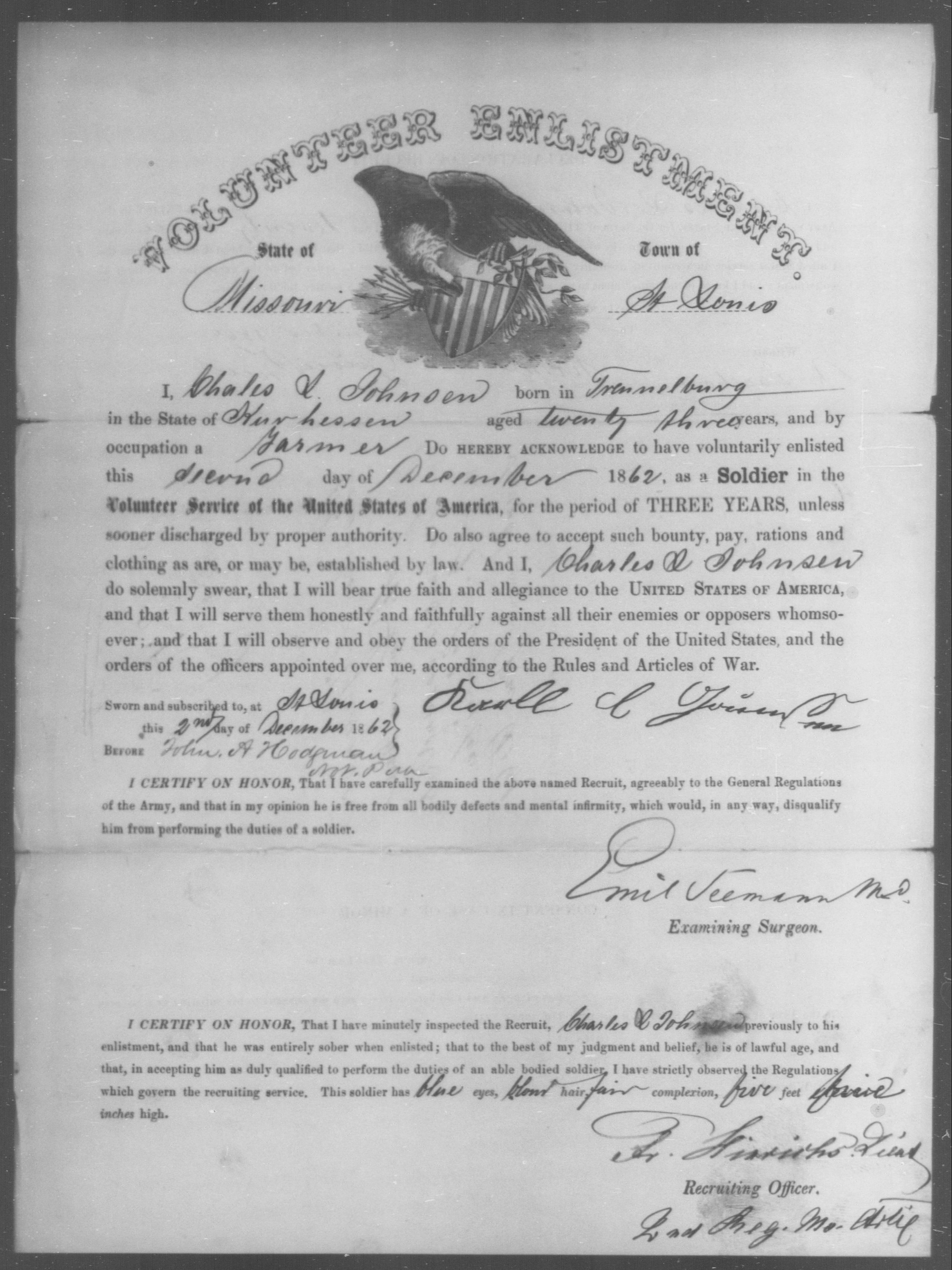
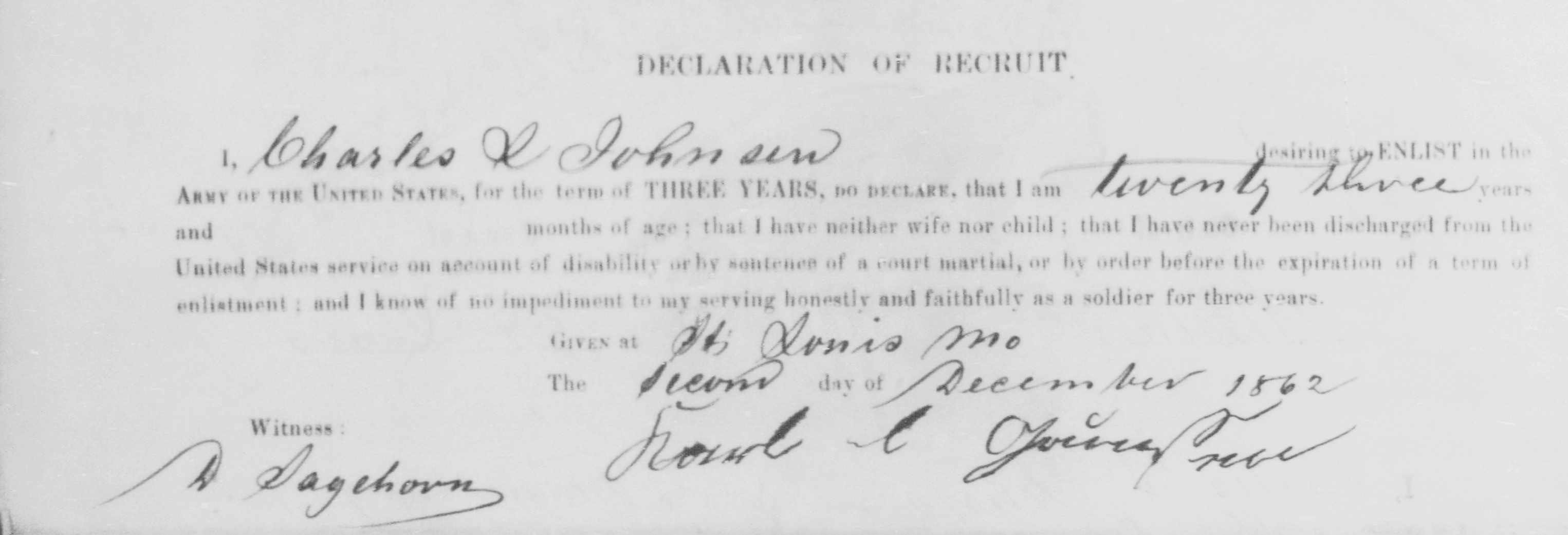
Charles went through a fixed routine. In the fall of 1862 the regiments’ recruiting officers enlisted three-year volunteers at offices in the city. Notaries swore them in, surgeons examined them, and they were sent to their units.11 In those months the papers of several recruits show the same three men at work. Lieutenant Frederick Hinrichs signed them up,12 Dr. Emil Seemann examined them, and Dietrich Sagehorn witnessed their declarations.13
The regiment’s Descriptive Book gives the details that were copied into every later list. It records him as “L. Charles Gannsen,” private, age 23, five feet five inches, fair complexion, blue eyes, blond hair, farmer. It gives his birthplace as “Freundburg, Kurhessen,” and says that Lieutenant Hinrichs enlisted him for three years.14 No place in Hesse is called “Freundburg.” This book reads it as the regimental clerk’s spelling of Trendelburg, the place Charles gave on his enlistment paper the same day. The other clerk’s slip, “Johnsen,” put the file under Johnson in the index.15
Charles called himself a farmer on enlistment day, and the army’s papers repeat the word. The surgeon’s form that Dr. Emil Seemann filled in the same day,16 the regiment’s Descriptive Book17 and three entries on the Missouri Adjutant General’s descriptive rolls all give “Farmer,” copying what he said that day.18 The enlistment forms had one blank for occupation and no room for detail. In English “farmer” covered everyone who worked the land, from a farm’s owner to a man hired by the month. The registers of Trendelburg, Deisel and the villages around them kept those ranks apart. They recorded a father either as a farmer on his own land or as a day laborer (see Chapter 1).19
“Farmer” probably describes the work he had done in Kurhessen. It possibly also covers farm work around St. Louis between his arrival and his enlistment; that idea rests only on the lack of any city record of him in those years.20
The battery’s monthly report for December 1862 lists him as a new man: “Gain Dec 2/62 St Louis Mo. Joined by enlistment.”21
The German artillery of St. Louis
The regiment he joined was formed at St. Louis between 16 September and 6 November 1861, and from 20 November 1861 it was the 2nd Missouri Artillery.22 Ella Lonn, the historian of foreign-born Union soldiers, judged it a German regiment. Most of its officers were German-born, and four-fifths to seven-eighths of its privates were German.23 The German volunteers of St. Louis made up most of the first Missouri Union regiments. Rural Missourians resented them as foreigners in uniform and called them “Hessians,” meaning alien military oppressors.24 (On the name, see Chapter 3.) The roll of Charles’s own company agrees with Lonn.25
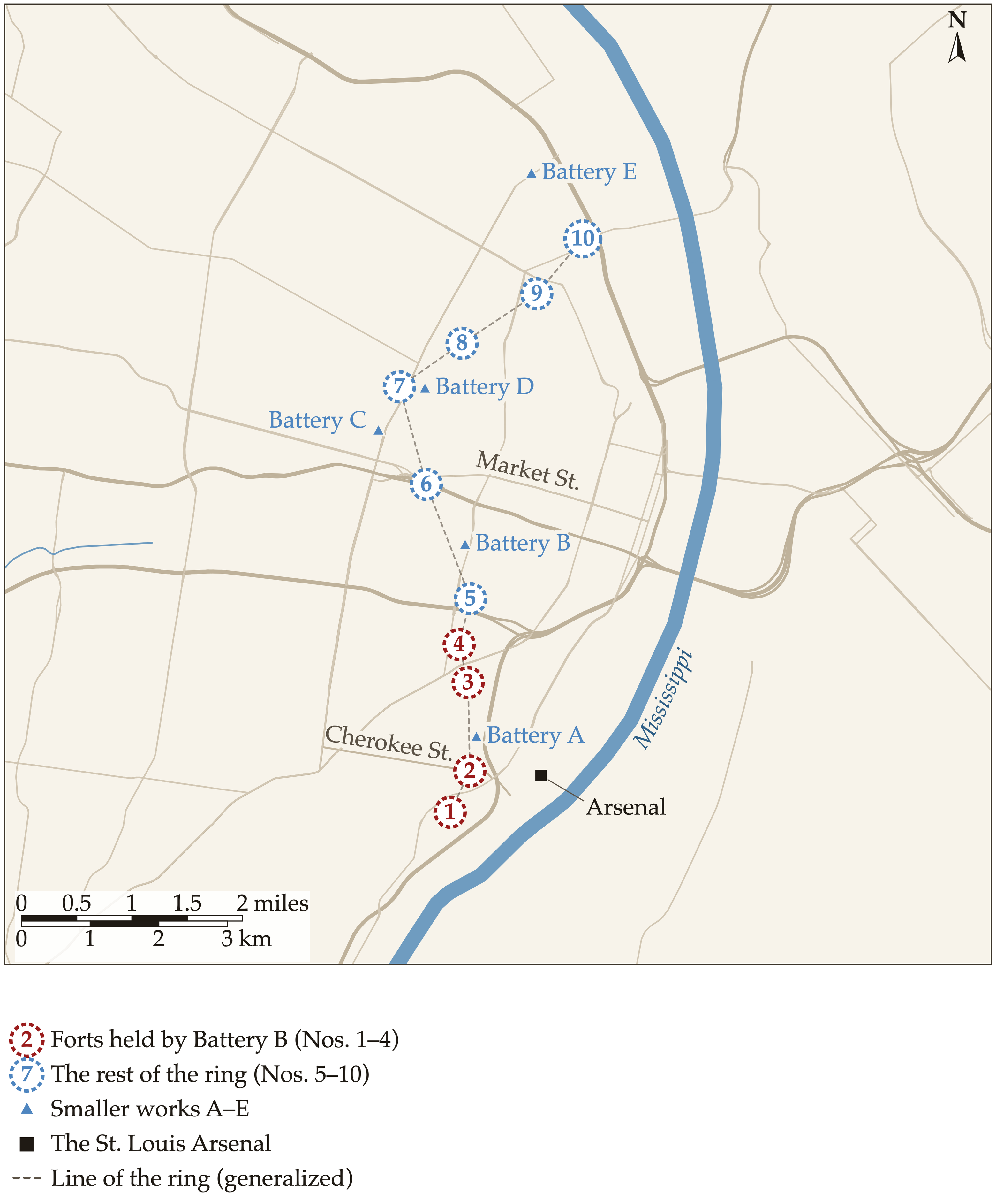
The 2nd Missouri had lettered companies, each under its own captain. In an artillery regiment a company was called a “battery.”26 Frederick H. Dyer’s Compendium of the War of the Rebellion, a register of Union regimental histories, says it served in the forts around St. Louis until September 1863.27 These were the ring of numbered earth forts around the city. (On how they were built, see the chapter “St. Louis before the War, 1859–1862.”)28
Many of the regiment’s men said they had joined as Home Guards of the Reserve Corps, not as volunteers. The Home Guard regiments of 1861 had been sworn in, as General Lyon reported, “upon the condition that they were not to be called to perform duty outside of the county of St. Louis.”29 When Washington ruled against them, some refused to serve.30 Those arrested for mutinous conduct in the first days of December faced a sentence of hard labor without pay for the rest of the war. Their colonel, Henry Almstedt, had the sentence set aside, on condition that the men be split up among other regiments and companies.31 Charles signed on as a three-year volunteer in the week of the arrests.32 He had no Home Guard enrollment of his own, so he had no such claim to make.33
The Missouri Adjutant General’s card file agrees with his enlistment paper. It has a card for him under the “2d (Old) Reg’t Art. Vols.,” the regiment as first organized in September 1861, and that card gives his enlistment as 2 December 1862 at St. Louis. A second card under “Gansen, Charles L.” points to it.34 No earlier enlistment has been found under any spelling of his name.35
The men sworn with him
Adam Herweck, another Hessian, enlisted with Charles that day.36 On 2 December 1862 he signed a Volunteer Enlistment at St. Louis. The form records him as “Adam Harwick, born in Lambertheim in the State of Hessen Darmstadt, aged thirty one years, and by occupation a Taylor,” and he signed it “Adam Herweck.” The same four men handled both recruits that day: Hinrichs, Dr. Seemann, the notary Hodgman and the witness Sagehorn. Herweck was five feet five, with blue eyes, brown hair and a fair complexion.37
Both men are on the Missouri Adjutant General’s descriptive roll of the old Company B, the company as first raised, mustered in at St. Louis on 2 December 1862.38 Both were privates on the battery’s first muster roll, for November and December 1862.39 Nothing shows whether they had known each other before, and Herweck did not swear for Charles’s pension.40
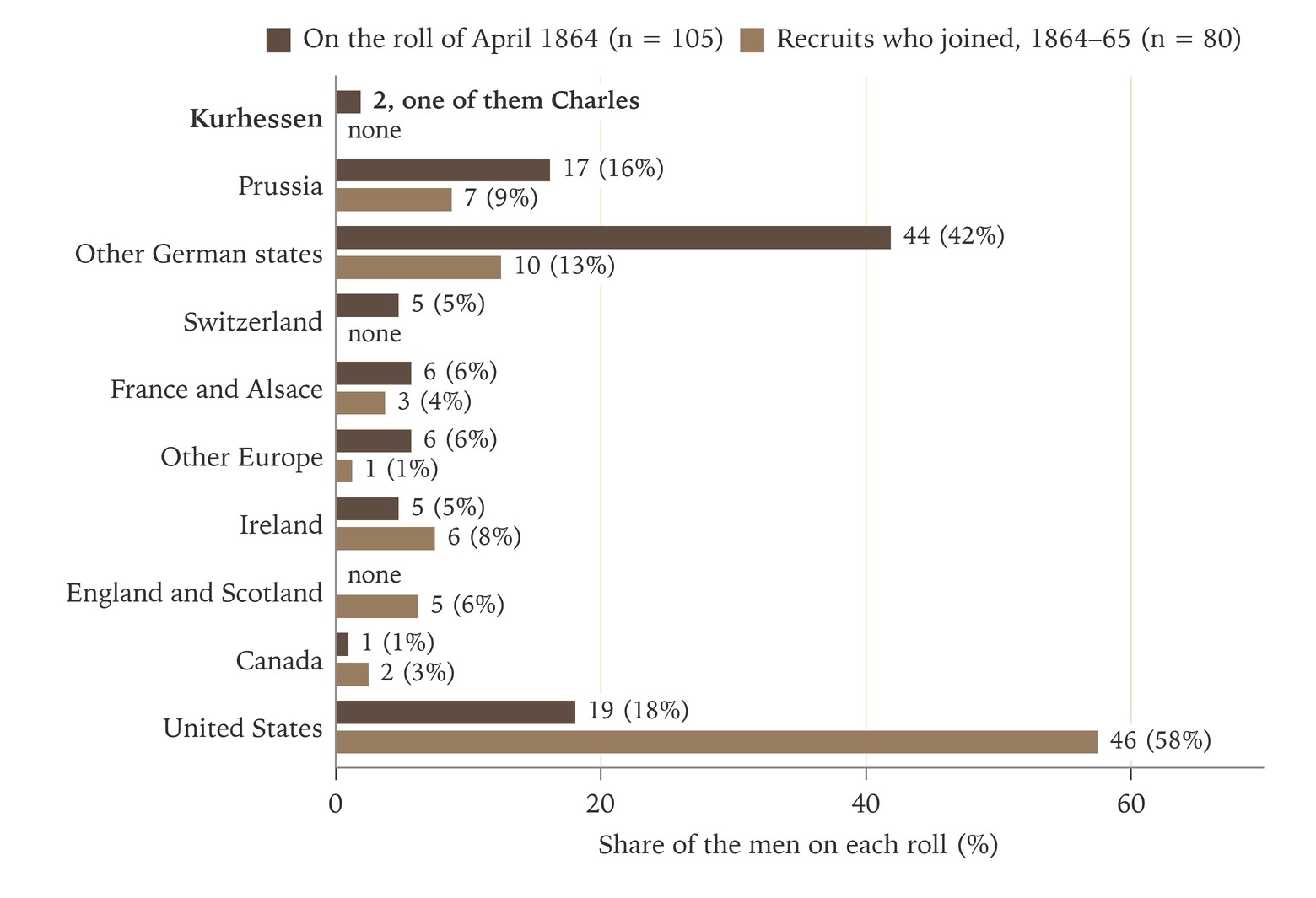
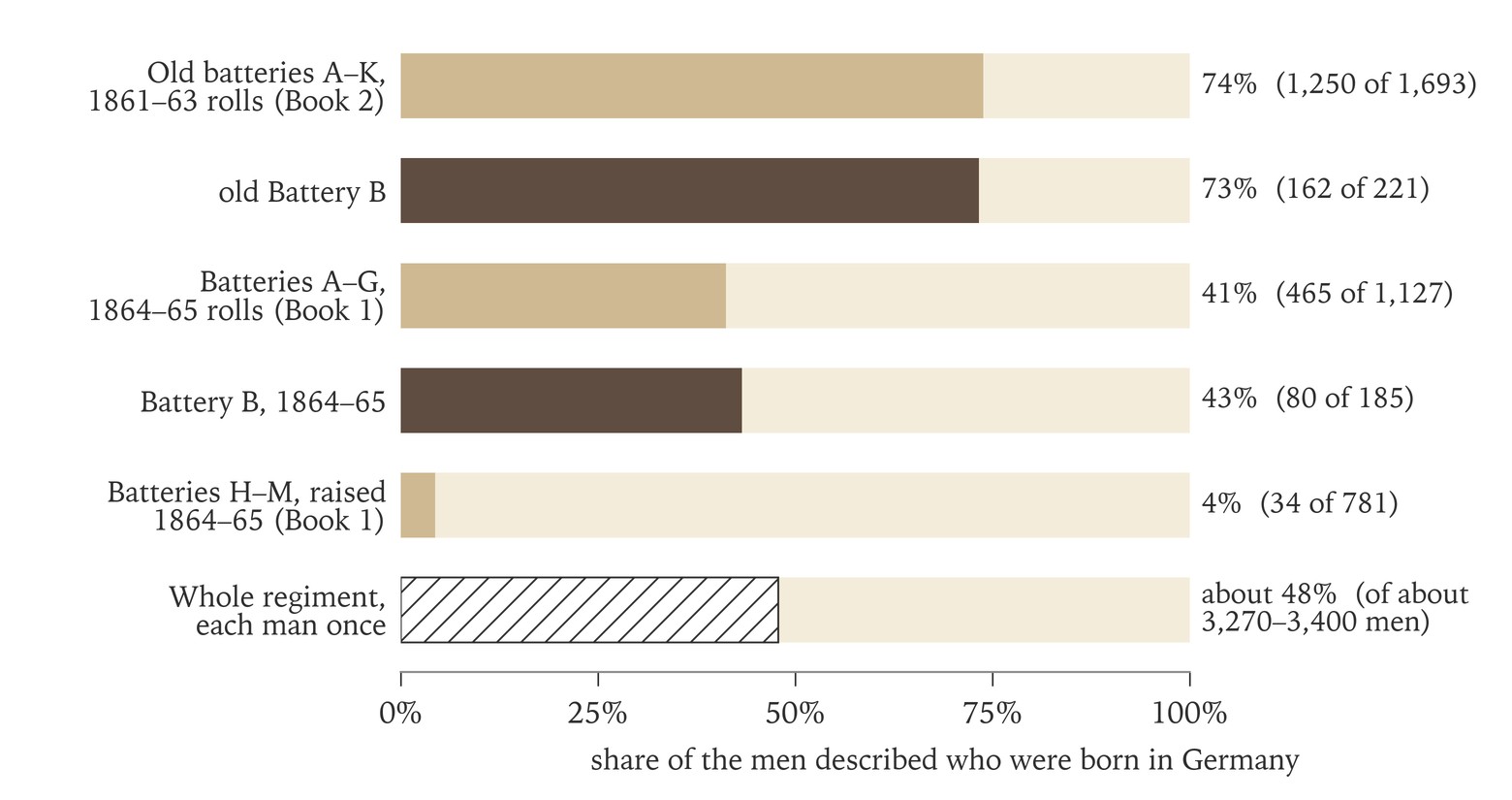
Most men in the company Charles joined were German, but many were not. The Adjutant General’s bound roll of the old Company B lists about 223 men. The largest group, about sixty men, came from Prussia, including Westphalia, and many of those came from the district of Minden, Herford and Bielefeld. Only four, Charles among them, were born in Kurhessen.41 On both descriptive rolls of Battery B he is the only man from Kreis Hofgeismar, the district of Trendelburg and Deisel.42
Why he enlisted
The government paid Charles $25 when he enlisted and owed him $75 more (see Chapter 6).45 A three-year volunteer’s federal bounty, a cash bonus for signing up, was $100, due by law at discharge. A War Department order of 7 July 1862 had $25 of it paid when the recruit was sworn in.46 Herweck’s papers record “four dollars premium & twenty five dollars bounty paid Decbr 3/62,” signed by the lieutenant of the 14th Infantry who mustered in and paid the recruits.47 Men who enlisted later received far more; Charles, enlisting at the end of 1862, had only the $100 of the older law.48 The bounty was small, but a draft was near.49
Through the fall of 1862 the city’s men were enrolled for the militia, and a draft was threatened for any shortfall.50 By October 1862 provost guards were stopping men in the streets of St. Louis to see their enrollment or exemption papers. A man without them could be put in a regiment or in prison.51 Köster, the schoolmaster from Charles’s own district, had written that summer: “Then it goes by compulsion” (see Chapter 3).52 Köster’s own health spared him. In September 1862 he wrote: “Through illness and bodily defects I have so far been free of military service, but what the future will bring I cannot know.”53 The war thinned the German singing societies. The more singers who joined the Union ranks, the wider the gaps in the tenor and bass sections, and rehearsals were poorly attended and at times put off.54
As a non-citizen, though, Charles could probably have claimed exemption. In July 1862 General John M. Schofield exempted from militia service in Missouri “the subjects of foreign powers lawfully pursuing their vocations.” Since May 1862 the War Department had asked for proof of foreign citizenship, usually a consul’s certificate.55 Most German soldiers in the Union army were volunteers; only about one in six was drafted.56
Steady pay possibly mattered too. A private earned $13 a month.57 In November 1862, a month before Charles enlisted, Köster wrote that only the war trade earned anything.58 That month a St. Louis bookkeeper wrote that potatoes had gone from 15 cents to a dollar a bushel in a year and dry goods had more than doubled. Business outside the army line, he wrote, was “extremely dull.”59 Charles has no city record before he enlisted, so nothing shows what work, if any, he had in St. Louis.60
In the German soldiers’ letters that Walter Kamphoefner and Wolfgang Helbich studied, few writers mentioned patriotism. Some had left Germany to escape its army. At least a third had enlisted for want of other work or for the pay.61 In August 1863 one German immigrant wrote home that for working men there was “no other way to earn a living except to enlist.”62 If Charles came in 1859, as one census suggests, he was a recent arrival when he enlisted.63
Service also gave a quicker way to citizenship. A discharged soldier who was not a citizen could become one after a year in the country.64 Ella Lonn doubted that this offer drew many men into the army; she counted it among the rewards of service.65
The records do not settle his reason. The draft probably did not force him, because of the exemption for foreign subjects. Pay is possibly the reason, as it was for many recent arrivals. Nothing he said about the Union survives (see “What His Life Tells Us”).
Sick within three weeks
Twenty days after he enlisted, Charles was “Sick in Regt’l Hospital since Dec 22d 1862.”66 Each regiment had its own hospital, run by its surgeon, for men it could treat in camp. It sent the gravely ill to the large army hospitals. Recruits from the countryside, crowded into city camps, brought measles, mumps and smallpox into the barracks. Diarrhea, dysentery, typhoid and malaria spread among the armies in the low ground along the rivers.67
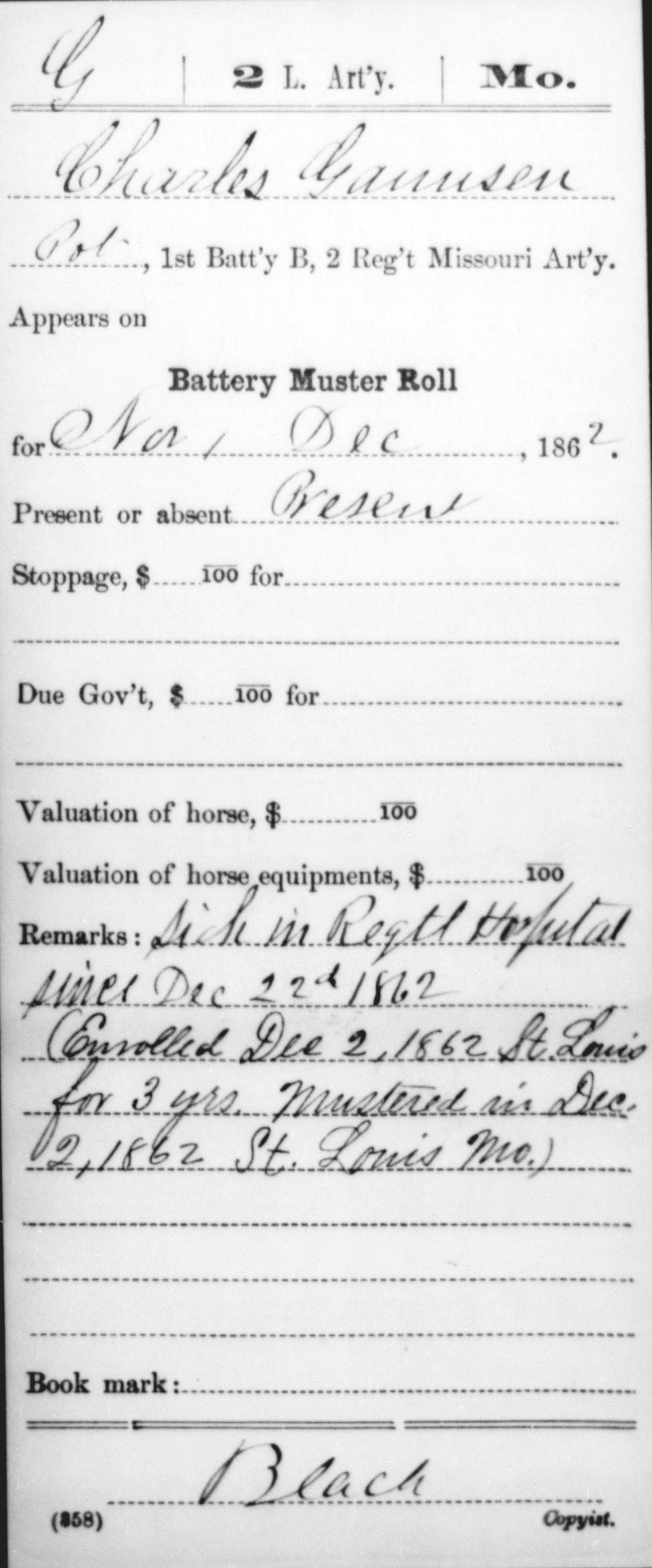
Disease killed about twice as many Union soldiers as battle.69 The whole regiment lost 47 men killed or mortally wounded and 131 to disease and other causes.70 Battery B’s own rolls show the same thing. Of the 344 men they describe from 1861 to 1865, sixteen died, only two of them from wounds. Table 4.1 gives the rest.71
Table 4.1. Battery B: what became of its 344 men, 1861–65
| Last outcome on the rolls | Men (no.) | Share (%) |
|---|---|---|
| Mustered out (117 with the battery in December 1865; 65 of the old company in August 1863; 6 at other dates) | 188 | 55 |
| Deserted (5 of them returned) | 61 | 18 |
| Discharged for disability (28 of them by the surgeon’s order, 1862) | 44 | 13 |
| Died (7 of disease, 2 of wounds, 1 by accidental gunshot, 1 shot himself, 2 executed, 3 cause not written) | 16 | 5 |
| Transferred, promoted out, discharged for other reasons, or resigned | 31 | 9 |
| No outcome written | 4 | 1 |
| All men described | 344 | 100 |
Source: Missouri Adjutant General, descriptive rolls of Battery B, Books 1 and 2, counted for this book.72
Note: each man is counted once, under the last outcome the rolls give him. Shares do not add to 100 because of rounding.
The battery’s roll for November and December 1862 lists Charles as present, as the rolls usually listed a man in his own regiment’s hospital.73 A card for January 1863 lists him as “absent sick Regt Hosp’t since Jan 30/63,” either a second illness or another clerk’s record of the first.74 Dr. Seemann, who had examined him on enlistment day, had been commissioned the regiment’s surgeon in January 1862.75 He held the post until he resigned on 10 February 1863, and Charles was very probably in his care during those weeks.76
The smallpox hospital
In February 1863 the army detached Charles from the battery to its smallpox hospital. The roll for January and February 1863 marks him absent: “On det. service at Small Pox Hospital since Feb. 20, 1863 by order of Maj. Genl. Curtis.”77 Curtis’s name is on the order only as a matter of form: orders from the department were the usual way to move a single soldier on and off a special assignment.78 The hospital’s own muster roll carries him as attached.79
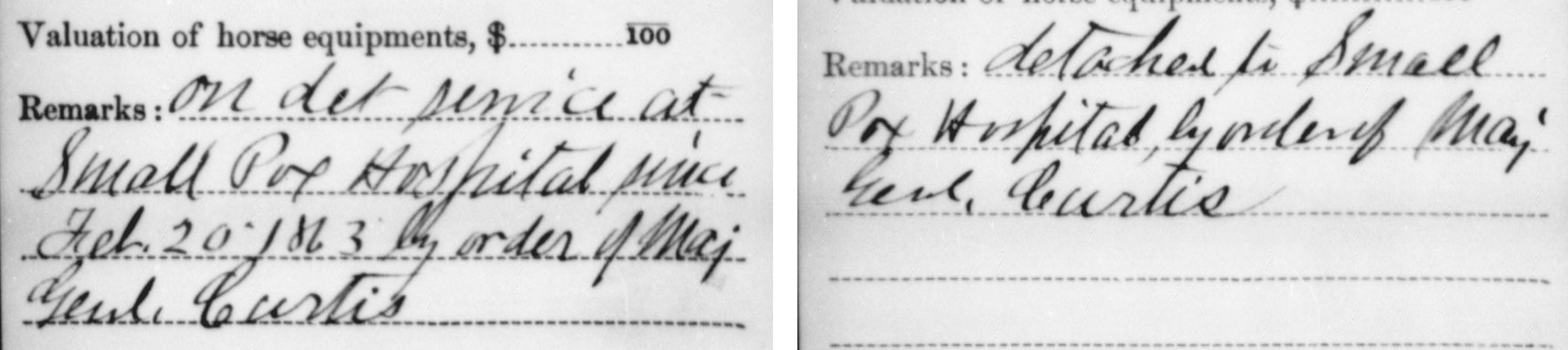
His first illness was probably not smallpox. The hospital roll covers the period from 31 October 1862 to 28 February 1863, so the army’s smallpox hospital at St. Louis was already open when Charles fell sick in December.80 If his December illness had been smallpox, he would probably have been sent there as a patient; the cards say only that he was in his own regiment’s hospital.
The cards use the words for a man on assignment away from his unit, not for a patient.81 The hospital roll says how he was employed there: “Nurse.” So Charles went to the smallpox hospital as a nurse.82 Under the 1861 army regulations, the cooks and nurses of a large army hospital were privates taken from the ranks. They did no other duty, and the hospital’s rolls carried them while they were away from their companies.83 The medical history of the war records that convalescents and men detailed from regiments nearby did much of the ward and guard duty.84 His detail came just as the army was making that practice formal.85 Possibly he had survived smallpox and was immune. Or possibly he was still too weak after his December illness for field duty, and was kept on as a hospital attendant, as the army then allowed.86
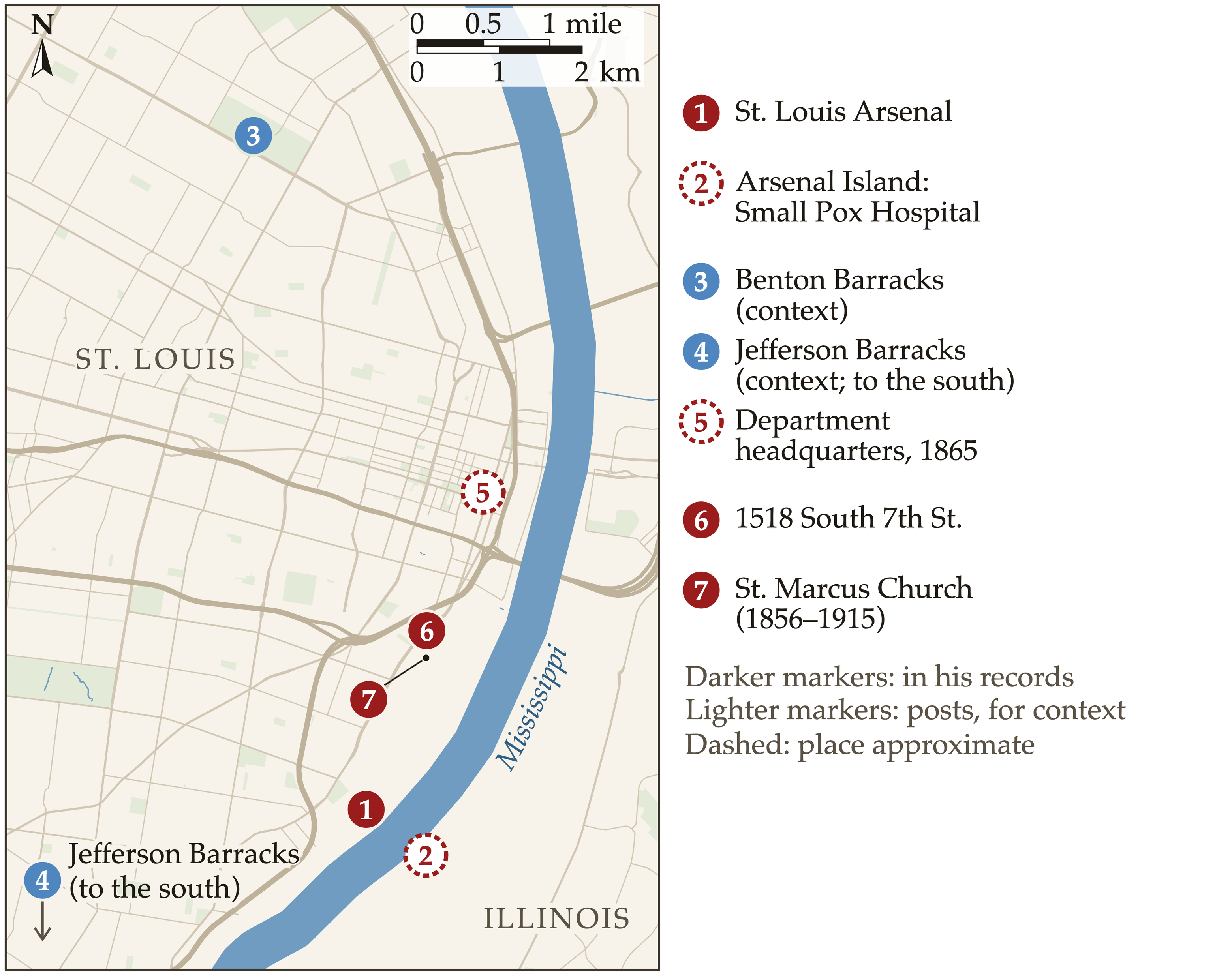
The hospital stood on an island in the Mississippi. In 1862 and 1863 the Western Sanitary Commission reported that the Small Pox Hospital was “on Duncan’s Island, in the Mississippi river, near the Missouri shore, opposite the Arsenal.”87 It was the low island the city had chosen years before as “the most isolated spot on which to erect a small pox hospital.” It could be reached from the Missouri bank “only by skiffs,” small rowboats.88 The Corps of Engineers calls it Arsenal Island. Scharf calls it both Quarantine Island and Arsenal Island, and says the government used the upper part of the island as a burial ground during the war.89
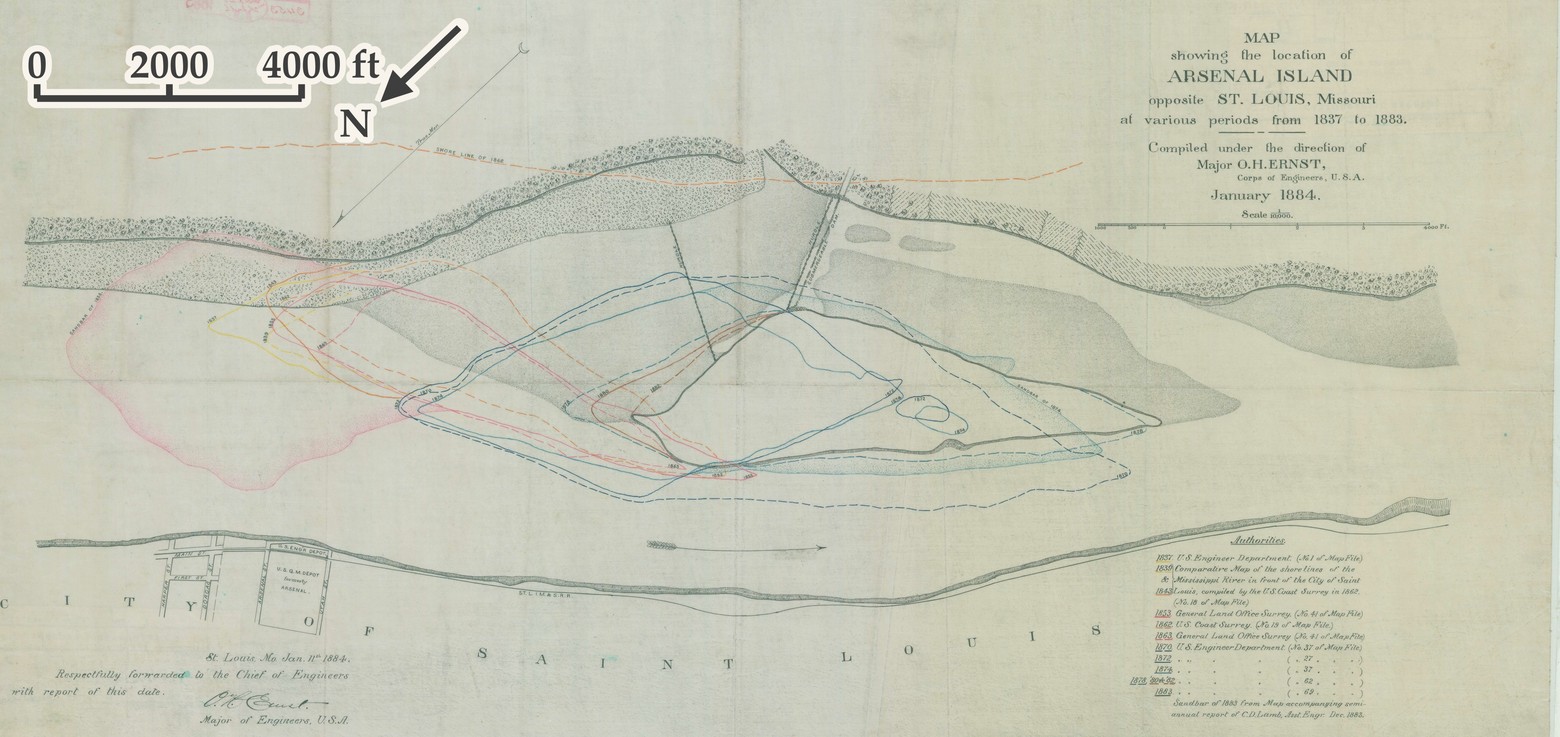
By the summer of 1863 the hospital’s whitewashed wooden wards and tents could hold 250 patients. From its opening to 1 June 1863 it received 871 patients, and 200 of them died, nearly one in four.91
By the roll for March and April 1863 he was back with the battery and present.92
The forts of St. Louis
Charles came back to garrison duty. When he joined the battery it held two of the city’s forts. Company B had moved to Fort No. 1 on 18 September 1862 and sent half its men to Fort No. 2 on 1 October. On 24 December 1862, two days after he fell sick, a detachment took over Fort No. 3 as well. Every roll to June 1863 repeats that the company has charge of Forts Nos. 1 and 2.93
In 1863 General John M. Schofield sent Missouri’s field regiments south to the siege of Vicksburg and left the state to the more conservative militia. Charles’s artillery regiment stayed in the city forts.94
Guns, horses and equipment
The 2nd Missouri was light artillery by name. A Union light battery at full strength had six field guns. Each was hitched to a limber, a two-wheeled ammunition cart, and pulled by six horses. One field gun of the drill book was the Napoleon, a bronze cannon that fired a 12-pound ball.95
Charles’s battery did not serve that way in 1862 and 1863. Until the middle of 1864 the regiment served mostly as heavy artillery, manning the big guns of the forts.96 Fort and siege guns were larger and did not travel with horses. They sat on platforms behind the fort’s earth wall. Men moved them with long wooden handspikes, rollers, hoists and ropes. The War Department’s Instruction for Heavy Artillery, adopted in October 1862, set out the drill for them. It differed from field drill in its numbers and its commands, and above all in its heavy lifting: the men moved cannonballs, gun carriages and guns by hand.97
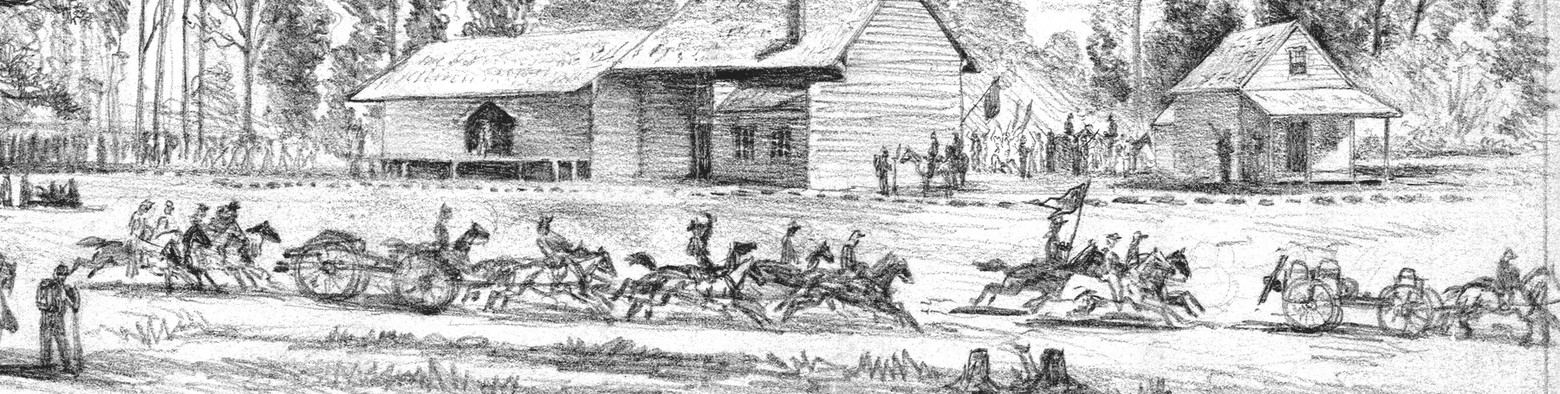
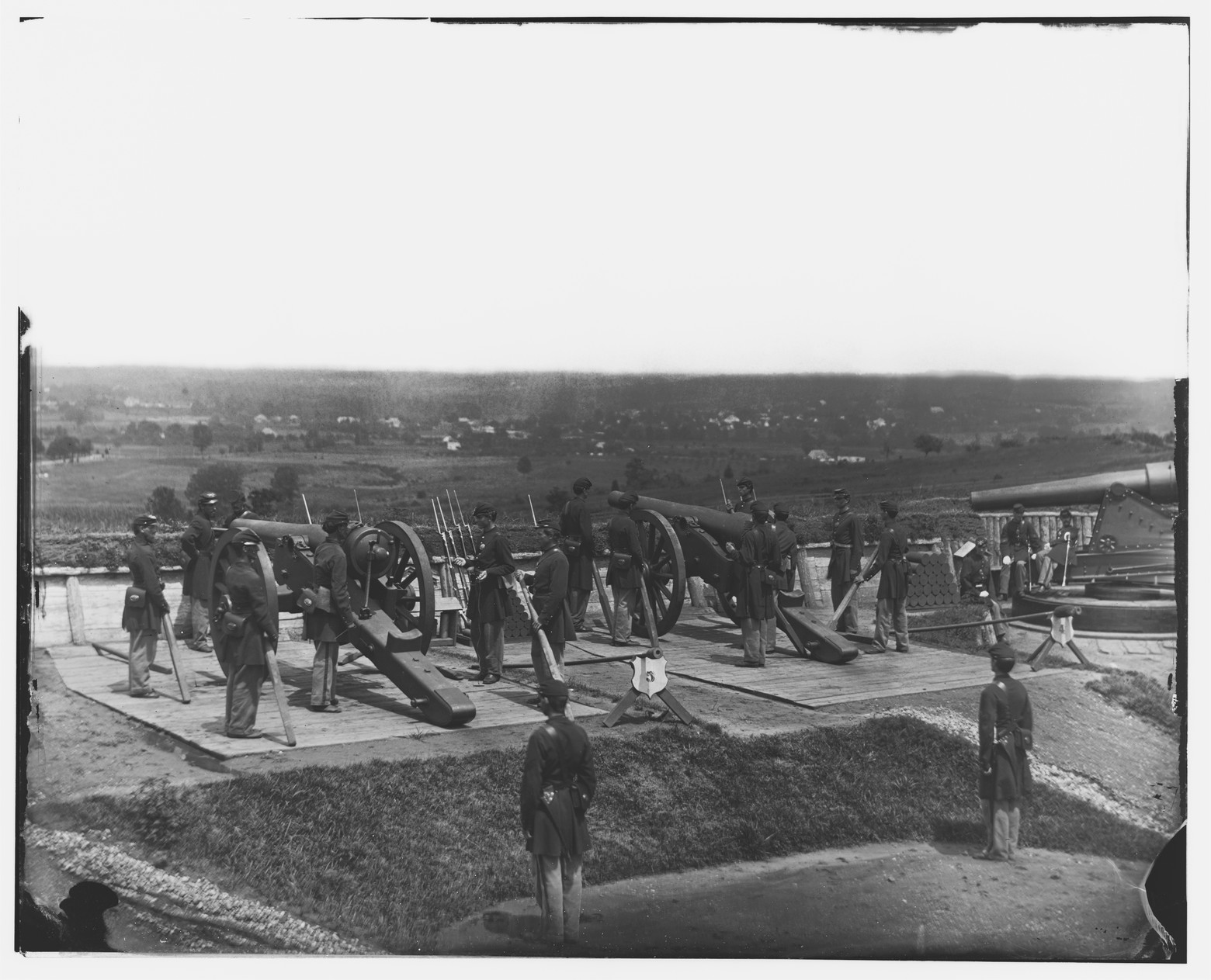
Each battery of the regiment carried its own guidon, a small flag with a forked end. Those of Batteries A and K survive in the Missouri State Museum.99
Third corporal, May 1863
Charles had enlisted as a private.100 On 29 May 1863 he was promoted corporal.101 The Adjutant General’s roll of the old Company B lists him among the privates as “Charles L. Gansen,” with the remark “Promoted as Corporal May 29th 1863.”102 The cards rank him third corporal for May–June 1863 and second corporal for July–August and September–October. He was present on every bimonthly roll from March to October.103
In the 1861 gun drill a corporal was the gunner, who aimed the gun. In action the gunner gave the commands to load, point and fire.104 Corporals and sergeants held numbered places by seniority, first corporal, second corporal and so on, so the number on a man’s card shows where he stood among them on the day of the muster.105 In a volunteer battery the regiment’s commander appointed them on the captain’s recommendation, and the captain could fill a vacancy until the commander decided. A man lost his rank only by court-martial or by the commander’s order at the captain’s request.106
The regiment rebuilt
Two officers commanded the regiment in Charles’s first year. Colonel Henry Almstedt resigned in August 1863, and Lieutenant Colonel Joseph Weydemeyer left in September, a few weeks before the regiment was consolidated.107
On 8 August 1863 Company B marched the two miles to Camp Edwards “to be reorganized.” It was back at Fort No. 2 by 11 September, when Adam Herweck was detached there for recruiting duty.108
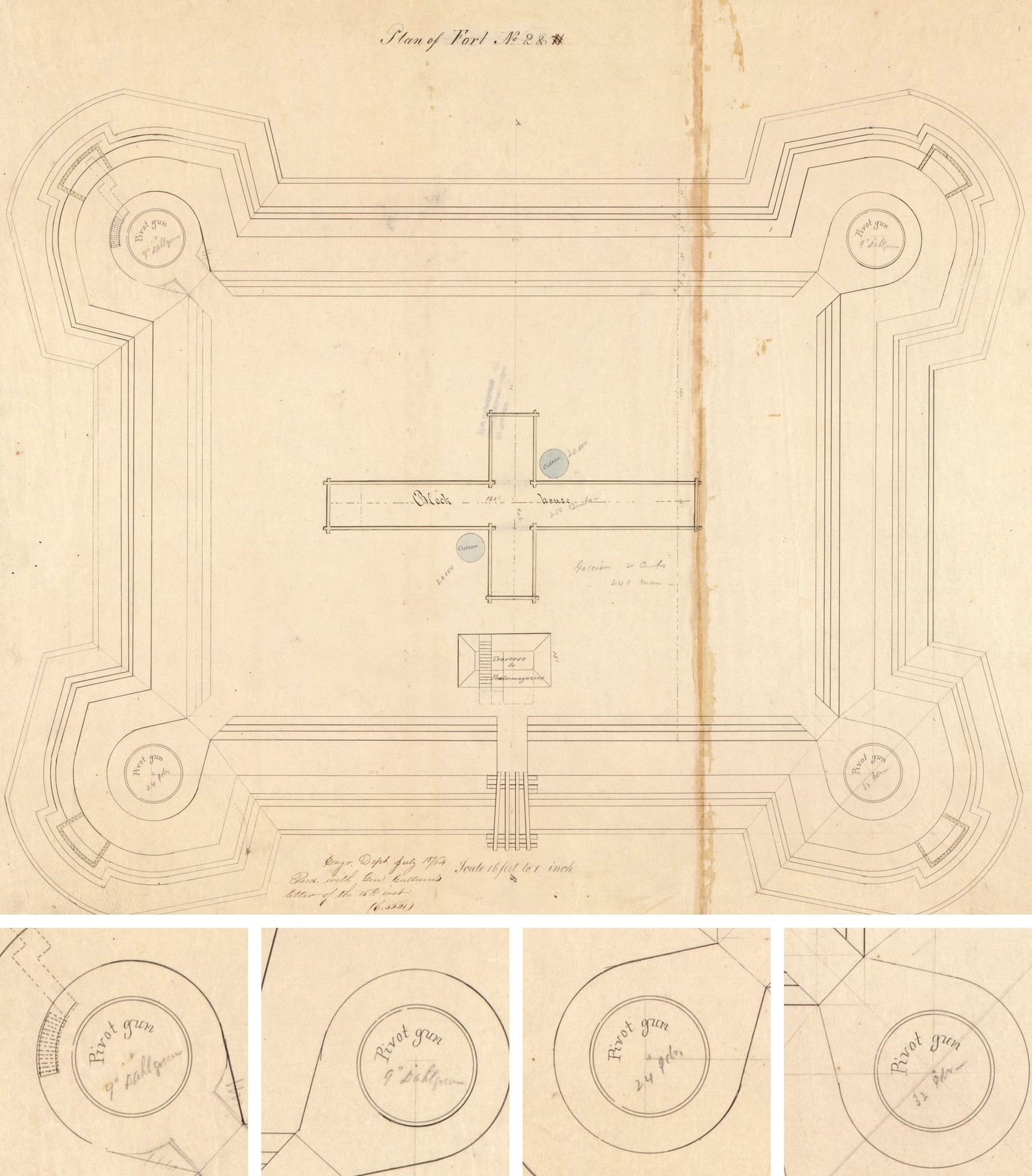
Fort No. 2 stood on the high ground at what is now Cherokee Street and Lemp Avenue. Like the others, it had earthen walls, a ditch and gun platforms.109 The army’s own plan of it survives at the Library of Congress. A round gun platform sits in each of its four corners, with a blockhouse and a powder magazine inside the walls.110 Charles served there. In September and early October 1863 the whole battery was stationed at Fort No. 2, and he was present on its roll.111
If the guns penciled in on the plan’s four platforms were in place in 1863, the two largest were 9-inch Dahlgrens, Navy shell guns of 9,000 pounds that each fired a 72-pound explosive shell.112 The plan’s 24- and 32-pounders were named for the weight of the solid ball each fired; the army’s iron guns of those sizes weighed about 5,800 and 7,200 pounds.113 A “pivot gun,” as the plan labels each one, sat on a frame that turned on one bolt, its pivot, so the crew could swing it across its round platform. The gun fired over the wall, not through it.114 The army’s drill book gave an iron gun on such a frame a gunner and four cannoneers; to aim it, two of them levered the frame left or right at his signal.115
In the fall of 1863 the regiment was rebuilt, and Charles moved from the old company into the new one with his rank. Dyer records that on 29 September 1863 it was cut down to a battalion of five companies. Company B, his company, kept its organization. The other old companies were merged into new Companies A, C, D and E, and new batteries were raised through the winter.117 On the War Department’s muster cards the change appears as a change of name: Charles’s old “1st Batt’y B” became the “3d Battery B.”118 The Missouri card headed “Gaunsen, Charles (or Gansen, Chas. L.)” records the same step in its own words: “Promoted Corp. May 29, 1863. Detached to small pox hospital. Transferred to Co. B, new organization,” and names Captain Sutter.119 He was present on both rolls.120
Captain John J. Sutter commanded both the old company and the new.121 He had been promoted from the regiment’s Company G to captain of Company B in October 1862, six weeks before Charles enlisted.122 The old company’s roll describes him as a clerk of twenty-four from Altenheim, near Offenburg in Baden.123
The new battery’s first duty was outside the city. On 9 October 1863 the company left Fort No. 2 by the Pacific Railroad. It reached California, Missouri, 165 miles to the west, on the 11th and went on to the bridge over the Lamine River. On the 19th it was ordered back. From the 20th it was at Fort No. 4.124 Colonel Jo Shelby’s Confederate raiders, at Tipton on 10 October, had burned the railroad’s bridge over the Lamine near Otterville. The battery was very probably sent to hold the crossing.125 The roll that records the journey marks Charles present.126
Corporal and sergeant
Soon after the battery came back, one of its privates killed a St. Louis gunsmith. Private Valentine Hansen, from Luxembourg, was on the old company’s roll. He had been away on duty. On the evening of 20 October 1863 Hansen came home to find that his landlord had raised the rent and collected it from his wife. The landlord was the gunsmith John Ellig, of Seventh Street between Allen and Geyer Avenues.127 According to Captain Sutter, Sergeant F. L. Haeger, left in charge at the fort, had let two armed men of the company go with Hansen. With them, Hansen went to Ellig’s house that night. When Ellig came to the door, one of the soldiers fired through it and missed; Hansen went around to a window and shot him. Ellig died the next morning.128
Hansen was convicted of murder and hanged at the St. Louis County jail on 15 April 1864. In November 1863 a general court-martial demoted Haeger to private, very probably for that night.129 Charles, a corporal, was present through those weeks.130
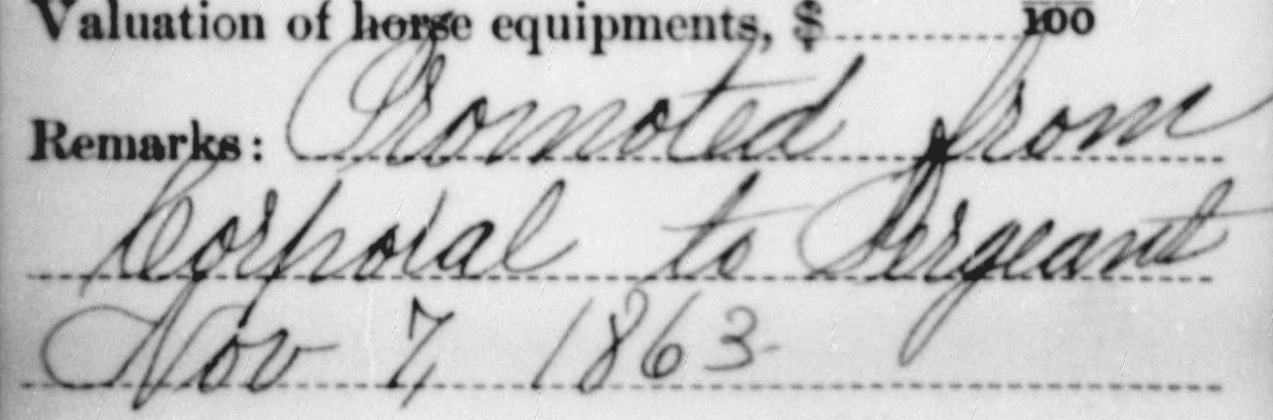
On 7 November 1863, at St. Louis, Charles was promoted from corporal to sergeant. The card for November and December 1863 lists him as “4 Sergt.,” fourth sergeant.131 His pay rose to the sergeant’s $17 a month.132 Adam Herweck, sworn in beside him, was promoted sergeant the same day.133
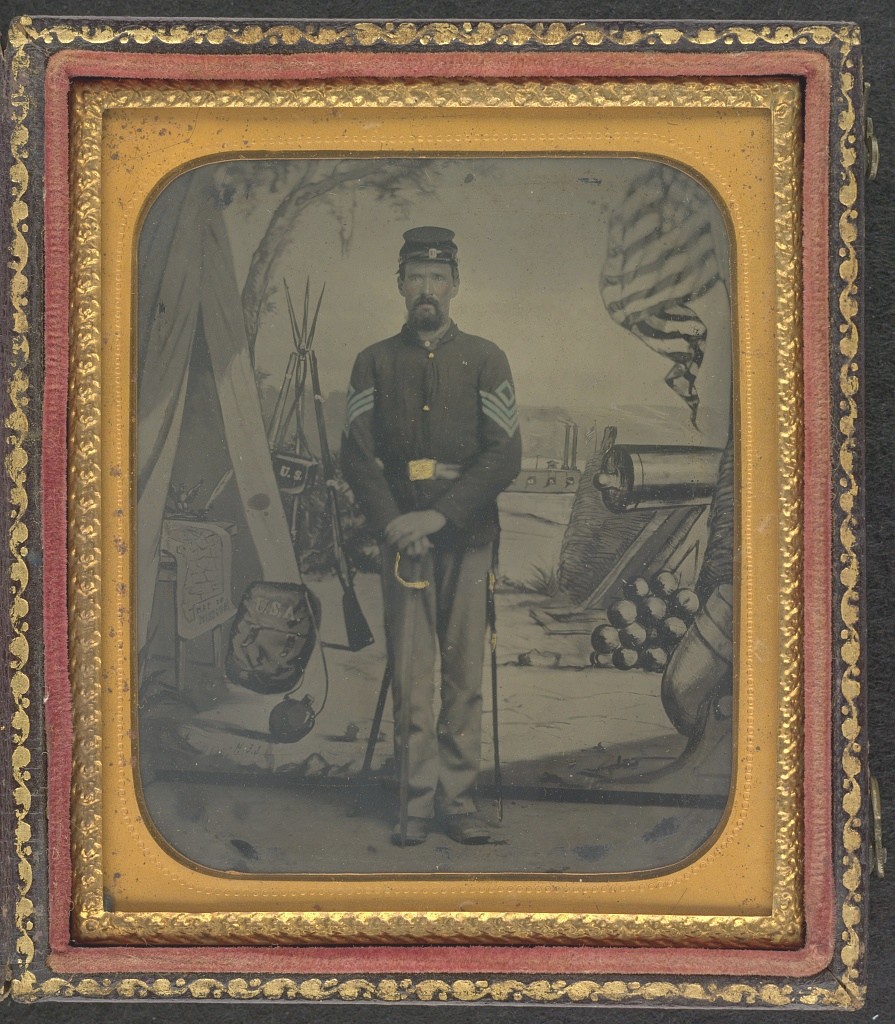
In a company guarding a fort, a sergeant kept a squad or a gun crew in order and saw to its food, quarters and weapons. He helped relieve the sentinels and answered to the first sergeant for all of it.135 In the 1861 gun drill a sergeant was “chief of the piece.” He was in charge of one gun, its crew, its horses and its ammunition, and he passed on the orders to its crew.136
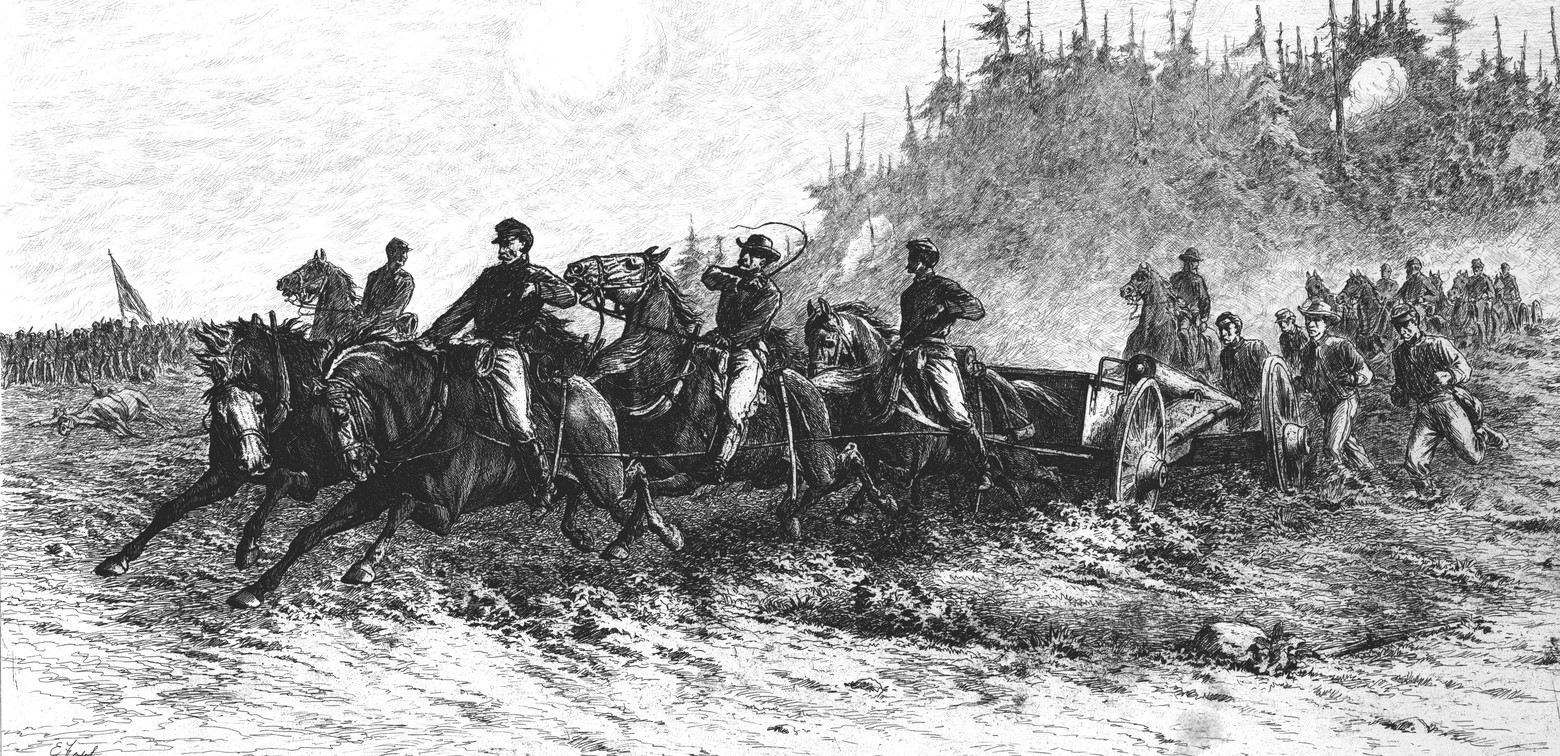
Apart from the Lamine journey, Battery B had spent the whole of Charles’s first year at St. Louis.137 On 1 December 1863 it moved from Fort No. 4 to New Madrid, on the Mississippi in the far southeast of the state, to take charge of the fort there.138 Sergeant Gannsen went with it.
Notes
138 notes
- Declaration of Recruit, Volunteer Enlistment and Form for Examining a Recruit, St. Louis, 2 Dec 1862; Original record, signed by Charles; primary information for the enlistment; direct evidence; Compiled Service Record cards, Battery B, 2nd Missouri Light Artillery (NARA M405, roll 327; Fold3 file 228767500, https://
www : accessed 29 October 2026): enrollment, hospital (22 Dec 1862). — Proven. From that day on, the record of his life comes from the army’s own papers. Most of them survive as cards. Years after the war, War Department clerks copied every entry for each soldier onto a card of its own. The entries came from the muster rolls, returns, descriptive books and hospital registers. The cards let the clerks check pension claims quickly. His papers also include the Missouri Adjutant General’s books describing each soldier, and a few orders. The cards are copies, but this book states their facts plainly, because they are the War Department’s own abstracts of the battery’s records. Where they can be compared with his enlistment paper and the Missouri Adjutant General’s rolls and cards, they agree on his enlistment and his promotion to sergeant. The battery’s original rolls have not been seen, so the comparison is partial; the few disagreements found are noted where they occur. National Archives, “Civil War Records: Basic Research Sources,” https://.fold3 .com/ file/ 228767500 www (reviewed 20 Dec 2024): accessed 1 November 2026; Missouri State Archives, Soldiers’ Records: War of 1812 – World War I, Adjutant General’s service cards, 2d (Old) Reg’t Art. Vols. “Gaunsen, Charles (or Gansen, Chas. L.)” (Soldiers’ Records IDs S125809 and S125810, reel s00878, image 1355, https://.archives .gov/ research/ military/ civil-war/ resources .html www : accessed 29 October 2026): enl; Same, Book 1 (reorganized Battery B, certified St. Louis 1 Apr 1864 by Col. N. Cole). [ENL62] [CSR] [NARACW] [ENL62] [AGOCARD] [AGO1].sos .mo .gov/ Images/ Archives/ Military/ s00878/ s00878_1355 .pdf - Missouri Republican (St. Louis; indexed as The St Louis Republic): 2 Dec 1862, p. 3, “Myrtle Street Prison—Report for December 1” (ten men committed, “of the Second Missouri Artillery, and imprisoned by order of Col. Urbin”); 12 Dec 1862, p. 3, “The Second Missouri Artillery” (arrest of 120 men for mutinous conduct, Almstedt’s intercession, distribution among other regiments; thirty-eight men of Captain Lorenz’s company under arrest at Cape Girardeau); Tri-Weekly Missouri Republican, 6 Dec 1862, p. 3, “Prisoners Transferred” (Gratiot Street prison to Schofield Barracks). images 666822540, 666822617, 1368641340; read in the page images, 13 Oct 2026; imaged, (https://
www ). [MUT62].newspapers .com/ image/ 666822540/ - River column, “Calamity—Business Dull—Weather Dull—Sale of the Progress …,” col. 6, and City News, cols. 2–4, Missouri Democrat (St. Louis), Wed. 3 Dec 1862, p. 4 ( image 571025901, filed as “St. Louis Globe-Democrat”; https://
www : accessed 11 November 2026). Read twice, independently, in the page image, 11 Nov 2026. [MODEM62].newspapers .com/ image/ 571025901/ - Declaration of Recruit, Volunteer Enlistment and Form for Examining a Recruit, St. Louis, 2 Dec 1862; Original record, signed by Charles; primary information for the enlistment; direct evidence. [ENL62]
- M405 roll 327 (Nov–Dec 1863 card: roll image 1572), Gannsen file: muster rolls Mar–Apr, May–June; Derivative record (War Department card copied from the original rolls); primary information; direct evidence. [CSR63]
- National Archives, RG 94, Compiled Service Records of Volunteer Union Soldiers … State of Missouri (microfilm M405), roll 327, file of Charles Gannsen, Battery B, 2nd Missouri Light Artillery (Fold3 file 228767500): Battery muster roll, Nov–Dec 1862, 1st Battery B (image 228767669, Fold3 p. 21, https://
www : accessed 29 October 2026): “Sick in Regt’l Hospital since Dec 22d 1862 (Enrolled Dec 2, 1862 St. Louis for 3 yrs. Mustered in Dec 2, 1862 St. Louis Mo.)”; the same card in the National Archives copy of the file (order G11-422819443E), p. 6, card B.; Declaration of Recruit, Volunteer Enlistment and Form for Examining a Recruit, St. Louis, 2 Dec 1862; Original record, signed by Charles; primary information for the enlistment; direct evidence. — Proven. [CSR62] [ENL62].fold3 .com/ image/ 228767669 - Declaration of Recruit, Volunteer Enlistment and Form for Examining a Recruit, St. Louis, 2 Dec 1862; Original record, signed by Charles; primary information for the enlistment; direct evidence. All three survive in the Missouri military records. [ENL62]
- Declaration of Recruit, Volunteer Enlistment and Form for Examining a Recruit, St. Louis, 2 Dec 1862; Original record, signed by Charles; primary information for the enlistment; direct evidence. [ENL62]
- Declaration of Recruit, Volunteer Enlistment and Form for Examining a Recruit, St. Louis, 2 Dec 1862; Original record, signed by Charles; primary information for the enlistment; direct evidence; The surname record: twenty-eight attestations of Charles’s surname in fourteen spellings. — Proven. [ENL62] [SURN]
- A German paleographer and compiler of village family books, letters to the author by email; A fellow researcher, reading of the 1862 signature. The initial is debated. The paleographer read it as a C, possibly for Christian. The fellow researcher reads it as an L. Every clerk wrote L, and so do his American records to the end of his life, so the initial he gave was probably L. The letter he wrote in the signature is still read both ways. [Paleographer's letters, 2026] [Fellow researcher's reading, 2026]
- Declaration of Recruit, Volunteer Enlistment and Form for Examining a Recruit, St. Louis, 2 Dec 1862; Original record, signed by Charles; primary information for the enlistment; direct evidence. [ENL62]
- M405, file of Ernst Kretschmar, 2nd Missouri Light Artillery: Form for Examining a Recruit, St. Louis, 5 Feb 1863, “presented by Lt. Fr. Hinrichs,” signed by S. Chase King, A. Asst. Surg. USA, as inspecting surgeon (Fold3 image 228986888, https://
www : accessed 29 October 2026). [KRETSCH].fold3 .com/ image/ 228986888 - M405, file of Valentine Lammert, 2nd Missouri Light Artillery: Volunteer Enlistment, St. Louis, 17 Oct 1862, and Declaration of Recruit (Fold3 images 228987981–228987982); imaged, Fold3 (https://
www : accessed 10 October 2026); Declaration of Recruit, Volunteer Enlistment and Form for Examining a Recruit, St. Louis, 2 Dec 1862; Original record, signed by Charles; primary information for the enlistment; direct evidence. Sagehorn was a grocer born in Bremen, thirty-one in 1864. He had first enlisted in the regiment in October 1861. M405, file of Dietrich Sagehorn, 2nd Missouri Light Artillery: Veteran Volunteer Enlistment, St. Louis, 25 Feb 1864 (born in Bremen, aged thirty-one, a grocer), and Declaration of Recruit, 23 Feb 1864 (docket: originally enlisted 11 Oct 1861) (Fold3 images 228993260–228993261, https://.fold3 .com/ image/ 228987981 www : accessed 30 October 2026). No rank is written on these papers. [LAMMERT] [ENL62] [SAGEHORN].fold3 .com/ image/ 228993260 - Regimental Descriptive Book card, “L. Charles Gannsen,” Pvt., roll 762. — Proven. An age of twenty-three points to a birth about 1839. That is within the range of 1833–41 that his own statements give. The burial register’s 1835 is four years earlier. Only the June 1880 census, which lists him at 1621 Jackson Street, points later, to about 1844, and a census age was often given by someone else in the household. 1880 U.S. census, first enumeration (5 June 1880), St. Louis, SD 1, ED 40, p. 14, dwelling 77, family 135, “Ganser, Charles,” 36. [RDB62] [C1880J]
- Declaration of Recruit, Volunteer Enlistment and Form for Examining a Recruit, St. Louis, 2 Dec 1862; Original record, signed by Charles; primary information for the enlistment; direct evidence. The argument is set out in Part Four, in the chapter “Where and When He Was Born.” [ENL62]
- Declaration of Recruit, Volunteer Enlistment and Form for Examining a Recruit, St. Louis, 2 Dec 1862; Original record, signed by Charles; primary information for the enlistment; direct evidence. [ENL62]
- Regimental Descriptive Book card, “L. Charles Gannsen,” Pvt., roll 762. [RDB62]
- Missouri Adjutant General, Descriptive Rolls, 2nd Regiment Artillery, roll 6, images 178–191; Missouri Adjutant General, descriptive roll, Company B. So six army papers give his occupation as farmer, but they are not six separate witnesses. The 1864 roll is a clean copy of the regiment’s own book. [AGO2] [AGO1]
- Evangelische Kirchengemeinde Deisel (Deisel, Kreis Hofgeismar, Kurhessen), “Konfirmationen 1831–1926” [Confirmations 1831–1926] (Archion register 218836), column “Namen und Stand der Eltern,” classes of 1847–1849 (Ackermann, Einwohner, Tagelöhner; no Anspänner among the fathers of these classes); imaged, Archion (https://
www : accessed 2 November 2026) > Hessen > Landeskirchliches Archiv der Evangelischen Kirche von Kurhessen-Waldeck > Kirchenkreis Hofgeismar > Deisel > Konfirmationen 1831-1926; citing Landeskirchliches Archiv der Evangelischen Kirche von Kurhessen-Waldeck, Kassel. [STORY1].archion .de/ de/ viewer/ churchRegister/ 218836 - 1860 U.S. census, St. Louis city and county; Negative directory searches, images 143, 228, 230, 243, 324, 332, 334, 359. [C1860] [DIRNEG]
- M405 roll 762 (Second Light Artillery, G–L), Gannsen files, p. 6. Returns card, frame 0038 (Fold3 file 237922697). [RET762]
- Frederick H. Dyer, A Compendium of the War of the Rebellion, pt. 3., p. 1313, p. 1316. [DYER]
- Ella Lonn, Foreigners in the Union Army and Navy (Baton Rouge: Louisiana State University Press, 1951), p. 72, p. 109. [LONN]
- Michael Fellman, Inside War, pp. 89–90. [FELLMAN89]
- Missouri Adjutant General, Descriptive Rolls, 2nd Regiment Artillery, roll 6, images 178–191; Wilhelm Kaufmann, Die Deutschen im amerikanischen Bürgerkriege (Sezessionskrieg 1861–1865), p. 188. In the spring of 1861 the Union cause in St. Louis depended above all on the city’s Germans. A battalion of light artillery under Major Franz Backof was one of the German units Missouri raised in 1861. Louis S. Gerteis, The Civil War in Missouri, p. 23. Backof was born in Germany and had trained in the German artillery. He fought beside Franz Sigel in the revolution of 1848, was jailed when it failed, and came to St. Louis in 1851. Frederick H. Dyer, A Compendium of the War of the Rebellion, pt. 3., p. 1313. His battalion fought at Wilson’s Creek on 10 August 1861 and was discharged at St. Louis on 4 September. Backof’s battalion was organized at St. Louis between 22 April and 18 May 1861 and served in Lyon’s Army of the West. After Wilson’s Creek it fell back by way of Rolla to St. Louis. The new regiment was formed between 16 September and 6 November 1861 and first named the 1st Regiment, Missouri Artillery, U.S. Reserve Corps. Frederick H. Dyer, A Compendium of the War of the Rebellion, pt. 3., p. 1313; Ella Lonn, Foreigners in the Union Army and Navy (Baton Rouge: Louisiana State University Press, 1951), p. 72, p. 109. The Reserve Corps regiments were the home-guard formations of 1861. Bell Irvin Wiley, The Life of Billy Yank: The Common Soldier of the Union (1952; repr., Garden City, N.Y.: Doubleday, 1971), 307–8; Internet Archive lending copy (lifeofbillyyankt00wile), read in the page images, 1 Nov 2026 and 8 Nov 2026. Across the Union army, the historian Bell Irvin Wiley estimated, German-born soldiers probably numbered more than 200,000. He found that their technical skill met specialist needs in the artillery, engineer and signal units. [AGO2] [KAUFMANN11] [GERTEIS12] [DYER] [DYER] [LONN] [WILEY]
- Frederick H. Dyer, A Compendium of the War of the Rebellion, pt. 3., p. 1313, pp. 1316–17. [DYER]
- Frederick H. Dyer, A Compendium of the War of the Rebellion, pt. 3., p. 1313, p. 1316. [DYER]
- Chris Naffziger, “Mapping St. Louis’ Long-Gone Civil War Forts,” St. Louis Magazine, 2 Nov 2016, https://
www (accessed 9 November 2026); Landmarks Association of St. Louis, newsletter vol. 55. [STLFORTS].stlmag .com/ history/ the -10 -civil -war -forts -that -once -ringed -st -louis - Robert J. Rombauer, The Union Cause in St. Louis in 1861, pp. 201–2. Page 255 (Lyon’s report). [ROMBAUER]
- Missouri Republican (St. Louis; indexed as The St Louis Republic): 2 Dec 1862, p. 3. 12 Dec 1862, p. 3, “The Second Missouri Artillery” ( image 666822617). [MUT62]
- Missouri Republican (St. Louis; indexed as The St Louis Republic): 2 Dec 1862, p. 3. The Missouri Republican, 12 December 1862, page 3, “The Second Missouri Artillery” ( image 666822617). [MUT62]
- Declaration of Recruit, Volunteer Enlistment and Form for Examining a Recruit, St. Louis, 2 Dec 1862; Original record, signed by Charles; primary information for the enlistment; direct evidence. [ENL62]
- Andrew Zimmerman, “From the Rhine to the Mississippi,” Journal of the Civil War Era 5, no. 1 (2015). Four of the five Home Guard regiments raised in the spring of 1861 were German. Zimmerman, pp. 15–16. Heinrich Börnstein, Fünfundsiebzig Jahre in der Alten und Neuen Welt: Memoiren eines Unbedeutenden [Seventy-five years in the Old and New World: memoirs of an insignificant man], 2 vols. (Leipzig: Otto Wigand, 1881), 2:280 (Internet Archive fnfundsiebzigjah21born; read in the page image, 1 Nov 2026; translation by Charles Gannsen Research). English edition: Memoirs of a Nobody, trans. and ed. Steven Rowan (St. Louis: Missouri Historical Society Press, 1997). Heinrich Börnstein, publisher of the Anzeiger des Westens and colonel of the 2nd Missouri Infantry in 1861, remembered the Home Guards as regiments of “married and older citizens” who were to “serve only in St. Louis itself.” Missouri Republican (St. Louis; indexed as The St Louis Republic): 2 Dec 1862, p. 3. They objected to leaving the state and to regular army duty. Department of the Missouri, General Orders No. 21, St. Louis, 29 Nov 1862, “By command of Major-General Curtis, H. Z. Curtis, Assistant Adjutant General,” printed in the Missouri Democrat (St. Louis; indexed as the St. Louis Globe-Democrat), 1 Dec 1862, p. 2, and repeated 3 and 4 Dec 1862, p. 2 ( images 571025682, 571025861, 571025950); read in the page images, 13 Oct 2026; imaged, (https://
www ). On 29 November 1862 the department answered with General Orders No. 21. The Missouri Democrat printed it on 1 December and for several mornings after. “The 2d Missouri artillery was first enrolled as Home Guards, but with their own consent they were afterwards regularly mustered in as three years volunteers, by Lieut. Sanford, U. S. A., and the matter was fully explained in German and English,” the order said. Anyone passing around petitions to be released, or threatening mutiny, would be arrested and tried by a military court. Missouri Republican (St. Louis; indexed as The St Louis Republic): 2 Dec 1862, p. 3. The 120 men had been arrested for mutinous conduct in the first days of December. Thirty-eight men of another of the regiment’s companies were under arrest at Cape Girardeau. Their colonel, Henry Almstedt, pleaded that their families had nothing to live on. Thaddeus Romansky, “‘This Large Class of Our Soldiers’: Self-Government, Deutschtum, and German-American Associationalism in the Mutiny of the 20th New York Infantry Regiment,” Yearbook of German-American Studies 49 (2014): 115–40, at 122 and 128, https://.newspapers .com/ image/ 571025682/ journals . Read 1 Nov 2026. The 2nd Missouri was not the only German regiment whose men disputed the terms they had signed. In April 1863 the German 20th New York had 201 men who believed their two-year term had ended, and they stacked their arms. They too were sentenced to hard labor for the rest of the war, and Lincoln pardoned them that August. “Disciplin und unsere Reservecorps-Regimenter,” Westliche Post (St. Louis, Missouri), 31 Dec 1862, p. 2, col. 2 ( image 640511658); read in the image twice, 1 Nov 2026; translation by Charles Gannsen Research; imaged, (https://.ku .edu/ ygas/ article/ view/ 18164 www : accessed 1 November 2026). The city’s German Republican paper, the Westliche Post, did not take the mutineers’ side. On 31 December 1862 it complained of “twelve months of continual unrest and bad examples of indiscipline in the ranks of the so-called Reserve regiments.” Whatever wrong the men believed they had suffered, it wrote, mutiny was “not the right means”; they should petition the authorities. “An undisciplined soldiery is worse than no military at all.” [ZIMMERMAN15] [BOERNSTEIN81] [MUT62] [GO21] [MUT62] [ROMANSKY14] [WP621231].newspapers .com/ image/ 640511658/ - Missouri State Archives, Soldiers’ Records: War of 1812 – World War I, Adjutant General’s service cards, 2d (Old) Reg’t Art. Vols. “Gaunsen, Charles (or Gansen, Chas. L.)” (Soldiers’ Records IDs S125809 and S125810, reel s00878, image 1355, https://
www : accessed 29 October 2026): enl. [AGOCARD].sos .mo .gov/ Images/ Archives/ Military/ s00878/ s00878_1355 .pdf - Missouri State Archives, Soldiers’ Records: War of 1812 – World War I, Adjutant General’s service cards, 2d (Old) Reg’t Art. Vols. “Gaunsen, Charles (or Gansen, Chas. L.)” (Soldiers’ Records IDs S125809 and S125810, reel s00878, image 1355, https://
www : accessed 29 October 2026): enl; Searches for earlier service, 7 Oct 2026: Missouri State Archives, Soldiers’ Records: War of 1812 – World War I, Civil War, all units (https://.sos .mo .gov/ Images/ Archives/ Military/ s00878/ s00878_1355 .pdf s1 ), searched through the form for Gannsen, Gansen, Gaunsen, Gunnsen and some thirty other forms, Johnson, Johnsen and Jansen included (control Kreichelt, 4 records); only the Battery B cards were found (IDs S124256, S124270, S125809, S125810, S137763). FamilySearch, “United States Civil War Soldiers Index, 1861–1865” (collection 1910717; NARA M390, rolls 17–18): six “Charles Gannsen” entries, five of them alias cards “filed under Gannsen,” all for the one Battery B record (index only). Missouri Union Provost Marshal Papers index (https://.sos .mo .gov/ records/ archives/ ArchivesMVC/ soldiers/ s1 ), seventeen name forms plus Johnson, Charles and Carl (control Johnson, 786 records): negative. — Proven. [AGOCARD] [OQ-SERV].sos .mo .gov/ records/ archives/ ArchivesMVC/ provost/ - Herweck was born on 16 July 1831 at Lampertheim, in the Starkenburg province of Hesse-Darmstadt, and was baptized Johann Adam the next day. Hesse-Darmstadt was the separate Hessian state to the south of Kurhessen. Lampertheim, Evangelical parish, baptism of Johann Adam Herwek, born 16 Jul 1831, baptized 17 Jul 1831; FamilySearch, “Deutschland, Geburten und Taufen, 1558–1898,” record NRPZ-3J5. Index entries: “Germany, Births and Baptisms, 1558-1898,” database, FamilySearch (https://
www : accessed 2 November 2026). [HWBAP].familysearch .org/ ark:/ 61903/ 1:1:NRPZ-3J5 - National Archives, M405 roll 329, file of Adam Herweck, 2nd Missouri Light Artillery: Volunteer Enlistment and Declaration of Recruit, St. Louis, 2 Dec 1862 (Fold3 images 229010818–229010819); battery muster roll, Nov–Dec 1862 (image 229010814), “Pvt.,” enrolled and mustered 2 Dec 1862; detachment muster roll, Nov–Dec 1863 (image 229010805), “Sergt.,” remark on leaving the company 11 Sep 1863 at Fort No. 2, St. Louis; imaged, Fold3 (https://
www : accessed 10 October 2026); Declaration of Recruit, Volunteer Enlistment and Form for Examining a Recruit, St. Louis, 2 Dec 1862; Original record, signed by Charles; primary information for the enlistment; direct evidence; Adam Herweck: CSR, NARA M405. — Proven. [HWCSR] [ENL62] [HERWECK].fold3 .com/ image/ 229010818 - Missouri Adjutant General, Descriptive Rolls, 2nd Regiment Artillery, roll 6, images 178–191. The mustering officer is given as Captain Cheek. Missouri Adjutant General, Descriptive Rolls, 2nd Regiment Artillery, roll 6, images 178–191, https://
www . Herweck’s line matches Charles’s in height, eyes and complexion. But it calls his hair blond, where his own enlistment paper says brown. It spells his birthplace “Lembertsheim,” Hesse-Darmstadt, and lists him as single. [AGO2] [AGO2].familysearch .org/ ark:/ 61903/ 3:1:3QHV-V3DP-93R2 - National Archives, M405 roll 329, file of Adam Herweck, 2nd Missouri Light Artillery. [HWCSR]
- Charles Gannson (Private, Battery B, 2nd Missouri Light Artillery, Civil War), pension application no. Inv. 749,432, certificate no. 684,507; Case Files of Approved Pension Applications of Veterans Who Served in the Army and Navy Mainly in the Civil War and the War with Spain, 1861–1934; Civil War and Later Pension Files; Record Group 15: Records of the Department of Veterans Affairs; National Archives, Washington, D.C.; digital copy of the file supplied to the author by the National Archives, imaged at https://
charles-research : accessed 30 October 2026. Mail-order copies ordered by the author, first a partial file, order F21-314123835E, submitted 14 February 2017 and delivered electronically, and then the complete file, order F41-523680269E, submitted 8 September 2019 and sent by mail. Charles was a sergeant from 7 November 1863 until 15 March 1865. [PEN].netlify .app/ pension-file .html - Missouri Adjutant General, Descriptive Rolls, 2nd Regiment Artillery, roll 6, images 178–191. About thirty were from Hanover and about fourteen from Baden. About twelve gave Hesse-Darmstadt or simply “Hessia,” and some forty were born in the United States, Ireland, England, Holland or Scandinavia. The rest came from Bavaria, Württemberg, Saxony, Nassau, Lippe, Luxembourg, Switzerland and France. The town names on the roll are often hard to read, so the counts are approximate. [AGO2]
- Missouri Adjutant General, descriptive roll, 2nd Reg’t Mo. Artillery, Co. B, Book 2 (old battery); Same, Book 1 (reorganized Battery B, certified St. Louis 1 Apr 1864 by Col. N. Cole). These counts are this book’s own, taken from the rolls. Counting a German Missouri unit by birthplace is not new: Earl J. Hess did it for the 12th Missouri Infantry in 1981. Earl J. Hess, “The 12th Missouri Infantry: A Socio-Military Profile of a Union Regiment,” Missouri Historical Review 76 (October 1981): 53–77; digitized, State Historical Society of Missouri, Digitized Collections, Missouri Historical Review, vol. 76, no. 1 (https://
digital : accessed 7 November 2026), p. 60 (birthplaces of the 802 men who gave one on the descriptive roll); read in the page image. [AGO2] [AGO1] [HESS81].shsmo .org/ digital/ collection/ mhr/ id/ 39818 - Same, Book 1 (reorganized Battery B, certified St. Louis 1 Apr 1864 by Col. N. Cole). Each pair of bars gives shares of each roll, with the count at the end of the bar. The bound roll of the old 1862–63 company, about 223 men, names four Kurhessians; the two rolls list different sets of men. [AGO1]
- Missouri Adjutant General, descriptive rolls, 2nd Regiment Missouri Artillery, Book 1 (companies A–M, rolls of 1864–65 and returns of recruits, images 5–163) and Book 2 (the old companies A–K, rolls of 1861–63, images 170–291), FamilySearch film 1021086, image group number (IGN) 008723493 (https://
www : accessed 5 November 2026); every line read in the images, 4–5 November 2026, and counted for this book. Birthplace is classed by the State column as written; a man listed twice in one company is counted once; men in both books are matched by name and town. A blind second reading of 18 Book 1 and 14 Book 2 images agreed on the birthplace class on 375 of 375 and 292 of 294 lines. Battery B’s outcomes are from the remarks column, Book 1 images 20–32 and Book 2 images 178–191, each man counted once (344 men); a blind second reading of 72 lines agreed on all 72. Charles joined a German battery in a regiment that grew less German as the war went on. In the old batteries of 1861–63 three men in four were born in Germany; in the batteries raised in 1864–65, mostly from Missouri and the South, hardly any were. The tan bars are groups of the regiment’s batteries, the hatched bar is the estimate for the whole regiment, and the pale part of each bar is the men born elsewhere. Kurhessians were few everywhere: counting each man once, the rolls name 21 men born in Kurhessen, or 35 if men whose town lies in Kurhessen are added, among about 1,600 German-born. The whole-regiment bar is an estimate, about 3,270 to 3,400 men, because many men appear in both books under different company letters. [AGOREG].familysearch .org/ search/ film/ 008723493 - M405 roll 327 (roll image 1560), Gannsen file: Battery muster-out roll, St. Louis, image 228767518, p. 2. [CSRMO]
- Act of 22 Jul 1861, sec. 5 (bounty of $100 to volunteers on honorable discharge); War Department General Orders No. 74. [DOSSIER]
- M405 roll 329. [HERWECK]
- M405 roll 327 (roll image 1560), Gannsen file: Battery muster-out roll, St. Louis, image 228767518, p. 2. August Derr, for example, joined the battery as a recruit on 19 August 1863. Because he had served before, he was due $402 in installments: the $400 bounty for veterans and a $2 premium. At muster-out he had received $175 of the bounty, with $225 still due. M405 roll 325, file of August Derr, 2nd Missouri Light Artillery, image 228979266. [CSRMO] [DERR]
- Act of 22 Jul 1861, sec. 5 (bounty of $100 to volunteers on honorable discharge); War Department General Orders No. 74; M405 roll 327 (roll image 1560), Gannsen file: Battery muster-out roll, St. Louis, image 228767518, p. 2; M405 roll 325, file of August Derr, 2nd Missouri Light Artillery, image 228979266; Army pay: Act of 6 Aug 1861 (privates $13 a month), printed in the appendix to the Revised United States Army Regulations of 1861 (Washington, 1863); American Battlefield Trust, “Military Pay during the Civil War,” (https://
www : accessed 9 November 2026) (sergeant $17 before 1864); Act of 20 Jun 1864, ch. 145, 13 Stat. 144 (from 1 May 1864: privates $16, sergeants $20); bounty of $100 under the Act of 22 Jul 1861, sec. 5, payable on discharge, of which $25 was paid on muster-in under War Department General Orders No. 74, 7 Jul 1862, par. V (Official Records, ser. III, vol. 2, pp. 206–207). [DOSSIER] [CSRMO] [DERR] [BOUNTY].battlefields .org/ learn/ articles/ military-pay - Standard histories used to check Köster’s letters, p. 132, p. 145, pp. 173–74. Militia Act of 17 July 1862, ch. 201, 12 Stat. 597; Official Records, ser. III, vol. 2, page 291 (General Orders No. 94, 4 August 1862). [STLHIST]
- NiNi Harris, A Most Unsettled State: First-Person Accounts of St. Louis during the Civil War (St. Louis: Reedy Press, 2013), 104–5 (letters of James M. Carpenter, a St. Louis bookkeeper, to J. O. T. Delany, 6 October and 12 November 1862); Internet Archive (https://
archive : accessed 6 November 2026); read in the page images. Pages 104–5, James M. Carpenter to J. O. T. Delany, 6 October 1862. [HARRIS13].org/ details/ mostunsettledsta0000harr - Johannes Köster to his wife, Christiane Köster (née Gunkel), and children at Kassel (one, 11 Jul 1862, to Frau Casselman, Kassel), letters, 6 Nov 1858 – 2 Dec 1862, typed transcription by Dr Rudolf Köster (1930s), typescript pp. 1–55. Letter of 12 August 1862, typescript p. 46, image 0099. [KOESTER]
- Johannes Köster to his wife, Christiane Köster (née Gunkel), and children at Kassel (one, 11 Jul 1862, to Frau Casselman, Kassel), letters, 6 Nov 1858 – 2 Dec 1862, typed transcription by Dr Rudolf Köster (1930s), typescript pp. 1–55. Letter of 10 September 1862, typescript p. 49, image 0102. [KOESTER]
- Ernst D. Kargau, The German Element in St. Louis, p. 165. No record shows that Charles belonged to a singing society. [KARGAU]
- Ella Lonn, Foreigners in the Union Army and Navy (Baton Rouge: Louisiana State University Press, 1951), p. 72. [LONN]
- Walter D. Kamphoefner, “St. Louis Germans and the Republican Party, 1848–1860,” Mid-America 57 (1975). Kamphoefner and Helbich, page 20. [KAMPH]
- Act of 6 Aug 1861, ch. 63, sec. 1, 12 Stat. 326, ch. 145. [PAY]
- Johannes Köster to his wife, Christiane Köster (née Gunkel), and children at Kassel (one, 11 Jul 1862, to Frau Casselman, Kassel), letters, 6 Nov 1858 – 2 Dec 1862, typed transcription by Dr Rudolf Köster (1930s), typescript pp. 1–55. Letter of 6 November 1862, typescript p. 53, image 0106. [KOESTER]
- NiNi Harris, A Most Unsettled State. Page 105, Carpenter to Delany, 12 November 1862. [HARRIS13]
- 1860 U.S. census, St. Louis city and county. [C1860]
- Walter D. Kamphoefner, “St. Louis Germans and the Republican Party, 1848–1860,” Mid-America 57 (1975). Kamphoefner and Helbich, pages 26–27. [KAMPH]
- Walter D. Kamphoefner, “St. Louis Germans and the Republican Party, 1848–1860,” Mid-America 57 (1975). Kamphoefner and Helbich, page 20. [KAMPH]
- Walter D. Kamphoefner, “St. Louis Germans and the Republican Party, 1848–1860,” Mid-America 57 (1975); 1900 U.S. census, City of St. Louis, Missouri, population schedule, Ward 9, ED 129, sheet 5-B (penned). Kamphoefner and Helbich, page 27, note 73. The editors add a caution. Most of the men who enlisted as a last resort were recent arrivals, so their small sample does not necessarily stand for all German soldiers. [KAMPH] [C1900]
- Act of 22 Jul 1861, sec. 5 (bounty of $100 to volunteers on honorable discharge); War Department General Orders No. 74. Act of 17 July 1862, sec. 21, 12 Stat. 597. [DOSSIER]
- Ella Lonn, Foreigners in the Union Army and Navy (Baton Rouge: Louisiana State University Press, 1951), p. 72. [LONN]
- National Archives, RG 94, Compiled Service Records of Volunteer Union Soldiers … State of Missouri (microfilm M405), roll 327. [CSR62]
- Revised Regulations for the Army of the United States, 1861 (Philadelphia: George W. Childs, 1862), paragraphs 1255–1258 and 1830 (soldiers detached from their companies to a general hospital carried on its muster and pay rolls; “Cooks and nurses will be taken from the privates, and will be exempt from other duty”; one nurse to ten patients; extra-duty pay). , identifier revisedregulati01deptgoog, accessed 7 November 2026; Joseph K. Barnes, dir., The Medical and Surgical History of the War of the Rebellion (1861–65), Part III, vol. I, Medical (Washington: Government Printing Office, 1888), pp. 957 (convalescents “frequently rated as nurses”; details made “from regiments in the neighborhood”) and 958 (guard and police duty at the general hospitals, at first by convalescents); Internet Archive, MSHWRMedical3 (https://
archive : accessed 11 November 2026), read in the page images. [AR61] [MSHWR].org/ details/ MSHWRMedical3 - The first card in his service record, from Battery B’s roll for November–December 1862: present, “Sick in Regt’l Hospital since Dec 22d 1862,” enrolled and mustered in at St. Louis on 2 December 1862.
- William F. Fox, Regimental Losses in the American Civil War, 1861–1865 (Albany: Albany Publishing Co., 1889), pp. 49–50: 199,720 Union deaths from disease, “more than double the number from battle” (110,070 killed or mortally wounded); p. 517, “Missouri Regiments,” light artillery, “2d Missouri L. Art’y”: killed and died of wounds 1 officer and 46 men (47); died of disease, accidents, in prison, etc. 5 officers and 126 men (131). [FOX]
- William F. Fox, Regimental Losses in the American Civil War, 1861–1865. [FOX]
- Missouri Adjutant General, descriptive rolls, 2nd Regiment Missouri Artillery. Each man is counted once, under the last outcome the rolls give him. Twenty-eight of the disability discharges were ordered by the regimental surgeon in February and March 1862, soon after enlistment. The rolls record a wound only when it killed, so men wounded and kept in service are not counted. Of the sixteen deaths, seven were from disease, two from wounds, one from an accidental gunshot, one man shot himself, two were executions, and three give no cause. [AGOREG]
- Missouri Adjutant General, descriptive rolls, 2nd Regiment Missouri Artillery. [AGOREG]
- National Archives, RG 94, Compiled Service Records of Volunteer Union Soldiers … State of Missouri (microfilm M405), roll 327; Compiled Service Record cards, Battery B, 2nd Missouri Light Artillery (NARA M405, roll 327; Fold3 file 228767500, https://
www : accessed 29 October 2026): enrollment, hospital (22 Dec 1862). — Proven. Charles Gannson (Private, Battery B, 2nd Missouri Light Artillery, Civil War), pension application no. Inv. 749,432, certificate no. 684,507; Case Files of Approved Pension Applications of Veterans Who Served in the Army and Navy Mainly in the Civil War and the War with Spain, 1861–1934; Civil War and Later Pension Files; Record Group 15: Records of the Department of Veterans Affairs; National Archives, Washington, D.C.; digital copy of the file supplied to the author by the National Archives, imaged at https://.fold3 .com/ file/ 228767500 charles-research : accessed 30 October 2026. P. 8: War Department, Record and Pension Division, reply of 5 Jun 1890. The copy used is National Archives order F41-523680269E. Charles was a sergeant from 7 November 1863 until 15 March 1865. The War Department confirmed the entry in 1890. [CSR62] [CSR] [PEN8].netlify .app/ pension-file .html - M405 roll 762 (Second Light Artillery, G–L), Gannsen files, p. 6. Returns card, frame 0038 (Fold3 file 237922697). The card is on a second microfilm roll. [RET762]
- Annual Report of the Adjutant General of the State of Missouri, December 31, 1863 (Jefferson City, 1864), p. 333, “2d Artillery, Missouri Volunteers” (old organization), field and staff and Companies A–E: John Jacob Sutter, captain of Company B, commissioned 17 Oct 1862 to rank from 25 Aug 1862, “T’d to new organization”; Emil Seaman [Seemann], surgeon, commissioned 7 Jan 1862, resigned 10 Feb 1863; Fred Heinrichs [Hinrichs], second lieutenant of Company E, promoted first lieutenant of Company I 17 Oct 1862. HathiTrust nyp.33433007111267, scan 339 (https://
babel : accessed 4 November 2026), read in the image. [AGR1863].hathitrust .org/ cgi/ pt ?id =nyp .33433007111267 &seq =339 - Annual Report of the Adjutant General of the State of Missouri, December 31, 1863. [AGR1863]
- M405 roll 327 (roll images 1578 and 1577), Gannsen file: muster roll Jan–Feb 1863 (image 228767663, Fold3 p. 20, https://
www : accessed 29 October 2026), “On det. service at Small Pox Hospital since Feb. 20, 1863 by order of Maj. Genl. Curtis”; Special Muster Roll, 10 Apr 1863 (Fold3 p. 19), absent, “detached to Small Pox Hospital, by order of Maj. Genl. Curtis.” A special muster roll of 10 April 1863 again marks him absent, “detached to Small Pox Hospital, by order of Maj. Genl. Curtis.” Missouri State Archives, Soldiers’ Records: War of 1812 – World War I, Adjutant General’s service cards, 2d (Old) Reg’t Art. Vols. “Gaunsen, Charles (or Gansen, Chas. L.)” (Soldiers’ Records IDs S125809 and S125810, reel s00878, image 1355, https://.fold3 .com/ image/ 228767663 www : accessed 29 October 2026): enl. The Missouri Adjutant General’s card repeats “Detached to small pox hospital.” — Proven. [CSR63A] [AGOCARD].sos .mo .gov/ Images/ Archives/ Military/ s00878/ s00878_1355 .pdf - Official Records, ser. I, vols. 22, 34, 41 and 48, vol. 22, pp. 344, 417 and 765. Major General Samuel R. Curtis commanded the Department of the Missouri until May 1863. The name at the head of a departmental order is the commanding general’s, not a sign that he acted personally. [DEPT]
- National Archives microfilm M405, roll 762 (Second Light Artillery, G–L). The hospital roll reads the date of attachment as 3 February 1863, and its remarks count his extra-duty pay from 18 February. The two rolls were kept by different clerks, and none of the dates can be preferred from them alone; the carded medical records of the regiment at the National Archives, not yet requested, could settle it. — Conflicting. [M405]
- National Archives microfilm M405, roll 762 (Second Light Artillery, G–L). [M405]
- Compiled Service Record cards, Charles Gannsen, Battery B, 2nd Missouri Light Artillery, National Archives microfilm M405, roll 327. [CSR]
- National Archives microfilm M405, roll 762 (Second Light Artillery, G–L). [M405]
- Revised Regulations for the Army of the United States, 1861. [AR61]
- Joseph K. Barnes, dir., The Medical and Surgical History of the War of the Rebellion (1861–65). [MSHWR]
- General Orders No. 36 and No. 69: War Department, Adjutant General’s Office, General Orders No. 36, Washington, 7 Apr 1862, par. 10 (chief medical officer in each city may employ convalescent, wounded or feeble men as cooks, nurses and attendants instead of discharging them), and General Orders No. 69, 20 Mar 1863 (such men to be organized in detachments at the general hospitals); printed copies in the National Library of Medicine Digital Collections (https://
collections and https://.nlm .nih .gov/ catalog/ nlm:nlmuid-101653587-bk collections : accessed 8 November 2026). War Department General Orders No. 36, of April 1862, had allowed the chief medical officer in each city to keep convalescent and feeble soldiers instead of discharging them. They served in the general hospitals as cooks, nurses and attendants. In March 1863, a few weeks after Charles’s detail began, General Orders No. 69 organized men unfit for field service into invalid detachments. The army drew clerks, nurses, cooks, and hospital attendants from them. General Orders No. 36 and No. 69. [GO36] [GO36].nlm .nih .gov/ catalog/ nlm:nlmuid-101534739-bk - General Orders No. 36 and No. 69; National Archives, RG 94, Compiled Service Records of Volunteer Union Soldiers … State of Missouri (microfilm M405), roll 327. — Possible. [GO36] [CSR62]
- Western Sanitary Commission, Report of the Western Sanitary Commission for the Year Ending June 1st, 1863 (St. Louis, 1863), pp. 16–17 (the Small Pox Hospital “situated on Duncan’s Island, in the Mississippi river, near the Missouri shore, opposite the Arsenal”; “opened as a Military Hospital Oct. 20, 1861”; accommodation for 250 including tents; Smith, then Acting Assistant Surgeon S. W. Adreon; 871 patients received, 443 returned to duty, 200 died, 162 of them prisoners of war, 56 of whom died), pp. 5–6 (Medical Directors J. J. B. Wright and Madison Mills). , identifier reportofwesterns00west (https://
archive : accessed 4 November 2026). The same figures are repeated in J. G. Forman, The Western Sanitary Commission; a Sketch (St. Louis: R. P. Studley, 1864), pp. 13–14, 86–87. [WSC63].org/ details/ reportofwesterns00west - Western Sanitary Commission, Report to the Western Sanitary Commission on the General Military Hospitals of St. Louis, Mo., presented August 1, 1862 (St. Louis: R. P. Studley, 1862), pp. 31–32 (the Small Pox Hospital: the island “selected by the city authorities years ago as the most isolated spot on which to erect a small pox hospital,” “approachable from the western shore only by skiffs”; the city’s 30 by 120 ft frame building of forty beds, the government’s second building, the receiving house on shore, the forty-cents-a-day arrangement and the hospital “placed under military control”; Dr. E. F. Smith in charge) and p. 8 (additions of November 1861). , identifier reporttowesterns00west (https://
archive : accessed 8 November 2026). [WSC62].org/ details/ reporttowesterns00west - J. Thomas Scharf, History of Saint Louis City and County (Philadelphia: Louis H. Everts, 1883), vol. 2, pp. 1553 and 1884 (“Prior to 1854 the quarantine station was on Arsenal Island”; the city’s later quarantine ground twelve miles below the city; “In 1867 four large buildings upon Arsenal Island were removed to quarantine”). Also p. 1058 (“known as ‘Quarantine Island,’ and sometimes called Arsenal Island”; “During the civil war the upper portion of the island was used as a burial-ground by the government”). Internet Archive, historyofsaintlov2scha (https://
archive : accessed 8 November 2026). Scharf does not mention the wartime army hospital; the post-1854 city quarantine station below Carondelet is a different place from the island; “1866: The Tale of Quarantine Island,” Lafayette Square Archives (https://.org/ details/ historyofsaintlov2scha lafayettesquarearchives : accessed 9 November 2026). The Duncan’s Island of the older maps, off the city front, had washed away by the 1860s, and the Commission’s description leaves no doubt which island it meant. [SCHARF2] [LSA].com/ 1867 -cholera -and -quarantine -island/ - City of St. Louis v. Rutz, 138 U.S. 226 (decided 2 Feb 1891), findings 11, 12 and 19: “Quarantine Island, also called ‘Arsenal Island’”; “a mere moving mass of alluvial deposits”; the dike built from the Illinois shore in 1876–1878 and the dam above it in 1878–1882, after which “by the year 1884 the same became dry land.” (law
.resource : accessed 19 October 2026). The Arsenal is lettered “U.S. Q.M. Depot, formerly Arsenal” at the lower left. The Corps of Engineers drew the island’s outlines at each survey from 1837 to 1883. The 1862 lines are the U.S. Coast Survey’s and the 1863 lines the General Land Office’s. The channel ran on the Illinois side. The island is gone today. In 1891 the Supreme Court, quoting one of its own earlier opinions, called it “a mere moving mass of alluvial deposits,” that is, of river mud and sand. In 1876–82 the United States built a dike and then a dam out from the Illinois shore, and the channel on that side filled with silt. By 1884 the ground was dry land joined to the Illinois bank. [RUTZ].org/ pub/ us/ case/ reporter/ US/ 138/ 138 .US .226 .html - Western Sanitary Commission, Report of the Western Sanitary Commission for the Year Ending June 1st, 1863 (St. Louis, 1863); J. Thomas Scharf, History of Saint Louis City and County, vol. 1., https://
archive ; Margaret Humphreys, Marrow of Tragedy: The Health Crisis of the American Civil War (Baltimore: Johns Hopkins University Press, 2013), 283; Internet Archive lending copy (marrowoftragedyh0000hump), read in the page image, 1 Nov 2026 and 8 Nov 2026. Hospitals like it were feared. Isolation wards for smallpox often spread the disease among the patients sent to them, and vaccination in the army often failed. The patients included 162 prisoners of war, and 443 men returned to duty. Western Sanitary Commission, Report to the Western Sanitary Commission on the General Military Hospitals of St. Louis, Mo., presented August 1, 1862. An old stone building on the St. Louis shore served as a receiving house when ice or storms closed the crossing. U.S. Department of Veterans Affairs, National Cemetery Administration, “Jefferson Barracks National Cemetery” (history: about 470 victims of smallpox at Arsenal Island reinterred there), https://.org/ details/ historyofsaintlo01scha www (accessed 18 November 2026); “1866: The Tale of Quarantine Island,” Lafayette Square Archives. About 470 victims of smallpox buried on the island were later reburied at Jefferson Barracks National Cemetery. It is sometimes confused with the smallpox camp on Sunflower Island at Alton, Illinois. That camp opened only in the summer of 1863, after his assignment had ended. [WSC63] [SCHARF1] [HUMPHREYS] [WSC63] [WSC62] [VAJB] [LSA].cem .va .gov/ cems/ nchp/ jeffersonbarracks .asp - M405 roll 327 (Nov–Dec 1863 card: roll image 1572), Gannsen file: muster rolls Mar–Apr, May–June; Derivative record (War Department card copied from the original rolls); primary information; direct evidence. [CSR63]
- National Archives, M405, 2nd Missouri Light Artillery, first roll, pp. 123–151, images 228672262, pp. 2–49. The battery’s stations come from its “record of events,” a paragraph on each muster roll that a War Department clerk copied onto a separate card. Such records vary widely in detail from one unit to the next. Michael P. Musick, “The Little Regiment: Civil War Units and Commands,” Prologue 27, no. 2 (Summer 1995), https://
www : accessed 1 November 2026. [ROEB] [MUSICK95].archives .gov/ publications/ prologue/ 1995/ summer/ little-regiment-1 .html - Andrew Zimmerman, “From the Rhine to the Mississippi,” Journal of the Civil War Era 5, no. 1 (2015). Zimmerman, pp. 28–29. On 31 July 1863 nine companies of the 2nd Missouri Artillery were at St. Louis. Official Records of the Union and Confederate Armies, ser. I, vol. 22, pt. 2 (1888), pp. 128–129, p. 417. National Archives, M405, 2nd Missouri Light Artillery, first roll, pp. 123–151, images 228672262, pp. 2–49. [ZIMMERMAN15] [OR22] [ROEB]
- Instruction for Field Artillery, prepared by a board of artillery officers. [IFA]
- Annual Report of the Adjutant General of Missouri, for the Year 1864, pp. 200–201. [AGR1864]
- War Department, Instruction for Heavy Artillery, pp. 2–11. [IHA]
- Official Records of the Union and Confederate Armies, ser. I, vol. 22, pt. 2 (1888), pp. 128–129, p. 333. The crews stand at their posts with the handspikes and rammers of the heavy-gun drill. The two guns in front are iron siege guns on wooden carriages and plank platforms, of the 24-pounder class that Battery B served at New Madrid in the winter of 1863–64. At the right, a heavier rifled gun turns on a round platform, like the platforms on the army’s plan of Fort No. 2 in St. Louis (map 4.4). [OR22]
- Guidon of Battery K, 2nd Regiment Missouri Light Artillery, Missouri State Museum, Jefferson City, object 00.2008.010.0068 (Missouri Civil War Battle Flags collection, Missouri Digital Heritage, https://
mdh : accessed 8 November 2026); and guidon of Battery A, object 00.2008.010.0067, in the same collection (https://.contentdm .oclc .org/ digital/ collection/ cwflag/ id/ 103 mdh : accessed 8 November 2026). [GUIDON].contentdm .oclc .org/ digital/ collection/ cwflag/ id/ 46 - National Archives, RG 94, Compiled Service Records of Volunteer Union Soldiers … State of Missouri (microfilm M405), roll 327. [CSR62]
- Missouri State Archives, Soldiers’ Records: War of 1812 – World War I, Adjutant General’s service cards, 2d (Old) Reg’t Art. Vols. “Gaunsen, Charles (or Gansen, Chas. L.)” (Soldiers’ Records IDs S125809 and S125810, reel s00878, image 1355, https://
www : accessed 29 October 2026): enl; Missouri Adjutant General, Descriptive Rolls, 2nd Regiment Artillery, roll 6, images 178–191. — Proven. [AGOCARD] [AGO2].sos .mo .gov/ Images/ Archives/ Military/ s00878/ s00878_1355 .pdf - Missouri Adjutant General, Descriptive Rolls, 2nd Regiment Artillery, roll 6, images 178–191. Among the corporals he is twenty-three, five feet five, blond, blue-eyed, fair-skinned, single and a farmer, born at “Freunelburg” or “Treunelburg” (the first letter is unclear), Kurhessen. Among the privates he has the same description, born “Freundburg,” Kurhessen. The two entries are copies of the same regimental record, written by different clerks. [AGO2]
- M405 roll 327 (Nov–Dec 1863 card: roll image 1572), Gannsen file: muster rolls Mar–Apr, May–June; Derivative record (War Department card copied from the original rolls); primary information; direct evidence. [CSR63]
- Instruction for Field Artillery, prepared by a board of artillery officers. [IFA]
- M405 roll 327 (Nov–Dec 1863 card: roll image 1572), Gannsen file: muster rolls Mar–Apr, May–June; Derivative record (War Department card copied from the original rolls); primary information; direct evidence. [CSR63]
- Revised United States Army Regulations of 1861, p. 19. [REGS79]
- Missouri Historical Society, Henry Almstedt Papers, finding aid (biographical note: colonel, 1st U.S. Reserve Corps, May–Aug 1861; colonel, 2nd Missouri Light Artillery, Nov 1861 to his resignation in Aug 1863; d. Fenton, St. Louis County, 21 Nov 1884); https://
mohistory ; checked 12 Oct 2026. The papers themselves were not seen; Karl Obermann, Joseph Weydemeyer: Pioneer of American Socialism (New York: International Publishers, 1947), p. 7 (Prussian artillery officer; came to the United States in 1851), pp. 10 and 26 (Marx), p. 11 (Muenster, Westphalia; artillery lieutenant), p. 119 (Frémont’s staff of technical aides; the fortifications), and p. 124 (term with the Second Missouri Artillery expired; mustered out September 1863); digital images, Internet Archive (https://.mobiusconsortium .org/ repositories/ 2/ resources/ 525 archive : accessed 6 November 2026). [ALMSTEDT] [WEYD].org/ details/ Joseph Weydemeyer Pioneer Of American Socialism - National Archives, M405, 2nd Missouri Light Artillery, first roll, pp. 123–151, images 228672262, pp. 2–49; M405 roll 329; National Archives, M405 roll 329, file of Adam Herweck, 2nd Missouri Light Artillery; Capt. John J. Sutter to Lt. Col. N. Cole, New Madrid, 9 Dec 1863, roll 329, images 229010820–229010821. Captain John J. Sutter’s letter of 9 December 1863 has Herweck “on recruiting service at St. Louis.” [ROEB] [HERWECK] [HWCSR] [SUTTER63]
- Landmarks Association of St. Louis, Landmarks Letter vol. 55 no. 1 (Spring 2025), pp. 1, 3–5, on the city’s Civil War forts; (https://
landmarks-stl : accessed 8 November 2026); Chris Naffziger, “Mapping St. Louis’ Long-Gone Civil War Forts,” St. Louis Magazine, 2 Nov 2016 (https://.org/ wp-content/ uploads/ 2025/ 05/ Vol-55-No-1-Spring-2025 .pdf www : accessed 9 November 2026). [LANDMARKS] [STLMAG-FORTS].stlmag .com/ history/ the -10 -civil -war -forts -that -once -ringed -st -louis - United States Army, Corps of Engineers, “Plan of Fort No. 2, St. Louis, Mo.,” manuscript plan, ink and watercolor, signed in pencil “Otto H. Matz,” undated; endorsed “Engr. Dept. July 18th 1864. Recd with Gen. Cullum’s letter of the 16th inst. (C.5621).” Sheet 7 of [Original plattings of forts at St. Louis, Mo.], 29 manuscript maps, Library of Congress, Geography and Map Division, G4164.S4 svar.U5 (Civil War Maps, 2nd ed., no. 304), (https://
www : accessed 2 November 2026); read in the image. [FORT2].loc .gov/ resource/ g4164sm .gcw0304000/ ?sp =7 - National Archives, M405, 2nd Missouri Light Artillery, first roll, pp. 123–151, images 228672262, pp. 2–49; M405 roll 327 (Nov–Dec 1863 card: roll image 1572), Gannsen file: muster rolls Mar–Apr, May–June; Derivative record (War Department card copied from the original rolls); primary information; direct evidence; Landmarks Association of St. Louis, Landmarks Letter vol. 55 no. 1 (Spring 2025); Chris Naffziger, “Mapping St. Louis’ Long-Gone Civil War Forts,” St. Louis Magazine; American Forts Network, “Southern Missouri” (Pete Payette, comp.), section on the Civil War defenses of St. Louis (Fort No. 2 at Cherokee Street and Lemp Avenue); checked 10 Oct 2026. The ring of forts ran in an arc through today’s Lemp, Jefferson and Grand avenues. The engineer Julius Pitzman supervised the building of Forts 1 to 5, and Major Justus McKinstry of the Quartermaster Corps Forts 6 to 10. The sites of the forts now lie under city blocks. United States Army, Corps of Engineers. The army’s own plan of Fort No. 2 survives at the Library of Congress, one of twenty-nine sheets of the St. Louis forts drawn for the Corps of Engineers. It shows the fort as it stood by July 1864. The draftsman signed it Otto H. Matz. It carries no date. A clerk noted on it that the Engineer Department received it on 18 July 1864, with General Cullum’s letter of the 16th. [ROEB] [CSR63] [LANDMARKS] [STLMAG-FORTS] [NAFORTS] [FORT2]
- United States, Navy Department, Bureau of Ordnance, Ordnance Instructions for the United States Navy, Relating to the Preparation of Vessels of War for Battle: To the Duties of Officers and Others when at Quarters: To Ordnance and Ordnance Stores, and to Gunnery, 2nd ed. (Washington: George W. Bowman, 1860), p. 135 (the IX-inch shell’s bursting charge, 3 lbs.), p. 141 (“Service Charges for Naval Guns”: IX-inch shell gun, 9,000 lbs., the unit given by ditto marks) and app. B, no. IV, p. lxx (IX-inch shell gun: “Shell … 72 lbs.”). Internet Archive, ordnanceinstruc00ordngoog (Harvard University copy), read in the page images (https://
archive : accessed 12 November 2026); place, printer and year from the title page; John Gibbon, The Artillerist’s Manual, Compiled from Various Sources, and Adapted to the Service of the United States (New York: D. Van Nostrand; London: Trübner, 1860), p. 100 (the “Dahlgren” gun, “now so well known in our navy”), p. 201 (the barbette carriage, on which a gun is mounted “to fire over a parapet instead of through it”; one form of it is for the “iron guns” from 12- to 42-pounders) and p. 204 (the pintle or bolt, “a pivot around which the whole system moves”). Internet Archive, bub_gb_8FEkwTZd9FMC (Harvard University copy), read in the page images (https://.org/ details/ ordnanceinstruc 00ordngoog archive : accessed 12 November 2026); place, publisher and year from the title page. [NAVYORD60] [GIBBON60].org/ details/ bub_gb_8FEkwTZd9FMC - United States, War Department, Ordnance Department, The Ordnance Manual for the Use of the Officers of the United States Army (Philadelphia: J. B. Lippincott, 1861), p. 14 (guns and howitzers “take their denominations from the weights of their solid shot in round numbers”) and p. 19 (“Principal Dimensions and Weights of Guns, Model 1839–1844”: iron 32-pounder sea-coast gun, 7,200 lbs.; iron 24-pounder siege and garrison gun, 5,790 lbs.). Internet Archive, cu31924031187887 (Cornell University Library copy), read in the page images (https://
archive : accessed 12 November 2026); place, publisher and year from the title page. [ORDMAN61].org/ details/ cu31924031187887 - John Gibbon, The Artillerist’s Manual, Compiled from Various Sources. [GIBBON60]
- War Department, Instruction for Heavy Artillery, pp. 2–11. Lesson IX, “Service of a gun mounted on a barbette carriage,” pages 42 and 48. John Gibbon, The Artillerist’s Manual, Compiled from Various Sources. [IHA] [GIBBON60]
- United States Army, Corps of Engineers, “Plan of Fort No. 2,” manuscript plan, ink with pencil additions, signed “Franz Kappner, Major, Engr. Corps” and “F. Hassendeubel, Col. com. Engineer Corps,” undated; endorsed “Engr. Dept. July 18/64. Recd. with Gen. Cullum’s letter of the 16th inst. (C. 5621),” as the Library’s catalog transcribes it. Sheet 5 of [Original plattings of forts at St. Louis, Mo.], 29 manuscript maps, Library of Congress, Geography and Map Division, G4164.S4 svar.U5 (Civil War Maps, 2nd ed., no. 304); imaged, Library of Congress (https://
www : accessed 5 November 2026); read in the image. The four corner platforms are marked “Pivot gun” in ink; the calibers (“9″ Dahlgren” twice, “24 pdr,” “32 pdr”) are in pencil; United States Army, Corps of Engineers. The platforms are in the same order as on the plan. The calibers are “9″ Dahlgren” in the two upper bastions as drawn, “24 pdr” at the lower left and “32 pdr” at the lower right. The pencil is possibly later than the ink, so these guns were probably, not certainly, in place in 1863. This sheet is signed by Major Franz Kappner and Colonel F. Hassendeubel of the engineers. Otto H. Matz drew another plan of the fort for the Corps of Engineers (sheet 7), with the same four platforms; no calibers were seen on it. The Engineer Department received both in Washington on 18 July 1864. [FORT2S5] [FORT2].loc .gov/ resource/ g4164sm .gcw0304000/ ?sp =5 - Frederick H. Dyer, A Compendium of the War of the Rebellion, pt. 3., p. 1313, p. 1316. Landgraeber’s horse battery became Company F on 30 September. Six new batteries were organized between November 1863 and February 1864: G, H, I, K, L and M.Pages 1316–17. The Missouri Adjutant General’s 1864 report gives 15 February 1864 as the date the regiment was complete. Frederick H. Dyer, A Compendium of the War of the Rebellion, pt. 3., p. 1313; Annual Report of the Adjutant General of Missouri, for the Year 1864, pp. 200–201. [DYER] [DYER] [AGR1864]
- M405 roll 327 (Nov–Dec 1863 card: roll image 1572), Gannsen file: muster rolls Mar–Apr, May–June; Derivative record (War Department card copied from the original rolls); primary information; direct evidence. Charles’s cards for November 1862 to August 1863 are headed “1st Batt’y B”; from September 1863 they read “3d Battery B.” The card for July and August 1863 carries the printed note “This Battery became 3d Battery B, Sept. 20, 1863.” The card for September and October 1863 carries the note “This battery was formed of 1st Battery B Sept. 29, 1863.” The two printed notes disagree. Dyer’s 29 September agrees with the second. Frederick H. Dyer, A Compendium of the War of the Rebellion, pt. 3., p. 1313, p. 1316. [CSR63] [DYER]
- Missouri State Archives, Soldiers’ Records: War of 1812 – World War I, Adjutant General’s service cards, 2d (Old) Reg’t Art. Vols. “Gaunsen, Charles (or Gansen, Chas. L.)” (Soldiers’ Records IDs S125809 and S125810, reel s00878, image 1355, https://
www : accessed 29 October 2026): enl. [AGOCARD].sos .mo .gov/ Images/ Archives/ Military/ s00878/ s00878_1355 .pdf - M405 roll 327 (Nov–Dec 1863 card: roll image 1572), Gannsen file: muster rolls Mar–Apr, May–June; Derivative record (War Department card copied from the original rolls); primary information; direct evidence. [CSR63]
- National Archives, Organization Index to Pension Files of Veterans Who Served Between 1861 and 1900, roll 289; Annual Report of the Adjutant General of Missouri, for the Year 1864, pp. 200–201. [T289] [AGR1864]
- Annual Report of the Adjutant General of the State of Missouri, December 31, 1863; Official Army Register of the Volunteer Force of the United States Army for the Years 1861, ’62, ’63, ’64, ’65, part 7 (Washington: Government Printing Office), pp. 66–68, 2nd Missouri Light Artillery: Battery B (Heavy), casualties (“Captain John J. Sutter, September 18, 1865,” discharged; Eugene Alcan dismissed 23 Aug 1864; Thomas Davies dismissed 21 Jan 1865); Battery G (First), “Second Lieut. John J. Sutter, October 18, 1862, to Captain battery B”; Battery E (Second), First Lieut. Frederick Hinrichs discharged 5 May 1864. HathiTrust nyp.33433008012282, scans 80–82 (p. 66, https://
babel ; p. 68, https://.hathitrust .org/ cgi/ pt ?id =nyp .33433008012282 &seq =80 babel : accessed 29 October 2026), read in the image. [AGR1863] [OAR7].hathitrust .org/ cgi/ pt ?id =nyp .33433008012282 &seq =82 - Missouri Adjutant General, Descriptive Rolls, 2nd Regiment Artillery, roll 6, images 178–191. [AGO2]
- National Archives, M405, 2nd Missouri Light Artillery, first roll, pp. 123–151, images 228672262, pp. 2–49. [ROEB]
- The War of the Rebellion: A Compilation of the Official Records of the Union and Confederate Armies, ser. I, vol. 22, pt. 1 (Washington, 1888), p. 16 (La Mine Bridge, on the Pacific Railroad), p. 621 (Tipton and La Mine Bridge, 10 Oct 1863), p. 623 (through Otterville, burning the bridge), p. 626, p. 670 (Col. Joseph O. Shelby), and p. 673. — Very probable. [SHELBY]
- M405 roll 327 (Nov–Dec 1863 card: roll image 1572), Gannsen file: muster rolls Mar–Apr, May–June; Derivative record (War Department card copied from the original rolls); primary information; direct evidence. September–October 1863 card (3d Battery B; roll image 1573; Fold3 image 228767626, p. 15). [CSR63]
- Missouri Democrat (indexed as the St. Louis Globe-Democrat), 22 Oct 1863, p. 4; Missouri Adjutant General, Descriptive Rolls, 2nd Regiment Artillery, roll 6, images 178–191. [ELLIG63] [AGO2]
- Missouri Democrat (indexed as the St. Louis Globe-Democrat), 22 Oct 1863, p. 4. [ELLIG63]
- Missouri Republican (St. Louis, Missouri): 15 Jan 1864, p. 3, “On Trial for Murder” (Lutz); 16 Jan 1864, p. 3, “Acquittal of Lutz”; 7 Feb 1864, p. 3, “Conviction of Valentine Hanson of Murder”; 16 Apr 1864, p. 2, “Execution of Hansen” (hanged 15 Apr 1864 in the St. Louis County jail yard; Schilling acquitted at the April term; Supreme Court refused a new trial; sentenced at the March term; born in Luxembourg, aged thirty-four). Missouri Democrat (St. Louis, Missouri), 5 Feb 1864, p. 4, “Trial of Valentine Hanson” (testimony of Mrs. Maria A. Ellig). images 666851370, 666851449, 666852940, 666857463, 571011701; read in the page images, 13 Oct 2026; execution report, image 666857463 (https://
www : accessed 29 October 2026). 16 Apr 1864, p. 2, “Execution of Hansen” ( image 666857463). — Very probable. Compiled service record of Frederick L. Haeger, Battery B, 2nd Missouri Light Artillery; “Military Prison Reports for October 24 and 25,” Missouri Democrat (St. Louis, Missouri), 27 Oct 1863, p. 4: Myrtle Street prison, “Committed for offense not stated: F. L. Haeger, sergeant 2d Missouri artillery, company B, arrested in St. Louis, October 24” ( image 571048858); read in the page image, 13 Oct 2026; imaged, (https://.newspapers .com/ image/ 666857463/ www ). Haeger was arrested in St. Louis on 24 October 1863 and committed to the Myrtle Street military prison. [HANSEN64] [CSRHAE] [MPR63].newspapers .com/ image/ 571048858/ - M405 roll 327 (Nov–Dec 1863 card: roll image 1572), Gannsen file: muster rolls Mar–Apr, May–June; Derivative record (War Department card copied from the original rolls); primary information; direct evidence. [CSR63]
- M405 roll 327 (Nov–Dec 1863 card: roll image 1572), Gannsen file: muster rolls Mar–Apr, May–June; Derivative record (War Department card copied from the original rolls); primary information; direct evidence; Compiled Service Record cards, Battery B, 2nd Missouri Light Artillery (NARA M405, roll 327; Fold3 file 228767500, https://
www : accessed 29 October 2026): enrollment, hospital (22 Dec 1862); Same, Book 1 (reorganized Battery B, certified St. Louis 1 Apr 1864 by Col. N. Cole). — Proven. Bureau of Pensions request of 4 Jun 1890 and War Department reply of 5 Jun 1890 on August Derr and Christian Meyer, no. Inv, no. 684,507, p. 35. In June 1890 the War Department told the pension office that the station of the company and regiment on 30 September and 30 November 1863 was St. Louis. Charles Gannson (Private, Battery B, 2nd Missouri Light Artillery, Civil War), pension application no. Inv. 749,432, certificate no. 684,507; Case Files of Approved Pension Applications of Veterans Who Served in the Army and Navy Mainly in the Civil War and the War with Spain, 1861–1934; Civil War and Later Pension Files; Record Group 15: Records of the Department of Veterans Affairs; National Archives, Washington, D.C.; digital copy of the file supplied to the author by the National Archives, imaged at https://.fold3 .com/ file/ 228767500 charles-research : accessed 30 October 2026. Mail-order copies ordered by the author, first a partial file, order F21-314123835E, submitted 14 February 2017 and delivered electronically, and then the complete file, order F41-523680269E, submitted 8 September 2019 and sent by mail. Charles was a sergeant from 7 November 1863 until 15 March 1865. — Proven. [CSR63] [CSR] [AGO1] [PEN35] [PEN] [CSR63].netlify .app/ pension-file .html - Act of 6 Aug 1861, ch. 63, sec. 1, 12 Stat. 326, ch. 145. [PAY]
- National Archives, M405 roll 329, file of Adam Herweck, 2nd Missouri Light Artillery; Missouri Adjutant General, descriptive roll, Company B.; Missouri State Archives, Soldiers’ Records: War of 1812 – World War I, service cards. [HWCSR] [AGO1] [MOCARDS]
- The card for November and December 1863, copied from the roll of the reorganized company (“3d Batt’y B”): “4 Sergt.,” present, with the remark “Promoted from Corporal to Sergeant Nov 7 1863.”
- Revised Regulations for the Army of the United States, 1861 (Philadelphia, 1861), art. XXVIII, p. 39, art. XXXIII, pp. 61–65. Paragraphs 90–102 and 118 (pages 21–23); 234 (page 40); 391 (page 60). [ARMYREG]
- Instruction for Field Artillery, prepared by a board of artillery officers. [IFA]
- Frederick H. Dyer, A Compendium of the War of the Rebellion, pt. 3., p. 1313, p. 1317. Official Records of the Union and Confederate Armies, ser. I, vol. 22, pt. 2 (1888), pp. 128–129; Bureau of Pensions request of 4 Jun 1890 and War Department reply of 5 Jun 1890 on August Derr and Christian Meyer, no. Inv, no. 684,507, p. 35; Capt. John J. Sutter to Lt. Col. N. Cole, New Madrid, 9 Dec 1863, roll 329, images 229010820–229010821; National Archives, M405, 2nd Missouri Light Artillery, first roll, pp. 123–151, images 228672262, pp. 2–49. Where the battery spent 1863 has to be pieced together. Dyer’s Compendium, drawn up decades later, sends it to New Madrid in February 1863. The monthly returns, the War Department’s stations, the captain’s own letter and the battery’s record of events are all earlier and more exact. They place it at St. Louis, and this book follows them. [DYER] [OR22] [PEN35] [SUTTER63] [ROEB]
- Bureau of Pensions request of 4 Jun 1890 and War Department reply of 5 Jun 1890 on August Derr and Christian Meyer, no. Inv, no. 684,507, p. 35; National Archives, M405, 2nd Missouri Light Artillery, first roll, pp. 123–151, images 228672262, pp. 2–49; Capt. John J. Sutter to Lt. Col. N. Cole, New Madrid, 9 Dec 1863, roll 329, images 229010820–229010821. [PEN35] [ROEB] [SUTTER63]
Also on this page
About the pictures
The printed captions of these pictures were shortened on 25 October 2026. Their full text is kept here.
Declaration of Recruit, St. Louis, 2 December 1862, from the same enlistment file (the top of the sheet). The clerk again wrote “Charles L Johnsen”, aged twenty-three; Charles declared that he had “neither wife nor child” and signed a second time in Kurrent, “Karll C. Gannsen” (a German paleographer’s reading of the second initial; the clerks wrote L). The witness at the left is Sergeant Dietrich Sagehorn, who presented the recruits that day.
Descriptive roll of the reorganized Battery B, 2nd Missouri Light Artillery, certified at St. Louis on 1 April 1864: number 3 among the sergeants, “Gaunsen Charles”, in two strips from the two halves of the same opening: (a) the left-hand page, “Gaunsen Charles”, rank “Sergeant” (by ditto), age 23, five feet five inches, blond hair, blue eyes, fair complexion; (b) the right-hand page of the same line, occupation “Farmer”, birthplace “Freundburg”, “Kurhessen”, the clerk’s rendering of Trendelburg, which Charles himself gave as “Trennelburg” on his enlistment paper. The line below in each strip is number 4, Frederick Schulze, a clerk born in Prussia.
The first card in his service record, copied from Battery B’s muster roll for November and December 1862: present, with the remarks “Sick in Reg’tl Hospital since Dec 22d 1862” and “Enrolled Dec 2, 1862 St. Louis for 3 yrs. Mustered in Dec. 2, 1862 St. Louis Mo.” Like the other cards shown in this book, it was written by a War Department copyist between 1890 and 1912 from the original roll; this copyist signed “Black”. National Archives, Record Group 94, Records of the Adjutant General’s Office, carded service records of volunteer soldiers, Missouri, file of Charles Gannsen, 2nd Missouri Light Artillery (National Archives Catalog NAID 36108812; microfilm M405, roll 327, image 1579). Federal record; public domain.
Two cards from his file. Left: the roll for January and February 1863, absent, “On det. service at Small Pox Hospital since Feb. 20, 1863 by order of Maj. Gen. Curtis”. Right: the special muster roll of 10 April 1863, absent, “detached to Small Pox Hospital, by order of Maj. Gen. Curtis”. National Archives, his compiled service record (full citation with the first card, in the chapter “Enlistment: Battery B at St. Louis, 1862–1863”). Federal record; public domain.
St. Louis in Charles's service, 1862–1865. Places in the city tied to his service: the St. Louis Arsenal; Arsenal Island, the city's old quarantine island opposite the Arsenal, where the army's Small Pox Hospital stood from October 1861 and where he was detached from February to April 1863 (the Western Sanitary Commission's reports of 1862 and 1863 settle the place; the island is gone today, so its position is approximate); downtown, where the headquarters of the Department of the Missouri stood in 1865 (the building has not been identified); and his first address after discharge. Benton Barracks and Jefferson Barracks are shown for context; no record places Charles at either. The river and roads are drawn as they are today.
The forts of St. Louis, 1861–1865. The ring of ten numbered earthwork forts and the smaller batteries between them, begun under Frémont in 1861 to cover the city on its landward side, from Fort No. 1 near the river in the south to Fort No. 10 by Hyde Park in the north. Fort No. 2, at Cherokee Street and Lemp Avenue, is the one the records tie to Battery B: the company was there on 11 September 1863, when Adam Herweck was detached from it for recruiting duty. None of the works survives, and their positions are block-level estimates from published street descriptions (Payette, North American Forts, after civilwarstlouis.com; Naffziger, St. Louis Magazine, 2016 and 2025; Landmarks Association, 2025), about 200 to 300 meters either way, drawn on present-day streets.
Plan of Fort No. 2, St. Louis, one of the ten forts that ringed the city in the war, drawn c. 1861–1864 for the Corps of Engineers by Otto H. Matz (scale 1:120). Charles’s company garrisoned it: half its men moved in on 1 October 1862, it held Forts No. 1 and 2 when he enlisted in December, and it was back at Fort No. 2 from September until 9 October 1863, by the battery’s record of events and Adam Herweck’s service record (see the text). The Lemp Brewery now occupies the site.
A Union sergeant photographed in St. Louis: an unidentified soldier at Benton Barracks, the army’s great camp of instruction on the north side of the city, in a hand-colored tintype by Enoch Long, the barracks photographer. He wears the four-button sack coat with a sergeant’s chevrons and holds a non-commissioned officer’s sword; the cannon, cannonballs, tent and flag are painted on the studio backdrop. Charles was promoted sergeant in November 1863. Sixth-plate tintype, hand-colored, Enoch Long, St. Louis, 1861–1865. Library of Congress, Prints and Photographs Division, Liljenquist Family Collection of Civil War Photographs, LC-DIG-ppmsca-57893 (LCCN 2019635056). No known restrictions on publication.
Descriptive roll of the old Company B, 2nd Missouri Light Artillery (Book 2): the corporals, with Adam Herweck on line 1 and Charles on line 2 as “Charles Gaunsen”, a farmer of 23, born at “Freunelburg”, Kurhessen, another clerk’s rendering of Trendelburg.
Life in a light battery, in full
The printed sections “A light battery” and “Guns, horses and equipment” were shortened on 31 October 2026 to the sentences that bear on Charles. The paragraphs that stood in the book are kept here.
A light battery
The day in camp ran by bugle call from reveille to tattoo, the last call at night. [ARMYREG] Ernst Kretschmar, an eighteen-year-old Prussian, enlisted in the regiment as a drummer in February 1863. [KRETSCH] Gun drill followed the 1861 manual. Each cannoneer of a piece had a numbered task, and every man was trained to take every post. [IFA] A corporal was gunner and aimed the piece. A sergeant, as chief of the piece, answered for one gun, its crew, its horses, and its ammunition, and gave the commands for loading and firing. [IFA]
Garrison duty added guard: sentries at the fort’s gate and magazine, at the horse lines and the commissary stores, and, in a guerrilla country, pickets on the roads. At a fixed post the men also cut wood, hauled water and repaired the earthworks. Escorts, scouts and foraging parties went out into the surrounding country. [ARMYREG]
The army ration was bread and meat, with coffee, sugar, salt and beans, peas, or rice; on the march it came down to hardtack and salt pork. [REGS79] [ARMYREG] The soldier bought what the government did not issue from the sutler, the licensed trader of the post, against his next pay. Charles’s muster-out roll opens its remarks with the words “Due Sutler.” [CSRMO]
Pay was fixed by statute. A private drew $13 a month from 1861; a sergeant drew $17. [PAY] The money was in greenbacks, paper notes whose value in gold fell and rose with the Union’s fortunes. [DOSSIER] Paymasters came at intervals of two months or more, and men in detached posts could go far longer unpaid.
Guns, horses and equipment
A Union light battery at full strength worked six field guns, each drawn by a limber and six horses and followed by a caisson carrying its ammunition chests. Each section of two guns was under a lieutenant. Each gun, with its limber, caisson, horses, drivers, and cannoneers, was a “piece.” [IFA] The manual lists among its pieces the 12-pounder light gun, or gun-howitzer, the bronze smoothbore known as the Napoleon. It is the gun Battery B would receive in 1864. [IFA] [AGR1864] By the manual’s table a mounted battery of six pieces needed well over a hundred horses, and men who did not drive or serve the guns still had to groom, water and feed them twice a day. [IFA]
Sources for this section
- ARMYREG Revised Regulations for the Army of the United States, 1861 (Philadelphia, 1861): daily calls, guard duty, the ration.
- KRETSCH M405, file of Ernst Kretschmar, 2nd Missouri Light Artillery: Form for Examining a Recruit, St. Louis, 5 Feb 1863, “presented by Lt. Fr. Hinrichs,” signed by S. Chase King, A. Asst. Surg. USA, as inspecting surgeon (Fold3 image 228986888, https://www.fold3.com/image/228986888 : accessed 29 Oct 2026).
- IFA Instruction for Field Artillery, prepared by a board of artillery officers (Philadelphia: J. B. Lippincott, 1861; New York: D. Van Nostrand, 1864): organization of a battery, “Pieces” (the 12-pounder light gun or gun-howitzer), table of horses required for a mounted battery of six pieces, the service of the piece, duties of the chief of piece and gunner. Archive.org, identifier instructionforf03deptgoog (1864).
- REGS79 Revised United States Army Regulations of 1861, with an Appendix (Washington: Government Printing Office, 1863), paragraph 79; see also paragraphs 73–74 on appointments and temporary vacancies, and paragraphs 1190–1191 (the ration and the substitution of desiccated vegetables). Archive.org, identifier revisedunitedsta00unitrich.
- CSRMO M405 roll 327, Gannsen file: Battery muster-out roll, St. Louis, 20 Dec 1865 (image 228767518, Fold3 p. 2, https://www.fold3.com/image/228767518 : accessed 29 Oct 2026), “Charles Gannssen,” private, 3d Battery B; last paid to 31 Dec 1864; clothing $59.26; bounty $25 paid, $75 due; “Due Sutler. Served as Sergt. until Mar 15, 65, when reduced to rank. Age 28.” (the 8 heavily inked, possibly over another figure)
- PAY Act of 6 Aug 1861 (privates’ pay raised to $13 a month), printed in the appendix to the Revised United States Army Regulations of 1861 (Washington, 1863); Act of 20 Jun 1864, ch. 145, sec. 1, 13 Stat. 144 (from 1 May 1864: sergeants of artillery $20, corporals $18, privates $16), https://www.govinfo.gov/link/statute/13/144; American Battlefield Trust, “Military Pay during the Civil War,” https://www.battlefields.org/learn/articles/military-pay (the 1861 rates: sergeant $17, corporal $13).
- DOSSIER Act of 22 Jul 1861, sec. 5 (bounty of $100 to volunteers on honorable discharge); War Department General Orders No. 74, 7 Jul 1862, par. V ($25 of the $100 bounty to be paid to every recruit on muster-in), in Official Records, ser. III, vol. 2, pp. 206–207; Act of 17 Jul 1862, sec. 21, 12 Stat. 597 (naturalization of honorably discharged alien soldiers); Wesley C. Mitchell, A History of the Greenbacks (Chicago, 1903), on the gold value of the paper currency in 1864.
- AGR1864 Annual Report of the Adjutant General of Missouri, for the Year 1864 (Jefferson City: W. A. Curry, 1865), “Report of the 2d Missouri Light Artillery for 1864,” pp. 200–201 (history of the regiment; HathiTrust nyp.33433007111275, scan 206, https://babel.hathitrust.org/cgi/pt?id=nyp.33433007111275&seq=206 : accessed 29 Oct 2026), and p. 198 (officers’ table, Company B; scan 204); 9th Missouri State Militia Cavalry report in the same volume. Annual Report of the Adjutant General of the State of Missouri, December 31, 1863 (Jefferson City: W. A. Curry, 1864), University of Missouri Digital Library, Civil War in Missouri collection (page images; not read for this book).
More of the chapter, as printed in the book until 6 November 2026
These passages were taken out of both editions of the book on 6 November 2026. The text that stood in “Enlistment: Battery B at St. Louis, 1862–1863” is kept here.
Two officers commanded the regiment in Charles’s first year. Henry Almstedt had been its colonel since November 1861. [ALMSTEDT] He had served in the Mexican War. Before the war he was known in St. Louis as Captain Almstedt, commander of the volunteer militia’s light artillery. He fired the national salute at sunrise on 4 July 1851, when ground was broken for the Pacific Railroad. [GERTEIS12] Page 22. On 7 May 1861 he marched the First Reserves, the Home Guard regiment from the city’s first ward, about twelve hundred men, into the Arsenal to be sworn in. [ROMBAUER] Later that month he led them at Camp Jackson. [GERTEIS] In 1863 he also commanded the army post of St. Louis. The department’s monthly reports for 30 June and 31 July 1863 list the regiment under him. By 31 July it had nine companies, led by Lieutenant Colonel Joseph Weydemeyer. [OR22] Weydemeyer, from Westphalia, had been a lieutenant in the Prussian artillery. He came to America in 1851 as a follower of Karl Marx. On Frémont’s staff in 1861 he was a technical aide, and one account credits him with superintending the building of the city’s forts. Almstedt resigned in August 1863 and Weydemeyer left in September, a few weeks before the regiment was consolidated, as told later in this chapter. [ALMSTEDT] [WEYD]
Sources for this section
- ALMSTEDT Missouri Historical Society, Henry Almstedt Papers, finding aid (biographical note: colonel, 1st U.S. Reserve Corps, May–Aug 1861; colonel, 2nd Missouri Light Artillery, Nov 1861 to his resignation in Aug 1863; d. Fenton, St. Louis County, 21 Nov 1884); https://mohistory.mobiusconsortium.org/repositories/2/resources/525; checked 12 Oct 2026. The papers themselves were not seen.
- GERTEIS12 Louis S. Gerteis, The Civil War in Missouri: A Military History (Columbia: University of Missouri Press, 2012), 22–23 (the U.S. Reserve Corps of 1861 and its colonels, McNeil and Almstedt among them; Franz Backof), 136–38 (New Madrid and Island No. 10, 1862; the Great Mingo Swamp; the 64th Illinois), 182 (Rosecrans’s caution; Grant’s criticism), 188–89 (Ewing’s retreat to Rolla; Price’s route past St. Louis and Jefferson City; the Pacific Railroad east of Franklin); EBSCO eBook Collection, read through Utah Valley University Library, 2 Nov 2026; quotations checked in the page images.
- ROMBAUER Robert J. Rombauer, The Union Cause in St. Louis in 1861: An Historical Sketch (St. Louis: Nixon-Jones, 1909), pp. 201–2 (the First Reserves under Almstedt; men enrolled by neighborhood, furnished themselves and stayed at their own residences), p. 221 (mustered in at the Arsenal, 7 May 1861, near 1,200 men), pp. 254–55 (Lyon’s report of 6 June 1861; strength of the St. Louis regiments). Internet Archive open copy, read 1 Nov 2026.
- GERTEIS Louis S. Gerteis, Civil War St. Louis (Lawrence: University Press of Kansas, 2001), p. 78 (the 1860 vote in the city), p. 96 (the United States Reserve Corps and its regiments), p. 103 (the Home Guard regiments ordered out on 10 May 1861), pp. 104–9 (Camp Jackson), p. 114 (the fighting in the streets afterward).
- OR22 The War of the Rebellion: A Compilation of the Official Records of the Union and Confederate Armies, ser. I, vol. 22, pt. 2 (Washington, 1888), pp. 128–129 (return of 28 Feb 1863), p. 344 (return of 30 Jun 1863: Saint Louis, Col. Henry Almstedt, “2d Missouri Light Artillery, Lieut. Col. Joseph Weydemeyer”), p. 417 (return of 31 Jul 1863: Post of Saint Louis, Col. Henry Almstedt, “2d Missouri Light Artillery (nine companies), Lieut. Col. Joseph Weydemeyer”), p. 333 (Col. Chester Harding Jr. to Capt. H. C. Fillebrown, New Madrid, 23 June 1863: in the lower fort “three 24-pounders mounted, one dismounted which can be mounted,” a third dismounted and spiked, and “a 12-pounder iron”; read in the full text of the same copy, 4 Nov 2026) and p. 765 (return of 31 Dec 1863). Pp. 344, 417 and 765 read in the page images of the Internet Archive copy warofrebellion222unit, 12 Oct 2026.
- WEYD Wikipedia, “Joseph Weydemeyer” (b. Münster 2 Feb 1818; lieutenant, Prussian artillery, 1838–1844; emigrated 1851; superintended the forts of St. Louis on Frémont’s staff; lieutenant colonel of Missouri volunteer artillery; garrison duty at St. Louis, left Sept 1863; colonel, 41st Missouri Infantry, 1864–65; d. St. Louis 20 Aug 1866); checked 12 Oct 2026.
Enlistment: Battery B at St. Louis, 1862–1863: more from the sources
This passage was cut from the printed chapter on 16 November 2026. It is background, not evidence about Charles. It is given as it stood, with its source.
1.
From the end of “Why he enlisted,” after the sentence “Nothing he said about the Union survives”: another German artilleryman in Missouri whose letters home survive.
Other German artillerymen in Missouri did write home. Ludwig Müller, a tailor from a village near Frankfurt, joined an Illinois battery at Cape Girardeau in October 1861 for three years. He later recalled that everyone had expected the war to end within a year. [KAMPH] Kamphoefner and Helbich, pages 364–65.
- KAMPH Walter D. Kamphoefner, “St. Louis Germans and the Republican Party, 1848–1860,” Mid-America 57 (1975): 69–88; Walter D. Kamphoefner and Wolfgang Helbich, eds., Germans in the Civil War: The Letters They Wrote Home, trans. Susan Carter Vogel (Chapel Hill: University of North Carolina Press, 2006), 5 (Lincoln carried only St. Louis and Gasconade Counties in the slave states), 7 (Germans most overrepresented in the Union army), 9 (table: German-born Union soldiers by state; Missouri 30,899 of 88,487), 20 (one German soldier in six drafted; Härring, 30 Aug 1863), 25–27 (motives for enlisting; 27 n. 73, recent arrivals), 351–52 and 356 (Adolph and Alwine Frick, Franklin County, 1862 and 29 Nov 1864), 363–66 (Ludwig Müller, Battery F, 2nd Illinois Light Artillery), 367–68 (Carl Anton Ruff, St. Louis, 12 Jan 1865), 371 (Johann C. Penzler, St. Louis, 27 May 1865); EBSCO eBook Collection, read through Utah Valley University Library, 2 Nov 2026; quotations checked in the page images.
Supplements
Records, images and data on this website that go with this chapter.
- His military record
- Sample pages of his army papers
- Compiled service record, transcribed
- Battery B, 2nd Missouri Light Artillery
- Battery B: officers, roll and stations
- Evidence card: the enlistment signature
- The smallpox hospital
- The forts of St. Louis
- Adam Herweck
- Civil War
- Charles Gannsen Civil War Military Record
- Charles Gannsen — Fold3 / NARA M405 Compiled Service Records
- Charles Gannsen — NARA Mail-Order Compiled Service Record (G11-422819443E)
- Project Attachment 3 — Civil War Service Image
- Card 3 — Civil War enlistment record · 'Freundburg, Kurhessen'
- Story 2 · Sworn in the same day
- August Derr — 1st Sergeant Co. B
- Christian Meyer — Battery B comrade
- Smallpox Hospital
- Enlistment: more from the sources