In the summer of 1860 census takers went from house to house across the country. In the First Ward of St. Louis one of them listed Johannes Köster as a private-school teacher and a boarder, with $400 in personal estate.1 Charles had possibly reached America the year before.2 No census taker that summer recorded him under any form of his name.3 The 1860 city directory has no entry for him, and no directory was published for 1861 or 1862.4 The occupation on his enlistment papers of December 1862, farmer, is the one clue to his work in these years.5 The city he came to is far better known, from its histories and from Köster’s letters.
In this chapter
A German city
Johannes Köster had left his wife and children at Kassel. In a note that follows his letter of 17 April 1861 he wrote to her: “A city where 160 thousand people live … and yet every two minutes one runs into a Kurhessian.”6 Köster’s figure is accurate: census takers counted 160,773 people in the city in 1860.7 He ran the St. George Deutsch-amerikanische Bürgerschule (German-American Citizens’ School).8 In 1860 the city had thirty-eight German schools, church and private, with 5,524 pupils. Its thirty-five public schools had 6,253.9 His letters never mention Charles under any form of his name.10
The Germans were the largest group in a city that had more than doubled in ten years. Census takers counted about seventy-eight thousand people in 1850 and more than twice as many in 1860. More than half of the people of 1860 had been born abroad, more than fifty thousand of them in the German states.11 Friedrich Münch, writing in 1859, put the true German population at well over fifty thousand, because the city census of 1858 had counted the children born there to immigrant parents as Americans. In the city’s two cotton mills, he wrote, most of the workers were Germans and Swiss, many of them girls.12 A history of the city published in 1860 went further and claimed that the Germans formed “at least one-half” of St. Louis. By the 1860 census, about three in ten of the city’s people had been born in the German states.13
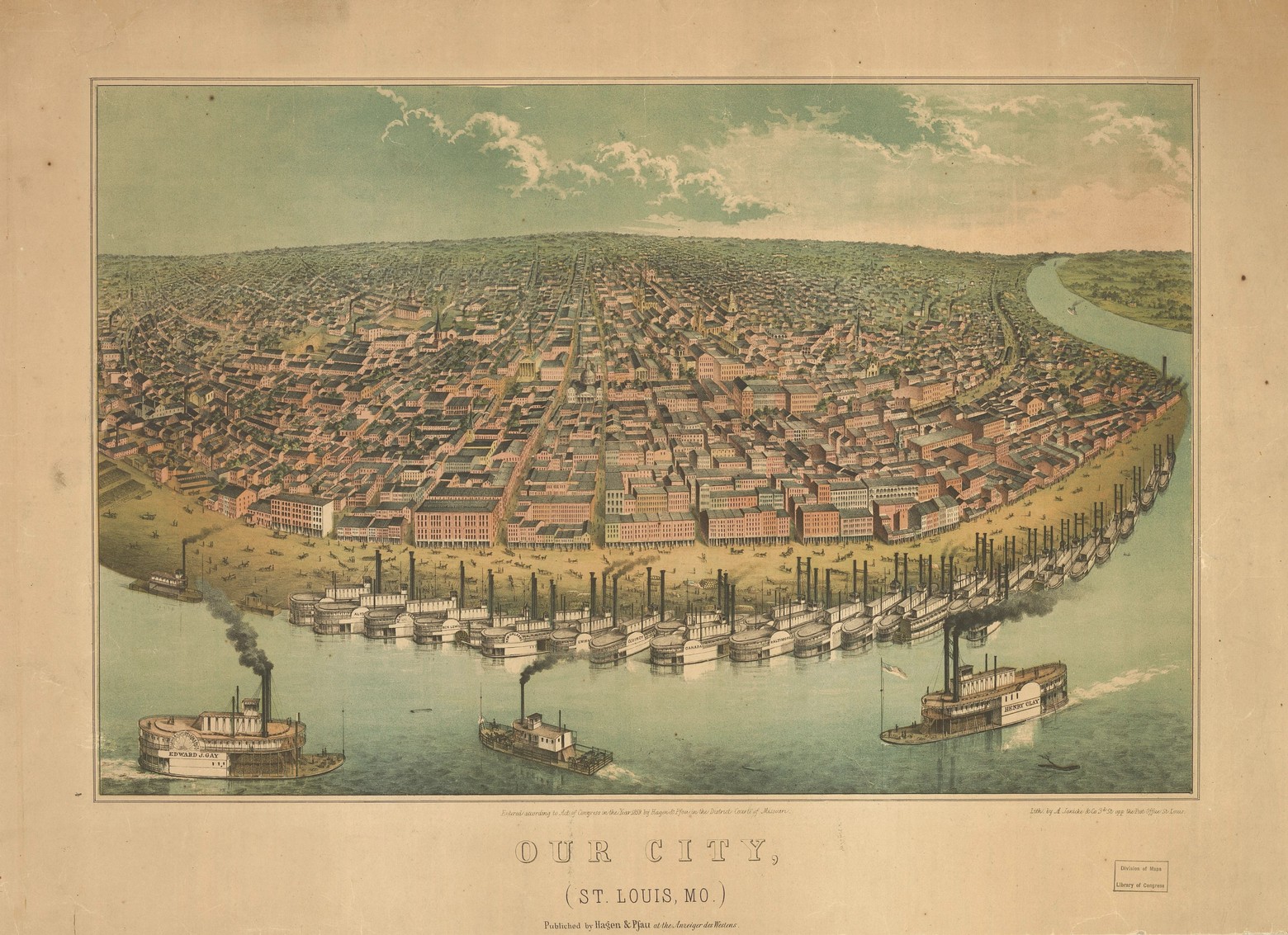
Most had come by river from New Orleans or by rail from the eastern ports (see Chapter 2), and Germans had settled in the city in large numbers for twenty years before Charles came.15 They were not always welcome. At the city election of 5 April 1853, Benton Democrats took over the poll at the Soulard Market, in the First Ward, and kept their opponents from voting. That afternoon a crowd of nearly five thousand native-born men moved on the market. A shot fired from Neumeyer’s tavern killed a young man, and the crowd mobbed the house, wrecked everything in it and burned it to the ground. The crowd brought up two six-pound cannon, which were never fired. That night twelve or fifteen hundred people marched on the office of the Anzeiger des Westens. The city militia met them there, and the crowd broke up.16
On the morning of 10 December 1857 the steamer Wm. M. Morrison was due at the St. Louis levee from New Orleans. She had left on the evening of 2 December with freight and “180 German emigrants.”17 She was one boat of many. In 1858 a Norwegian visitor counted “fifty steamers. lying side by side along the levee,” and often, he wrote, there were “two hundred at one time.”18 In the year that ended in May 1858, the German Society of New Orleans counted 13,912 Germans landed there. It sent 9,796 of them on to St. Louis, about seven in ten.19 In 1858 yellow fever was at its worst in New Orleans when the ship Carl reached the river’s mouth with 225 passengers. The Society had her stopped below the city, and a river steamer carried her emigrants upstream “ohne die Stadt zu berühren,” without touching the city.20
A newcomer did not have to rely on friends alone. The emigrants’ handbook of Traugott Bromme told readers bound for St. Louis that they would find there “the same friendly advice” as at New Orleans, from the city’s German Society. Its agent, Georg Reichard, had an office at Chestnut and Second Streets, opposite the post office, and was to do without charge whatever would help a newcomer on his way.21 He kept a book in which emigrants could leave an address for friends who came after them. In one cholera summer, his report said (the handbook gives no year), he found places in the city hospital for forty newcomers and had twenty-seven buried at the city’s expense.22 In his report of 12 January 1858 Spannagel gave the traffic of that winter. Since 25 October, 34 boats had brought 5,025 emigrants up from New Orleans. His office had found work for 511 people.23 The reports name none of the people the office helped. No record found shows whether Charles went to the Society.
Most newcomers spent their first nights in hotels and boarding houses near the riverfront. In 1850 the Second Ward, just south of the business district, was a first home of this kind. Nearly a third of its people were German-born, but fewer than two in a hundred of them owned any land. Most rented or boarded and later moved farther south.24
Charles left no account of the city he came to; Köster’s letters describe its German daily life as a schoolmaster saw it. Newspapers from home reached Köster by every steamer, and the hospitals took in the poor without charge. Theft from the mails was “the order of the day,” he wrote. So money went home by bill of exchange, a banker’s draft that was paid out in Germany.25 He kept the St. George school until January 1862, then sold it and became the teacher of an independent Evangelical congregation.26
Families spent summer evenings and Sunday afternoons in the beer gardens, from a small enclosure beside a neighborhood saloon to Uhrig’s Cave. In 1854 Franz Joseph Uhrig had the idea of cooling his brewery’s beer in a cave at Washington Street and Jefferson Avenue, and he built the garden above it. Inside its high walls were graveled yards, oleanders in green tubs, three music pavilions and a stage for light opera.27 In 1860 the Daily Missouri Republican counted forty breweries in St. Louis, worth more than $1 million and making over two hundred thousand barrels of beer a year.28
Countrymen from home
Many emigrants from Kurhessen came to the city, and Charles was one of them, though the people around him in his later records came from all over Germany, from Hanover, the Palatinate and Westphalia.29 Köster did not welcome them. His remark about meeting a Kurhessian every two minutes was a complaint. Newcomers from home sought him out “because everyone who comes wants help, and often must have it.” He asked his wife to keep his address from everyone at Kassel.30
The surviving records rarely show where in Kurhessen the city’s Kurhessians came from.32 One exception is the marriage register of Pastor Georg Wendelin Wall of St. Marcus Church, on the south side. From 1850 it had a “Heimath” (homeland) column, where he recorded where the bride and groom came from. In the years up to 1866, when Charles married, it holds at least sixty brides and grooms from Kurhessen. Apart from Charles’s own marriage entry of January 1866, none came from Kreis Hofgeismar or the villages around Trendelburg.33
Men from Charles’s own district were in the city before him. Anton Wilhelm Konze, a barber, was in St. Louis by April 1856, when he declared his intention to become a citizen. He was very probably the Anton Wilhelm Konze born at Trendelburg on 12 September 1806, son of Christoph Conze, a grenadier (an infantry soldier). In St. Louis he became a citizen in 1859. He married at Holy Ghost Evangelical Church in 1861 and died in the city on 15 September 1887.34 At least three children of his brother Johann Carl Ludwig, an innkeeper at Bremen, probably followed him to St. Louis between 1857 and 1867.35 Pastor Wall married the eldest, Marie, at St. Marcus in August 1857.36 The 1860 census lists Konze and Köster in the same ward, seven pages apart.37
August Hermann Bötte of Deisel was released as a Hessian subject in 1854, at fourteen or fifteen.38 He was the August H. Boette who served in the 17th Missouri Infantry and was a post-office clerk in 1880. This is proven: his discharge from the regiment gives Deisel as his birthplace.39 His 1922 death certificate gives the day of his Deisel baptism, 6 July 1839.40 The St. Louis tanner Conrad Albrecht was probably Johann Conrad Albrecht, born at Trendelburg in 1835. His 1880 census entry, though, gives Brunswick as his birthplace (see the chapter “Where and When He Was Born”).41
No record puts Charles with Anton Wilhelm Konze, one contact he could have had in the city (see Chapter 2), or with any of the others. If Charles was a Gans, no man of that name from the district is known in the city. A “Jacob Gans” in an 1859 marriage at Holy Ghost is a misreading of Jacob Gaus, a shoemaker from Baden.42
Two lives, 1860
Köster was hiding. In December 1860 he admitted to his wife that he headed his letters “Louisville” on purpose, “since no one is to know where I am.” He sent her his real St. Louis address on a separate slip marked “Caution.” She was to show it to no one.43 Wilhelmine Grosbernd, the young woman who had crossed with him on the Rubens (see Chapter 2), lived with him as his wife. On 9 September 1860 the two had their son August baptized at St. Paul’s Evangelical Church. The pastor recorded the father as “Johannes Köster aus Deisel, Kurhessen.”44 The Deisel man of this register and the writer of the letters were the same man. At St. Paul’s he was a Deisel man with a wife and son. In his letters home he was a schoolmaster living alone.
In his own records Charles did the opposite of what Köster did. He gave the army his birthplace when he enlisted in December 1862, and Pastor Wall recorded his village in the marriage entry of January 1866.45
The south side
The German south side ran south along the river from the edge of the business district, past the United States Arsenal.46 Most houses were two-story brick, built to the sidewalk on narrow lots. Smaller houses and rooms stood at the back of the lot, on the alley. Much of the working population lived in these “rear” units. Charles appears in no record of the south side before the war.47 With no front yards, families sat out on their stone steps on summer evenings. The limestone streets held the day’s heat long after dark. Most of the city’s fuel was soft coal, bought by the bushel. Smoke poured from factory chimneys, house chimneys and steamboat stacks, and on still days in autumn and winter it hung over the city like a pall.48
German newcomers looked for a bed near the landing, and Second Street gave them one. Its boarding houses and inns bore names from home: Zum Darmstaedter Hof, Der Pfaelzer Hof, Stadt Mainz, Der Gasthof zum gruenen Baum. German bakers, butchers and grocers took the places of the French ones, and the French café gave way to the beer hall. A man walking down the street could believe himself in Germany, for he heard only German spoken.49
The city divides, 1860–1861
As a body, the Germans of St. Louis were the strongest Union and antislavery vote in Missouri. On the evening of 1 August 1860 Carl Schurz spoke at Verandah Hall at the invitation of the city’s Germans. Fully three thousand people came to hear him.50 In the presidential election of 1860 Lincoln ran fourth in Missouri as a whole. In the city, though, he took about 40 percent of the vote, almost all of it in the German wards.51 In all the slave states, Lincoln carried only two counties, St. Louis and Gasconade, both in Missouri and both German.52
That winter Köster reported the crisis to his wife. In an undated postscript of about February 1861 he wrote that “everything here is in uproar.” Six states had left the Union and elected their own president, and people feared the worst.53
Charles appears in no record of April 1861, when the war began. That month the German volunteer companies of St. Louis were sworn into federal service as four regiments of Missouri volunteers. Five more regiments, the “United States Reserve Corps” or Home Guards, were raised to defend the city, most of them from the German wards.54 Germans made up about four-fifths of the men in the regiments St. Louis raised that spring.55 The first Reserve Corps companies sworn in came from the First and Second Wards, on the south side.56 The Reserve Corps men were enrolled by neighborhood, supplied their own uniforms and slept at home.57
Some Germans saw the war as a chance to prove their loyalty and answer the slur “the Dutch” (from Deutsch). One recruit said each man was “eager to teach the German-haters a never-to-be-forgotten lesson.”58 The scorn could be crude. At parties, the Baptist pastor Galusha Anderson heard secessionist ladies call the city’s Germans “Amsterdam Dutch without the Amster.”59 Of the states with large German populations, none sent a larger share of its Germans into the Union army than Missouri. About thirty-one thousand German-born Missourians served in the Union army, about a third of all the Germans in the state.60
The city’s secessionist newspapers called the Union volunteers, most of them Germans, “hired Hessians” (käufliche Hessen), the old name for the German soldiers Britain had hired against the American Revolution.61 Most of those soldiers, 16,992 of 29,875 by the count Edward Lowell gave, came from Hesse-Kassel, the state that became Charles’s Kurhessen.62
Among the Home Guards of 1861 were Georg Kreichelt and his son August, the father and brother of Auguste Kreichelt, whom Charles married in 1866.63 Both served in the 2nd United States Reserve Corps.64 That regiment, 736 men under Colonel Herman Kallman, was organized on 7 May 1861.65
The city at war, 1861–1862
Major General John C. Frémont, the Union commander in the West, declared martial law in St. Louis on 14 August 1861 and across Missouri on 30 August. That fall refugees from the guerrilla war crowded in. Frémont began a ring of earth forts around the city, later numbered one to ten.66 On Tuesday, 10 September 1861, Köster wrote home from a city under martial law. He had been ill that summer with the ague. His school had opened again on 2 September, with fewer children than before. War news could not be printed, he wrote, because of “martial law and the state of siege.” The city was being armed with the heaviest guns, and “everyone who can work must dig entrenchments day and night.” Thousands had fled into the city from the rest of the state.67 He had no doubt of the outcome: “The Union is winning, must win and will win, however great the sacrifices.”68
The war also cut into the mails. In the summer of 1861 Köster’s wife wrote that his letters were being opened. He answered on 3 August that he did not think letters from Germany were opened: all letters going South were, he wrote, but not those coming here to the West.69 That September he wrote that the mails to the South were closed. Letters no longer passed between Deisel and the village’s men at Charleston: “nor can cousin Fremder in Deisel write to Charleston.”70 Charles’s marriage entry records that he came from “Deiße,” probably Deisel.71
The same break ran through another Deisel family. Mary Niemeyer’s brother Fred had gone to Charleston to clerk for their cousin Louis F. Koester (see Chapter 2). When the war began, she wrote, “All communication by mail was cut off.” The family later learned that he had joined the army early in the war, and they hoped to find him among the Southern troops who entered Maryland. After the battles of South Mountain and Antietam he came home. (p. 160) So a boy who had started school at Deisel (p. 41) very probably served in the Southern army.72
Köster was for the Union without reservation. He headed his letter of 30 November 1861 with a motto: “Long live the Republic of America, and may her flags wave into the remotest corner of the earth.”73 He called himself a citizen, and he wrote of his oath: “the oath binds me to my new fatherland, and demands goods and blood of me.”74 Charles swore an oath of his own at his enlistment in December 1862.75
In February 1862 he wrote about how the Germans were repaid. Who, he asked, was giving his blood for this war? He answered: “The German. Yes, the German man lays his blood and fortune on this altar, and reaps for it ingratitude and contemptuous neglect in all his endeavors.”76
The same letter shows what the war had done to money in the city. Gold and silver had “vanished entirely from circulation,” and paper money lost value every day. Sending money home cost him dearly: the twenty-five thalers he sent before Christmas had cost him nearly fifty, and the rate had grown worse since. Coffee cost nearly half a dollar a pound, “and so everything is very dear.”77 Small change vanished too. For a time riders paid their horse-car fares in postage stamps, which stuck together in a hot summer pocket. In 1862 the government issued paper “postage currency” in notes as small as five cents. These were generally called “shinplasters,” and in the smoky city they were quickly worn and filthy.78
In April 1862 he called the times both happy and unhappy. They were happy, he wrote, “because the United States of the North strike victory upon victory, and slavery too is finding its destruction.” They were unhappy “because the land is strewn daily with thousands of cripples and the whole land is nothing but a graveyard.” In all the schools, he wrote, the children sat pulling threads from old linen into lint, for dressing wounds, and cutting bandages.79 Before the year was out, Charles was a soldier in that war.80
The draft and the volunteers, 1862
On 11 July 1862 Köster wrote that three hundred thousand men were being called up again, “hence no work and no earnings either.”81 Lincoln had called for three hundred thousand more volunteers on 1 and 2 July 1862.82 A month later the call had become a threat of a draft. In August 1862 Köster wrote: “All inhabitants from 18 to 45 must become soldiers, and the time for volunteering runs out on the 15th; then it goes by compulsion,” with “six hundred thousand men” to march south.83 Köster had the facts right.84
In Missouri the federal call came on top of a state one. From July 1862 the state organized the Enrolled Missouri Militia. Every able-bodied man of military age had to sign up.85 The city’s ward regiments were formed in September and October 1862. On 9 September the Missouri Republican printed orders for the ward regiments. In the Fourth Ward every white male, “whether enrolled or not, excepting those having certificates of exemption,” had to report.86 Charles, twenty-three by his own count that December, was of military age; whether he enrolled in his ward is not known.87
Some German men went back to Germany rather than serve. In November 1862 Köster wrote that German-Americans were swarming over German soil “like locusts,” because they could not stand “the smell of powder and the whistle of lead.”88 On 8 August 1862 the War Department stopped men who could be drafted from leaving the country.89 Köster himself had applied for a passport and been refused.90 Charles was unmarried and in his twenties.91 He could have tried to leave too, or waited to see whether the draft would reach him.
By the late fall of 1862 Köster saw a city whose trade depended on the war. “War, and only the war trade, is carried on here,” he wrote on 6 November; “whatever is not connected with it earns nothing.”92
On Tuesday, 2 December 1862, Johannes Köster wrote a Christmas letter to his wife and children at Kassel. He began it with the German feast days, “electric sparks” that “on a foreign shore quicken every German’s heart and draw it mightily homeward.” He was waiting for “the President’s message to Congress,” which Lincoln had sent the day before. His congregation was holding a ball on 6 December. His last description of the city reads: “everything here stands on its head.”93 The letter is the last in the series. He did not go home. In 1864 Köster moved on to Bloomington, Illinois.94 There he kept a German school until 1871 and then published a German weekly, the McLean Co. Deutsche Presse, until his death.95 In 1880 the census taker listed him there as John Koester, sixty-four, a printer. With him were Wilhelmina, forty, keeping house, and seven children. The eldest was August, nineteen, born in Missouri.96
Charles had stayed too. On the day of that last letter he enlisted at St. Louis and signed on for three years.97
Notes
97 notes
- Rudolf Köster, “Die Briefe des Johannes Köster aus Amerika”, Hessische Familienkunde 21, pp. 163–164 and 211–214, images 0012–0017; Fellow villagers in St. Louis, 1850–1875 (research log of 13 Oct 2026): 1860 U.S. census, St. Louis, 1st Ward, Anton W. Konze (“Konzi”), FamilySearch image group number (IGN) 005170228, image 222, and Johann Köster, image 215 (index); August H. Boette, St. Louis, censuses of 1880 and 1900, NARA M405 roll 509 (17th Missouri Infantry), naturalization 12 Oct 1866 (index); Missouri certificate of death, St. Louis, 16 Jan 1922, registered no. 560 (state file 37485), August H. Boette, born 6 Jul 1839, Germany, retired post-office employee, father August Boette (informant Louise Boette), read in the image (Missouri State Archives, Missouri Death Certificates 1910–1975), against the Deisel baptism of August Hermann Bötte, born 6 Jul 1839, son of Ludwig Bötte, tailor, and Anna Katharina Dettmar (Archion register 218842, Nro 406); Conrad Albrecht, Trendelburg, 19, ship Marianne, Baltimore 1855 (IGN 007066716, image 180), and the St. Louis tanner Conrad J. Albrecht, naturalized 6 Apr 1863 (index card), d. 1907, whose 1880 census entry gives Brunswick; LAGIS Hessische Auswanderer, all entries 1840–66 for Trendelburg, Deisel, Friedrichsfeld, Langenthal, Eberschütz, Sielen, Stammen, Gottsbüren, Hümme, Helmarshausen, Lamerden, Ostheim and Gieselwerder (305 surname forms), searched against the FamilySearch indexes of the 1850, 1860 and 1870 censuses of St. Louis, filtered to Hessian birthplaces; Conrad Discher, 26, “Hesse Cassel,” 4th Ward 1860 (IGN 005170230, image 326); William Kuhlmann, 35, with Margaret, Henry and Mary, “Hessia,” St. Louis 1850 (IGN 004195945, image 725). Index entries, not read in the image; birthplaces given as “Hessia” or “Hesse” may mean Hesse-Darmstadt; imaged, Archion (https://
www : accessed 2 November 2026) > Hessen > Landeskirchliches Archiv der Evangelischen Kirche von Kurhessen-Waldeck > Kirchenkreis Hofgeismar > Deisel > Taufen 1830-1861; also imaged, FamilySearch (https://.archion .de/ de/ viewer/ churchRegister/ 218842 www ), by the image group numbers and images given; citing Landeskirchliches Archiv der Evangelischen Kirche von Kurhessen-Waldeck, Kassel; Johann Köster, 43, “Tächer of privat School,” Hessia; 1860 U.S. census, St. Louis, 1st Ward, p. 212, line 1; value of personal estate $400 (column 9; column 8, real estate, blank); NARA M653; FamilySearch 1:1:MHZZ-L4N (image 3:1:33SQ-GBSC-9GZT). Read in the image, 1 Nov 2026. [KRK] [LANDS] [C1860K].familysearch .org - 1900 U.S. census, City of St. Louis, Missouri, population schedule, Ward 9, ED 129, sheet 5-B (penned). The year comes from the census of 1900, where a census taker entered 1859 as the year Charles immigrated (see the last chapter). [C1900]
- 1860 U.S. census, complete re-walk of St. Louis city and county, 4,716 images, every unindexed page read in the image (Oct 2026; earlier), negative for Charles. The index entries for all 4,716 images of the 1860 census of the city and county were gone through, and every page the index leaves out was read in the image. [C1860]
- St. Louis city directories (Edwards’, Gould’s), 1860–1904, every volume searched under every known spelling of the surname. [DIRS]
- Declaration of Recruit, Volunteer Enlistment and surgeon’s certificate, 2 Dec 1862, St. Louis; Regimental Descriptive Book card, “L. Charles Gannsen,” Pvt., roll 762. [ENL62] [RDB62]
- Johannes Köster to his wife, Christiane Köster (née Gunkel), and children at Kassel (one, 11 Jul 1862, to Frau Casselman, Kassel), letters, 6 Nov 1858 – 2 Dec 1862, typed transcription by Dr Rudolf Köster (1930s), typescript pp. 1–55. Note following the letter of 17 April 1861, typescript p. 15, image 0068. The letter is headed “Louisville,” but it was written in St. Louis. [KOESTER]
- Standard histories used to check Köster’s letters, p. 132, p. 145, pp. 173–74. Population of the United States in 1860, page xxxii. [STLHIST]
- Johannes Köster to his wife, Christiane Köster (née Gunkel), and children at Kassel (one, 11 Jul 1862, to Frau Casselman, Kassel), letters, 6 Nov 1858 – 2 Dec 1862, typed transcription by Dr Rudolf Köster (1930s), typescript pp. 1–55. Undated letter of about February 1861, typescript p. 11, image 0064. [KOESTER]
- Audrey L. Olson, St. Louis Germans, 1850–1920, pp. 13–36, p. 13, p. 94. The letters were read in full, and every name in them was indexed. [OLSON]
- Johannes Köster to his wife, Christiane Köster (née Gunkel), and children at Kassel (one, 11 Jul 1862, to Frau Casselman, Kassel), letters, 6 Nov 1858 – 2 Dec 1862, typed transcription by Dr Rudolf Köster (1930s), typescript pp. 1–55. [KOESTER]
- J. D. B. De Bow, The Seventh Census of the United States, p. 66. Population of the United States in 1860 (Washington, 1864), p. xxxii. Population of the United States in 1860 (Washington, 1864), p. xxxii. [CEN]
- Friedrich Münch, Der Staat Missouri. [MUENCH59]
- Richard Edwards and M. Hopewell, Edwards’s Great West and Her Commercial Metropolis (St. Louis: Office of “Edwards’s Monthly,” 1860), p. 165, “German Newspapers”; Internet Archive, item cu31924028846827 (https://
archive : accessed 16 November 2026); read in the page image; J. D. B. De Bow, The Seventh Census of the United States, p. 66. Edwards, p. 165, gives no source for his figure. The 1860 census counted 50,510 people born in the German states among the 160,773 in the city, or 31.4 percent. [EDWARDS60] [CEN].org/ details/ cu31924028846827 - The bird’s-eye view looks west over the river and the steamboats at the levee, the landing along the riverbank. A. Janicke & Co. made the lithograph. Hagen & Pfau published it in 1859 at the office of the Anzeiger des Westens, the city’s German daily paper.
- P. M. Warden, “Ungesund: Yellow Fever, the Antebellum Gulf South, and German Immigration,” Southern Spaces (2017); Audrey L. Olson, St. Louis Germans, 1850–1920, pp. 13–36, p. 13. [WARDEN] [OLSON]
- Audrey L. Olson, St. Louis Germans, 1850–1920, pp. 13–36, p. 13, pp. 169–70. In 1853 the First Ward took in all of South St. Louis. The riot came six years before Charles possibly reached the city. Luke Ritter, “Immigration, Crime, and the Economic Origins of Political Nativism in the Antebellum West,” Journal of American Ethnic History 39, no. 2 (Winter 2020): 62–91, at 78–79 and 82–85, https://
www ; read in the page images through Utah Valley University Library (JSTOR), 2 November 2026. In August 1854 American mobs fought Germans and Irish in the streets for three days. A crowd nearly wrecked St. Francis Xavier Church, and rioters threatened to burn the office of the German Anzeiger des Westens. The next year the city elected a Know-Nothing mayor, from the anti-immigrant American Party. By October 1855, though, the aldermen had paid $8,149.26 to the riot’s German and Irish victims. Pages 78–79, 82–85. The riot began on Monday 7 August 1854 and ran into Wednesday 9 August. [OLSON] [RITTER20].jstor .org/ stable/ 10 .5406/ jamerethnhist .39 .2 .0062 - “Steamer Wm. M. Morrison,” river column, Daily Missouri Republican (St. Louis), Thu. 10 Dec 1857, p. 3 ( image 666867770, filed as “The St Louis Republic”; https://
www : accessed 11 November 2026). Read twice, independently, in the page image, 11 Nov 2026. [REP57M].newspapers .com/ image/ 666867770/ - Audrey L. Olson, St. Louis Germans, 1850–1920, pp. 13–36, p. 13. Page 31, quoting the visitor, who is not named in her text. [OLSON]
- J. Hanno Deiler, Geschichte der deutschen Gesellschaft von New Orleans, mit einer Einleitung: Die europäische Einwanderung nach den Vereinigten Staaten von 1820 bis 1896 … (New Orleans: im Selbstverlage, 1897), 45, 82 (“Das X., XI. und XII. Geschäftsjahr, 1856 bis 1859,” Statistik), 84 and 85; the Society’s business years ran from June to May. Internet Archive, bub_gb_uCczAQAAIAAJ and bub_gb_DDIKAQAAMAAJ, two scans of the same edition; page 82 is leaf n89 (https://
archive : accessed 11 November 2026). Title page (“New Orleans: Im Selbstverlage. 1897”) read in the image, 11 Nov 2026. Pages 82 and 84 read twice, independently, in the page images, 11 Nov 2026. Page 82. [DEILER97].org/ details/ bub_gb_uCczAQAAIAAJ/ page/ n89 - J. Hanno Deiler, Geschichte der deutschen Gesellschaft von New Orleans, p. 84. Deiler tells it within the epidemic of 1858 but gives no day or month, and does not say where the steamer took them. [DEILER97]
- Bromme prints the agent’s name “Reinhard.” The Society’s own notice of June 1848, which announced his appointment, and Kargau’s history both give Reichard. “Agency of the German Benevolent Society,” notice dated 23 June 1848, signed John C. Meyer, Pres’t, and Arthur Olshausen, Sec’y, Missouri Republican (St. Louis), Mon. 26 Jun 1848, p. 3, col. 4 ( image 1367719662, filed as “The St Louis Republic”; https://
www : accessed 11 November 2026): “Mr. George Reichard has been appointed the duly authorized agent of the German Society.” Read twice, independently, in the page image, 11 Nov 2026; Ernst D. Kargau, St. Louis in früheren Jahren, pp. 280–86, https://.newspapers .com/ image/ 1367719662/ archive . [REP48GS] [KARGAU93].org/ details/ stlouisinfrhere 00karggoog - Traugott Bromme, Traugott Bromme’s Hand- und Reisebuch für Auswanderer und Reisende nach Nord; Ernst D. Kargau, St. Louis in früheren Jahren, pp. 280–86. Pages 282 and 285: Kargau says Reichard was the Society’s agent for its first ten years. A paper of July 1857 reports that the members failed to elect an agent in April 1857, so the board appointed J. H. Spannagel. Report of the Deutsche Gesellschaft’s general meeting, Abend-Anzeiger (St. Louis), Wed. 22 Jul 1857, p. 3, col. 3 ( image 642015090, https://
www : accessed 11 November 2026). Read twice, independently, in the page image, 11 Nov 2026. [BROMME53] [KARGAU93] [AA57].newspapers .com/ image/ 642015090/ - “Bericht des Agenten der Deutschen Gesellschaft,” dated St. Louis, 12 Jan 1858, signed J. H. Spannagel, Agent, Abend-Anzeiger (St. Louis), Thu. 14 Jan 1858, p. 3, col. 4 ( images 570734115 and 642052770, two scans; https://
www : accessed 11 November 2026). Read twice, independently, in the page images, 11 Nov 2026; the categories of work sum to 511. By the report, 40 ships had landed 10,293 emigrants at New Orleans in those months. With about 3,500 more from the eastern ports, 8,525 had reached St. Louis in all. The work found included 125 places on the railroads, 130 on farms and in gardens, and 102 for maids and nurses. [AA58].newspapers .com/ image/ 570734115/ - Audrey L. Olson, St. Louis Germans, 1850–1920, pp. 13–36, p. 13. Pages 15, 24 and table 4 (p. 23): 3,083 German-born in the Second Ward, 30.6 percent of its people, and 54 of them (1.7 percent) owning real estate. The figures are for 1850, a decade before Charles came. [OLSON]
- Johannes Köster to his wife, Christiane Köster (née Gunkel), and children at Kassel (one, 11 Jul 1862, to Frau Casselman, Kassel), letters, 6 Nov 1858 – 2 Dec 1862, typed transcription by Dr Rudolf Köster (1930s), typescript pp. 1–55. Letter headed “Louisville, 17/4 61,” typescript p. 13, image 0066. He read the Frankfurter Journal and the Kasseler Zeitung and called newspapers “necessary things for every working man.” A letter posted at St. Louis took about three weeks to reach Kassel. Bills of exchange were made out in two copies. [KOESTER]
- Johannes Köster to his wife, Christiane Köster (née Gunkel), and children at Kassel (one, 11 Jul 1862, to Frau Casselman, Kassel), letters, 6 Nov 1858 – 2 Dec 1862, typed transcription by Dr Rudolf Köster (1930s), typescript pp. 1–55. Letter of 25 January 1862, typescript pp. 27–28, images 0080–0081. [KOESTER]
- Audrey L. Olson, St. Louis Germans, 1850–1920, pp. 13–36, p. 13, p. 214. [OLSON]
- Henry Herbst, Don Roussin and Kevin Kious, St. Louis Brews, pp. 7, 9. The Bavarian Brewery, which Eberhard Anheuser’s firm took over soon afterward and which grew into Anheuser-Busch, ranked twenty-ninth, with 3,200 barrels. [STLBREWS]
- Charles Gannson (Private, Battery B, 2nd Missouri Light Artillery, Civil War), pension application no. Inv. 749,432, certificate no. 684,507; Case Files of Approved Pension Applications of Veterans Who Served in the Army and Navy Mainly in the Civil War and the War with Spain, 1861–1934; Civil War and Later Pension Files; Record Group 15: Records of the Department of Veterans Affairs; National Archives, Washington, D.C.; digital copy of the file supplied to the author by the National Archives, imaged at https://
charles-research : accessed 30 October 2026. Mail-order copies ordered by the author, first a partial file, order F21-314123835E, submitted 14 February 2017 and delivered electronically, and then the complete file, order F41-523680269E, submitted 8 September 2019 and sent by mail. Charles was a sergeant from 7 November 1863 until 15 March 1865, p. 20. Kreichelt family: St. Louis directories 1864–66 (South Seventh Street) and Gould’s 1877, p. 542; Henry D. Niemeier: Edwards’ and Gould’s St. Louis directories, p. 632. Henry Niemeier: 1880 U.S. census, St. Louis, first enumeration (rejected), ED 65, sheet 566A, “Niemeyer, Henry,” born Hanover (FamilySearch, https://.netlify .app/ pension-file .html www : accessed 29 October 2026). St. Marcus Evangelical Church (St. Louis, Missouri), marriage register, 9 Sep 1857, No. 449/46, Jacob Orlemann of Marnheim, Rheinbaiern, and Philippina Braun of Flonheim (image group number (IGN) 007769184, image 346); imaged, FamilySearch (https://.familysearch .org/ ark:/ 61903/ 3:1:33SQ-GYB8-9DNG www : accessed 10 October 2026), by the image group numbers and images given; citing “St. Marcus Evangelical Church records, 1847-1981,” microfilm of originals at the Eden Archives in St. Louis, Missouri; Theodore Gottlob, 2409 DeKalb Street, p. 14; Theodore Gottlob’s own records, all read in the images, p. 98. [PEN] [KR] [NIEMEIER] [ORL57] [GOTTLOB] [JGOTT].familysearch .org - Johannes Köster to his wife, Christiane Köster (née Gunkel), and children at Kassel (one, 11 Jul 1862, to Frau Casselman, Kassel), letters, 6 Nov 1858 – 2 Dec 1862, typed transcription by Dr Rudolf Köster (1930s), typescript pp. 1–55. Undated letter of about February 1861, typescript p. 11, image 0064. “There are too many of my countrymen here, of whom I want to know nothing.” He named two of them. One, a man named Grebenstein from Kirchhain, had served in the hussars, the light cavalry, with Köster’s brother Georg, and was now a peddler. Köster had spent a good deal on him, “all for nothing.” The other was the son of a district official. Köster had paid his board for two weeks, just to be rid of him. Still, he asked, what was a man to do “when one sees a countryman in rags”? [KOESTER]
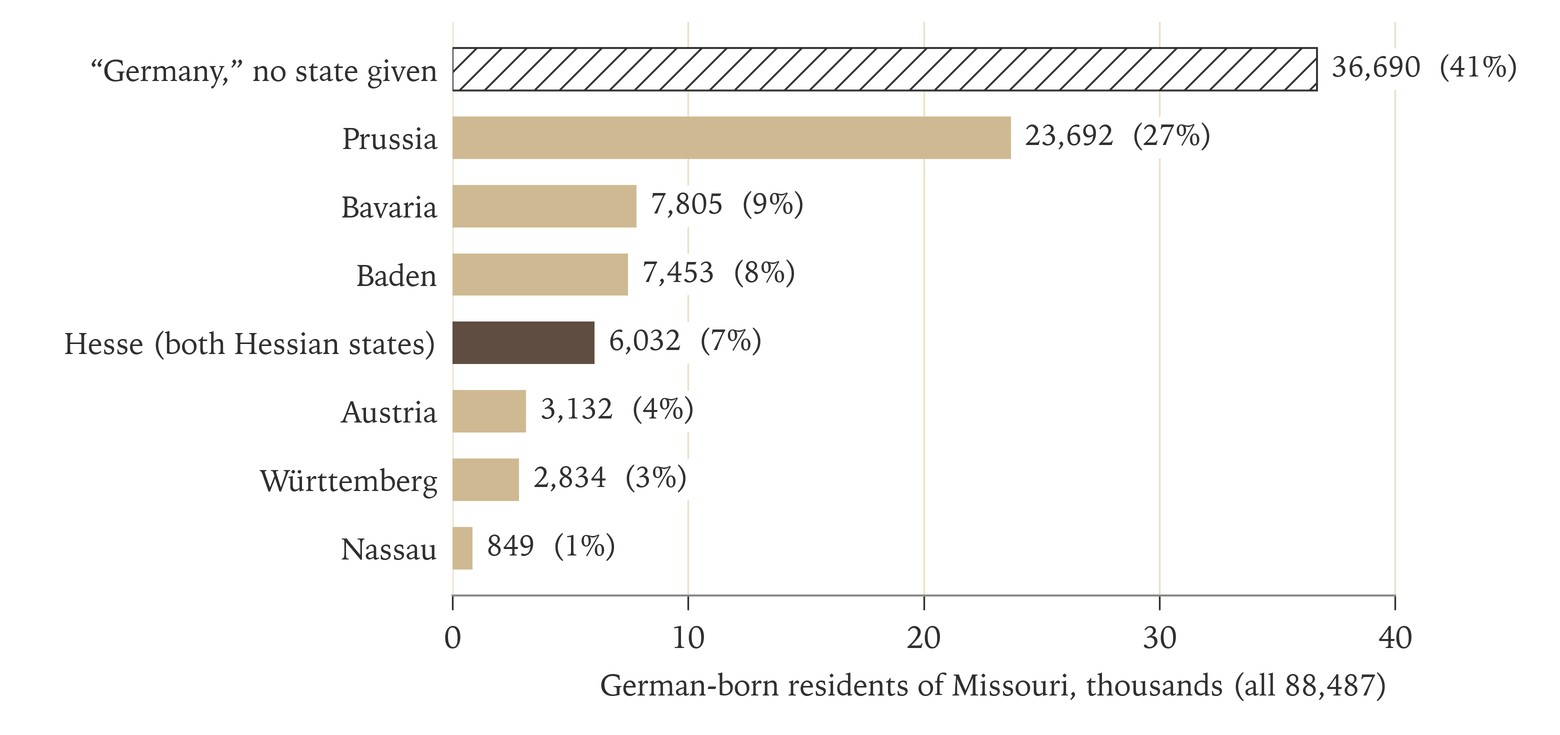
- U.S. Census Office, Population of the United States in 1860; Compiled from the Original Returns of the Eighth Census (Washington: Government Printing Office, 1864), State of Missouri, table no. 5, “Nativities of the Free Population,” p. 301, under “German States”: Austria 3,132; Bavaria 7,805; Baden 7,453; Hesse 6,032; Nassau 849; Prussia 23,692; Wurtemberg 2,834; Germany (not specified) 36,690; total 88,487; and Introduction, “Principal Cities and Towns,” p. xxxii, St. Louis, German States 50,510 (https://
www : accessed 4 November 2026); read in the page images. The largest group of German-born Missourians of 1860, two in five, were entered with no state at all, and Hessians of either kind were a small group. The census counted 50,510 of the 88,487 in the city of St. Louis. Hanover, Saxony and Oldenburg had no line of their own and are among those entered only as born in “Germany.” Because the census printed one line for both Hessian states, Kurhessians cannot be told apart from Hesse-Darmstadters; together they made up about a fifteenth of the German-born. Chapter 7 estimates the Kurhessian share from the home places given in St. Louis church marriages. The census gives no breakdown by state for the city alone. Twenty years later, Olson’s count of the 1880 returns for the city found 1,996 born in “Hesse” among 53,931 German-born. Nearly half, 25,580, were entered only as born in “Germany.” By 1880 Kurhessen had been a Prussian province for fourteen years, so some Kurhessians were entered as born in “Prussia.” Olson’s precinct total is a little below the published census figure of 54,901. [CEN60].census .gov/ library/ publications/ 1864/ dec/ 1860a .html - The Hessian state index of registered emigrants holds about 6,800 entries for Kreis Hofgeismar in the years 1840–70, for some 4,250 people. Of those bound for America, ninety-eight in a hundred give no place more exact than “North America” or “America.” Only two entries name St. Louis, and both are for a Henrich Zimmermann or Gauding emigrating with his family. One, dated August 1857, gives his home as Helmarshausen; the other, undated, gives Beverungen, a Prussian town on the Weser. They are probably one family. LAGIS Hessen, Hessische Auswanderer database, entries for Kreis Hofgeismar, 1840–70; destination “St. Louis”: record 82259, “Zimmermann; Gaudng, Henrich Ludwig, Helmarshausen,” dated August 1857, p. 375, and record 82260, “Gauding; Zimmerman, Henrich, Beverungen,” undated, p. 382, both with family (Hessisches Staatsarchiv Marburg, Best. 180 Hofgeismar Nr. 134; https://
lagis and https://.hessen .de/ resolve/ de/ ha/ 82259 lagis : accessed 4 November 2026). Also record 14639, “Boette, August Hermann, Deisel, 1854,” destination “Amerika,” dated September 1854, born 1839 (Best. 180 Hofgeismar Nr. 128, p. 270; https://.hessen .de/ resolve/ de/ ha/ 82260 lagis : accessed 9 November 2026). [LAGIS].hessen .de/ resolve/ de/ ha/ 14639 - St. Marcus Evangelical Church (St. Louis, Missouri), marriage register 1850–1880, images 324–449. The register was read entry by entry from 1850 to 1880. Its Kurhessians came from other districts (Kreise), such as Fritzlar, Ziegenhain, Frankenberg, Marburg and Eschwege. From January 1860 Wall mostly wrote the couple’s St. Louis address in that column, not their birthplace. In the first four months of 1866 only that one entry gives a German place of origin. For the later years, to 1880, see the chapter “Marriage, 1866.” St. Marcus Evangelical Church (St. Louis, Missouri), marriage register 1866, p. 135, entry 676/4. Why Wall recorded “Kreis Caßel” for a village of Kreis Hofgeismar is discussed in the chapter “Where and When He Was Born.” The spelling Deiße has a parallel in Köster’s own letters. Köster was born at Deisel. The family’s typed copy of his letters spells the village both ways: Deißel four times and Deisel five times. A man from Deisel, writing its name from memory in America, could use the same ß. Johannes Köster to his wife, Christiane Köster (née Gunkel), and children at Kassel (one, 11 Jul 1862, to Frau Casselman, Kassel), letters, 6 Nov 1858 – 2 Dec 1862, typed transcription by Dr Rudolf Köster (1930s), typescript pp. 1–55. [HEIM] [MAR66] [KOESTER]
- His age at death matches the Trendelburg birth to the day, although no American record names Trendelburg.
- HStAM Best. 180 Hofgeismar Nr. 56, fol. 5–6, no. 39. [JCL]
- Anton Wilhelm Konze: born 12 Sep 1806, baptized 17 Sep 1806, image 1059, p. 151. St. Marcus marriage register 1857, no. 440/37, 8 Aug 1857 (IGN 007769184, image 345). In the Heimath column the register gives both bride and groom simply as of “St. Louis, Mo.” Wall marked Marie “min.,” a minor. Her guardians, Eduard and Carl F. Eggers, gave her away. [AWK]
- Fellow villagers in St. Louis, 1850–1875 (research log of 13 Oct 2026). [LANDS]
- LAGIS Hessen, Hessische Auswanderer database, entries for Kreis Hofgeismar, 1840–70. [LAGIS]
- National Archives, RG 94, Compiled Service Records of Volunteer Union Soldiers … State of Missouri (microfilm M405), roll 509. [CSRBOE]
- Fellow villagers in St. Louis, 1850–1875 (research log of 13 Oct 2026). The death certificate names his father as August Boette; the baptism names Ludwig Bötte, a tailor. The informant was Louise Boette, probably his daughter, since he was a widower. [LANDS]
- Fellow villagers in St. Louis, 1850–1875 (research log of 13 Oct 2026). The 1850, 1860 and 1870 St. Louis census indexes were searched for the surname of every registered emigrant of 1840–66 from Trendelburg, Deisel and eleven nearby villages. Some of those names turned up among men born in Hesse. One was Conrad Discher; a Discher family had left Ostheim in 1847. Another was a Kuhlmann family; a Kuhlmann family had left Eberschütz in 1847. Nothing ties any of them to a village of the district or to Charles. [LANDS]
- Holy Ghost Evangelical Church, St. Louis, marriage no. 485, 19 Aug 1859, Jacob Gaus (read earlier as Gans) and Caroline Gerhard (FamilySearch image group number (IGN) 7857117, image 596); civil recording, St. Louis Recorder, marriage book p. 359, “Mr Jacob Gaus” (FamilySearch, “Missouri, County Marriage, Naturalization, and Court Records,” image https://
www ); 1870 U.S. census and 1880, St. Louis, Jacob Gaus, born about 1830 in Baden, shoemaker (FamilySearch M4XR-LLS, M6N7-JQW); St. Louis directories 1872–1893, “Gaus Jacob, shoemkr.”; Kennedy’s St. Louis directories 1857 and 1860 and Edwards’ 1869 directory, searched for Gans. 9 Oct 2026. [HG1859].familysearch .org/ ark:/ 61903/ 3:1:3QS7-998M-T4YW - Johannes Köster to his wife, Christiane Köster (née Gunkel), and children at Kassel (one, 11 Jul 1862, to Frau Casselman, Kassel), letters, 6 Nov 1858 – 2 Dec 1862, typed transcription by Dr Rudolf Köster (1930s), typescript pp. 1–55. Letter of 12 December 1860, with the slip, typescript p. 10, image 0063. [KOESTER]
- St. Paul’s Evangelical Church, St. Louis, baptisms 1860, p. 11. The register names the mother as Wilhelmine Grosbernd. She is the young woman who crossed with the letter-writer as “Wilhelmine Köster” and lived with him in St. Louis. His letters hid where he lived, so their silence about her and the child is not a conflict. [STPAUL60]
- Declaration of Recruit, Volunteer Enlistment and surgeon’s certificate, 2 Dec 1862, St. Louis; St. Marcus Evangelical Church (St. Louis, Missouri), marriage register 1866, p. 135, entry 676/4. Köster is a warning to anyone who traces Charles. A man from Charles’s own village lived one life in St. Louis and described another to his family at home. He avoided the countrymen who could have known him. Charles possibly chose to say nothing about his family in Germany too. Köster does not prove that. He shows only that a man of Deisel did such a thing. [ENL62] [MAR66]
- James Neal Primm, Lion of the Valley, pp. 149–50. Address chronology of Charles, 1865–1903, pp. 28–29. See the research website page “Charles’s Addresses and Occupations, Year by Year.” Camille Dry drew the atlas Pictorial St. Louis in 1875, and Richard Compton published it in 1876. It shows every building of these blocks as if seen from above. Its plates of Gate Street (plate 10) and of the Jackson Street, DeKalb Street and Sidney Street blocks (plates 5, 16 and 15) appear in the chapters on those years. [PRIMM] [RES]
- Richard J. Compton and Camille N. Dry, Pictorial St. Louis; Address chronology of Charles, 1865–1903, pp. 28–29. See the research website page “Charles’s Addresses and Occupations, Year by Year.” [PICT75] [RES]
- Galusha Anderson, The Story of a Border City during the Civil War (Boston: Little, Brown, 1908), pp. 2–4, 16, 160, 268–70; Project Gutenberg eBook 71105 (https://
www : accessed 16 November 2026), which keeps the printed page numbers. Anderson, pastor of the Second Baptist Church of St. Louis from 1858 to 1866, wrote some forty-five years later from memory, checked, he says, against wide reading (p. vii), pp. 2–3. Anderson, a Baptist pastor, came to St. Louis in the autumn of 1858 (page 4) and wrote these memories in 1908. [GALUSHA08].gutenberg .org/ ebooks/ 71105 - Ernst D. Kargau, The German Element in St. Louis, pp. 8–9. Kargau, writing in 1893, dates the change from the mass immigration that began in 1848. [KARGAU]
- Galusha Anderson, The Story of a Border City during the Civil War (Boston: Little, Brown, 1908), p. 16. Anderson put the city’s Germans at fifty to sixty thousand, “almost solidly Republican.” [GALUSHA08]
- Walter D. Kamphoefner, “St. Louis Germans and the Republican Party, 1848–1860,” Mid-America 57 (1975); Louis S. Gerteis, Civil War St. Louis (Lawrence: University Press of Kansas, 2001), p. 78 (the 1860 vote in the city), p. 96 (the United States Reserve Corps and its regiments), p. 103 (the Home Guard regiments ordered out on 10 May 1861), pp. 104–9 (Camp Jackson), p. 114 (the fighting in the streets afterward), p. 78. [KAMPH] [GERTEIS]
- Walter D. Kamphoefner, “St. Louis Germans and the Republican Party, 1848–1860,” Mid-America 57 (1975). Kamphoefner and Helbich, page 5. [KAMPH]
- Johannes Köster to his wife, Christiane Köster (née Gunkel), and children at Kassel (one, 11 Jul 1862, to Frau Casselman, Kassel), letters, 6 Nov 1858 – 2 Dec 1862, typed transcription by Dr Rudolf Köster (1930s), typescript pp. 1–55. Undated letter of about February 1861, postscript, typescript p. 12, image 0065. [KOESTER]
- Louis S. Gerteis, Civil War St. Louis (Lawrence: University Press of Kansas, 2001), p. 78, p. 96. Frederick H. Dyer, A Compendium of the War of the Rebellion, pt. 3., pp. 1316–17, https://
archive . The five Reserve Corps regiments, pp. 1321–24. [GERTEIS] [DYER].org/ details/ bub_gb_OBkNAQAAMAAJ - Ella Lonn, Foreigners in the Union Army and Navy (Baton Rouge: Louisiana State University Press, 1951), p. 108; Robert J. Rombauer, The Union Cause in St. Louis in 1861, p. 142. Lyon’s report of 6 June 1861, pp. 254–55. In the Third to Fifth Wards, nearly 1,300 men formed three American companies, one French company and the rest German. [LONN] [ROMBAUER]
- Virgil C. Blum, “The Political and Military Activities of the German Element in St. Louis, 1859–1861,” Missouri Historical Review 42, no. 2 (January 1948): 103–29, at 125–26 (the first Reserve Corps companies from the First and Second Wards, quoting the Anzeiger des Westens, 8 May 1861; the Third to Fifth Wards, nearly 1,300 men, 9 May 1861; the 2nd Regiment of 736 men organized 7 May under Col. Herman Kallman); Internet Archive, sim_missouri-historical-review_1948-01_42_2. Read in the page images, 2 Nov 2026; Robert J. Rombauer, The Union Cause in St. Louis in 1861, p. 142. [BLUM48] [ROMBAUER]
- Robert J. Rombauer, The Union Cause in St. Louis in 1861, p. 142, pp. 201–2. [ROMBAUER]
- Robyn Burnett and Ken Luebbering, German Settlement in Missouri, p. 71. [BURNETT96]
- Galusha Anderson, The Story of a Border City during the Civil War (Boston: Little, Brown, 1908), p. 160. [GALUSHA08]
- Walter D. Kamphoefner, “St. Louis Germans and the Republican Party, 1848–1860,” Mid-America 57 (1975). Kamphoefner and Helbich, p. 9 (table). Stephen D. Engle, “Yankee Dutchmen: Germans, the Union, and the Construction of a Wartime Identity,” in Susannah J. Ural, ed., Civil War Citizens: Race, Ethnicity, and Identity in America’s Bloodiest Conflict (New York: New York University Press, 2010), 11–56, at 23 and 25, https://
www . Read 1 Nov 2026; open access, accessed 7 November 2026. Across the North, the Sanitary Commission’s count found Germans the most overrepresented nationality in the Union army, Canadians aside. Kamphoefner and Helbich, page 7. Walter D. Kamphoefner, “St. Louis Germans and the Republican Party, 1848–1860,” Mid-America 57 (1975). [KAMPH] [ENGLE10] [KAMPH].jstor .org/ stable/ j .ctt9qg4vn .4 - Wilhelm Kaufmann, Die Deutschen im amerikanischen Bürgerkriege (Sezessionskrieg 1861–1865), p. 201. [KAUFMANN11]
- Edward J. Lowell, The Hessians and the Other German Auxiliaries of Great Britain in the Revolutionary War (New York: Harper & Brothers, 1884), 20 (after Friedrich Kapp: “Hesse-Cassel sent 16,992” of a total of 29,875) and 299–300 (the year-by-year table); Internet Archive, cu31924032739967 (https://
archive : accessed 5 November 2026). [LOWELL84].org/ details/ cu31924032739967 - Kreichelt family: St. Louis directories 1864–66 (South Seventh Street) and Gould’s 1877, p. 542. [KR]
- Civil War pension file of Georg Kreichelt, Co. B, 2nd U.S. Reserve Corps (Missouri), NARA RG 15, file F41-648375876E; Missouri State Archives, Soldiers’ Records, service card S187514, August Kreichelt, Co. G, 2nd U.S. Reserve Corps: enlisted 6 Jun 1861, mustered out 16 Aug 1861, St. Louis Arsenal (https://
s1 : accessed 8 November 2026). [KRPEN].sos .mo .gov/ Records/ Archives/ ArchivesMvc/ Soldiers/ Detail ?id =S187514 &conflict =Civil %20War - Virgil C. Blum, “The Political and Military Activities of the German Element in St. Louis, 1859–1861,” Missouri Historical Review 42. [BLUM48]
- Standard histories used to check Köster’s letters, p. 132, p. 145, pp. 173–74; Chris Naffziger, “Mapping St. Louis’ Long-Gone Civil War Forts,” St. Louis Magazine, 2 Nov 2016 (https://
www : accessed 11 November 2026); Landmarks Association of St. Louis, Landmarks Letter vol. 55. [STLHIST] [STLFORTS].stlmag .com/ history/ the -10 -civil -war -forts -that -once -ringed -st -louis - Johannes Köster to his wife, Christiane Köster (née Gunkel), and children at Kassel (one, 11 Jul 1862, to Frau Casselman, Kassel), letters, 6 Nov 1858 – 2 Dec 1862, typed transcription by Dr Rudolf Köster (1930s), typescript pp. 1–55. Letter of 10 September 1861, typescript pp. 18–21, images 0071–0074. [KOESTER]
- Johannes Köster to his wife, Christiane Köster (née Gunkel), and children at Kassel (one, 11 Jul 1862, to Frau Casselman, Kassel), letters, 6 Nov 1858 – 2 Dec 1862, typed transcription by Dr Rudolf Köster (1930s), typescript pp. 1–55. Letter of 10 September 1861, typescript p. 18, image 0071. [KOESTER]
- Johannes Köster to his wife, Christiane Köster (née Gunkel), and children at Kassel (one, 11 Jul 1862, to Frau Casselman, Kassel), letters, 6 Nov 1858 – 2 Dec 1862, typed transcription by Dr Rudolf Köster (1930s), typescript pp. 1–55. Letter of 3 August 1861, typescript p. 17, image 0070. [KOESTER]
- Johannes Köster to his wife, Christiane Köster (née Gunkel), and children at Kassel (one, 11 Jul 1862, to Frau Casselman, Kassel), letters, 6 Nov 1858 – 2 Dec 1862, typed transcription by Dr Rudolf Köster (1930s), typescript pp. 1–55. Letter of 10 September 1861, typescript p. 19, image 0072. [KOESTER]
- St. Marcus Evangelical Church (St. Louis, Missouri), marriage register 1866, p. 135, entry 676/4. [MAR66]
- Mary A. Niemeyer, Light in Darkness, pp. 41, 102–106, 160. [NIEMLID]
- Johannes Köster to his wife, Christiane Köster (née Gunkel), and children at Kassel (one, 11 Jul 1862, to Frau Casselman, Kassel), letters, 6 Nov 1858 – 2 Dec 1862, typed transcription by Dr Rudolf Köster (1930s), typescript pp. 1–55. Letter of 30 November 1861, typescript p. 24, image 0077. [KOESTER]
- Johannes Köster to his wife, Christiane Köster (née Gunkel), and children at Kassel (one, 11 Jul 1862, to Frau Casselman, Kassel), letters, 6 Nov 1858 – 2 Dec 1862, typed transcription by Dr Rudolf Köster (1930s), typescript pp. 1–55. Letter of 12 August 1862, typescript p. 47, image 0100 (citizen); letter of 21 February 1862, typescript p. 33, image 0086 (oath). [KOESTER]
- Declaration of Recruit, Volunteer Enlistment and surgeon’s certificate, 2 Dec 1862, St. Louis. [ENL62]
- Johannes Köster to his wife, Christiane Köster (née Gunkel), and children at Kassel (one, 11 Jul 1862, to Frau Casselman, Kassel), letters, 6 Nov 1858 – 2 Dec 1862, typed transcription by Dr Rudolf Köster (1930s), typescript pp. 1–55. Letter of 21 February 1862, typescript p. 32, image 0085. [KOESTER]
- Johannes Köster to his wife, Christiane Köster (née Gunkel), and children at Kassel (one, 11 Jul 1862, to Frau Casselman, Kassel), letters, 6 Nov 1858 – 2 Dec 1862, typed transcription by Dr Rudolf Köster (1930s), typescript pp. 1–55. Letter of 21 February 1862, enclosure, typescript p. 36, image 0089. [KOESTER]
- Galusha Anderson, The Story of a Border City during the Civil War (Boston: Little, Brown, 1908), pp. 268–70. Anderson dates the postage currency to March 1862. The act of 17 July 1862 (12 Stat. 592) made postage stamps exchangeable for United States notes and receivable for federal dues under five dollars, and from 1 August barred private notes under one dollar. The text therefore says only “1862.” [GALUSHA08]
- Johannes Köster to his wife, Christiane Köster (née Gunkel), and children at Kassel (one, 11 Jul 1862, to Frau Casselman, Kassel), letters, 6 Nov 1858 – 2 Dec 1862, typed transcription by Dr Rudolf Köster (1930s), typescript pp. 1–55. Letter of 15 April 1862, typescript p. 39, image 0092. [KOESTER]
- Declaration of Recruit, Volunteer Enlistment and surgeon’s certificate, 2 Dec 1862, St. Louis. [ENL62]
- Johannes Köster to his wife, Christiane Köster (née Gunkel), and children at Kassel (one, 11 Jul 1862, to Frau Casselman, Kassel), letters, 6 Nov 1858 – 2 Dec 1862, typed transcription by Dr Rudolf Köster (1930s), typescript pp. 1–55. Letter to his family of 11 July 1862, typescript p. 45, image 0098. [KOESTER]
- Standard histories used to check Köster’s letters, p. 132, p. 145, pp. 173–74. U.S. War Department, The War of the Rebellion: Official Records, ser. III, vol. 2, pp. 187–88 (call of 1 July 1862). [STLHIST]
- Johannes Köster to his wife, Christiane Köster (née Gunkel), and children at Kassel (one, 11 Jul 1862, to Frau Casselman, Kassel), letters, 6 Nov 1858 – 2 Dec 1862, typed transcription by Dr Rudolf Köster (1930s), typescript pp. 1–55. Typescript p. 46, image 0099. The letter is dated at St. Louis on 12 August 1862. [KOESTER]
- Standard histories used to check Köster’s letters, p. 132, p. 145, pp. 173–74. U.S. War Department, The War of the Rebellion: Official Records, ser. III, vol. 2, p. 291 (General Orders No. 94, 4 Aug 1862); Militia Act of 17 July 1862, 12 Stat. 597. The Militia Act of 17 July 1862 covered men aged eighteen to forty-five. The War Department’s order of 4 August called up three hundred thousand militia for nine months. Any state that had not filled its share by 15 August would make up the rest by draft. Added to the three hundred thousand volunteers called in July, that made six hundred thousand. [STLHIST]
- Standard histories used to check Köster’s letters, p. 132, p. 145, pp. 173–74; Enrolled Missouri Militia records, 1862, Missouri State Archives, RG 133.13; Daily Missouri Republican, 9 Sep 1862, p. 2 (orders for the ward regiments; Fourth Ward Special Order No. 4, Turner’s Hall), imaged, (https://
www : accessed 7 November 2026). [STLHIST] [EMM62].newspapers .com/ image/ 666821727/ - Enrolled Missouri Militia records, 1862, Missouri State Archives. The Daily Missouri Republican, 9 September 1862, page 2 ( image 666821727). No list of the non-citizens who claimed exemption has been found. [EMM62]
- Declaration of Recruit, Volunteer Enlistment and surgeon’s certificate, 2 Dec 1862, St. Louis. [ENL62]
- Johannes Köster to his wife, Christiane Köster (née Gunkel), and children at Kassel (one, 11 Jul 1862, to Frau Casselman, Kassel), letters, 6 Nov 1858 – 2 Dec 1862, typed transcription by Dr Rudolf Köster (1930s), typescript pp. 1–55. Letter of 6 November 1862, typescript p. 50, image 0103. [KOESTER]
- Standard histories used to check Köster’s letters, p. 132, p. 145, pp. 173–74. Official Records, ser. III, vol. 2, page 370. [STLHIST]
- Johannes Köster to his wife, Christiane Köster (née Gunkel), and children at Kassel (one, 11 Jul 1862, to Frau Casselman, Kassel), letters, 6 Nov 1858 – 2 Dec 1862, typed transcription by Dr Rudolf Köster (1930s), typescript pp. 1–55. Letter of 12 August 1862, typescript p. 47, image 0100. [KOESTER]
- Declaration of Recruit, Volunteer Enlistment and surgeon’s certificate, 2 Dec 1862, St. Louis. [ENL62]
- Johannes Köster to his wife, Christiane Köster (née Gunkel), and children at Kassel (one, 11 Jul 1862, to Frau Casselman, Kassel), letters, 6 Nov 1858 – 2 Dec 1862, typed transcription by Dr Rudolf Köster (1930s), typescript pp. 1–55. Letter of 6 November 1862, typescript p. 53, image 0106. [KOESTER]
- Standard histories used to check Köster’s letters, p. 132, p. 145, pp. 173–74; Johannes Köster to his wife, Christiane Köster (née Gunkel), and children at Kassel (one, 11 Jul 1862, to Frau Casselman, Kassel), letters, 6 Nov 1858 – 2 Dec 1862, typed transcription by Dr Rudolf Köster (1930s), typescript pp. 1–55. Letter of 2 December 1862, typescript p. 55, image 0108. Letter of 2 December 1862, typescript pp. 54–55, images 0107–0108. [STLHIST] [KOESTER]
- “Death of an Old Citizen,” The Pantagraph (Bloomington, Ill.), 17 Oct 1893, p. 7: John Koester, editor of the McLean County Deutsche Presse, died at Bloomington the day before; born in Germany 11 Jul 1815; he had taught school in St. Louis and moved to Bloomington in 1864; imaged, (https://
www : accessed 15 November 2026). Read twice, independently, in the page image, 15 Nov 2026. Rudolf Köster’s article gives 1865 and notes that the Pantagraph obituary gives 1864. Rudolf Köster, “Die Briefe des Johannes Köster aus Amerika”, Hessische Familienkunde 21, pp. 163–164 and 211–214, images 0012–0017. [PANT93] [KRK].newspapers .com/ image/ 70409076/ - Rudolf Köster, “Die Briefe des Johannes Köster aus Amerika”, Hessische Familienkunde 21, pp. 163–164 and 211–214, images 0012–0017. [KRK]
- Abstract of the U.S. census of 1880, Illinois, McLean County, Bloomington, Ward 3, ED 162, dwelling 132, family 140 (marginal address 814 South Side Front Street): John Koester, 64, printer, born Prussia; Wilhelmina, 40, keeping house; August, 19, printer, born Missouri; Clara, 13; Hulda, 11; Oscar, 9; Willie, 4; Flora, 2; and John, 3/12, born Illinois. Handwritten abstract on a printed form, filed in the Gotha series Köster/Köster (Forschungsbibliothek Gotha, image 0046). Read in the image, 26 Oct 2026, and read again independently. 1880 U.S. census, Bloomington, McLean Co., Ill., ED 162, sheet 204-A, dwelling 132, family 140, John Koester, 64, printer, born Prussia (NARA T9 roll 230; FamilySearch, https://
www , image 17: accessed 29 October 2026). The census image agrees with the handwritten abstract filed with the letters at Gotha. [KRK80].familysearch .org/ ark:/ 61903/ 3:1:33SQ-GYY1-9X3F - Declaration of Recruit, Volunteer Enlistment and surgeon’s certificate, 2 Dec 1862, St. Louis. [ENL62]
Also on this page
About the pictures
The printed captions of these pictures were shortened on 25 October 2026. Their full text is kept here.
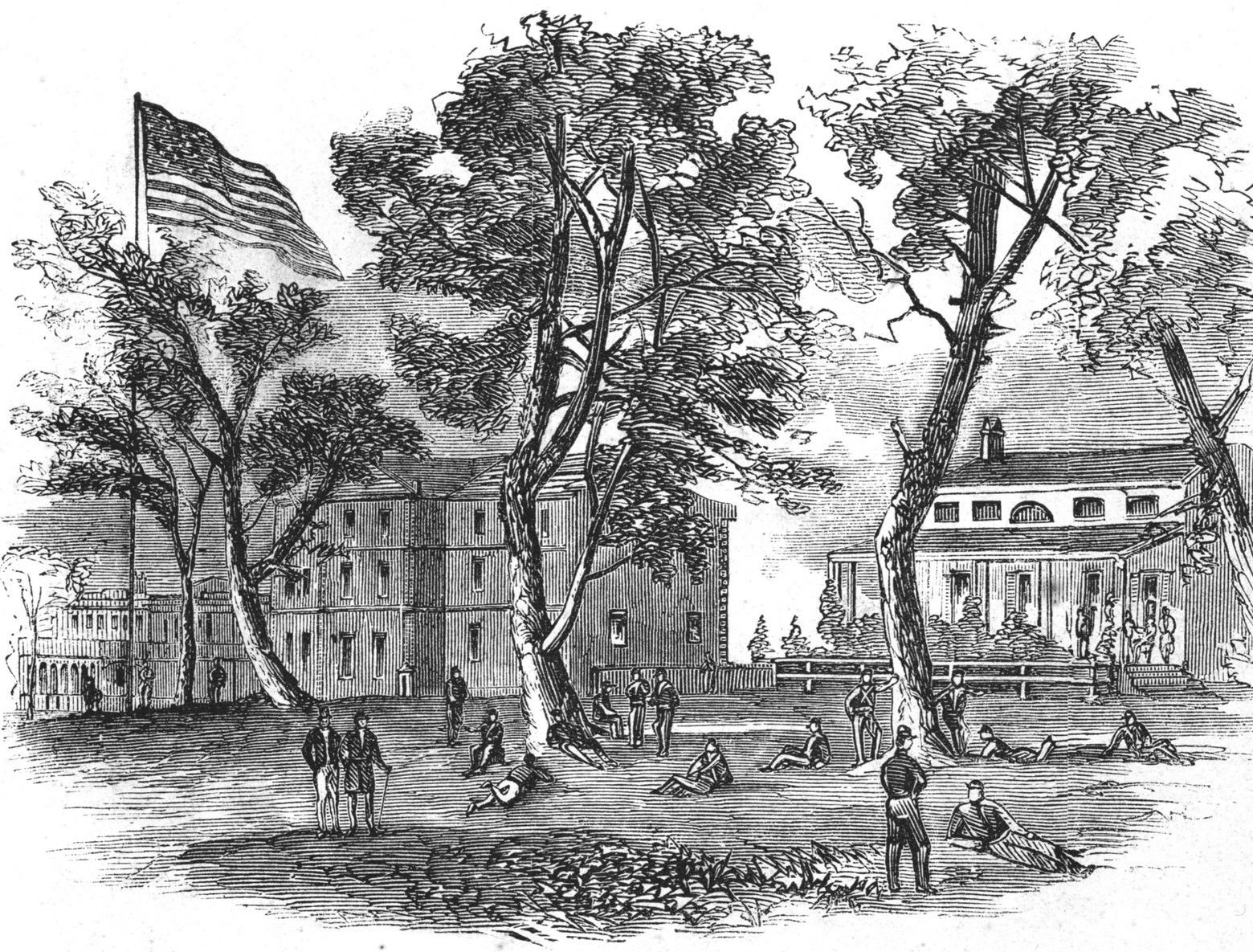
Camp Benton, the army camp laid out in 1861 on the fairgrounds north of the city and generally called Benton Barracks: barracks around a parade ground, with troops drilling and the headquarters building under its flag. The lithograph, by Alexander McLean of St. Louis, was printed as a letterhead; this copy heads a letter of 24 October 1863. Alexander McLean, lithographer, St. Louis, about 1863. Missouri Historical Society, via Wikimedia Commons. Public domain.
St. Louis before the War, 1859–1862: more from the sources
These passages were cut from the printed chapter on 16 November 2026. They are background, not evidence about Charles. Each one is given as it stood, with its sources.
1.
From “A German city,” first paragraph: the breakdown of the thirty-eight German schools of 1860. The print edition keeps the totals and the page number; the breakdown by denomination moved here.
In 1860 the city had thirty-eight German schools, church and private, with 5,524 pupils. Its thirty-five public schools had 6,253. [OLSON] Page 94: twenty Protestant, six Catholic and ten nonsectarian schools, with one each of the Free-Thinkers and the Jewish congregation.
- OLSON Audrey L. Olson, St. Louis Germans, 1850–1920: The Nature of an Immigrant Community and Its Relation to the Assimilation Process (New York: Arno Press, 1980; originally the author’s University of Kansas thesis, 1970), chapter 2, “A Sectional City: St. Louis Germans, 1850,” pp. 13–36: p. 13 (German influx from the early 1830s); pp. 15, 23–24 (first lodgings near the riverfront; the Second Ward); p. 20, table 3, “Number of Germans in Total Population – 1850,” from the Seventh Census and the manuscript census; pp. 16–17, figure 1, the six wards of 1850; pp. 26–27 (the First Ward; “South St. Louis Dutch”); p. 29 (New Bremen); p. 31 (the levee in 1858); p. 11 (the published 1880 count, 54,901 German-born of 350,518); and appendix II, p. 292, “Nativity of German Born – Compilation of Precincts, St. Louis, 1880”; chapter 4, “Pressures from Within”, p. 94 (German and public schools, 1860) and pp. 121–24 (party loyalties); chapter 6, “Pressures from Without,” pp. 169–70 (the election riot of 5 April 1853) and pp. 172–73 (after Camp Jackson); chapter 7, “Prohibition and Post War,” p. 214 (beer gardens). Read in the compiler’s photographs of the pages.
2.
From “A German city,” the paragraph on the steamer Wm. M. Morrison and the levee: the German Society of New Orleans’s figures for the years before and after 1857–58, and the places where Deiler’s book disagrees with itself. The print edition keeps the 1857–58 figures and the page number.
In the year that ended in May 1858, the German Society of New Orleans counted 13,912 Germans landed there. It sent 9,796 of them on to St. Louis, about seven in ten. [DEILER97] Page 82. The Society’s figures for 1856–57 are 12,642 landed and 8,476 sent to St. Louis, and for 1858–59, 6,549 and 4,557. Deiler’s book is not consistent with itself: page 45 gives 4,559 for 1858–59, and pages 45 and 85 give 12,360 landed in 1856–57. The figures here are those of page 82.
- DEILER97 J. Hanno Deiler, Geschichte der deutschen Gesellschaft von New Orleans, mit einer Einleitung: Die europäische Einwanderung nach den Vereinigten Staaten von 1820 bis 1896 … (New Orleans: im Selbstverlage, 1897), 45, 82 (“Das X., XI. und XII. Geschäftsjahr, 1856 bis 1859,” Statistik), 84 and 85; the Society’s business years ran from June to May. Internet Archive, bub_gb_uCczAQAAIAAJ and bub_gb_DDIKAQAAMAAJ, two scans of the same edition; page 82 is leaf n89 (https://archive.org/details/bub_gb_uCczAQAAIAAJ/page/n89 : accessed 11 November 2026). Title page (“New Orleans: Im Selbstverlage. 1897”) read in the image, 11 Nov 2026. Pages 82 and 84 read twice, independently, in the page images, 11 Nov 2026.
3.
From “A German city,” the paragraph on the German Society of St. Louis: the death of its agent J. H. Spannagel. In the print edition the paragraph ends with his report of January 1858.
On the morning of 29 November 1859 Spannagel was climbing the steps of the post office when he collapsed and died. [REP59S]
- REP59S “Death in the Street from Apoplexy,” Missouri Republican (St. Louis), Wed. 30 Nov 1859, p. 3 (Newspapers.com image 666862437, https://www.newspapers.com/image/666862437/ : accessed 11 November 2026); the same item in the Tri-Weekly Missouri Republican, 30 Nov 1859, p. 3, col. 3 (image 1368622728). Read independently in the two editions, 11 Nov 2026.
4.
From “The city at war, 1861–1862,” the paragraph on the mails: what a letter from Germany cost Köster in time and money in 1861. The print edition keeps his answer of 3 August 1861 about opened letters.
Earlier that year he had complained that a letter from Germany took nearly four weeks to reach him and cost twice as much as one sent the other way. [KOESTER]
- KOESTER Johannes Köster to his wife, Christiane Köster (née Gunkel), and children at Kassel (one, 11 Jul 1862, to Frau Casselman, Kassel), letters, 6 Nov 1858 – 2 Dec 1862, typed transcription by Dr Rudolf Köster (1930s), typescript pp. 1–55 (images 0053–0110); series Köster/Köster (NABS Ordner 74), Deutsche Auswandererbriefsammlung [German emigrant letter collection]; Forschungsbibliothek Gotha der Universität Erfurt, Gotha. The scans (Gotha order K9P90) are in the public domain, as the library confirmed on 20 Jul 2026. English translations by Charles Gannsen Research (Jed Johnson). Pages 1–27 (imgs 0054–0080) are read against the scan; pages 28–55 (imgs 0081–0108) are translated from uncorrected OCR, so their names and figures are unchecked, but every passage quoted here has been read against the scan. Gutberlet reward notice: Missouri Democrat (St. Louis; indexed as the St. Louis Globe-Democrat), p. 2, 3, 7, 11 and 12 Jul 1862 (Newspapers.com). Letters cited in this chapter: St. Louis, 12 Dec 1860, with slip (typescript p. 10, image 0063); undated, after 9 Feb 1861 (pp. 11–13, images 0064–0066); headed “Louisville, 17/4 61,” written at St. Louis (pp. 13–17, images 0066–0070); 3 Aug 1861 (pp. 17–18, images 0070–0071); 10 Sep 1861 (pp. 18–21, images 0071–0074); headed “Louisville, Kentucky 30/11 61” (pp. 24–27, images 0077–0080); 25 Jan 1862 (pp. 27–29, images 0080–0082); 21 Feb 1862 (pp. 31–36, images 0084–0089); 15 Apr 1862 (pp. 37–40, images 0090–0093); 11 Jul 1862 (pp. 44–46, images 0097–0099); 12 Aug 1862 (image 0099); 10 Sep 1862 (pp. 48–49, images 0101–0102); 6 Nov 1862 (pp. 50–53, images 0103–0106); 2 Dec 1862 (pp. 54–55, images 0107–0108); and the address on a money order of 1 Apr 1862 (image 0110). The spellings Deißel and Deisel were counted in the typescript, and every name in the letters was indexed.
Supplements
Records, images and data on this website that go with this chapter.