★ At a Glance
FIRST-BORN · CHILD 1 of 7 · DIED AS INFANT FS LB5X-RYCCharles and Auguste's firstborn son. He arrived in June 1866 — just months after their wedding — and died as an infant 16 months later. He never knew his six younger siblings.
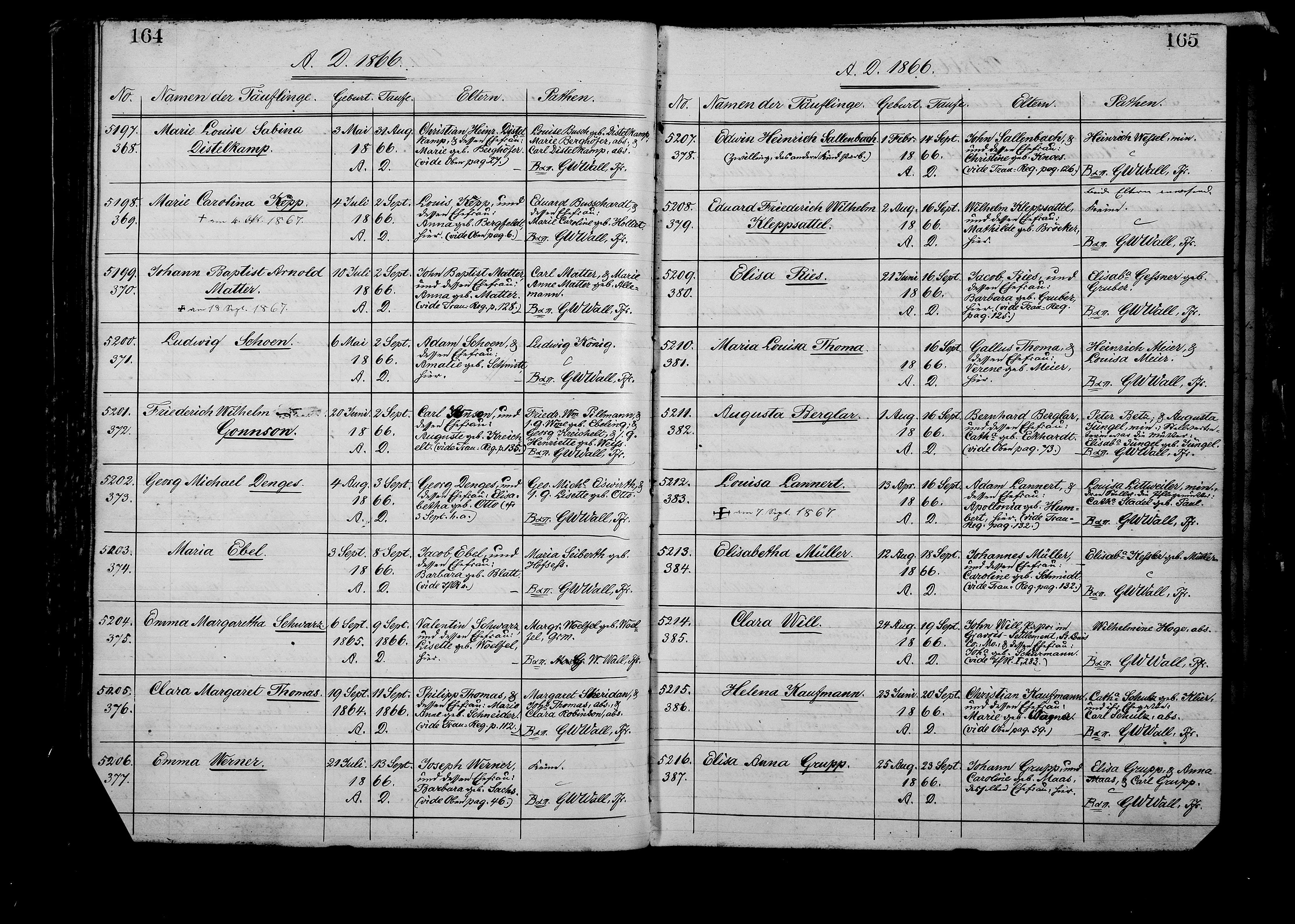
Friedrich Wilhelm Gonnson (b. 20 June 1866, d. 30 October 1867 at age 16 months) was the first-born child of Charles & Auguste — called “George” at home — born three days after Prussia declared war on Hesse-Kassel and christened on 2 September 1866 — about six weeks after news of the deposition of Elector Friedrich Wilhelm I would have reached St. Louis. The baby's documented namesake is his godfather Friedrich Wilhelm Pillmann (per the standard Lutheran firstborn-naming convention); the name happens also to be that of the deposed Elector, an echo discussed below. Sponsors: Friedr. Wm Pillmann and his wife Wilhelmine née Ebeling, and the maternal grandparents Georg & Henriette Kreichelt. Surname rendered Gonnson — same spelling as Charles's January 1866 marriage record.
Vital details
| Name as baptized | Friedrich Wilhelm Gonnson |
| Called at home | George (parents’ death notice, city interment register, cemetery lot register) |
| Surname spelling | Gonnson |
| Born | 20 June 1866, St. Louis, St. Louis, Missouri, United States (3 sources) |
| Christened | 2 September 1866, St. Marcus German Evangelical Church, St. Louis, Missouri (1 source) |
| Died | 30 October 1867, 1501 Closey Avenue, St. Louis · marasmus · ~16 months old (city Report of Interments; parents’ death notice) |
| Buried | 31 October 1867, Old St. Marcus Cemetery, St. Louis (3 sources) |
| FamilySearch profile | LB5X-RYC · 5 sources · 3 memories |
| Birth order | 1 of 7 children |
Family tree
Baptism record & sponsors
Friedrich Wilhelm was baptized at St. Marcus German Evangelical Church, St. Louis, on 2 September 1866. The 2020 AncestryProGenealogists journal indexed Doc G–Doc L of the St. Marcus baptism register (children 2 through 7) and the firstborn's entry was added in subsequent reconstructions. He was baptized as "Gonnson" — the same surname Charles used at his marriage in January 1866 — fitting the post-marriage pattern that ran until summer 1870.
St. Marcus Baptism Register · A.D. 1866 · pages 164-165 · Entry №5201 / running 372 · FHL Microfilm 1503034
Baptism sponsors
- SponsorFriedrich Wilhelm Pillmann — written “Friedr. Wm Pillmann, & s. G. [seine Gattin] Wme geb. Ebeling”: a married man standing with his wife, so not the unmarried Frederick W. Pillmann (b. 1846/47, married 1870) but probably his father; an 1858 St. Louis deed shows a Friedrich and Wilhelmine Pillmann. The 1870 sponsor “Friedrich Billmann” is probably the son. · FamilySearch L17N-8Q6
- SponsorWilhelmine Pillmann, née Ebeling — “s. G. Wme geb. Ebeling”, wife of Friedr. Wm Pillmann. An earlier identification with Dorothea Wilhelmine Leue née Ebling (1810–1872, FS M6G9-FJR), made on name evidence only, is probably wrong.
- SponsorGeorg Andreas Kreigelt — Auguste's father; Charles's father-in-law. Corrected July 2026: not a Battery B veteran and not Charles's comrade in the unit — his only Civil War service was three months in Co. B, 2nd U.S. Reserve Corps Infantry (7 May – 16 Aug 1861), ending sixteen months before Charles enlisted (Errata). Born Clausthal, Hannover 1819; emigrated 1853; d. 1883 St. Louis with a Civil War pension awarded six months earlier. Walked his daughter Auguste down the aisle at her January 1866 wedding to Charles. · FamilySearch LZXC-NH9
- SponsorHenriette (Weiss) Kreichelt — Auguste's mother; Charles's mother-in-law. Born Clausthal 1820 as Louise Friederike Henriette Weiss; m. Georg 1844. Sponsor again at the 1873 Louise baptism — making her one of three recurring sponsors across the seven Gannsen baptisms (with Georg and Babette Kreichelt). · FamilySearch LZXC-NG7
The 1866 sponsor pool sits on the standard Lutheran-Evangelical default for a firstborn: both maternal grandparents stand at the font (Georg and Henriette), plus a second married couple, Friedr. Wm Pillmann and his wife Wilhelmine née Ebeling (read in the image: “Friedr. Wm Pillmann, & s. G. Wme geb. Ebeling; & Georg Kreichelt, & s. G. Henriette geb. Weiß”). The Pillmanns were probably the parents of Frederick W. Pillmann, who married Catharina Albrecht’s sister in 1870; they are not known to be kin of the Kreichelts in 1866. The earlier identification of the godmother as Wilhelmine Leue is withdrawn (see errata). Originally documented in the 2020 AncestryProGenealogists journal (held by the author), Doc G; first sponsor identifications by Jed and the Trendelburg researcher, December 2025.
⚜ A name that points home — the precise 1866 timeline
Charles and Auguste married at St. Marcus Church on 7 January 1866. Their first child was born 20 June 1866 and christened 2 September 1866 as Friedrich Wilhelm Gonnson. The same summer of 1866 saw the political destruction of Charles's homeland, the Electorate of Hesse-Kassel. The exact day-by-day timeline is striking:
| 17 June 1866 | Prussia declares war on Hesse-Kassel, Hanover, and Saxony — start of the Austro-Prussian War |
| ~19 June 1866 | Prussian troops occupy Kassel, the Electoral capital |
| 20 June 1866 | ★ Friedrich Wilhelm Gonnson born in St. Louis — three days after Prussia's declaration of war, ~one day after the occupation of Kassel |
| 23 June 1866 | Elector Friedrich Wilhelm I refuses to negotiate with Prussia and is transferred as a prisoner to Stettin (per Wikipedia, citing the New International Encyclopedia 1905). This is the operative moment of his political deposition — three days after the baby was born. |
| ~late July 1866 | Trans-Atlantic news of Kassel's occupation and the Elector's arrest reaches St. Louis (10–14-day steamship lag, before the second transatlantic telegraph cable was operational on 27 July 1866) |
| 23 August 1866 | Peace of Prague ends the war |
| 2 September 1866 | ★ Friedrich Wilhelm Gonnson christened at St. Marcus — by this date Charles had known about the Elector's deposition for ~6 weeks; the war was over but formal annexation had not yet occurred |
| 20 September 1866 | Hesse-Kassel formally annexed by Prussia (Annexionsgesetz) — the Electorate ceases to exist as a polity |
★★★ Two competing readings of "Friedrich Wilhelm"
The exact dates above allow us to test two interpretations of the firstborn's name. The choice between them turns on what Charles knew when, and what he chose to do with it.
Reading A · Coincidental name, deliberate sponsor choice
The baby was born 20 June 1866, the very day Prussian troops occupied Kassel. Charles in St. Louis on that day would not yet have known about the war's outbreak (declared three days earlier on 17 June, with no transatlantic telegraph yet operational and steamship news ~10 days behind). The name Friedrich Wilhelm was very likely chosen weeks earlier in spring 1866, when the parents arranged for the godfather: Friedr. Wm Pillmann (probably the father of Frederick W. Pillmann) was their first choice for godfather, and per the standard German Lutheran convention, the firstborn was named after his godfather. The match with the Elector's name was, on this reading, a coincidence — both Pillmann and the Elector happened to share the common Hessian name Friedrich Wilhelm.
However: by the 2 September 1866 baptism, Charles knew his sovereign had been deposed. He could have changed sponsor plans — invited a different godfather, given the baby a different name, or distanced himself from the now-politically-charged "Friedrich Wilhelm" associations. He did not. He proceeded with the original sponsor pool: Friedr. Wm Pillmann (godfather), Wilhelmine Pillmann née Ebeling (godmother, Pillmann’s wife — note the female form of Wilhelm), Georg & Henriette Kreichelt (maternal grandparents). The September baptism formally registered the baby's name in the German Evangelical record as Friedrich Wilhelm — exactly the name of the now-imprisoned Elector — at a moment when Charles knew exactly what that name meant politically.
Reading B · Intentional sponsor choice to invoke the Elector's name
An alternative reading credits Charles with deliberate sponsor selection. Among the available godfather candidates in his St. Louis circle (the Battery B men Adam Herweck and August Kreichelt, and Georg Kreichelt, a veteran of the 1861 Reserve Corps), Charles selected Friedr. Wm Pillmann, whose wife Wilhelmine carried the female form of Wilhelm, so that the baptism record would textually carry the Elector's name. The Pillmanns were not known to be kin of the Kreichelts in 1866, so the choice was not a family-tier default.
If Reading B is correct, the firstborn's name is Charles's first deliberate political act in America regarding his lost homeland: a documented loyalty gesture at the precise moment the Electorate ceased to exist. Because the godmother was the godfather's wife, the matching Wilhelm root came with the couple and adds little weight to this reading.
Verdict
Both readings end in the same place: by 2 September 1866, when Charles stood at the baptismal font and the parish clerk wrote Friedrich Wilhelm Gonnson, Charles knew the Elector had been deposed. Which reading is correct cannot be settled from the record. Reading A — the more parsimonious one — is that the firstborn was named for his godfather per ordinary Lutheran convention, and the overlap with the Elector's name is a coincidence (a common name, a charged year). Reading B credits Charles with a deliberate gesture. The naming is consistent with a Hesse-Kassel origin and is a genuinely evocative detail, but it is an indirect, interpretive piece of context — not independent proof of origin. The geographic identification of Charles's homeland rests on the 1862 enlistment and 1866 marriage records (Key Evidence Cards 2–3).
Death and burial — “George”
At home the boy was called George, very probably after his grandfather and godfather Georg Kreichelt. His parents’ notice in the Westliche Post of 31 October 1867 (p. 2) announces the death “yesterday morning at 4 o’clock, after a long illness” of “unser lieber Sohn George”, the funeral to leave that afternoon from No. 1501 Closey; it is signed Charles Gannsen and Augusta Gannsen geb. Kreichelt.
The city’s weekly Report of Interments for the week ending 1 November 1867 (St. Louis Board of Health; Missouri State Archives death records, Ancestry coll. 1172, St. Louis 1867–68, image 11) gives the date: “30 [Oct] · George Johnson · St. Louis · 1501 Closey Av. · Marasmus · 1 [yr] 5 [mos] · St. Mark”. He was buried on 31 October 1867 in his father’s lot at Old St. Marcus Cemetery, Block 10, Lot 7, where the lot register reads “Infant Gansen, George, 10-31-1867, 1 yr”. There is no St. Marcus pastor’s burial entry for him.
The date 26 October 1867, sometimes given for his death, belongs to another person: the Ancestry index record long attached to him (rec. 11546182) is the first row of the same register page, a 20-year-old man who died at the City Hospital on 26 October. See the errata and the research note, 10 Oct 2026.
Sources & cross-references
- FamilySearch · Friedrich Wilhelm Gonnson (LB5X-RYC)
- St. Louis Board of Health, “Report of Interments”, week ending 1 Nov 1867 — Missouri State Archives death records; Ancestry “Missouri, U.S., Death Records, 1850-1931” (coll. 1172), St. Louis 1867–1868, image 11 (George Johnson, d. 30 Oct 1867)
- Westliche Post (St. Louis), 31 Oct 1867, p. 2, death notice of the son George (Newspapers.com image 641137168)
- Old St. Marcus Cemetery, Block 10 Lot 7
- Wikipedia · Friedrich Wilhelm I, Elector of Hesse
- → Hesse history timeline (main site)
- → Charles in America (main site)